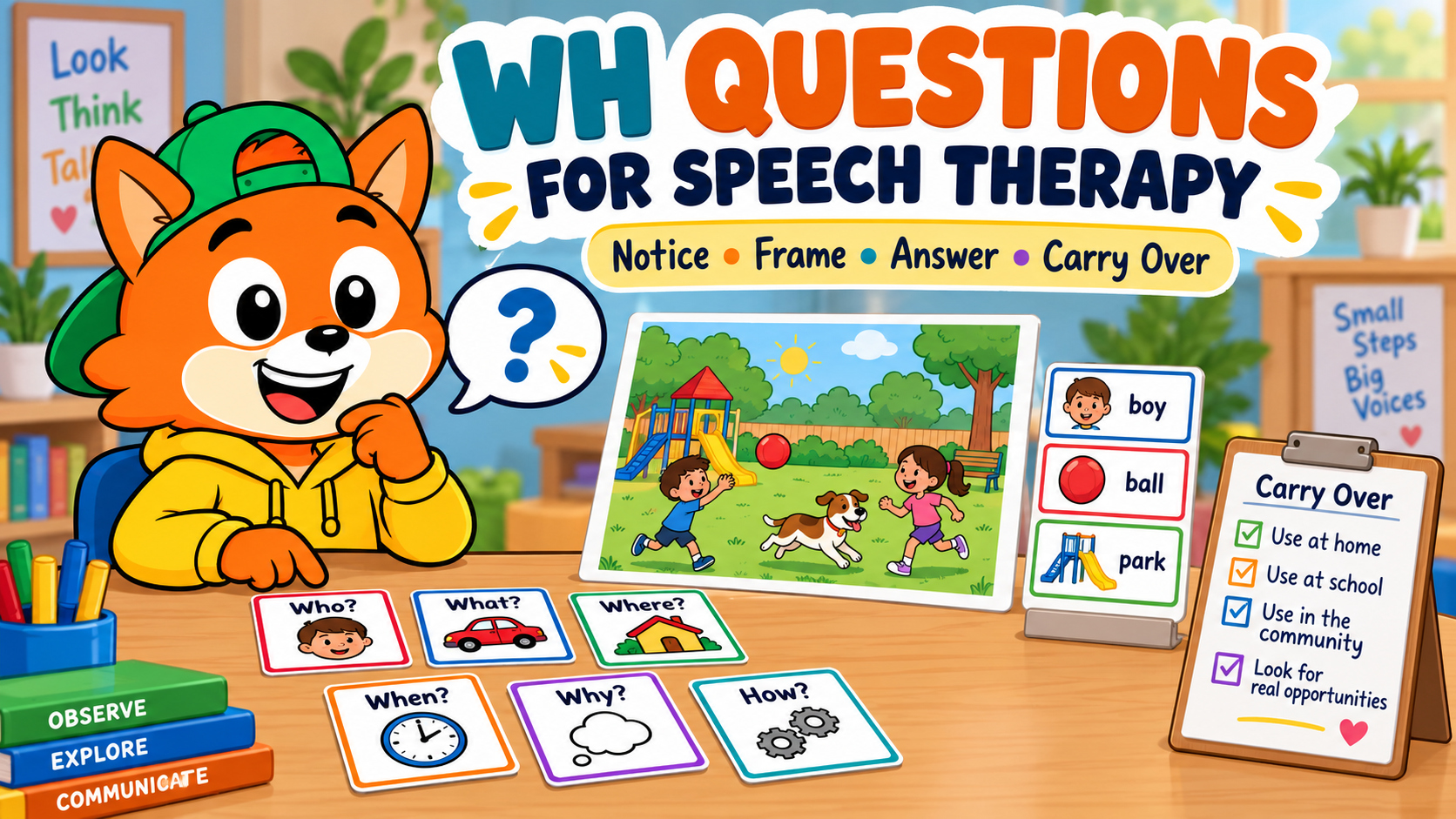
A WH questions visual can make the question word, the information needed, and the response path easier to see during speech and language practice. A useful visual is more than a row of who, what, where, when, why, and how labels. It helps the learner understand the communication purpose, find relevant clues, and answer through an accessible mode.
This guide explains how to choose and use visual supports for WH-question practice. It covers target selection, setup, prompt progression, multimodal responses, differentiation, progress notes, and carryover. A qualified SLP should individualize goals and interpret performance within the learner’s language, culture, communication system, and setting. The ASHA Practice Portal provides broader context for functional and individualized language support.
Table of Contents
- What a WH questions visual should make clear
- Match the visual to the question purpose
- Build a notice-ask-find-answer routine
- Prompt without turning the visual into a script
- Adapt the visual across learners and settings
- Collect progress data and plan carryover
- Frequently asked questions
What a WH Questions Visual Should Make Clear
Question words point to different kinds of information. Who asks about a person or group, what asks about an action or object, where asks about a place, when asks about time or sequence, why asks about a reason or purpose, and how can ask about a manner, process, amount, or condition. The exact interpretation depends on the sentence and context.
A visual support should make the question job visible without forcing one answer format. The learner might answer with a word, phrase, sentence, AAC message, sign, gesture, pointing, drawing, writing, or multimodal combination. If the visual only supports naming a picture, it may not help the learner answer a question in conversation, a story, or a classroom routine.
Before choosing a page or card, identify the target:
- answering a specific question type about a familiar routine;
- locating information in a picture, book, conversation, or lesson;
- asking a WH question to obtain information;
- combining an answer with a carrier phrase or explanation;
- comparing two possible answers and selecting relevant evidence; or
- transferring a question routine to a new partner or activity.
The visual should support the communication job that matters today. A learner may know the word where but need help searching the scene. Another may find the answer but need a response route. A third may answer a structured question yet struggle when the listener does not share the same picture.
Match the Visual to the Question Purpose
For who questions, use people, roles, characters, or groups that are meaningful in the story or routine. A visual can show the person and provide a sentence frame, but keep the activity connected to a real reason to identify who acted, helped, arrived, or participated.
For what questions, separate objects from actions when that distinction matters. A learner may need to answer what happened, what someone wants, or what object is present. Use pictures, objects, actions, and short phrases that reflect the target rather than presenting every possible noun.
For where questions, make the place visible and consider whether the learner is locating a person, object, or event. A simple map, scene, classroom photo, or choice board may provide better access than an isolated question card.
For when questions, connect the answer to routine, sequence, time, or event order. First, next, later, and last can be useful when the target is a story or procedure. A calendar or daily schedule may be more meaningful for a functional question.
For why questions, show the relationship between an event and a reason, purpose, or result. Use clues and allow more than one reasonable explanation when the context supports it. For how questions, clarify whether the target is method, amount, feeling, change, or process so the visual does not become too broad.
Build a Notice-Ask-Find-Answer Routine
A repeatable routine can make a WH questions visual easier to use across pictures, books, routines, and conversations. Keep the broad sequence stable while changing the content and partner. The routine should support attention and reasoning, not require the learner to memorize a response.
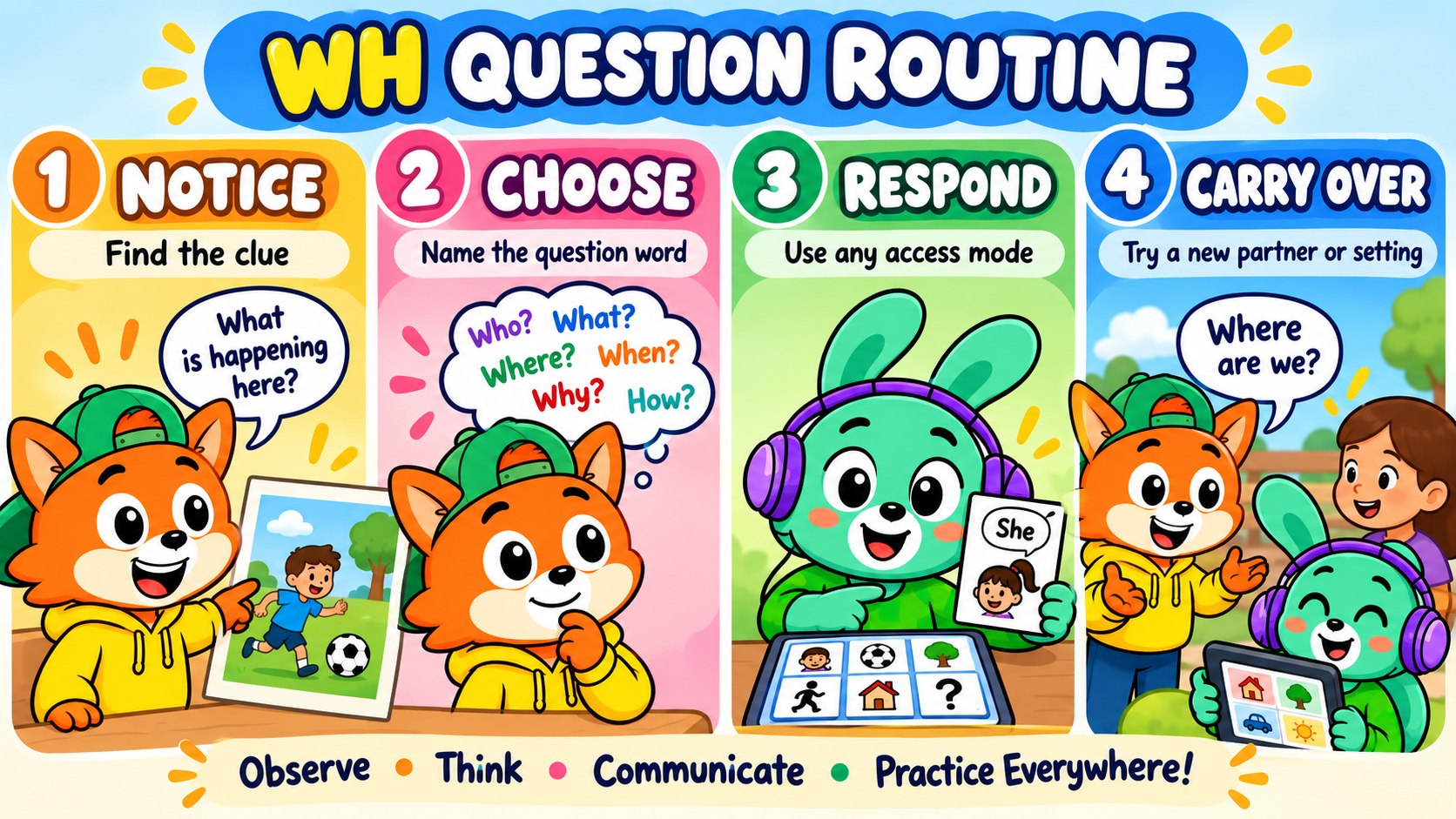
Notice: Look at the scene, story, object, schedule, or conversation. Identify the information that may answer the question. Pointing, eye gaze, object exploration, or a brief description can count as meaningful noticing.
Ask: State or show the WH question. Make the question word visible and use language appropriate to the learner’s access. If the learner is practicing asking questions, provide a reason to obtain information from a partner.
Find: Search the available clues. The learner may scan a picture, revisit a sentence, arrange choices, look at a visual schedule, or ask for more information. Wait long enough for the learner to navigate the communication system or organize the response.
Answer: Communicate the answer and check whether the listener understood. The learner can use a word, phrase, symbol sequence, gesture, sign, writing, or combination. Add an explanation when the target or context requires it.
Repeat with one controlled change. Reduce a choice, use a new picture, change the partner, remove a support, or ask the learner to use the question in a real routine. A small variation shows whether the visual supports a flexible skill rather than one memorized card.
Prompt Without Turning the Visual Into a Script
Use the least intrusive prompt likely to help. Start with the visible question word, wait time, or a gesture toward the relevant clue. Add a choice, sentence starter, brief model, or direct question when the learner needs a more specific route. Record the support so it can be varied or retained intentionally.
Possible prompts include:
- “Which question word tells us what to find?”
- “Look again. Who is doing the action?”
- “Where could we look for that information?”
- “Tell me one clue that helps.”
- “Would you like to point, say it, or show it on AAC?”
- “What could you ask your partner to learn more?”
Avoid asking the same leading question until the learner guesses the adult’s answer. If the learner gives an unexpected response, consider whether the visual, language, cultural context, or response route is unclear. A different interpretation can be meaningful information rather than an automatic error.
Prompt fading should preserve access. Reduce a direct verbal cue before removing a visual that the learner can use independently. The goal is not to make the support disappear; it is to help the learner communicate a relevant answer or question with the support that fits the context.
Adapt the Visual Across Learners and Settings
For early communicators, begin with familiar people, objects, and actions. Use real objects, photos, or a small choice set, and accept gaze, gesture, reaching, symbols, sounds, or words when they answer the communication purpose. Practice one question type at a time while keeping the interaction meaningful.
For preschool and early school-age learners, use shared books, picture scenes, play routines, and classroom events. Link the visual to who, what, and where before adding when, why, or how when those question purposes are accessible. Use a short visual frame rather than presenting a crowded page.
For school-age learners, include questions that require locating information, connecting clues, explaining a reason, or asking a partner for information. Move from picture support to brief notes, highlighted text, graphic organizers, or self-generated reminders when that change helps the learner participate.
For older learners, use age-respectful materials such as schedules, work tasks, community signs, personal experiences, short articles, and problem-solving conversations. WH-question practice can support a handoff, appointment, group project, or self-advocacy message.
For multilingual learners and multimodal communicators, consider the languages and modes used in real life. A learner may understand the question and answer in a language or mode different from the teaching material. Provide the response route that gives access to the meaning, and coordinate interpretation with the broader team.
Collect Progress Data and Plan Carryover
Data should describe the question, information available, response, support, and context. A percentage without those details can hide whether the learner answered a familiar picture question or found information in a new setting.
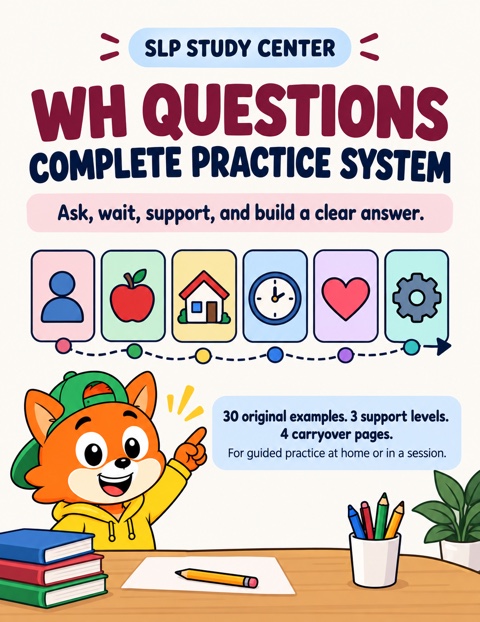
Possible data fields include:
- question word and communication purpose;
- picture, story, routine, or conversation context;
- clue or information available;
- response mode and message clarity;
- prompt, wait time, visual support, and partner response;
- whether the learner asked, answered, repaired, or requested more information; and
- transfer to a new person, activity, language, or setting.
Define the opportunity before counting. “Four of five” in repeated picture choices is different from four questions asked by a learner during a new group activity. Include meaningful initiations, refusals, repairs, and multimodal responses in the record when they answer the team’s planning question.
Carryover works best when the learner has a real reason to ask or answer. Ask about a missing object, find information in a shared book, use a schedule to plan the next step, interview a partner, or explain what happened. Keep the visual available while changing one condition at a time, such as partner, topic, amount of text, or level of choice.
Frequently Asked Questions
What is the best WH questions visual?
The best visual is the one that matches the learner’s question purpose, access method, language, age, and context. It should help the learner notice information, communicate a question or answer, and participate with a responsive partner.
Should I teach all WH question words together?
Not necessarily. Start with the question purposes that matter in the learner’s routines and add complexity when the response route is accessible. Some learners benefit from contrasting two question types, while others need a focused routine before expanding.
Can WH questions be answered with AAC or gestures?
Yes. AAC, speech, sign, gesture, pointing, writing, drawing, and combinations can carry a meaningful answer. Track the information communicated and the support used rather than treating spoken sentence form as the only measure.
How do I know if the visual is helping?
Compare performance across question types, contexts, partners, response modes, and support levels. Look for more relevant answers, stronger clue use, independent asking, repair, partner understanding, and transfer to real routines.
A WH questions visual is most useful when it makes the information search and response path visible. Match the visual to the question purpose, preserve multimodal access, prompt with care, and let context-rich progress notes guide the next practice opportunity.