Voice disorders Praxis practice questions become more manageable when you connect the sound you hear to the question the case is asking. A stem may describe quality, pitch, loudness, resonance, phonation, endurance, effort, or communication impact. The answer usually depends on the evidence source, the clinical stage, and the boundary between SLP assessment and medical evaluation.
ASHA’s Voice Disorders Practice Portal describes voice concerns in relation to quality, pitch, loudness, and whether the voice meets a person’s daily needs. It also notes that perceptual voice quality alone may not explain severity or etiology. Use the current ASHA and ETS pages for changing information, then use the original reasoning system below to review voice concepts without turning one sign into a diagnosis shortcut.
What voice questions are testing
A voice item may ask you to identify a perceptual feature, choose a history question, select an assessment procedure, recognize a referral need, plan a functional intervention, or select a progress measure. The word voice does not tell you the answer by itself. The final verb tells you whether to describe, assess, refer, plan, or monitor.
| Question task | What to locate | Review output |
|---|---|---|
| Identify a feature | Quality, pitch, loudness, resonance, effort, or endurance | Perceptual note |
| Choose assessment | Missing history, sample, demand, or objective evidence | Next information step |
| Set a boundary | What the available data can and cannot explain | Cautious interpretation |
| Plan support | Person’s goal, vocal demand, and context | Functional plan |
| Monitor change | Voice behavior, participation, and return condition | Outcome measure |
Rewrite the request before looking at the choices. If the stem asks what information is needed to understand etiology, an exercise may be premature. If it asks how a voice concern affects work, a perceptual label alone may not answer the participation question.
Use the details that change the decision: onset, variability, vocal load, discomfort, fatigue, loudness, pitch, resonance, environmental noise, hydration, medication history, prior evaluation, and the person’s own concern. Do not let a familiar voice term replace the case pattern.
Anchor review to the ASHA 5331 scope
ASHA’s current Speech-Language Pathology 5331 content page places voice, resonance, and motor speech within assessment procedures and treatment. The broad exam frame also includes foundations and professional practice, screening and assessment, treatment planning, treatment implementation, and treatment evaluation.
| 5331 lens | Voice question example | Study tag |
|---|---|---|
| Foundations | What voice or communication feature is described? | Definition and anatomy |
| Assessment | What history or procedure adds relevant evidence? | Data source and sequence |
| Referral and interpretation | What conclusion needs another professional or tool? | Boundary and collaboration |
| Treatment planning | What goal fits the person’s vocal demand? | Function and implementation |
| Treatment evaluation | How will change be monitored in context? | Measure and generalization |
Map each item to one main lens. A case can include a hoarse-sounding voice, fatigue, occupational demand, and a prior medical referral, but the question may ask only for the next assessment step. Identifying the stage keeps a relevant fact from becoming the wrong answer.
Use ASHA for clinical content and ETS for current exam logistics. Third-party practice pages can help reveal search intent, but their labels, claims, and question wording are not substitutes for responsible source material.
Separate voice, resonance, and speech-sound clues
Voice concerns involve the sound produced by the laryngeal source and its use in communication. Resonance concerns the way sound is modified through the vocal tract, including oral and nasal balance. Speech-sound errors concern the selection or production of speech sounds. A question can mention more than one layer, so identify which layer controls the requested decision.
| Layer | Clues to review | Question filter |
|---|---|---|
| Voice | Quality, pitch, loudness, phonation, effort, or endurance | What is heard during voicing? |
| Resonance | Oral or nasal focus, hypernasality, hyponasality, or cul-de-sac quality | How is the sound shaped through the tract? |
| Speech sound | Substitutions, omissions, distortions, or motor speech patterns | Which sound or movement is affected? |
| Communication impact | Intelligibility, participation, fatigue, or listener access | What daily need is affected? |
| Etiology boundary | Structural, neurologic, functional, or other possible contributors | What evidence is still needed? |
A nasal-sounding voice does not automatically mean a voice disorder, and a rough quality does not by itself identify a lesion. The correct review move is to name the perceptual feature, identify the relevant assessment information, and respect the referral or instrumental boundary.
Use a two-line note: the sound or behavior that is observed, followed by the system or decision that remains uncertain. This prevents a vivid description from becoming an unsupported cause.
Organize perceptual voice features
ASHA’s voice guidance lists perceptual features that can include abnormal loudness, pitch changes, aphonia, phonation breaks, weak or asthenic quality, pulsed or creaky quality, tremor, effort, fatigue, breath support concerns, coughing, throat clearing, or laryngeal discomfort. A practice question may use one clue or combine several.
- Quality: describe roughness, breathiness, strain, weakness, instability, or another audible quality without adding an etiology that the case does not support.
- Pitch: note whether pitch is high, low, unstable, limited in range, or mismatched to the person’s stated communication need.
- Loudness: note reduced, excessive, variable, or effortful loudness in relation to the task and environment.
- Phonation: examine onset, offset, sustained voicing, breaks, and the ability to support phrasing.
- Endurance: ask whether voice use leads to fatigue, reduced quality, discomfort, or a need to stop.
- Context: compare the voice across tasks, time of day, vocal load, noise, and communication partners.
Do not treat the list as a checklist that establishes a diagnosis. It is an observation framework. The best answer connects the feature to the person’s goal and identifies what additional information is needed to interpret it.
When a stem includes a perceptual rating, ask what it can show and what it cannot show. Auditory-perceptual analysis can describe the sound, while other assessment or medical information may be needed to understand severity, physiology, or etiology.
Read case history and referral boundaries
History helps explain when the voice changed, what demands make it worse, what the person has tried, and whether another professional has evaluated the laryngeal or medical context. Review the history as a guide to assessment rather than as a diagnosis in itself.
| History field | Question to ask | Why it matters |
|---|---|---|
| Onset | When did the change begin and how has it varied? | Clarifies pattern and need for follow-up. |
| Vocal demand | How much speaking, singing, teaching, calling, or projecting occurs? | Connects the concern to function. |
| Associated symptoms | Are fatigue, pain, cough, or breathing concerns reported? | May affect referral and assessment sequence. |
| Prior evaluation | Has a physician or other professional assessed the relevant system? | Prevents duplicated or unsupported assumptions. |
| Person’s goal | What change would make communication more useful? | Centers planning on participation. |
Questions involving persistent or concerning voice change may test whether you recognize the need for appropriate medical collaboration or referral before treating the voice as an isolated behavior. The answer should follow the source-supported boundary and the case details, not a blanket rule invented from one symptom.
Separate urgent wording from routine planning. If the stem supplies a prior evaluation and asks for SLP treatment planning, use the available findings and the person’s goal. If the stem omits relevant medical information while asking about etiology, select the answer that adds or seeks the missing information.
Choose assessment evidence with purpose
A voice assessment question is easier when you ask what uncertainty the next procedure will reduce. Case history, conversation, reading, sustained phonation, connected speech, vocal-demand observation, self-report, perceptual analysis, acoustic or aerodynamic information, and collaboration can answer different questions.
| Evidence source | What it can add | Review caution |
|---|---|---|
| Case history | Onset, variability, prior care, demand, and concern | History does not replace current voice sampling. |
| Conversation | Voice in natural interaction and turn-taking | Record partner, topic, and environment. |
| Reading or sustained task | Phonation, endurance, and consistency under a defined demand | Interpret the task rather than generalizing broadly. |
| Perceptual analysis | Quality, pitch, loudness, resonance, effort, and breaks | Perceptual data may not explain etiology alone. |
| Instrumental or objective data | Additional information about physiology or voice signal | Use when indicated and within professional roles. |
| Self-report | Fatigue, discomfort, participation, and vocal experience | Do not infer the person’s experience without asking. |
Choose the evidence that matches the item. A question about vocal endurance needs a task and duration that make endurance relevant. A question about participation may need self-report and a real-world demand. A question about physiology may need a referral or instrumental pathway rather than a perceptual guess.
Triangulation means that different sources inform the same decision; it does not mean every possible procedure belongs in every evaluation. State the question, select the smallest useful set of evidence, and document what remains uncertain.
Know when instrumental information matters
ASHA notes that auditory-perceptual quality alone may not determine the severity or etiology of a voice disorder and that further instrumental assessment may be indicated. On the Praxis, the key is usually recognizing the information boundary, not naming a specific medical diagnosis from a sound sample.
| Case wording | Reasoning move | Boundary |
|---|---|---|
| Perceptual change only | Describe the feature and gather history or samples | Do not infer cause from sound alone. |
| Concern about physiology | Coordinate the appropriate referral or objective pathway | Stay within the SLP role described by the case. |
| Known medical finding | Use the finding to plan communication support | Do not reinterpret the medical finding. |
| Functional voice goal | Sample the relevant demand and define outcome | Do not substitute a lab measure for participation. |
| Changing symptoms | Compare contexts and follow the responsible source plan | Do not dismiss variability. |
The strongest answer is often a collaboration answer when the question asks about cause or laryngeal status. The SLP can contribute communication assessment and functional planning while coordinating with qualified professionals when the case requires information outside the available speech sample.
Keep the wording cautious in your notes. Write that a procedure may add information about physiology or etiology when indicated, rather than writing that one procedure establishes a particular condition in isolation.
Connect voice to demand and participation
Voice is functional when it supports a person’s communication needs in the settings that matter. A teacher may need endurance across a school day, a call-center worker may need intelligibility in noise, a singer may have performance-specific demands, and another person may prioritize comfortable conversation. The goal should reflect the person’s context.
| Demand | Useful question | Possible outcome field |
|---|---|---|
| Teaching or presentation | Can the person communicate across the required duration? | Endurance and participation |
| Phone or noisy setting | Can the listener access the message? | Intelligibility and strategy use |
| Daily conversation | Is voice comfortable and adequate for routine needs? | Self-report and activity success |
| Professional identity | What voice qualities matter to the person? | Person-centered goal and satisfaction |
| Home communication | What partner and environment affect the task? | Generalization condition |
A treatment-planning item may present a tempting exercise, but the answer should still connect the activity to the person’s goal, vocal demand, and available assessment information. Avoid treating a single acoustic or perceptual change as the only outcome when communication participation is the stated concern.
Use a function sentence in your tracker: the person wants to do what, with whom, where, under which demand, and with what observable sign of improved access or comfort. That sentence makes a vague voice goal easier to evaluate.
Consider cultural and linguistic context
Voice expectations can vary by language, dialect, culture, geography, gender identity, profession, and communication community. A voice that differs from a narrow comparison is not automatically disordered. The question may be testing whether you ask what the person wants, what their community considers functional, and which communication demand is affected.
- Ask how the person describes the voice and what change they want, rather than relying only on an outside listener’s preference.
- Consider language, dialect, cultural setting, and typical communication style when interpreting pitch, resonance, loudness, and prosody.
- Record the speaking environments and partners in which the concern is noticed.
- Use qualified collaboration when language access or cultural knowledge is needed for a fair assessment.
- Separate a communication goal from an assumption that one voice norm fits every speaker.
Do not make a clinical interpretation from difference alone. The responsible answer connects the reported concern, observable function, relevant assessment evidence, and the person’s priorities. It also avoids imposing a voice target that the person did not identify as useful.
When a case includes a gender-affirming or identity-related goal, keep the focus on the person’s chosen communication outcomes and appropriate collaborative care. Do not reduce the goal to conformity with one listener’s expectation.
Map a voice question from evidence to plan
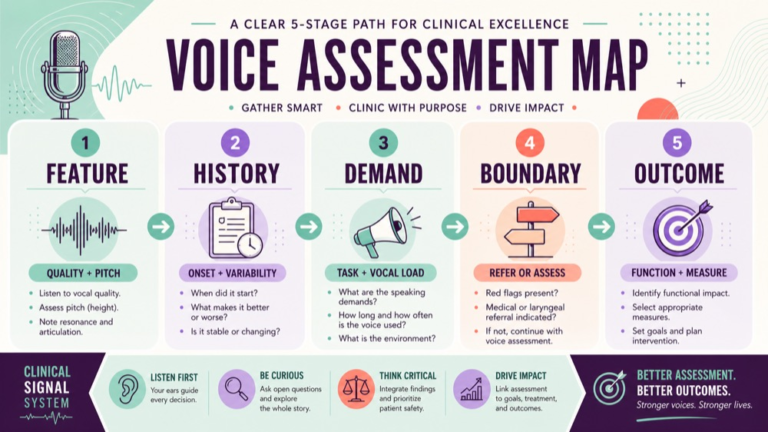
Use a five-field map for voice questions: feature, evidence, demand, plan, and outcome. Start with what is heard or reported, identify the data source that matters, connect the voice concern to a real communication demand, choose the stage-appropriate action, and define how change will be checked.
| Map field | Prompt | Example review note |
|---|---|---|
| Feature | What quality, pitch, loudness, or effort is described? | Voice becomes strained after extended teaching. |
| Evidence | What history or sample supports the observation? | Conversation and a workday report. |
| Demand | Where does the voice need to work? | Classroom projection with background noise. |
| Plan | What assessment, referral, or support fits? | Clarify history and coordinate indicated evaluation. |
| Outcome | How will the result be observed? | Comfortable participation under a defined demand. |
The map keeps a perceptual description from becoming an etiologic claim. If the cause is uncertain, the plan can add history, sampling, collaboration, or indicated objective information. If the goal is functional, the outcome should include the communication activity rather than only a clinic rating.
Change one field to practice transfer. Keep the voice feature stable but change the speaker’s job, partner, noise level, or goal, then explain which assessment source or outcome condition should change. This method tests reasoning rather than repeated wording.
Use a voice assessment review board
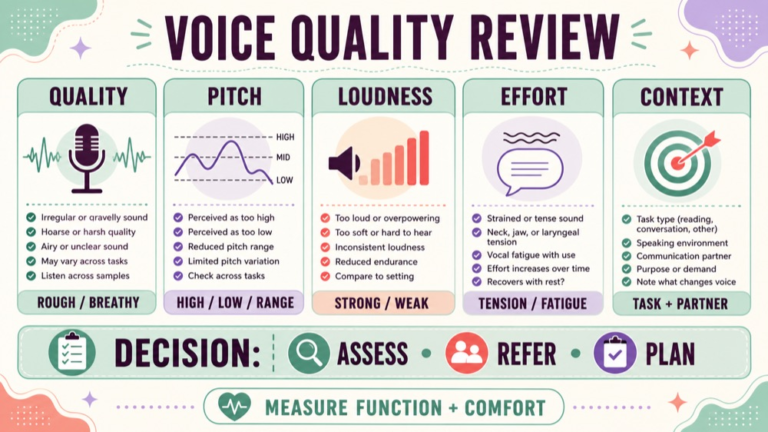
A review board separates what the listener hears from what the speaker experiences and what the evidence supports. Put quality, pitch, loudness, resonance, effort, and endurance in the first columns, then add demand, referral boundary, decision stage, and measure. This is useful when the stem contains several voice clues.
| Board column | Write | Check |
|---|---|---|
| Quality | Rough, breathy, strained, weak, unstable, or another feature | What was observed? |
| Use | Pitch, loudness, phrasing, endurance, and task performance | What demand was present? |
| Experience | Fatigue, discomfort, concern, identity, or participation | What did the person report? |
| Boundary | Referral, medical information, or objective data still needed | What cannot be inferred yet? |
| Decision | Assess, refer, plan, implement, or monitor | What did the question ask? |
| Measure | Voice behavior plus functional condition | How will change be checked? |
Use the board after a mixed question set. Group misses by perceptual description, anatomy and system distinction, assessment selection, referral boundary, functional planning, or outcome evaluation. The group with the most misses becomes the next targeted review block.
Keep the board in your own words. It is a reasoning tool, not a place to copy flashcards, screenshots, or protected question-bank material. A concise feature-evidence-demand summary is enough to create an original transfer case.
Question 1: perceptual assessment and etiology
Question 1: A teacher reports a new rough and effortful voice after a period of heavy classroom speaking. The practice item gives no prior evaluation, no information about onset beyond the report, and no description of how the voice changes across tasks. Which review action best fits the missing information?
- A. Name a specific laryngeal lesion from the sound quality alone.
- B. Gather a focused case history and relevant voice samples, then identify whether referral or additional evaluation is indicated by the complete pattern.
- C. Choose a fixed vocal exercise and treat the teacher’s voice without clarifying the concern or demand.
- D. Dismiss the report because roughness is common after speaking.
Correct Answer: B. The case provides a perceptual feature and a vocal-demand clue but lacks history, variability, functional impact, and information about the relevant evaluation pathway. Gathering those data supports a responsible next decision without claiming an etiology from one sound sample.
Why the Other Options Are Wrong: A turns a perceptual description into a medical conclusion. C chooses an intervention before clarifying the assessment and referral boundary. D minimizes a reported change without investigating onset, persistence, effort, or the teacher’s communication needs.
Exam Trap: Perceptual voice quality can describe what is heard, but it does not by itself identify why the voice changed. Match the next step to the missing history, samples, and possible referral need.
Question 2: referral and instrumental information
Question 2: An adult presents with persistent voice change and asks whether the SLP can determine the laryngeal cause from a short conversation sample. Which response best reflects an appropriate assessment boundary?
- A. Confirm the laryngeal cause from the perceptual sample and begin a cause-specific plan.
- B. Describe the voice findings, gather relevant history, and coordinate appropriate medical or instrumental evaluation when the case indicates that information is needed.
- C. Avoid documenting the voice because only medical professionals can hear voice quality.
- D. Use a single loudness score as a complete assessment of voice severity and etiology.
Correct Answer: B. The SLP can contribute perceptual and functional communication assessment while recognizing when information about laryngeal status or physiology requires another evaluation pathway. The plan should follow the case, the person’s concern, and responsible professional roles.
Why the Other Options Are Wrong: A claims a cause from limited evidence. C incorrectly removes the SLP’s assessment role. D treats one measure as a complete explanation of a multidimensional voice concern and ignores the need for context and possible instrumental information.
Exam Trap: The question is testing the boundary between describing voice and establishing etiology. Choose the collaborative answer when the missing information concerns physiology or laryngeal status.
Question 3: functional voice planning
Question 3: A client wants to participate in workplace meetings for a full afternoon with less vocal fatigue. The case includes a functional history and an agreed assessment plan, but no single acoustic target is named. Which planning choice best matches the stated goal?
- A. Choose the lowest possible pitch as the only outcome, regardless of the client’s communication demands.
- B. Build graded practice around relevant meeting demands and monitor vocal comfort, communication access, and participation under defined conditions.
- C. Replace the workplace goal with an unrelated articulation drill because it is easier to score.
- D. Measure only whether the voice sounds different to the clinician during one short session.
Correct Answer: B. The stated outcome concerns participation and fatigue across a real demand. A plan can use appropriate voice targets and supports, but the review measure should include the client’s functional activity, comfort, and communication access under the conditions that matter.
Why the Other Options Are Wrong: A imposes a single target without a person-centered rationale. C does not address the workplace goal. D substitutes one brief clinician impression for the activity and endurance outcome described in the case.
Exam Trap: A measurable voice variable can be useful, but it is not automatically the client’s primary outcome. Tie the plan and measure to the stated communication demand.
Review common voice distractors
Voice distractors often use a real perceptual term at the wrong clinical stage or turn one measure into a complete explanation. A rough quality may be correctly identified but incorrectly linked to a lesion. A medical referral may be appropriate but may not answer a later treatment-planning question when the necessary findings are already supplied.
| Distractor pattern | Why it attracts attention | Review test |
|---|---|---|
| Etiology shortcut | The sound seems distinctive | What evidence actually supports cause? |
| One-measure answer | The score feels objective | Does it capture the stated demand? |
| Exercise too early | The activity sounds helpful | Is history or referral information missing? |
| Normative target | A preferred voice is presented as universal | What does the person want and need? |
| Clinic-only outcome | The setting is easy to control | Will the result transfer to the real task? |
Write the closest distractor mismatch in one sentence. It may confuse voice with resonance, treat perceptual quality as etiology, skip relevant collaboration, or ignore the person’s functional demand. Specific mismatch language turns a missed item into a reusable rule.
Use the last action word as the final filter. If the item asks what information is needed, do not select a treatment exercise simply because it is familiar. If it asks for an outcome, include the activity and condition that make the outcome meaningful.
Build a voice practice block
Use a small block that mixes perceptual features, system distinctions, history, assessment, referral, treatment planning, and evaluation. Include quality, pitch, loudness, resonance, phonation, endurance, vocal demand, self-report, and functional context when the case supports them.
| Block part | Example prompt | Review product |
|---|---|---|
| Feature | What is heard or reported? | Perceptual description |
| System | Is the clue voice, resonance, or speech sound? | Layer distinction |
| History | What onset or demand information matters? | Case-history question |
| Assessment | What evidence reduces the uncertainty? | Data-source plan |
| Boundary | What requires referral or objective information? | Collaboration note |
| Outcome | How will the real communication task be monitored? | Functional measure |
Keep the block small enough to review eight to fifteen questions carefully. For each item, record the requested action, the decisive clue, the missing evidence, and the closest distractor. This makes a score more useful than a percentage without a reason.
Create one changed-context prompt after the block. Change the vocal load, partner, noise level, language, work setting, or goal and explain which evidence or measure should change. Transfer practice checks whether the reasoning survives a new case.
Track reasoning and confidence
A voice-question tracker should include the source, date, question task, original answer, confidence, perceptual feature, system layer, demand, referral boundary, closest distractor, and next action. These fields reveal whether a miss came from hearing the clue, choosing the evidence, understanding the professional boundary, or planning the outcome.
| Tracker field | Prompt | Example |
|---|---|---|
| Requested action | What did the item ask me to do? | Choose the next assessment step. |
| Feature | What was heard or reported? | Effort and reduced endurance after teaching. |
| Demand | Where must the voice function? | Afternoon meetings with background noise. |
| Boundary | What information is outside this sample? | Laryngeal status is not established. |
| Confidence | How certain was I before feedback? | Two choices remained. |
| Next action | What will I practice? | Compare referral and functional-planning choices. |
Review high-confidence misses and low-confidence correct answers. A correct choice without a reason may reflect recognition, while a confident miss may reveal a rule that needs to be rebuilt from the case details and responsible source boundary.
Use the ASHA Practice Portal when a voice concept needs clarification and use the live ETS page for exam details that may change. The tracker supports preparation; it does not replace an individualized assessment or qualified professional judgment.
Voice disorders Praxis practice questions checklist
Use this checklist for each small voice-disorders practice set.
- I identified whether the item asked for description, screening, assessment, referral, treatment planning, or monitoring.
- I separated voice, resonance, speech-sound, motor-speech, and communication-impact clues when relevant.
- I organized quality, pitch, loudness, phonation, effort, endurance, and context evidence.
- I checked onset, variability, vocal demand, associated symptoms, prior evaluation, and the person’s concern.
- I selected evidence that matches the uncertainty instead of choosing every possible procedure.
- I recognized when objective or medical information may be needed to understand physiology or etiology.
- I included the person’s identity, language, culture, communication community, and functional priorities when the case supports them.
- I connected the plan to the real vocal demand, partner, setting, and participation goal.
- I explained why the selected answer fits the clinical stage and evidence.
- I named the closest distractor and its specific mismatch.
- I wrote the rationale in my own words without copying protected source material.
- I created one changed-context transfer prompt.
- I specified a voice or participation outcome and the condition under which it will be checked.
- I rechecked changing exam and professional information with the responsible source.
The checklist keeps voice questions connected to evidence, boundaries, and function. The goal is not to name an etiology from one auditory feature. The goal is to explain what the case supports, what remains uncertain, what action fits, and how the result will be evaluated.
Sources and next steps
Use the ASHA Voice Disorders Practice Portal for current clinical framing of voice quality, pitch, loudness, resonance, assessment, referral boundaries, and functional planning. Use the ASHA Speech-Language Pathology Exam 5331 Content page to map voice, resonance, assessment, and treatment questions to broad exam areas.
Use the live ETS Speech-Language Pathology 5331 page for current exam identity and administration information, and the ETS practice-test selector for current preparation options. Read each resource’s access terms and do not treat third-party flashcards as official exam material.
For a structured preparation path, see the SLP Study Center Complete Prep resource. On your next study block, answer a small mixed voice set, build three feature-evidence-demand cards, and write one transfer question with a functional outcome condition.