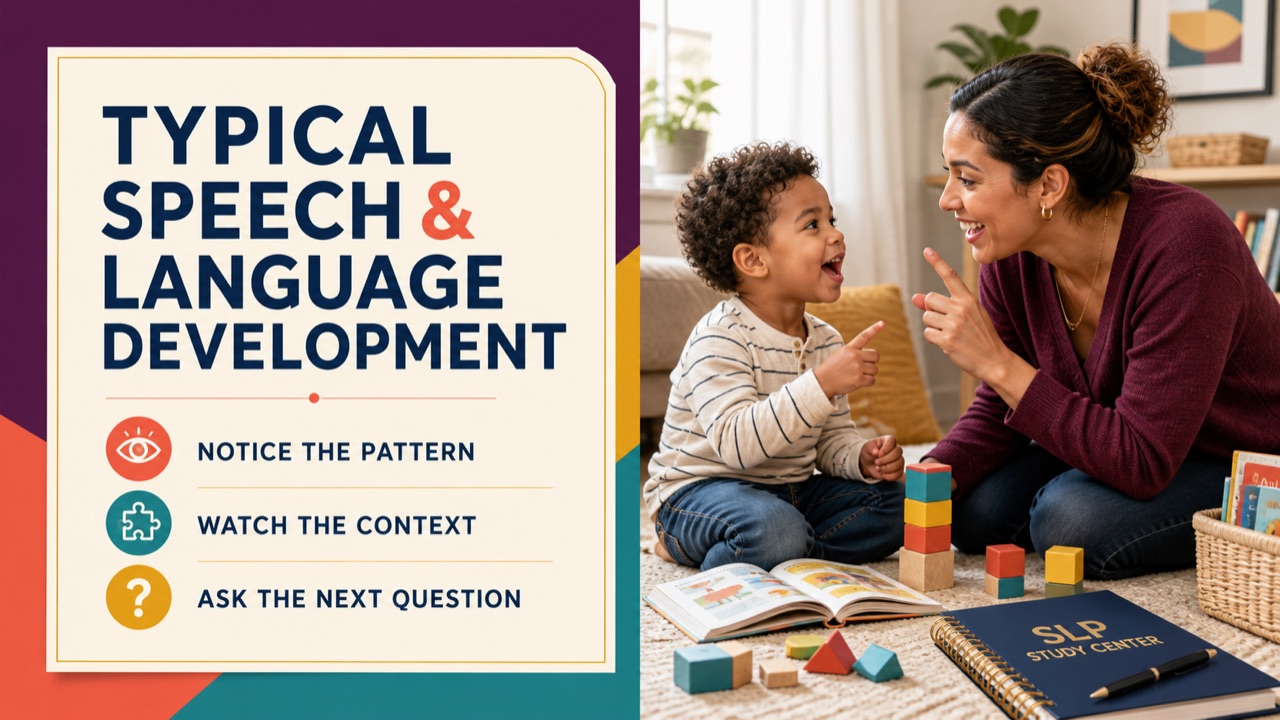
Typical speech and language development is easiest to understand as a pattern across communication, hearing, interaction, and everyday participation—not as a single score or a checklist that every child completes on one exact date. This guide offers a broad birth-to-five framework for caregivers, students, and clinicians who want to observe development carefully without turning one milestone into a diagnosis.
Speech, language, hearing, social communication, and feeding or swallowing influence one another, but they are not interchangeable. A child may have strong language ideas with speech that is still difficult to understand, or communicate socially with gestures while spoken words are emerging. The most useful interpretation considers the whole profile, the child’s languages and routines, change over time, and the effect on participation.
Table of Contents
- What typical speech and language development includes
- How the developmental domains fit together
- A cautious birth-to-five overview
- How to observe development in everyday routines
- Common confusions: related does not mean identical
- When to seek an evaluation
- Multilingual development and individual variation
- A short SLP Praxis 5331 application
- Quick review
What Typical Speech and Language Development Includes
In a clinical learning context, typical speech and language development describes common ways children develop the ability to receive, organize, express, and share messages. “Typical” describes a broad pattern, not a promise that every child will show the same behavior at the same age. Children can reach related skills in different orders, show uneven strengths, or need more time in one area while moving quickly in another.
Speech concerns spoken sound production, voice, and fluency. Language concerns meaning: understanding words and sentences, choosing vocabulary, combining words, using grammar, and communicating to request, comment, explain, or repair a misunderstanding. Social communication concerns how a child uses available communication with people, including turn-taking, shared attention, gesture, topic shifts, and adapting a message to a partner or situation.
Hearing is an access system rather than a speech or language skill. Consistent access to speech and meaningful sounds can support learning, but hearing status is one part of a developmental profile. Feeding and swallowing involve the safe, coordinated management of food, liquid, and saliva, including oral movements, chewing, drinking, and mealtime participation. The domains can interact while still requiring separate clinical questions.
- Understanding: responses to familiar words, routines, gestures, and increasingly complex messages.
- Expression: sounds, gestures, signs, words, combinations, and other reliable communication forms.
- Connection: initiation, turn exchange, shared enjoyment, requesting help, commenting, and repairing breakdowns.
- Hearing access: reactions to voices and environmental sounds, followed by hearing-focused follow-up when needed.
- Mealtime function: chewing, drinking, textures, pacing, comfort, and safety rather than feeding preference as speech data.
This whole-profile approach is why a milestone chart works best as an observation aid. It can prompt a useful conversation with a pediatrician, audiologist, or speech-language pathologist, but it cannot answer every clinical question. Development is better interpreted through repeated observations across people, activities, and communication opportunities.
How the Developmental Domains Fit Together
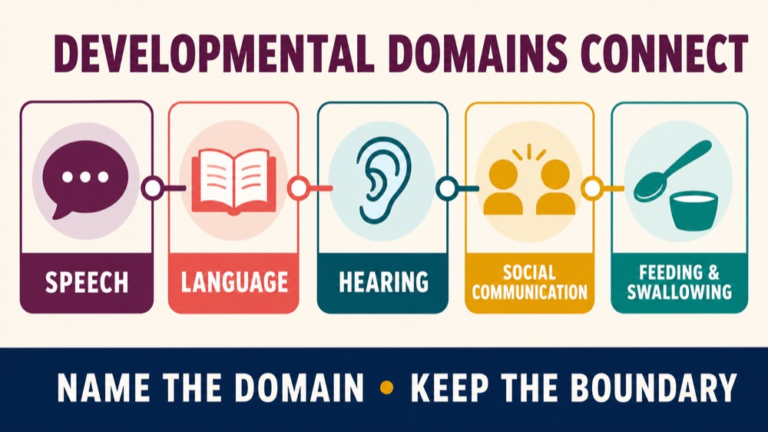
Imagine a three-year-old who points to a toy, uses a few spoken words and longer strings of unclear speech, follows familiar play routines, and eats a narrow range of textures without coughing. Several questions must remain separate: What language does the child understand? How is intent communicated? How understandable is the speech? Is hearing access adequate? Are feeding safety and nutrition affected?
| Domain | Clinical question | Everyday observation | Boundary |
|---|---|---|---|
| Speech | How is spoken communication produced? | Sound patterns, voice, fluency, and intelligibility in context. | Clarity does not describe vocabulary, comprehension, or social intent. |
| Language | What meaning is understood and expressed? | Words, combinations, grammar, directions, answers, and stories. | Spoken output is one part; gestures and other modes also carry meaning. |
| Hearing | Does the child have access to relevant sound? | Responses to voices, names, environmental sounds, and listening conditions. | Observation cannot replace a hearing assessment when access is uncertain. |
| Social communication | How is communication used with people? | Initiating, shared attention, turn-taking, topic shifts, and message adjustment. | One behavior such as eye gaze or quietness needs context. |
| Feeding and swallowing | How safely and efficiently are food and liquid managed? | Chewing, drinking, textures, pacing, comfort, and airway signs. | Food preference and speech development are different questions. |
The domains interact: limited hearing access may affect access to speech models, language difficulty may affect play participation, and oral-motor or structural factors may influence feeding and speech. These are pathways to investigate, not conclusions from a chart. Describe the observation first, identify its domain, and then examine the connections.
A Cautious Birth-to-Five Overview
The following broad age bands organize common observations. They overlap on purpose because development is continuous. Use them to notice patterns and changes in daily life, not to decide that a child passes or fails because one item appears earlier or later.
| Broad period | Communication and hearing | Social communication and feeding |
|---|---|---|
| Birth to about 6 months | Many infants respond to voices or meaningful sounds, vary cries, begin cooing, and join early vocal exchanges. | Facial expression, movement, vocal play, and shared routines grow. Feeding includes coordinating sucking, swallowing, breathing, and comfort. |
| About 6 to 12 months | Babbling may become varied; responses to familiar voices, names, or words and intentional vocalizations may increase. | Turn-taking, shared enjoyment, reaching, showing, and pointing may emerge. Observe textures, chewing practice, drinking, and difficulty with complementary foods. |
| About 12 to 18 months | Children may understand familiar routines, use gestures and meaningful words, imitate, and communicate requests or protests. | They may seek help, share objects, and join social routines. Mealtime skills continue to develop with varied age-appropriate experiences. |
| About 18 to 24 months | Understanding often exceeds spoken output while vocabulary, imitation, and early combinations grow. Familiar directions may be easier with context. | Requesting, commenting, refusing, and bringing an adult into an activity may increase. Watch comfort and safety during meals. |
| About 2 to 3 years | Children often combine more words, use growing grammar, understand more questions, and join short conversations. Familiar listeners may understand more than unfamiliar listeners. | More turns in play and simple social problem-solving may appear. Food variety, utensils, pacing, and independence can change. |
| About 3 to 4 years | Longer sentences, descriptions, questions, and simple narratives may develop. Speech often becomes more understandable, though some sound differences remain. | Children may negotiate pretend-play roles and explain ideas. Observe mealtime participation in the context of comfort and safety. |
| About 4 to 5 years | Connected stories, explanations, complex language, and conversations with less adult support may grow. Speech is often increasingly understandable outside the family. | Children may maintain topics, interpret a partner’s needs, and repair misunderstandings. Feeding efficiency and preferences still vary. |
These examples are descriptive rather than numerical. A child may show a later skill early, use another communication route, or need support in one domain while showing strengths in another. ASHA and NIDCD resources frame what to watch; an evaluation considers history, hearing, languages, motor factors, interaction, and functional impact.
Regression deserves separate attention from a slow or uneven trajectory. A child who loses a reliable communication, social, or feeding skill should be discussed with a qualified health or developmental professional. The concern is the change in the child’s own pattern, not comparison with a rigid chart.
How to Observe Development in Everyday Routines
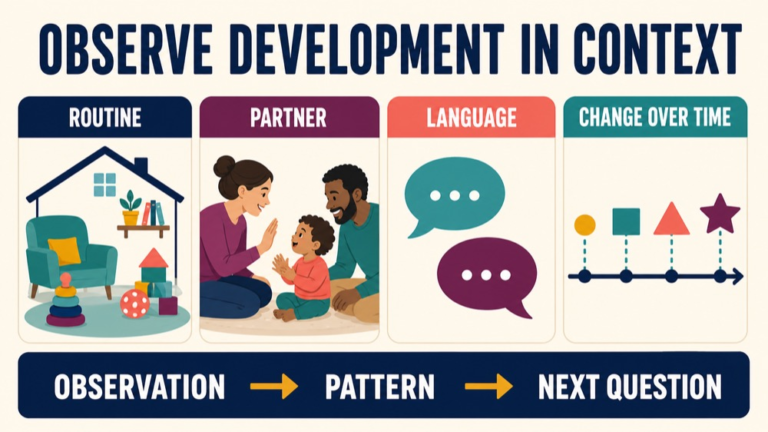
Milestone information becomes more useful when attached to a routine. Observe play, dressing, book sharing, snack, bath time, or a transition instead of testing with a series of questions. Note what the child noticed, how the child communicated, what the partner did, and whether the message worked. This captures comprehension, expression, interaction, hearing access, and participation together.
During book sharing, one child may turn pages, point, make a sound, and look toward an adult for a response. Another may label a picture, answer a question, and add a detail about a familiar experience. Both examples contain meaningful communication but invite different follow-up questions. Record the behavior before choosing a skill label.
- Context: activity, people, language, and sensory conditions.
- Initiation: whether the child starts a message, responds, or does both.
- Form: movement, gesture, sign, sound, word, phrase, sentence, or combination.
- Meaning: requesting, refusing, sharing, asking, describing, pretending, or repairing.
- Understanding: what is followed without a gesture, repetition, or extra context.
- Partner response: whether the message is understood and receives a useful response.
- Participation: whether communication supports joining, problem-solving, or staying engaged.
- Change: whether the pattern expands, stays uneven, or shows loss of a previous skill.
A short record can be more informative than a word count: “During snack, the child pointed to the cup, vocalized, accepted a modeled word, and drank without coughing; during book time, the child followed a familiar instruction with a gesture but did not respond to a new question.” This separates communication intent, language understanding, speech output, and swallowing observations.
Common Confusions: Related Does Not Mean Identical
These domains support the shared goal of connecting with other people, so they can sound interchangeable. The distinctions below help prevent overinterpretation when reviewing a milestone chart.
Speech is not language. A child may know what to say and understand a conversation while sound production makes the message hard to understand. Another may pronounce words clearly but have difficulty understanding directions or combining ideas. Ask separate questions about meaning and form.
Hearing is not listening behavior. A child may respond in a quiet room but miss speech in noise, or follow visual cues without consistent access to spoken information. A home observation can raise a hearing question but cannot settle it.
Social communication is not a score for eye gaze or talkativeness. It describes how a child shares meaning with a partner through available modes. A quiet child can communicate intentionally, while a highly verbal child can need support with turn-taking, topic maintenance, or interpreting a partner.
Feeding preference is not automatically a swallowing problem. Selectivity can have many contributors. Coughing, choking, wet or gurgly vocal quality after eating, breathing changes, or prolonged stressful meals raise a different safety question from refusing one food.
- Age range as deadline: look for patterns across skills, contexts, and time.
- Word count as language profile: include understanding, gestures, purpose, combinations, and interaction.
- Speech difference as total explanation: examine speech, language, hearing, and social use separately.
- One quiet behavior as social conclusion: compare people, activities, cultures, and sensory conditions.
- Food preference as swallowing inference: consider safety, efficiency, comfort, nutrition, hydration, and change.
The practical rule is to name the observation, name the domain, and describe the boundary of what it supports. That sequence keeps developmental education useful without turning it into an unsupported label.
When to Seek an Evaluation: Red Flags With Context
A red flag is a reason to seek timely professional discussion, not a diagnosis. A pediatrician, audiologist, speech-language pathologist, or feeding and swallowing team may need different information. Age, languages, health history, hearing access, and daily impact all affect interpretation.
- A child loses a communication, social, or feeding skill that had been reliable.
- Caregivers notice inconsistent responses to voices or important environmental sounds, or have a specific hearing concern.
- Understanding or expressing messages limits ordinary routines, play, learning, or relationships.
- Communication attempts are limited, difficult to interpret, or accompanied by persistent frustration that affects participation.
- Speech remains hard for familiar or unfamiliar partners to understand, especially when progress and context do not explain the pattern.
- A child has difficulty coordinating breathing, chewing, or swallowing, or shows coughing, choking, wet vocal quality, or breathing changes around meals.
- Mealtimes are prolonged, exhausting, painful, or associated with concerns about nutrition, hydration, or growth.
- A caregiver, teacher, or clinician continues to have a concern even though one milestone appears present.
One missed skill on one day may reflect fatigue, unfamiliarity, limited opportunity, a hearing or sensory condition, or another communication route. A cluster, persistent functional effect, regression, or safety concern deserves more attention than one comparison. If eating or breathing safety is in question, seek appropriate medical guidance promptly rather than relying on an online chart.
An evaluation is a structured way to understand strengths, access needs, communication partners, and possible supports. Families can bring routine observations, hearing questions, examples from every language used, and notes about change over time. This helps the professional ask a more precise question.
Multilingual Development and Individual Variation
A child who hears or uses more than one language should be understood across the full communication environment. Looking only at English words can undercount concepts, interaction, or communication with family. Ask what the child understands and expresses in each language, who uses each language, and which routines provide meaningful opportunities. A bilingual SLP or qualified interpreter can support access to evaluation.
Multilingual development can look uneven because exposure, vocabulary topics, and conversational partners differ across languages. That unevenness is not, by itself, evidence of a disorder. A persistent concern across languages and settings should still be examined rather than dismissed as bilingualism. Interpretation should reflect the whole profile and functional participation.
Individual variation also includes temperament, culture, opportunity, motor development, sensory experience, health history, family routines, and the match between a child and a setting. A milestone chart starts questions; it cannot account for every pathway or replace listening to the family and observing meaningful routines.
- Which languages and communication modes does the child hear and use?
- Which people and routines make communication easiest or hardest?
- Are concerns present across languages, partners, and settings?
- What strengths does the child use to make meaning, solve problems, or connect?
- Has the pattern changed, and does it affect participation or safety?
These questions reduce the risk of confusing limited opportunity in one language with a broad language difficulty, or a culturally shaped interaction style with a lack of social communication.
A Short SLP Praxis 5331 Application
For SLP Praxis 5331 study, this topic is useful as a domain-separation and clinical-reasoning framework. Use the current ETS Speech-Language Pathology 5331 page and applicable current blueprint for exam scope and logistics; this article does not freeze changing test specifications. For a developmental scenario:
- Name the domain: speech, language, hearing, social communication, feeding or swallowing, or a connection.
- Describe the evidence: behavior, context, partner, language, and time pattern rather than a label such as “late talker.”
- Separate conclusion from next question: state what the observation supports and what requires hearing assessment, broader evaluation, or more history.
- Protect the boundary: broad milestones guide observation; they do not establish a diagnosis or fixed outcome from one item.
Original study example: A preschool child uses detailed gestures and long strings of speech, but unfamiliar listeners understand only part of the message. Separate language formulation from speech intelligibility, then consider hearing access, context, and communication partners. The observation does not identify a disorder or determine treatment by itself. This teaching scenario was created for this article and is not a reproduction of an exam item.
This reasoning prevents selecting an answer based on the most visible behavior while overlooking the domain the scenario actually tests. Explain both the best-supported interpretation and the information that remains unknown.
Quick Review: What to Remember
Use this checklist when reviewing a developmental chart, discussing a concern, or studying a clinical scenario. The goal is careful observation and a fitting next question, not memorization of a rigid staircase.
- Typical development describes broad patterns, not identical timing for every child.
- Speech describes spoken production; language describes meaning, understanding, and expression.
- Hearing provides access information and deserves follow-up when concern is present.
- Social communication describes how a child connects and shares meaning with partners.
- Feeding and swallowing require separate attention to safety, efficiency, comfort, and participation.
- Birth-to-five age bands are orientation tools, not pass-or-fail cutoffs.
- Observe routines, partners, languages, change over time, and functional impact.
- Regression, hearing concerns, participation limits, or feeding safety signs warrant professional discussion.
- Multilingual interpretation should include the child’s whole language environment.
- For SLP Praxis study, identify the domain, decisive evidence, boundary, and next question.
If you want a structured way to turn this framework into review notes, you can explore the SLP Study Center Complete Prep resources and decide whether they fit your own study plan. Keep the current ETS page and authoritative clinical resources as the source of changing exam and developmental guidance.
References
- ASHA: Typical Speech and Language Development — public development charts and caregiver observations; verify the current page before publication.
- ASHA: Communication Milestones — public communication examples and support ideas.
- NIDCD: Speech and Language Developmental Milestones — public overview of early speech and language development and the role of hearing access.
- ETS: Speech-Language Pathology 5331 — current exam page to consult for changing scope and logistics.