treatment praxis practice questions are easier to reason through when you connect the person’s functional goal to a measurable target, a supported intervention choice, and a plan for checking response. A treatment stem may mention goals, cueing, intensity, counseling, generalization, collaboration, or progress data. The best answer explains why the action fits this person, task, setting, and current evidence.
The current ASHA Speech-Language Pathology 5331 content page places treatment, evidence-based practice, counseling, collaboration, culturally and linguistically appropriate service delivery, documentation, and client advocacy within the professional study frame. Use the relevant ASHA Practice Portal topic and the live ETS practice-test page for current context. The maps, rationales, and A-D items below are original study material and do not reproduce live test content.
What treatment Praxis practice questions are testing
Treatment items ask you to move from assessment evidence to a responsible plan. The stem may describe a speech sound target, language activity, fluency participation goal, voice need, motor-speech profile, AAC system, cognitive-communication task, feeding or swallowing concern, or counseling decision. Identify the target, the person’s priority, the context, and the evidence that supports the intervention choice.
| Treatment task | Clue to locate | Reasoning output |
|---|---|---|
| Goal selection | Activity, partner, communication demand, safety need, and person preference | Functional target |
| Intervention fit | Mechanism, skill, response pattern, evidence, and context | Purposeful method |
| Support level | Cue, model, prompt, visual, device, partner, or environmental change | Accessible entry point |
| Practice design | Repetitions, variability, feedback, task difficulty, and meaningful use | Learning opportunity |
| Outcome monitoring | Observable change, participation, safety, independence, and generalization | Adaptation decision |
| Professional process | Consent, culture, collaboration, scope, documentation, and referral | Responsible care |
Rewrite a vague intervention request into a treatment question. “Which therapy is best?” becomes “Which supported activity addresses the assessed barrier and helps the person participate in the named routine?” “How many trials?” becomes “What practice conditions are feasible, safe, and sufficient to observe a meaningful response?” The new question makes the clinical reasoning visible.
Look for the facts that alter the answer: the person’s goal, response mode, baseline, fatigue, hearing, language, partner, risk, prior response, and available support. A method may be useful in one context but poorly matched to another. Treatment reasoning is a fit problem, not a popularity contest.
Start with the functional treatment question
A treatment plan begins with what the person wants or needs to do. Name the activity, partner, environment, barrier, and desired participation. Then decide which skill or support is a reasonable target. This order prevents an isolated drill from becoming the goal and keeps treatment connected to the person’s life.
| Planning field | Question to ask | Why it matters |
|---|---|---|
| Activity | What communication, learning, eating, or safety activity matters? | Defines the outcome |
| Partner | With whom does the activity occur? | Shapes support and practice |
| Barrier | Which observed skill or condition limits success? | Identifies the treatment target |
| Strength | What strategy, mode, or support already works? | Builds from capability |
| Priority | What does the person want changed first? | Supports participation and consent |
| Measure | What observable response will show a useful change? | Guides monitoring |
A functional question can still lead to impairment-level practice when that practice helps the person reach the activity. The key is to explain the link. A speech sound drill, word-retrieval strategy, respiratory task, AAC symbol set, or swallowing exercise should have a clear relation to the person’s goal and the conditions in which the skill will be used.
Write measurable person-centered goals
A useful goal names the behavior, condition, support, and criterion that matter to the decision. It should be understandable to the person and team, meaningful in context, and open to revision. Avoid goals that describe only a clinician’s activity, such as “will receive therapy,” without stating what the person will do or what participation will change.
| Goal element | Example question | Quality check |
|---|---|---|
| Behavior | What will the person say, understand, select, produce, or use? | Is it observable? |
| Condition | In what task, routine, partner, or environment? | Is the context meaningful? |
| Support | What cue, device, visual, or partner help is allowed? | Is access included? |
| Criterion | What level or pattern will count as useful progress? | Can it be measured? |
| Time and review | When will the team examine response and revise the goal? | Is follow-up planned? |
Do not confuse a numerical criterion with a meaningful goal. A percentage can be useful when the task and conditions are clear, but it does not replace a functional outcome or the person’s priorities. In a question, look for an answer that balances measurable data with access, generalization, safety, and participation.
Match intervention to the target
Intervention selection should follow the assessed target and the reason it matters. For speech sound work, examine the sound pattern, word context, intelligibility, and communication goal. For language, consider comprehension, expression, vocabulary, syntax, discourse, literacy, and partner demands. For motor speech, voice, fluency, AAC, cognition, or swallowing, match the method to the relevant subsystem, response, and safety context.
| Target question | Evidence to connect | Plan direction |
|---|---|---|
| What skill is limited? | Assessment data, observation, report, and strengths | Define the target precisely |
| What mechanism or process matters? | Pattern, task demand, access, and response condition | Select a compatible method |
| What activity is affected? | Partner, setting, routine, and participation barrier | Embed meaningful practice |
| What risk or burden exists? | Fatigue, safety, frustration, privacy, or opportunity cost | Adjust and monitor |
| What will show response? | Baseline and repeatable functional or skill data | Define a review point |
Be cautious with a choice that names a familiar technique but never connects it to the assessed need. The correct treatment answer is not necessarily the newest, hardest, or most intensive option. It is the option with a defensible fit that can be implemented, monitored, and revised with the person and team.
Select cues and supports
Cues and supports open access to a target while the learner practices a new response. Choose them deliberately. A visual cue, model, gesture, written keyword, tactile support, device, partner strategy, or environmental change may help, but the support should match the barrier and be faded or adapted when independence is the goal.
| Support | When it may help | Question to monitor |
|---|---|---|
| Model | The person needs an example of the target response | Can the response be produced after the model? |
| Visual | Written, pictured, signed, or symbol information supports access | Does the visual support the intended task? |
| Choice set | Open retrieval or initiation creates too much demand | Can choices expand over time? |
| Partner cue | Daily communication depends on a trained partner | Does the partner use the strategy consistently? |
| Environmental change | Noise, layout, pace, or materials create a barrier | Does the change carry into the routine? |
Do not treat cueing as failure. A supported response provides information about access and learning. At the same time, do not report a highly cued response as independent performance. Record the level and type of support so the plan can target both successful communication and growing autonomy.
Plan practice and feedback
Practice design includes task selection, repetition, variability, feedback, timing, rest, and meaning. Start at a level that allows a useful response, then adjust the demand. Feedback should tell the learner what helped and how to use the response, not merely signal right or wrong. The choice between immediate and delayed feedback depends on the learner, target, task, and purpose.
- Define the target and the activity in plain language.
- Choose a starting condition that allows access and safety.
- Provide a cue or model that matches the barrier.
- Vary people, materials, words, or contexts when transfer matters.
- Give feedback that supports the next attempt and the learner’s strategy.
- Record the response, support level, fatigue, and functional relevance.
A long drill is not automatically a strong treatment plan. Ask what the practice prepares the person to do outside the therapy task. If the goal is conversation, practice should eventually include conversation demands; if the goal is classroom participation, include the relevant directions, partner, pace, and support.
Consider dose, intensity, and feasibility
Questions about dose and intensity require context. Consider task difficulty, frequency, duration, fatigue, health, safety, motivation, scheduling, caregiver or partner capacity, and the person’s access to practice outside the session. Avoid inventing a universal dose from a single vignette. Select a feasible starting plan, monitor response, and revise using data.
| Planning factor | Question to ask | Responsible adjustment |
|---|---|---|
| Frequency | How often can meaningful practice occur? | Align with routine and resources |
| Duration | How long can the person participate with quality? | Use rest and shorter sets when needed |
| Difficulty | Is the task easy enough for success and hard enough to learn? | Grade the demand |
| Intensity | What does intensity mean for this target and person? | Define it instead of assuming |
| Feasibility | Can the person, partner, and setting carry out the plan? | Adapt materials and supports |
| Response | What data will show whether the plan is helping? | Set a review point |
When a stem highlights fatigue, pain, limited attendance, or a high-burden plan, the best answer usually adjusts the plan while protecting the goal. A plan that cannot be implemented cannot be evaluated fairly.
Support generalization and maintenance
Generalization means using a learned response beyond the exact practice condition; maintenance means retaining it over time. Plan for transfer instead of waiting for it to appear. Change the partner, activity, materials, setting, pace, or level of support in a controlled way, then monitor whether the person can use the skill meaningfully.
| Transfer variable | Practice question | Plan direction |
|---|---|---|
| Partner | Can the person use the response with more than the clinician? | Train and vary partners |
| Activity | Does the skill work during a meaningful routine? | Embed functional tasks |
| Materials | Does performance depend on one practiced item? | Vary examples and content |
| Setting | What environmental demands change outside therapy? | Practice relevant conditions |
| Support | What happens when cues are reduced or changed? | Fade or replace support carefully |
| Time | Does the response remain available later? | Schedule maintenance checks |
Do not interpret a strong therapy-room response as proof of functional transfer. It is encouraging evidence that should guide the next observation. The most useful answer identifies how to test transfer and how the person or partner can continue the strategy in daily life.
Use functional and outcome data
Progress data should help the team decide whether to continue, adapt, pause, or change the plan. Collect information that is repeatable and meaningful: target response, support level, communication breakdowns, participation, safety, effort, partner success, and person-reported value. A single better or worse session needs context.
| Data type | What it tells you | Use in treatment reasoning |
|---|---|---|
| Skill data | Response under defined practice conditions | Adjust task or cueing |
| Functional data | Communication or participation in a real activity | Check transfer |
| Support data | Type and amount of assistance required | Plan fading or access |
| Person report | Preference, effort, confidence, burden, and meaningful change | Refine priorities |
| Partner report | Carryover, opportunity, and environmental barriers | Change the support system |
| Safety data | Signs that require caution, referral, or a different provider | Protect welfare |
Use the data to ask a focused question. If the skill is stronger with a model but not in conversation, examine transfer and cue fading. If the score is stable but the person reports easier participation, include both findings. If the person is fatigued or unsafe, change the plan before chasing a numerical target.
Adapt treatment to language and culture
Treatment should be understandable, relevant, and accessible across the person’s languages, dialects, communication modes, routines, and cultural context. Select words, examples, partners, and materials that fit the person’s experience. If the clinician lacks needed linguistic or cultural knowledge, seek qualified collaboration rather than treating one language or cultural routine as the default.
Review the current ASHA Cultural Responsiveness resource and Multilingual Service Delivery resource when a question highlights language access. The ethical treatment answer preserves the target while adapting the route to it. A dialectal feature should not be selected as a treatment target simply because it differs from the clinician’s variety.
Include communication partners and team members
Many treatment outcomes depend on partners, teachers, family members, aides, nurses, physicians, or other professionals. Define each role, obtain appropriate consent, protect privacy, and train partners on the strategy they can realistically use. Collaboration should expand access and continuity, not shift responsibility without support or oversight.
| Partner role | What to clarify | Plan output |
|---|---|---|
| Person served | Goal, preference, mode, consent, and feedback | Shared decision |
| Family or support | Routine, opportunity, language, burden, and priorities | Feasible carryover |
| Educator or employer | Task demand, accommodation, timing, and privacy | Context support |
| Assistant or student | Training, scope, supervision, and documentation | Accountable implementation |
| Interprofessional team | Role, referral question, safety, and communication channel | Coordinated plan |
In a question, avoid the choice that assumes the partner can carry out a complex strategy without training or that shares information without authorization. The stronger answer explains the task, demonstrates the support, checks understanding, and establishes follow-up.
Protect safety, consent, and autonomy
Treatment choices should respect the person’s right to understand, participate, accept, modify, or decline as permitted by the setting. Explain the proposed activity, meaningful benefits and burdens, alternatives, privacy considerations, and relevant safety limits. Revisit consent when the plan, technology, risk, participants, or purpose changes.
Safety does not mean removing every challenge or deciding for the person. It means identifying foreseeable risk, selecting appropriate precautions, monitoring response, and consulting or referring when the concern exceeds the clinician’s role. A question that includes a red flag usually rewards the answer that pauses the routine and uses the appropriate safety pathway.
Choose evidence responsibly
Evidence-based treatment integrates research, clinical expertise, and the person’s values, goals, culture, access, and context. A study can inform a choice without dictating a universal protocol. Check the population, target, comparison, outcome, setting, dosage description, limitations, and fit with the person in the stem.
| Evidence lens | Question to ask | Practice implication |
|---|---|---|
| Target | Does the evidence address the skill or activity in question? | Choose a relevant method |
| Population | How similar are participants to the person and context? | Calibrate transfer |
| Outcome | Was meaningful function measured or only a narrow task? | Track the needed outcome |
| Fit | Can the person access and tolerate the approach? | Adapt implementation |
| Uncertainty | What limitations should shape the recommendation? | Use cautious language |
Document the treatment decision
Document the goal, baseline, intervention, support, response, person or partner participation, safety consideration, and next plan. A useful note lets another professional understand why the method was selected and what the data mean. Record conditions and cueing so a later change is interpretable.
- State the activity and target connected to the person’s goal.
- Describe the method, materials, conditions, support, and duration.
- Record observable response and the level of assistance.
- Note preference, fatigue, safety, communication access, and partner participation.
- Interpret the result with its limitation and functional meaning.
- Set the next practice, referral, monitoring, or review step.
Map a treatment question to an action plan
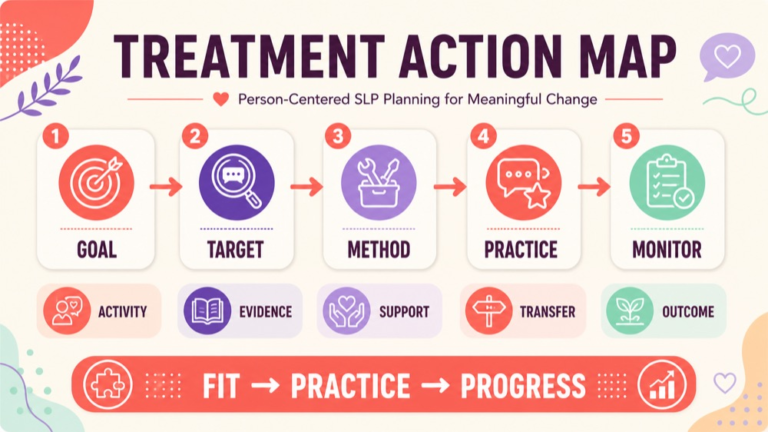
Use a five-step treatment map when the answer choices mix goals, techniques, cues, and outcomes. Define the activity, name the target, choose a supportable method, practice under meaningful conditions, and monitor the response. This keeps the intervention tied to the person instead of to a technique name.
| Map step | Margin question | Common error |
|---|---|---|
| Activity | What does the person need or want to do? | Starting with a drill |
| Target | Which observed skill or barrier limits that activity? | Choosing a global goal |
| Method | What intervention and support fit the target? | Using a favorite technique automatically |
| Practice | How will access, variability, feedback, and transfer be planned? | Practicing one narrow condition |
| Monitor | What data will guide continuation or adaptation? | Ending without a review point |
Use a treatment review board
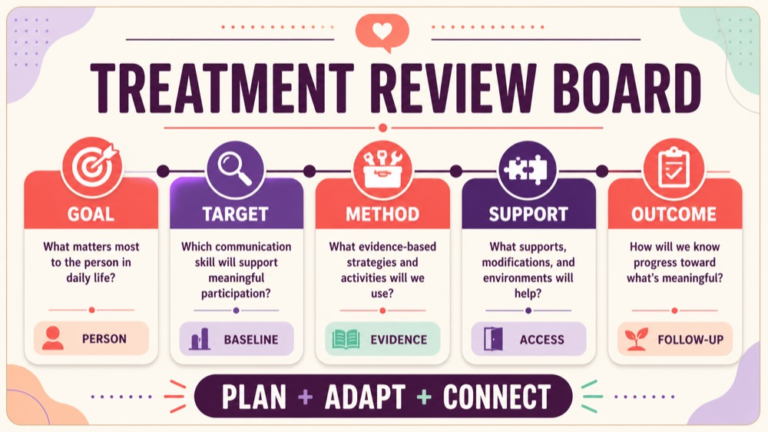
A treatment review board helps you compare a plan with the facts. Fill cards for goal, target, method, support, and outcome. If a choice mentions a technique but leaves the person’s goal or measurement blank, treat it as incomplete until the missing connection is supplied.
| Board card | Write down | Ask yourself |
|---|---|---|
| Goal | Activity, partner, priority, and participation outcome | Why does this matter to the person? |
| Target | Observed skill, barrier, strength, and baseline | What exactly is being changed? |
| Method | Intervention, evidence, materials, and conditions | Does the approach fit the target? |
| Support | Cue, mode, device, partner, environment, and fading plan | Can the person access the task? |
| Outcome | Skill, function, safety, preference, and review date | What will guide the next decision? |
Question 1: goal and intervention fit
Practice Question 1. An adult wants to participate more successfully in weekly team meetings. Assessment shows that the adult can formulate short messages but loses the main point when explaining a multi-step update. Which treatment plan best matches the goal?
A. Practice isolated word repetition without connecting it to explanations or meeting demands.
B. Choose a broad speech goal without observing the meeting routine.
C. Practice organizing and delivering a short meeting update with a visual outline, then vary topics and partners while monitoring message clarity and support needs.
D. Require the adult to memorize a fixed script for every possible meeting.
Correct Answer: C. The plan connects the assessed discourse barrier to the person’s participation goal, provides an access support, and includes variation for transfer. It also creates observable data about clarity and cueing.
Why the Other Options Are Wrong: A is not linked to the reported activity. B names a goal without defining the task or evidence. D may help one rehearsed situation but does not support flexible communication across meetings. C matches target, context, support, and outcome.
Exam Trap: A technique or script can sound organized while missing the participation demand. Choose the answer that explains how practice will transfer to the person’s stated activity.
Question 2: cueing and generalization
Practice Question 2. A child uses an AAC device to request a preferred activity when the clinician points to the correct symbol. The child does not initiate requests with a caregiver at home. What is the best next treatment action?
A. Remove the device because independent requests have not appeared.
B. Continue pointing to the same symbol in therapy and record the skill as generalized.
C. Train the caregiver in a consistent partner strategy, practice across motivating routines, and monitor the type and amount of cueing as support is adjusted.
D. Add many new symbols before examining the current access and partner conditions.
Correct Answer: C. The child’s supported response shows a starting point, but the home-context barrier requires partner training, meaningful routines, and data on cueing and transfer. The device remains an available communication mode while the support plan is strengthened.
Why the Other Options Are Wrong: A removes an access route without addressing the reason for limited initiation. B confuses a cued therapy response with generalization. D changes the system before checking the current routine and partner support. C addresses access, partner behavior, motivation, and transfer.
Exam Trap: A cue is data, not evidence of independence. When carryover is limited, look for partner training and varied functional practice before discarding the method.
Question 3: progress data and adaptation
Practice Question 3. A client’s speech sound accuracy is higher in structured words, but intelligibility during conversation has remained unchanged. The current plan uses only repeated word drills. What is the most appropriate next step?
A. Continue the same drills indefinitely because structured accuracy has increased.
B. Stop treatment because the structured measure changed but conversation did not.
C. Review the goal and baseline, add connected-speech practice with relevant partners and contexts, and monitor both target production and functional intelligibility.
D. Replace the goal with a different speech sound without reviewing the conversation data.
Correct Answer: C. The data suggest a transfer gap. The plan should preserve useful structured practice while adding the communication conditions that matter and monitoring both skill and participation outcomes.
Why the Other Options Are Wrong: A treats a narrow gain as the whole outcome. B discards useful progress instead of adapting the plan. D changes the target without explaining the functional barrier. C uses the data to refine practice and measure generalization.
Exam Trap: When one measure changes and the functional outcome does not, look for a mismatch in practice conditions, support, partner, or outcome—not an automatic pass or stop decision.
Review common treatment distractors
Treatment distractors often name a real technique but detach it from the goal, context, or measurement. They may confuse high effort with useful intensity, structured accuracy with generalization, or a clinician preference with person-centered care. Identify the missing treatment field before selecting an answer.
| Distractor pattern | Why it sounds attractive | Correction |
|---|---|---|
| Favorite technique first | The method is familiar | Start with target and activity |
| Drill equals function | Structured data are easy to collect | Plan transfer and participation |
| More intensity always helps | Effort sounds like commitment | Check feasibility, safety, and response |
| Prompted equals independent | The response was correct | Record support and plan fading |
| One goal fits everyone | A template feels efficient | Use person-centered priorities |
| Research dictates protocol | Evidence sounds definitive | Check population, target, fit, and limits |
| Referral ends treatment | Another professional may be needed | Coordinate continuity and next steps |
| Score replaces preference | Numbers appear objective | Include person report and meaningful outcomes |
Build a treatment practice block
A focused treatment block should mix goal writing, intervention fit, cueing, practice design, transfer, progress data, and professional process. Use cases from speech, language, fluency, voice, motor speech, AAC, cognition, feeding, and swallowing while keeping the same reasoning sequence.
- Underline the person’s goal, activity, partner, and setting.
- Write the assessed target and baseline in one sentence.
- Label each choice as goal, method, support, monitoring, or referral.
- Complete the three original questions on this page without reading the rationales.
- Explain which treatment field each distractor leaves incomplete.
- Write one transfer condition and one safety or feasibility check.
- End with the data that would guide continuation or adaptation.
Use contrast pairs. Keep the same target but change the activity. Keep the same method but change the communication mode. Keep the same accuracy gain but remove functional transfer. Explain why the plan should change when the decision or context changes.
Track treatment reasoning and confidence
Record the goal, target, method, support, response, and next decision rather than only the answer letter. If you miss an item, label the problem: goal mismatch, evidence fit, cueing, generalization, safety, consent, feasibility, or outcome monitoring.
| Log field | Example entry | What it reveals |
|---|---|---|
| Goal | Participate in weekly team updates | Whether the person’s activity stayed visible |
| Target | Organize a multi-step explanation | Whether the skill was precise |
| Method | Visual outline plus varied meeting simulations | Whether the intervention fits |
| Support | Written keywords, then reduced cueing | Whether access and independence were tracked |
| Outcome | Message clarity with familiar and new partners | Whether transfer was measured |
| Distractor type | Drill equals function | Which shortcut to avoid |
| Confidence | 58% before rationale, 91% after explanation | Where review transfers |
Treatment Praxis practice questions checklist
Use this checklist before submitting an answer. It is a study aid, not a substitute for current ASHA guidance, applicable law, consent, supervision, facility policy, or individualized clinical judgment.
- Did I identify the person’s activity, partner, priority, and participation outcome?
- Did I connect the treatment target to assessment evidence and a clear baseline?
- Did I select a method that fits the target, response pattern, language, mode, and context?
- Did I plan cues, supports, access, partner training, and a responsible fading approach?
- Did I consider practice conditions, variability, feedback, rest, feasibility, and motivation?
- Did I avoid inventing a universal dose or treating effort as the only outcome?
- Did I plan for generalization, maintenance, and meaningful real-world use?
- Did I track both skill data and functional or person-reported outcomes?
- Did I include language, dialect, culture, communication mode, and partner context?
- Did I protect safety, consent, autonomy, privacy, competence, and continuity?
- Did I document the method, support, response, limitation, and next review step?
- Did I explain why each distractor is incomplete for the facts given?
Sources and next steps
For the professional-practice and treatment study frame, review ASHA’s Speech-Language Pathology 5331 content page and the relevant ASHA Practice Portal topic. For culturally and linguistically responsive service, review ASHA Cultural Responsiveness and Multilingual Service Delivery.
For current preparation context, use the live ETS practice-test page and ETS Speech-Language Pathology 5331 page. This page’s maps, rationales, and A-D questions are original educational material, separate from the live ETS test, and not individualized clinical advice.
For your next review, choose one functional goal and write two treatment plans: one for structured practice and one for transfer. State the support, the data, and the condition that would make you adapt the plan. That exercise turns technique recognition into treatment reasoning.
Continue your preparation: Explore the SLP Study Center learning resources.