treatment planning praxis questions are easier to solve when you connect the assessment finding to a functional goal, a feasible procedure, and an observable outcome. A stem may ask you to prioritize goals, choose a treatment detail, generate a prognosis, communicate recommendations, or evaluate progress. The strongest answer follows the sequence rather than selecting a familiar technique from a diagnostic label.
The current ASHA Speech-Language Pathology 5331 content page places treatment planning, implementation, and evaluation in a major exam category. ASHA’s Documentation in Health Care resource also describes measurable functional goals, treatment details, progress monitoring, and plan modification. Use the live ETS Speech-Language Pathology 5331 page for changing exam information. The maps and questions below are original study material.
What treatment planning questions are testing
A treatment planning item may ask you to identify the highest-priority goal, choose a treatment procedure, decide how to communicate a recommendation, select a measure of progress, or determine whether a plan should be modified. The diagnosis is only one part of the decision. The person’s assessment profile, activity, preferences, learning conditions, support network, and setting determine what belongs in the plan.
| Question task | Evidence to locate | Review output |
|---|---|---|
| Prioritize | Safety, participation, readiness, strengths, needs, and the person’s stated goal | First target and rationale |
| Write a goal | Baseline, activity, condition, criterion, and meaningful outcome | Measurable functional goal |
| Select treatment | Target skill, cueing, evidence, learning profile, and access | Procedure and support |
| Set treatment details | Setting, frequency, duration, materials, partner, and carryover | Feasible implementation |
| Evaluate | Progress data, participation, generalization, and response to support | Continue, adapt, or discharge decision |
Rewrite the question as a planning decision before reading the choices. “Which goal should be prioritized?” is different from “Which procedure should be used?” and different again from “How should progress be evaluated?” Many distractors are reasonable actions placed at the wrong point in the plan.
Look for details that change treatment planning: the severity and pattern of the need, the person’s communication context, attention, fatigue, motivation, cultural and language background, motor or sensory access, caregiver capacity, medical stability, learning response, and available resources. A strong plan fits the actual conditions instead of assuming that a diagnosis predicts one universal intervention.
Anchor review to the ASHA 5331 scope
The ASHA 5331 treatment framework includes evaluating factors that can affect treatment, initiating and prioritizing treatment, developing goals, determining treatment details, generating a prognosis, communicating recommendations, and applying general treatment principles. It also includes monitoring progress and outcomes to evaluate assessment or treatment plans and following up on referrals and recommendations.
| 5331 lens | Treatment planning question example | Study tag |
|---|---|---|
| Priorities | Which need should be addressed first and why? | Risk, readiness, and function |
| Goals | What observable change should occur in a meaningful activity? | Baseline and criterion |
| Procedures | Which strategy matches the target and the person’s learning conditions? | Method and support |
| Details | What frequency, duration, setting, materials, or partner support is feasible? | Implementation fit |
| Prognosis | What factors support or limit expected change? | Calibrated forecast |
| Evaluation | How will progress and generalization be measured? | Data and modification |
Map the case to one primary planning lens even when the stem contains several needs. A student may have articulation, vocabulary, literacy, and classroom participation concerns, but the question may ask which goal is most functional for the current referral. The requested action and the baseline clues should decide the answer.
Use the ASHA pages for clinical and professional concepts and ETS for current exam information. This page offers original practice content; it does not reproduce live test material. When a detail depends on a state, setting, or current policy, check the responsible organization rather than relying on a static note.
Move from assessment to treatment priorities
Treatment planning begins with a clear interpretation of the assessment. Identify the person’s strengths, primary needs, communication activity, and barriers to participation. Then decide which change is most important, feasible, and meaningful at the current stage. A priority may address safety, access, a foundational skill, a partner or environmental barrier, or a routine the person wants to join.
| Assessment information | Planning question | Priority clue |
|---|---|---|
| Immediate safety or health concern | What must be coordinated before routine practice continues? | Urgency and referral boundary |
| Core skill affecting many activities | Which target gives the person a useful starting point? | Potential functional reach |
| Partner or environment barrier | What change can create communication opportunity now? | Access and participation |
| Person’s stated activity | Which goal matters in the person’s daily life? | Motivation and relevance |
| Variable performance | What condition or support should be tested first? | Learning and generalization |
Do not confuse “most impaired” with “highest priority” automatically. A small skill difference may not affect the person’s goals, while a partner or access barrier may prevent participation across settings. Conversely, a health or safety issue may need coordination before a participation goal can be addressed. The stem’s facts should establish the priority.
Write functional, measurable goals
A useful goal names the person, activity, condition or support, observable behavior, and criterion or outcome. It should be linked to the assessment and meaningful to the person. “Improve language” or “increase intelligibility” is too broad for a treatment-planning decision. A goal such as “produce target words during a classroom response with a defined cue level across repeated opportunities” gives the team something to observe and adjust.
| Goal element | Question to answer | Example study wording |
|---|---|---|
| Person | Who will perform or use the skill? | The student will… |
| Activity | What communication or participation task matters? | …during a classroom response… |
| Condition | With what cue, partner, material, or setting? | …with a visual cue and familiar topic… |
| Behavior | What can be counted or described? | …produce the target word clearly… |
| Criterion | What level or pattern indicates progress? | …in 8 of 10 opportunities across two sessions. |
A functional goal does not need to ignore impairment-level work. It should show how the target connects to communication, learning, work, self-advocacy, eating, social interaction, or another valued routine. Use the activity to explain why the target matters and the criterion to define how progress will be recognized.
Prioritize goals and sequence care
When several goals are possible, prioritize by considering safety, urgency, foundational value, person preference, participation impact, readiness, and available support. Sequence the plan so that early targets create access to later targets when appropriate. The plan may include direct treatment, partner training, environmental support, consultation, referral, or monitoring in parallel.
| Priority factor | Question to ask | Planning implication |
|---|---|---|
| Urgency | Is there a safety, medical, or access issue that changes timing? | Coordinate the responsible pathway first. |
| Functional impact | Which need limits the person’s most important activity? | Start with a high-value participation target. |
| Foundation | Which skill supports several later tasks? | Sequence practice with a clear bridge to function. |
| Readiness | Can the person attend, understand, access, and practice the target? | Adjust conditions or select a more accessible entry point. |
| Preference | Which activity does the person want to change? | Use the goal to support engagement and relevance. |
A choice that lists every possible goal may sound comprehensive but fail to prioritize. Look for the option that identifies the first meaningful target and explains how other needs will be addressed or revisited. Good sequencing keeps the plan focused without pretending that one goal is the entire person.
Select treatment procedures and cues
Choose a procedure that directly addresses the target behavior and matches the person’s learning profile. Consider modeling, imitation, feedback, cueing, practice structure, task complexity, distributed or intensive opportunities, communication partner support, and response to prior treatment. A procedure should have a rationale that connects the method to the assessment finding and the goal.
| Target question | Procedure filter | What to monitor |
|---|---|---|
| Speech sound or motor speech | Does the practice provide the needed movement, feedback, and communication context? | Accuracy, intelligibility, cueing, and transfer. |
| Language | Does the activity support the language process and the person’s functional message? | Use across partners, tasks, and languages. |
| Fluency or voice | Does the plan fit the communication goal, self-report, and speaking environment? | Participation, effort, and communication effectiveness. |
| Cognition or AAC | Does the support fit attention, memory, access, partner, and environment? | Independence, repair, and generalization. |
| Feeding or swallowing | Does the plan fit the task, safety evidence, person, and team boundary? | Safety, efficiency, intake, and participation. |
Do not treat a technique as a label-specific answer. The same technique can have different value depending on the goal, cue level, person’s response, and setting. If the stem asks for the best treatment detail, select the option that includes a target and a way to judge whether the procedure is helping.
Match dosage, setting, and support
Treatment details include frequency, duration, intensity or practice opportunities, materials, setting, communication partner, home or classroom practice, and the support required for access. The plan should be realistic for the person and the people implementing it. A theoretically strong procedure can fail if the materials are unavailable, the task is too demanding, or the partner does not understand the routine.
| Detail | Planning question | Fit check |
|---|---|---|
| Frequency | How often can the person and team practice meaningfully? | Match resources and recovery. |
| Duration | How long can attention, voice, energy, or posture support the task? | Use realistic practice windows. |
| Materials | Which words, foods, devices, books, or environments are relevant? | Support transfer to real routines. |
| Partner | Who will model, cue, respond, or document? | Train the people who carry the plan. |
| Setting | Where must the skill be available? | Practice across important contexts. |
| Access | What hearing, vision, motor, language, or literacy support is needed? | Make the task usable before judging performance. |
When a question asks for the best plan, favor feasibility with a clear rationale over an impressive but unusable schedule. Consider what can occur in therapy and what needs to be embedded in school, home, work, healthcare, or community activities. The plan should make its support conditions visible.
Use evidence and clinical judgment
Evidence-based treatment planning combines the best available evidence, clinical expertise, and the person’s values, preferences, and context. A study question may mention a research-supported approach, but the correct answer still needs to fit the individual and the decision stage. Use the assessment profile to explain why the approach is relevant and what will be monitored.
| Evidence source | What it contributes | Planning caution |
|---|---|---|
| Research evidence | Information about approaches, populations, outcomes, and conditions | Do not transfer a result without checking fit. |
| Clinical expertise | Interpretation, adaptation, safety, and sequencing | Make the rationale visible and update it with data. |
| Person preference | Values, goals, burden, identity, and desired activities | Include choice without ignoring safety or evidence. |
| Context | Language, culture, partners, resources, and environment | Plan for actual implementation. |
| Progress data | Response, learning, generalization, and participation | Modify the plan when the data do not support it. |
A common distractor cites evidence as though it eliminates the need for individualized reasoning. Another ignores research and relies only on habit. The strongest answer connects evidence, expertise, preference, and context, then names the outcome that will show whether the decision remains appropriate.
Consider motivation, access, and participation
Engagement is shaped by whether a person can access the task, understands its purpose, sees its value, and receives a respectful response from partners. Treatment planning should consider attention, fatigue, sensory needs, emotional response, language, culture, motor access, communication mode, and the consequences of success. The person’s goal can help select materials and routines without reducing treatment to preference alone.
- Ask what activity the person wants to do more effectively or independently.
- Check whether instructions, materials, feedback, and response modes are accessible.
- Use the person’s preferred language, communication system, and meaningful topics.
- Adjust task difficulty so that practice is challenging but interpretable.
- Include partners who can create opportunities and respond to communication.
- Track participation and self-report alongside skill-level data.
If performance changes with a partner, setting, or support, treat that change as clinically useful information. The answer may need to address the environment rather than asking the person to work harder in an inaccessible task. A functional plan creates opportunities for the skill to matter outside the therapy room.
Communicate recommendations and education
Recommendations should be understandable, specific, and connected to the person’s goals and evidence. Explain what to do, why it matters, when to use it, what to watch for, and whom to contact with questions. Adapt communication to language, literacy, hearing, cognition, and the partner’s role. Education is part of implementation, not a final sentence added after the plan.
| Communication element | Question to ask | Useful output |
|---|---|---|
| Purpose | Why does this recommendation matter to the person? | Shared rationale |
| Action | What should the person or partner do? | Concrete step |
| Condition | When, where, and with whom should it be used? | Routine fit |
| Feedback | What response should be documented or reported? | Monitoring plan |
| Boundary | When should the team pause, adapt, or seek help? | Safety and referral guidance |
In a Praxis item, the most detailed option is not necessarily the best communication. Choose the option that is accurate, accessible, actionable, and appropriate for the professional’s role. Avoid jargon that hides the next step or education that gives instructions without a reason or a way to check understanding.
Generate a calibrated prognosis
A prognosis is a reasoned expectation about response to treatment, not a guarantee. Consider the nature and severity of the need, onset, health, cognition, sensory and motor access, learning response, motivation, support, opportunity for practice, environmental barriers, and available services. State factors that support progress and factors that may limit or slow it.
| Prognosis factor | Question to ask | How it informs the plan |
|---|---|---|
| Onset and course | Is the need developmental, acquired, stable, or changing? | Set expectations and review timing. |
| Baseline | What can the person do under which conditions? | Choose a realistic starting point. |
| Response | What happens with support, cueing, or practice? | Adjust target and procedure. |
| Health and access | What medical, sensory, motor, language, or cognitive factors matter? | Coordinate support and referral. |
| Opportunity | Can the person practice in meaningful routines? | Plan for generalization. |
Choose a prognosis statement that reflects the evidence and uncertainty. “Good” or “poor” without a rationale is weak. So is an answer that predicts a specific outcome without considering the person’s health, access, support, or response. The prognosis should guide priorities and review points.
Monitor progress and modify the plan
Treatment evaluation asks whether the plan is producing meaningful change under defined conditions. Track the target behavior, support or cue level, task, partner, setting, and criterion. Also ask whether the change generalizes, reduces burden, supports access to a routine, or aligns with the person’s report. If data do not support the plan, modify the target, procedure, condition, or outcome.
| Monitoring field | Example question | Decision use |
|---|---|---|
| Target | What behavior or skill is changing? | Confirms that the measure matches the goal. |
| Condition | With which cue, partner, material, and setting? | Shows where the change occurs. |
| Criterion | What level or pattern counts as progress? | Supports continue, adapt, or discharge decisions. |
| Generalization | Does the skill appear in another meaningful context? | Connects therapy to daily life. |
| Participation | What does the person report about effort, confidence, or activity? | Adds person-centered meaning. |
Do not measure only what is easiest to count. A high accuracy percentage in a clinic drill may not answer whether the person communicates more effectively at work or joins a family meal. Conversely, a participation change may be meaningful even when a narrow skill score moves slowly. Use both when they answer the plan’s question.
Coordinate team and referral boundaries
Treatment planning often crosses professional boundaries. A person may need audiology, medical, nutrition, occupational therapy, physical therapy, psychology, education, social work, or technology support alongside SLP services. The plan should identify who is responsible for each action, how information will be shared, and how the person’s goals will remain connected across services.
| Planning clue | Team question | Best reasoning move |
|---|---|---|
| Hearing or access concern | Which service can verify the barrier or support? | Coordinate before judging the target skill. |
| Medical or respiratory change | Who needs to review the health question? | Use the appropriate medical pathway. |
| School or work participation | Which partners can support generalization? | Embed goals in the relevant routine. |
| Nutrition or feeding concern | Which professionals share the safety and intake plan? | Clarify roles and monitor outcomes together. |
| Technology or mobility need | Who can address equipment, positioning, or access? | Include the relevant discipline and user. |
A choice that assigns every action to one clinician may sound efficient but can ignore scope and implementation. A choice that refers without stating the SLP contribution can also be incomplete. The strongest plan coordinates roles while keeping the person’s functional outcome visible.
Map assessment to goal and outcome
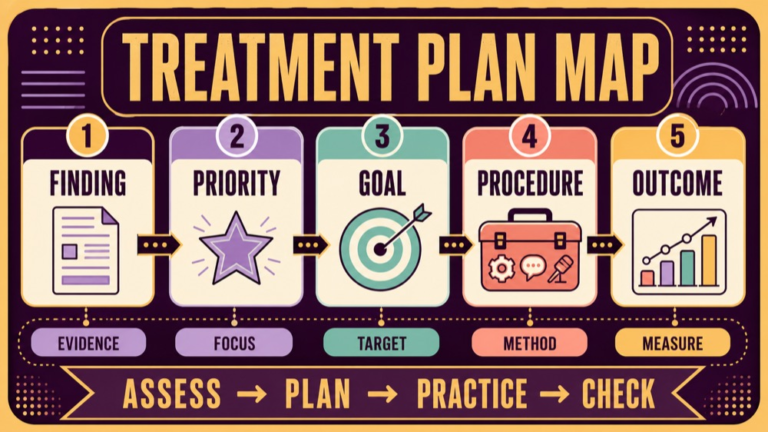
Use the first visual map as a five-step treatment chain: finding, priority, goal, procedure, and outcome. Start with the assessment evidence, identify the functional priority, write an observable goal, choose a procedure and support, and define how the result will be measured. If a practice option skips a link, ask whether the stem supplies enough information for the jump.
| Map step | Margin question | Common error |
|---|---|---|
| Finding | What did the assessment show under defined conditions? | Planning from the diagnostic label alone. |
| Priority | Which need matters most now and why? | Listing every goal without sequence. |
| Goal | What activity and observable change will matter? | Writing a vague impairment statement. |
| Procedure | What method, cue, partner, and material fit? | Choosing a familiar technique without rationale. |
| Outcome | How will progress and generalization be seen? | Counting only a clinic drill. |
Write the chain finding → priority → goal → procedure → outcome beside each item. It makes it easier to identify the option that is clinically plausible but answers the wrong stage of treatment planning.
Use a treatment planning review board
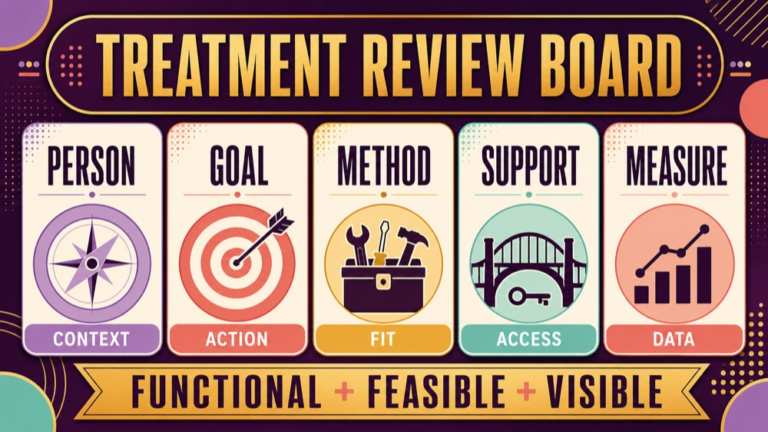
The second visual is a review board with five fields: person, goal, method, support, and measure. Place the case facts into each field and mark what is known, observed, or missing. This board protects against a common error: selecting a technique before clarifying the person’s activity and the measure that will tell the team whether it helped.
| Board field | Write down | Use it to ask |
|---|---|---|
| Person | Strengths, needs, language, culture, access, preference, and support | What makes the plan individual? |
| Goal | Activity, behavior, condition, and criterion | What will change and where? |
| Method | Procedure, cueing, materials, and practice structure | Why does this target fit? |
| Support | Partner, environment, schedule, referral, and education | What makes implementation feasible? |
| Measure | Progress, generalization, participation, and self-report | How will the plan be evaluated? |
If a board field is empty, choose the answer that gathers or clarifies it. If the fields are complete and the question asks for a decision, use the chain to compare the options. The board is a study tool for organized reasoning, not a replacement for current clinical standards or individualized care.
Question 1: goal prioritization
Practice Question 1. An elementary student has difficulty producing a speech sound in connected classroom responses, but the assessment also identifies several isolated sound errors. The student’s stated goal is to answer questions more clearly during group discussion. Which goal should be prioritized first?
A. Eliminate every sound error in isolation before practicing any classroom communication.
B. Target clear production of the sound pattern during a defined classroom-response activity, using a measurable cue and performance criterion.
C. Focus only on oral-motor exercises because they are easier to count than connected speech.
D. Write a goal to support every communication skill without naming a task or outcome.
Correct Answer: B. The student’s functional goal and assessment show that connected classroom communication is the meaningful priority. A treatment plan can use appropriately sequenced practice, but the goal should name the activity, support, and criterion. The item does not require eliminating every isolated error before addressing participation.
Why the Other Options Are Wrong: A creates an unnecessary prerequisite and loses the student’s stated activity. C selects a procedure without evidence that it addresses the target or the classroom task. D is too broad to measure or guide implementation. B connects the assessment finding to a functional goal.
Exam Trap: “Most errors” is not the same as “highest priority.” Look for the activity the person wants to perform and the assessment evidence showing what limits that activity.
Question 2: treatment detail and access
Practice Question 2. An adult with aphasia communicates more successfully when conversation partners use written keywords, extra wait time, and personally relevant topics. The current plan uses rapid clinician questioning on unfamiliar topics, and progress has not generalized to family conversations. Which treatment-planning change is best supported?
A. Increase the speed of questioning so the person learns to respond under pressure.
B. Remove written keywords because support makes the result less authentic.
C. Adapt practice to include supported conversation, relevant topics, trained partners, and measures of communication access across settings.
D. Continue the same plan for a longer period without reviewing the generalization data.
Correct Answer: C. The person’s response and lack of generalization identify a support and context mismatch. The plan should use effective supports, train partners, connect practice to meaningful topics, and measure communication across settings. Support is part of treatment design, not evidence that the person’s communication is invalid.
Why the Other Options Are Wrong: A removes the conditions that currently support success. B treats access support as a problem rather than using the observed response. D ignores progress and generalization data. C uses assessment evidence to modify method, partner, context, and outcome.
Exam Trap: When a stem shows better performance with a support, do not automatically remove the support. Ask whether the goal is independent performance, partner-supported access, or generalization, then match the measure to that goal.
Question 3: treatment evaluation
Practice Question 3. A child meets a speech-production criterion during structured therapy trials with visual cues. The family reports little change in intelligibility during home routines, and the child uses a different speaking partner and topic at home. What is the best next evaluation step?
A. Discharge immediately because the clinic criterion was met.
B. Continue the exact same drills and ignore the home report.
C. Collect data in a defined home-relevant communication task, review cueing and partner conditions, and modify the plan based on generalization.
D. Lower the clinic criterion until the home report matches the therapy score.
Correct Answer: C. The clinic data show a supported skill, while the home report shows limited transfer. Treatment evaluation should compare conditions, collect functional evidence, and adjust practice or partner support as indicated. A single clinic score should not end the reasoning when the functional goal has not generalized.
Why the Other Options Are Wrong: A confuses supported clinic performance with functional completion. B ignores outcome information that should guide modification. D changes the criterion without addressing the context gap. C connects the measure to the activity where the outcome matters.
Exam Trap: Look for the difference between acquisition and generalization. If performance is strong only with a cue or in one setting, the next step should examine the missing condition instead of repeating or ending treatment automatically.
Review common treatment planning distractors
Treatment-planning distractors often use an impressive technique, a broad goal, an unsupported prognosis, or a rigid schedule. Label the problem before deciding whether the action could belong later in a different plan.
| Distractor pattern | Why it sounds attractive | Correction |
|---|---|---|
| Diagnosis chooses the treatment | It offers a familiar label-to-technique shortcut. | Match the method to assessment, goal, person, and setting. |
| Most impaired equals first goal | It appears objective. | Consider safety, function, preference, and priority. |
| Vague goal | It covers many possible improvements. | Name the activity, behavior, condition, and criterion. |
| Rigid dosage | It sounds organized. | Check capacity, resources, access, and recovery. |
| Remove effective support | It appears to demand independence. | Define the goal and measure support-supported participation. |
| Clinic score equals outcome | It is easy to count. | Measure generalization and participation in meaningful contexts. |
Use “right idea, wrong planning stage” as a review label. A goal, procedure, partner strategy, referral, or outcome may all be useful, but the question’s action word decides which piece belongs in the answer.
Build a treatment planning practice block
A focused block should move from assessment interpretation to goal writing and then to implementation and evaluation. Use cases that vary the person’s language, setting, access, partner, health, and stated activity. End by explaining which evidence makes one option more feasible or functional than another.
- Draw five columns labeled finding, priority, goal, procedure, and outcome.
- Rewrite ten prompts as prioritize, write, select, communicate, forecast, or evaluate.
- Complete the three original questions on this page before reading the rationales.
- Write one vague goal and revise it into a functional measurable goal.
- Change one context variable, such as partner, language, cue, or setting, and revise the plan.
- Check current ASHA and ETS pages for source and exam information before final review.
Use contrast cases to practice sequencing. Keep the same diagnosis but change the person’s goal; keep the same goal but change the access support; keep the same clinic score but change the home report. Your answer should shift when the planning evidence shifts.
Track treatment reasoning and confidence
Record why you selected an answer, not only which letter was correct. A treatment option can sound compassionate, evidence-based, or efficient and still miss the baseline, goal, setting, or outcome. A reasoning log shows where the plan broke down.
| Log field | Example entry | What it reveals |
|---|---|---|
| Assessment finding | Supported clinic skill with limited home transfer | Whether the data informed the plan. |
| Requested action | Modify treatment evaluation | Whether you answered the action word. |
| Functional goal | Family conversation with defined partner support | Whether the activity was visible. |
| Missing condition | Home partner and topic | What evidence should be collected next. |
| Distractor type | Clinic score equals discharge | Which shortcut to avoid next time. |
| Confidence | 65% before rationale, 90% after explanation | Where review improves transfer. |
Revisit low-confidence items even when correct. Write one sentence for the strongest assessment clue and one sentence for the goal, support, or outcome that made the answer fit. This turns treatment planning from a list of techniques into a reasoned sequence.
Treatment Planning Praxis questions checklist
Use this checklist before submitting an answer. It is a study aid, not a substitute for current clinical standards, supervision, consent, or an individualized plan of care.
- Did I identify whether the stem asks for priority, goal, procedure, detail, prognosis, recommendation, or evaluation?
- Did I connect the plan to the assessment finding and the person’s functional activity?
- Did I prioritize using safety, urgency, function, readiness, preference, and support?
- Did I write or select a goal with a person, activity, condition, behavior, and criterion?
- Did I match the procedure, cue, material, dosage, and setting to the person?
- Did I consider language, culture, hearing, vision, motor, cognition, literacy, and access?
- Did I include partners, environment, education, referral, and team roles?
- Did I state a calibrated prognosis rather than a guarantee?
- Did I define progress, generalization, participation, and self-report outcomes?
- Did I explain why each distractor is wrong for this stage or evidence pattern?
If you can use the checklist consistently, you are practicing the planning sequence behind many 5331 vignettes: interpret the assessment, prioritize the need, write the goal, choose a feasible method, and monitor what matters in the person’s life.
Sources and next steps
For the exam treatment framework, review ASHA’s Speech-Language Pathology 5331 content page. For measurable functional goals, progress monitoring, and plan modification, review ASHA’s Documentation in Health Care resource. For clinical treatment examples, use the relevant ASHA Practice Portal topic, such as Spoken Language Disorders or Dysarthria in Adults. For current test identity and administration information, use ETS Speech-Language Pathology 5331 and the ETS practice-test page.
This page’s maps, rationales, and A-D practice questions are original educational material. They are separate from the live ETS test and do not reproduce test material. They are not individualized medical advice. Use current clinical standards, supervision, and interdisciplinary procedures when applying treatment-planning knowledge to real people.
For your next review, complete one timed case using the five-link chain: finding → priority → goal → procedure → outcome. Then change one variable, such as the person’s goal, partner, access support, or setting, and explain why the best plan changes or stays the same.
Continue your preparation: Explore the SLP Study Center learning resources.