
Toddler language development is not a single ladder that every child climbs in exactly the same order. It is a changing pattern of understanding, expressing, sharing attention, using gestures, playing, and participating with other people. A toddler may communicate an idea with a look, a point, a sound, a sign, a word, a word combination, or a coordinated group of these modes.
For clinical learning, the most useful question is not simply how many words a child says. It is what the child understands, how the child makes meaning visible, whether communication is growing across routines, and how hearing, language access, interaction partners, and opportunities shape what an observer sees. Broad developmental guides can organize observation, but one missed milestone does not diagnose a condition or explain an entire communication profile.
Table of Contents
- Toddler language development: a multidomain framework
- What to observe in real routines
- Receptive language, expressive vocabulary, and word combinations
- Gestures, play, and social communication carry meaning
- Broad developmental patterns without rigid cutoffs
- Common confusions in toddler language development
- Hearing and communication access come before interpretation
- When to seek an evaluation and what it should cover
- A short SLP Praxis application
- Quick review: what to carry forward
- Source boundaries and next steps
Toddler language development: a multidomain framework
Language is the shared system people use to understand and express meaning. In toddler learning, that meaning may be expressed through speech, signs, gestures, pictures, aided communication, body movement, or combinations of modes. Speech is one way to transmit a message; it is not the same thing as language. A child may understand a great deal but use few spoken words, or may speak often while having difficulty understanding a new message or coordinating communication with a partner.
A practical framework separates related questions without pretending that development occurs in isolated boxes. When observing a toddler, consider these connected domains:
- Receptive language: What does the child understand about people, objects, actions, routines, and relationships?
- Expressive vocabulary: What meanings does the child communicate, and which words, signs, sounds, or other symbols carry those meanings?
- Word combinations: Does the child combine meaningful units to request, comment, reject, describe, or direct another person?
- Gestures: Does the child point, show, give, reach, wave, nod, imitate, or use another movement intentionally?
- Play: Does the child explore, imitate actions, use objects flexibly, and build simple pretend or shared play sequences?
- Social communication: Does the child initiate, respond, share attention, take turns, and repair a message when a partner does not understand?
These domains influence one another. A toddler asking for help may look, hand over an object, vocalize, wait, and later add a word. That sequence shows gesture, expressive intent, social communication, and learning; a word count alone would miss much of it.
What to observe in real routines
Language is easiest to understand when it is observed in activities that have a purpose for the child. The same toddler may show different abilities during snack, a picture book, outdoor play, dressing, or a transition. Routine context supplies clues, but it can also hide difficulty if a child has memorized a familiar sequence. Observe several activities and note both independent communication and responses to a supportive partner.
| Routine | Possible observation | Question the observation raises |
|---|---|---|
| Snack | The child points to a choice, reaches, labels a food, rejects an item, or asks for more through a word, sign, or gesture. | Can the child communicate a preference and understand a partner’s response? |
| Picture book | The child looks where a partner points, turns pages, labels a familiar picture, imitates a sound, or brings the book back for another turn. | Does the child share attention, understand familiar language, and use the book socially? |
| Getting dressed | The child responds to a familiar direction, anticipates the next step, names clothing, or asks for help. | Is the response based on language, routine memory, visual cues, or a combination? |
| Play with objects | The child gives an object to a partner, imitates an action, combines toys, pretends, or changes a play plan. | How flexible are the child’s symbolic, social, and problem-solving messages? |
| Transition | The child protests, follows a clean-up cue, seeks a partner, or uses a gesture or word to repair a misunderstanding. | Can the child communicate when the routine changes or the first message fails? |
A useful observation note records more than a successful answer. Note the partner’s wording, available cues, the child’s mode, and what followed. This helps distinguish prompted imitation from independent, spontaneous use.
- Record whether the child initiated or only responded.
- Note whether the message was understood by familiar partners, unfamiliar partners, or both.
- Compare a highly familiar routine with a new but meaningful activity.
- Describe what the child did when a partner misunderstood.
- Look for growth over repeated observations instead of relying on one performance.
Receptive language, expressive vocabulary, and word combinations
Receptive language concerns understanding. In a toddler routine, it may appear when a child recognizes a named object, anticipates a phrase, follows a meaningful direction, or shows understanding through action. Context, gesture, object placement, and routine knowledge can support a response, so following a familiar snack sequence does not automatically show the same understanding for a new direction in another setting.
Expressive vocabulary concerns the meanings a child communicates. Spoken words are important, but a clinical description should also notice meaningful signs, consistent word approximations, gestures, and other communication modes. The useful question is whether the child is using symbols intentionally and whether the range of meanings is expanding: people, actions, objects, locations, social routines, rejection, help, and comments all matter.
Word combinations are meaningful units used together to make a more specific message: a request, description, rejection, possession, or comment. A child may move from a single word or gesture for a ball to a message combining the object with an action, location, or partner-directed request. The key is growing ability to build and vary messages, not a phrase memorized from an adult.
These distinctions prevent two opposite mistakes: overlooking strong understanding because speech is limited, or overestimating language from a repeated phrase without flexible comprehension. Examine meaning, independence, variety, and transfer.
- Ask what the child understands without a gesture and what becomes clear with a gesture or object.
- Separate labels from action words, social words, questions, refusals, and repair messages.
- Notice whether a phrase changes when the object, partner, or routine changes.
- Count communication across the child’s languages and modes rather than treating English words as the whole profile.
- Look at how the child responds after an adult expands or models a message.
Gestures, play, and social communication carry meaning
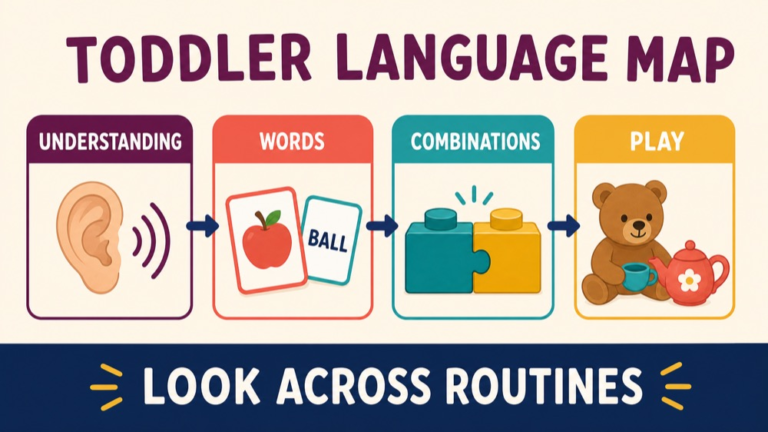
Gestures are not merely a waiting room for speech. Pointing, showing, giving, waving, or nodding can communicate a relationship among the child, a partner, and an idea. Gesture becomes especially informative when coordinated with looking, vocalizing, a word, or a turn.
Play creates a natural setting for language because it gives a child something to notice and a reason to communicate. A toddler may first explore how an object works, then imitate a familiar action, then combine actions into a short sequence. In shared play, an adult can observe whether the child accepts a partner’s idea, changes the plan, waits for a turn, asks for help, or uses an object to represent something else. Play is not a test of personality; it is one context for seeing communication in action.
Social communication includes initiation, response, shared attention, turn exchange, activity management, and repair. A toddler who brings a toy to an adult, waits for the adult to look, and continues the game is communicating even without naming it. Frustration after a misunderstanding may signal a need for more accessible repair, but the emotion alone does not identify the cause.
When observing a shared activity, follow the sequence rather than scoring one isolated behavior:
- What attracted the child’s attention?
- How did the child make the message available to a partner?
- Did the partner recognize the message and respond?
- Did the child continue, change, or repair the communication?
- Could the child use a similar strategy in another routine?
Broad developmental patterns without rigid cutoffs
Public developmental guides help when they organize observation, not when they turn a broad range into a pass-or-fail test. Across the toddler period, communication may become more intentional, varied, partner-directed, and flexible; understanding, combinations, imitation, sequencing, and shared participation may expand. The pace and order are not identical for every child.
| Broad period | Communication may be expanding | Keep checking |
|---|---|---|
| Early toddler period | Intentional gestures, vocal or word attempts, recognition of familiar people and routines, and more purposeful requests or comments may be emerging. | Hearing and visual access, consistency across partners, understanding with and without context, and the child’s available communication modes. |
| Middle toddler period | Functional vocabulary, action messages, shared attention, imitation, and early combinations may become more varied across daily activities. | Whether the child understands new language, communicates for more than requesting, and uses the same idea across languages, partners, and settings. |
| Later toddler period | Longer or more flexible combinations, questions, negation, pretend sequences, social routines, and repair attempts may be developing. | Speech clarity, language form and meaning, participation with peers and adults, and the effect of hearing, access, or context. |
These descriptions are orientation points, not promises. Variation can reflect communication opportunities, temperament, attention, available languages, hearing access, motor or sensory factors, and setting demands. A quiet child may use other modes effectively; a talkative child may still struggle with unfamiliar language. Patterns over time and across contexts matter more than one comparison.
- Use developmental guides to decide what to observe next.
- Ask whether a skill is present, emerging, consistent, and transferable.
- Compare the child’s own pattern over time instead of ranking children against one another.
- Include communication that is spoken, signed, gestural, aided, or multimodal.
Common confusions in toddler language development
Early communication questions become confusing when one visible behavior is treated as a complete explanation. These distinctions help organize observation and family conversations.
| Common confusion | More useful question |
|---|---|
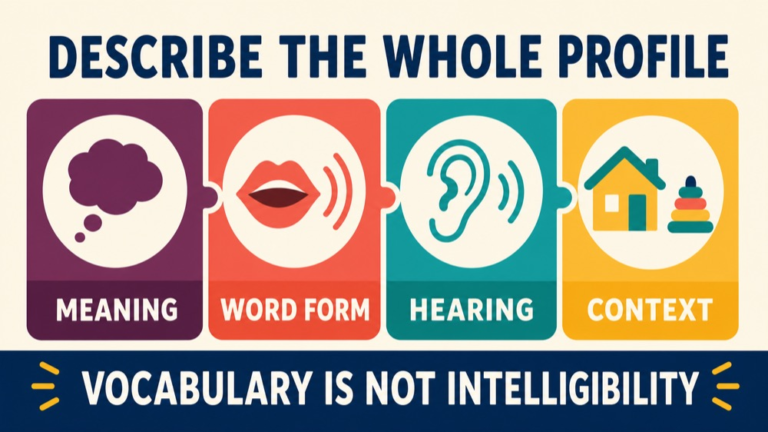
| Vocabulary versus intelligibility | How many meanings does the child communicate, and how understandable is the speech in different contexts? A child can have many words that are difficult for unfamiliar listeners to understand, or clear words with a smaller expressive repertoire. |
| Bilingual development versus disorder | What does the child understand and express across the full linguistic repertoire and with familiar partners? Exposure to more than one language is not, by itself, evidence of a disorder. Evaluation should not treat one language in isolation as the whole child. |
| Quiet versus noncommunicative | Does the child initiate or respond with gaze, gesture, movement, signs, sounds, words, or other modes? Low speech volume or few spoken words does not answer every question about intent and understanding. |
| Routine compliance versus broad comprehension | Can the child respond when wording, objects, partners, or settings change? A familiar action may be supported by memory and context as well as language. |
| One missed milestone versus a developmental profile | Is there a pattern across time, settings, communication partners, access, and participation? One observation cannot determine cause or diagnosis. |
For bilingual toddlers, the languages should not be made to compete. A child may know a concept in one language, use a family expression in another, and use gesture in both. Evaluation considers opportunities, partners, comprehension, expression, and participation across languages, separating language difference from possible communication difficulty.
Vocabulary and intelligibility also answer different questions. Vocabulary concerns meanings; intelligibility concerns how much spoken message a listener understands. Context, familiarity, sound development, rate, noise, and listener experience can change intelligibility, so one adult impression is not a full communication observation.
Hearing and communication access come before interpretation
Language learning depends on access to a usable communication system. Hearing access can vary with background noise, distance, attention, ear health, equipment, or the quality of the signal. Visual access, partner positioning, lighting, and the availability of a signed, aided, or multimodal system can also influence what a toddler is able to notice and use. A child who misses a spoken cue may be showing an access problem, an understanding problem, an attention shift, or more than one factor; the observation alone does not decide which.
For that reason, hearing is not an optional footnote in a toddler language discussion. When caregivers or professionals are concerned about inconsistent responses to sound, difficulty noticing speech, changes in communication, or access to a hearing device or communication system, the appropriate next step is a context-sensitive conversation with the relevant health, hearing, and speech-language professionals. This article does not determine hearing status or device function.
- Ask what the child can access in quiet and noisy environments.
- Note distance, partner position, visual cues, and whether the message was repeated.
- Consider whether communication partners expect speech only or accept the child’s available modes.
- Check whether a skill appears with a familiar partner but not in a less supported setting.
- Separate a change in access from a conclusion about language ability.
When to seek an evaluation and what it should cover
A family does not need to wait for a perfect checklist before asking a qualified professional about a concern. Discussion or evaluation may be appropriate with little progress over time, loss of previously used communication, persistent difficulty understanding, limited initiation or repair, participation-limiting frustration, hearing-access concern, or concern across routines.
That list is a reason to gather better information, not a diagnostic formula. It is also appropriate to ask about evaluation when the concern is present in any language or mode. An English-only snapshot can miss a child’s strengths and can confuse language exposure with language ability.
A thoughtful evaluation looks at the whole communication system. Depending on the concern and setting, it may consider:
- hearing history and current access to speech or other communication signals;
- receptive language in familiar and less familiar routines;
- expressive vocabulary, combinations, gestures, signs, and other modes;
- speech production and intelligibility when spoken communication is part of the concern;
- play, shared attention, initiation, turn exchange, and repair;
- the languages used by the child and partners, with appropriate language support;
- communication demands, participation, and family priorities.
The result should describe abilities, supports, uncertainties, and follow-up questions, not reduce the child to one score or milestone. For learners, assessment is a reasoning process: define the question, collect contextual information, consider alternatives, and choose a next step within scope.
A short SLP Praxis application
The current ETS test page and applicable blueprint should control any changing Praxis scope or logistics. For concept application, an original practice scenario can be useful without pretending to reproduce an exam item: a toddler uses a few spoken words, several gestures, and familiar routines to request help; the child follows some routine directions but is less consistent when the wording or setting changes; caregivers also report that unfamiliar listeners understand little of the speech.
The strongest first interpretation is not a label based on the word count or on intelligibility alone. It is to separate the evidence into receptive language, expressive communication, speech clarity, social communication, hearing or access, and participation. Then ask what information is missing and what evaluation pathway would clarify it. This reasoning respects the difference between a developmental guide and a diagnosis.
- Identify the exact communication question: understanding, expression, speech clarity, interaction, access, or participation.
- Look for evidence across routines, partners, settings, and the child’s full linguistic repertoire.
- Check hearing and communication access before interpreting an inconsistent response as a language limitation.
- Use the observed pattern to select assessment questions, not to infer certainty from one milestone.
- Choose an answer that protects scope, context, and the need for appropriate professional evaluation.
This is original practice content for reasoning, not an official, recalled, actual, leaked, or guaranteed-pass question. The point is the decision process: distinguish constructs, weigh context, and avoid overclaiming.
Quick review: what to carry forward
When you review toddler language development, use this compact checklist:
- Receptive language asks what the child understands, not only whether the child complies with a familiar routine.
- Expressive vocabulary includes the meanings communicated through available spoken and nonspoken modes.
- Word combinations show growing message-building, but a memorized phrase is not the same as flexible language use.
- Gestures can carry intentional meaning and should be observed alongside speech.
- Play reveals opportunities for imitation, symbolism, shared attention, and social problem solving.
- Social communication includes initiation, response, turn exchange, and repair.
- Vocabulary and intelligibility are related but different clinical questions.
- Bilingual experience should be considered across languages and should not be treated as a disorder by itself.
- Hearing and communication access affect interpretation and belong in the evaluation picture.
- Broad milestones guide observation; patterns across time and routines guide professional reasoning.
Source boundaries and next steps
This guide uses the NIDCD speech and language development resource for broad early-development and speech-language distinctions, the ASHA Practice Portal and ASHA Evidence Maps for clinical and evidence-oriented framing, and the current ETS Speech-Language Pathology Praxis page for the boundary around exam application. The linked sources and any relevant topic-specific guidance should be reviewed again before publication.
If this topic is part of a broader review plan, you can explore the SLP Study Center Complete Prep page as a next learning step. The article itself remains a general clinical learning guide, not individualized medical advice or a substitute for an evaluation.