
A timed slp praxis practice test is useful when the clock has a specific job. You may be testing pacing, reading, skip-and-return behavior, stamina, or how well you can explain a decision under time pressure. If all of those are mixed into one percentage, the result is harder to repair.
The current ETS Speech-Language Pathology (5331) page describes a computer-delivered selected-response test with 132 questions and 150 minutes. Use the live ETS page and your account for changing details. ASHA preparation guidance also encourages practice questions, timed work, and a plan based on individual strengths and weaknesses.
What a timed SLP Praxis practice test should show
A timed practice test should produce a process record as well as an answer record. Note where you reread, where you skipped, how often you changed an answer, when rushing began, and whether the pattern appeared in one lane or across the whole set.
| Timing target | Evidence to record | Useful interpretation |
|---|---|---|
| Reading | Rereads and task restatements. | Check whether the stem task was clear. |
| Pacing | Checkpoints and items completed. | Identify where the plan drifted. |
| Triage | Skips, returns, and time spent on close choices. | Review decision rules. |
| Stamina | Late-session confidence and error pattern. | Separate fatigue from topic gaps. |
Timing evidence is not the same as content evidence. A late error may reflect fatigue, a long stem, a difficult concept, or a combination. Record enough detail to test the most likely pattern in a smaller follow-up block.
Use confidence labels: stable, uncertain, rushed, skipped, or changed. A correct answer reached after a long struggle is different from a correct answer supported by a clear rationale. Keep the label beside the timing note so process and content remain visible.
Confirm the current 5331 source
Start with the current ETS Speech-Language Pathology (5331) page. Use it for subject identity, current delivery and timing information, broad content direction, question count, duration, and official preparation links. The page currently lists 132 questions and 150 minutes for a computer-delivered selected-response exam. Date your note because the live source controls changing details.
Use the ETS practice-test page to locate current options by subject. Read the resource description before using it as a timed practice test. A short drill, sample, or third-party bank may have a different job from a longer simulation.
- Verify the subject: confirm Speech-Language Pathology (5331).
- Record the source: save provider, title, date, and format.
- Label the timing: distinguish learning mode, short timed mode, and simulation mode.
- Separate official facts: use ETS for current administration and appointment information.
- Protect originality: avoid purported live or confidential content.
For planning principles, review ASHA’s Praxis preparation guidance. Keep its study guidance separate from the current ETS timing and logistics record. Use each source for its stated role when you update your preparation notes.
Set the timing task before you start
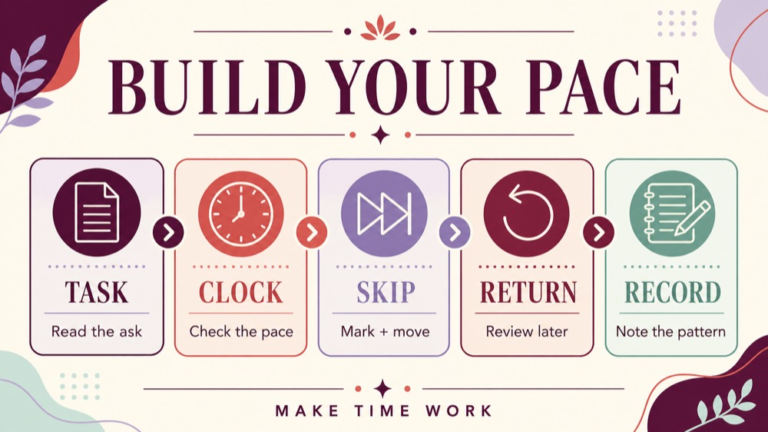
Decide what the clock is meant to teach before you begin. A first timed block may test whether you can read the final task sentence and commit to an answer. A later block may test checkpoints or skip-and-return behavior. A long simulation may test stamina. Write the job at the top of the page.
| Timing mode | What to practice | What to keep |
|---|---|---|
| Short clocked block | Task recognition and commitment. | Rereads, hesitation, and answer changes. |
| Mixed timed block | Switching among foundations, assessment, and treatment. | Lane, task, and checkpoint. |
| Long simulation | Stamina, pacing, and skip-and-return habits. | Late-session pattern and breaks. |
| Review block | Reasoning without a clock. | Evidence and distractor rationale. |
Choose one primary timing target for a session. If you are trying to improve reading, do not change the source, environment, timer, and question mix at the same time. Stable conditions make it easier to interpret the next result.
Prepare a mark for uncertainty before the timer starts. It can be a star, a question mark, or a short note. The mark should be quick enough that it does not create a second timing problem.
Build a pacing record
Use a run sheet with beginning, middle, and end checkpoints. Record the planned checkpoint, actual position, skipped items, rereads, interruptions, and confidence trend. The record does not need to capture every second. It is a prompt for comparison, not a second timer.
| Field | Example | Why it helps |
|---|---|---|
| Start condition | Timed, quiet space, explanations hidden. | Defines the session. |
| Checkpoint | Beginning, middle, end. | Shows drift. |
| Skip mark | Two items marked to return. | Shows triage behavior. |
| Reread note | Long stem reread twice. | Identifies reading friction. |
| Confidence | Stable early, rushed late. | Separates stamina from content. |
Pair the run sheet with a reasoning log. For selected items, record lane, task, deciding evidence, answer confidence, closest distractor, and next check. The two records answer different questions and should not be collapsed.
Use checkpoints without chasing a perfect split
Checkpoints are reminders, not a promise that every section will take the same amount of time. A difficult stem may require more reading, while a familiar item may move quickly. Use checkpoints to notice drift and make a deliberate decision about the next block.
- Choose two or three checkpoint moments before starting.
- At each point, note progress and confidence without stopping for a full review.
- If you are behind, identify whether the cause is reading, indecision, or content uncertainty.
- Use the next item to test one process adjustment.
- Record the effect after the session.
A useful checkpoint note says “spent too long comparing two options in assessment sequence” rather than “too slow.” The first note points to a repair: compare task and evidence, choose the closer fit, and return later if the rule permits.
Do not make the clock the only feedback. The goal is a process that supports accurate, explainable decisions. Speed without task recognition can create a different error pattern, so pair pace notes with a brief reasoning check.
Protect reading and task recognition
Many timing problems begin before the answer choices. If you misread “next,” “best,” “most appropriate,” or “initial,” you may spend time solving a different question. Use a short task-restatement habit.
- Read the final sentence first enough to identify the requested action.
- Read the stem for the evidence that controls that action.
- Restate the task in a few words.
- Choose the option that fits the task and evidence.
- Mark uncertainty and move when your rule says to move.
Practice the habit untimed before using it in a longer session. A timing technique should reduce avoidable rereading while preserving attention to the evidence and the question’s requested action.
If your record shows repeated task misses, schedule a reading block rather than simply shortening the time per item. The repair is to recognize the question’s job, not to push the clock harder.
Use skip-and-return rules
A skip-and-return rule prevents one difficult item from consuming the time needed for several later decisions. Define the rule before the run. For example, you may mark an item when you cannot identify the deciding evidence after a deliberate reread, then return at a planned checkpoint.
| Situation | Move | Record |
|---|---|---|
| Task is clear, answer is close | Compare the two strongest options and commit. | Distractor reason. |
| Task is unclear | Restate the final question and reread the evidence. | Reading cue. |
| Evidence is missing | Mark and move according to your rule. | Missing information. |
| Time is drifting | Use the checkpoint adjustment. | Process change. |
Do not turn skipping into avoidance. The review record should show which items were returned to and what evidence changed your answer. If the same decision type is repeatedly skipped, add untimed repair work before the next long block.
Separate content lanes from clock behavior
Map each item to foundations and professional practice, assessment and evaluation, or treatment planning and evaluation. Then record the timing signal separately. This makes it possible to see whether a late error is concentrated in one lane or follows the clock across lanes.
| Record layer | Examples | Follow-up |
|---|---|---|
| Content lane | Foundations, assessment, treatment. | Targeted concept or decision review. |
| Decision type | Retrieval, interpretation, sequence, measure. | Fresh item with changed wording. |
| Clock behavior | Reread, skip, rush, change. | Short process block. |
| Confidence | Stable, uncertain, unresolved. | Rationale and transfer check. |
The current ETS page controls the official test facts. Your timing record controls what happened in your practice session. Keep the two records connected but distinct so later review has a clear source and condition.
Review the clock with the content
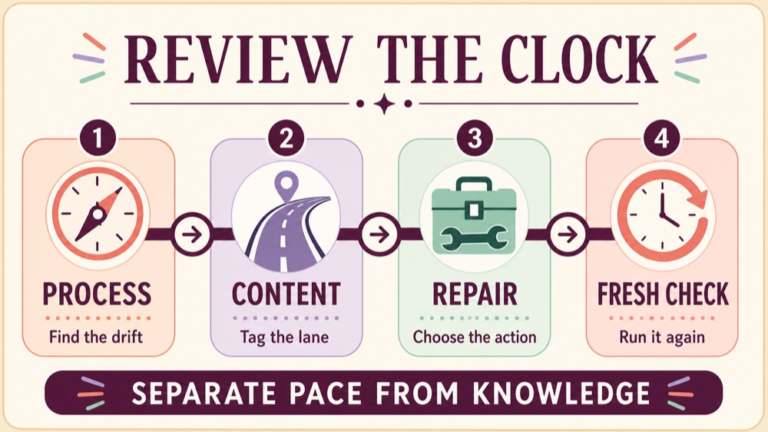
Review process first, then reasoning. Start by marking where pacing changed. Next, inspect representative items from before and after that change. Finally, decide whether the next repair should target timing, content, task recognition, or a combination.
- Process pass: compare checkpoints, skips, rereads, and late-session behavior.
- Content pass: tag lane, task, evidence, confidence, and distractor.
- Repair pass: choose a short action and a fresh check.
For example, if late errors appear across all three lanes but explanations are clear during review, test pacing in a shorter timed block. If errors remain concentrated in assessment sequence even when the clock is comfortable, repair that decision type instead.
Review uncertain correct answers too. They may reveal a timing shortcut that happened to work once but is not yet transferable.
Try three original timing and reasoning questions
The following items are original study examples created for this article. They are not copied from ETS and are not presented as live test material. Answer before reading the rationale, then tag the content lane and the timing or reasoning issue.
Question 1: Respond to a pacing drift
Scenario: During a timed block, you spend several minutes comparing two close choices, then rush the next items. Which adjustment best protects the rest of the session?
Correct Answer: B. Why This Answer Is Correct: The issue is time allocation around one unresolved item. A defined mark-and-return rule protects later questions while preserving a chance to review the evidence.
Why the Other Options Are Wrong: A allows one item to control the remaining session. C removes task recognition and evidence review. D changes the session without addressing the process pattern. B matches the timing problem to a practical triage move.
Question 2: Separate content from timing
Scenario: A learner misses assessment-sequence questions in both untimed and timed practice, while foundations errors appear only late in long sessions. What should the next plan include?
Correct Answer: B. Why This Answer Is Correct: The assessment pattern appears across conditions, while the foundations pattern is linked to late-session behavior. Separating them creates two targeted repairs.
Why the Other Options Are Wrong: A collapses different evidence into one label. C removes the decision type that needs work. D increases duration before repairing the stable content pattern. B follows the conditions in the scenario.
Question 3: Read the task before the choices
Scenario: A stem describes a communication concern and asks what information should be gathered before choosing a measure. Which habit best supports accurate timing?
Correct Answer: B. Why This Answer Is Correct: Restating the requested sequence prevents a named measure from redirecting the task. Identifying missing evidence supports a focused comparison and reduces avoidable rereading.
Why the Other Options Are Wrong: A lets a familiar term replace the question’s purpose. C delays task recognition and can increase clock pressure. D commits before comparing evidence. B protects both reasoning and pacing.
Repair a pacing pattern
Match the repair to the pattern:
| Pattern | Repair block | Fresh evidence |
|---|---|---|
| Long rereads | Practice task restatement with short stems. | Fewer rereads without task misses. |
| Long comparison | Use a two-choice evidence comparison and move rule. | Decision plus distractor note. |
| Late rushing | Use checkpoints in a shorter timed block. | Stable process near the end. |
| Lane-specific misses | Repair the content decision untimed. | Fresh scenario under comfortable timing. |
Choose one primary repair for the next session and keep the comparison condition stable. A small improvement that you can explain is more useful than a dramatic change with several variables.
Use breaks and stamina as recorded conditions
Record planned and unplanned breaks, interruptions, device changes, and the point at which concentration shifted. A break can be part of a practice design or a source of variation. The note lets you interpret the result instead of guessing.
- Planned break: record when it occurred and how you resumed.
- Interruption: record the cause and the affected block.
- Late-session change: record confidence, pace, and lane pattern.
- Recovery: record whether a shorter follow-up block changed the pattern.
Use a manageable block when the goal is process practice. Schedule a longer run when you have a specific stamina question and a way to review it afterward.
Keep practice results separate from official scores
A practice percentage is evidence from one source under one set of conditions. Keep it separate from official score reporting, passing requirements, licensing decisions, or appointment rules. Use the live responsible source for those external questions.
The current ETS page lists 132 questions and 150 minutes, but that fact does not make every timed resource equivalent to the official test. Record the source and conditions of your own session. Use that note when comparing later blocks.
Avoid timed practice-test traps
- Using a timer without deciding what skill it is meant to test.
- Chasing a rigid split instead of recording where the process drifted.
- Spending an entire block on one close choice.
- Skipping without a return rule or review mark.
- Calling every late error a content gap.
- Calling every content gap a timing issue.
- Changing source, environment, timer, and question mix at the same time.
- Using a practice percentage as an official scaled score.
- Relying on a practice page for changing appointment information.
- Copying purported live or confidential content into public notes.
The correction is a visible record: define the timing job, use checkpoints, mark uncertainty, separate clock behavior from content, and schedule a fresh check for the repair.
Timed SLP Praxis practice-test checklist
Use this checklist with a timed slp praxis practice test:
- Did I confirm the Speech-Language Pathology (5331) subject through the current ETS page?
- Did I label the source and format?
- Did I choose one primary timing target?
- Did I record checkpoints and progress?
- Did I mark skips, returns, rereads, interruptions, and answer changes?
- Did I tag lane and decision type?
- Did I separate timing evidence from content evidence?
- Did I review uncertain correct answers?
- Did I choose a short repair block?
- Did I test the repair with fresh wording or a stable comparison condition?
- Did I keep practice evidence separate from official score and logistics claims?
A timed SLP Praxis practice test should leave you with a clearer process, not just a faster feeling. The useful result is the pattern you can describe and the next check you can run.
Sources and next steps
Use the current ETS Speech-Language Pathology (5331) page for subject identity, format, duration, question count, content areas, and official preparation links. Search the ETS Praxis practice-test page for current subject options. Review ASHA’s Praxis preparation guidance for preparation materials, practice questions, timed work, and using strengths and weaknesses to guide review.
Continue your preparation: Explore the SLP Study Center learning resources after you have completed the pacing record and selected the next repair.