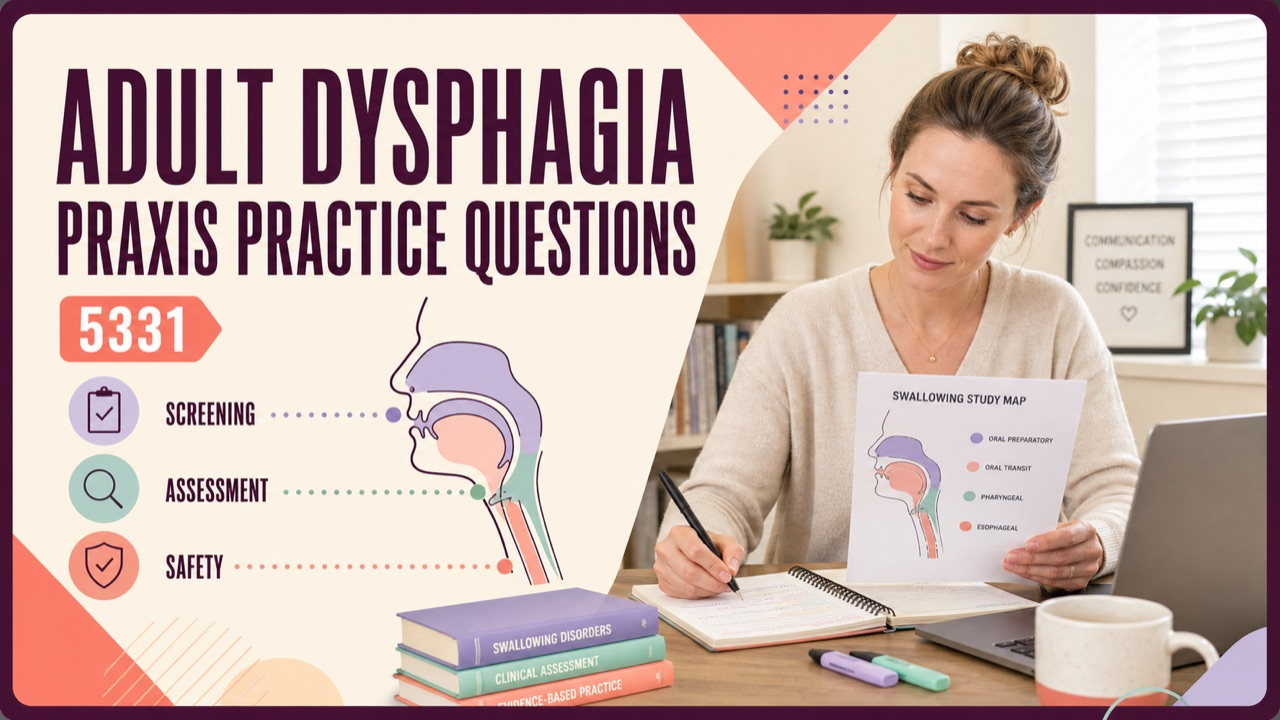
swallowing praxis practice questions become more manageable when you identify the phase, the evidence, the requested decision, and the person’s functional goal. A stem may mention coughing, wet vocal quality, residue, fatigue, a medical history, or a change in mealtime participation. The best answer does not jump from one clue to a conclusion. It connects the pattern to the next appropriate step.
ASHA’s Adult Dysphagia Practice Portal describes swallowing concerns across the oral cavity, pharynx, esophagus, and gastroesophageal junction. It also emphasizes that signs and symptoms need to be interpreted in context and that speech-language pathologists work within an interdisciplinary assessment and management process. Use the current ASHA Adult Dysphagia Practice Portal and ASHA Speech-Language Pathology 5331 content page for the clinical and exam framework; the maps and questions below are original study material.
What swallowing questions are testing
A swallowing item may ask you to recognize the affected phase, select a screening action, choose the next assessment step, interpret a cluster of signs, identify a referral need, plan a safety-focused intervention, or monitor a functional outcome. The word dysphagia does not determine the answer. First locate the action requested by the stem, then match the evidence to that action.
| Question task | Evidence to locate | Review output |
|---|---|---|
| Identify a concern | Timing, bolus handling, airway-protection signs, residue, fatigue, medical history, and participation change | Pattern, not a single sign |
| Choose screening | Setting, purpose, risk context, protocol, and need for a referral decision | Pass, concern, or next step within scope |
| Choose assessment | History, oral mechanism findings, clinical observation, and unanswered safety or efficiency questions | Focused evidence plan |
| Plan support | Person’s goals, preferences, physiology, environment, and team input | Safe and usable plan |
| Monitor change | Defined intake task, assistance level, efficiency, safety indicators, and participation | Functional outcome measure |
Rewrite the stem as a short decision sentence before reading the choices. For example, “The clinician needs to decide whether more swallowing evaluation is indicated” is a different task from “The team needs to monitor whether a mealtime plan is helping.” This simple rewrite prevents a plausible intervention from replacing the assessment step the question actually requests.
Pay attention to details that change the reasoning: new onset versus long-standing difficulty, alertness, respiratory status, nutrition and hydration, medication administration, dentition, positioning, fatigue, language, caregiver observations, and the person’s own report. A familiar term such as aspiration, residue, or delayed swallow should organize the evidence rather than stand in for the full decision.
Anchor review to the ASHA 5331 scope
The current ASHA 5331 content framework places feeding and swallowing within the broad knowledge and clinical practice areas tested through foundations, screening, assessment, evaluation and diagnosis, treatment planning, implementation, and treatment evaluation. That means a swallowing question can test anatomy and physiology, but it can also test sequencing, clinical judgment, collaboration, or outcome measurement.
| 5331 lens | Swallowing question example | Study tag |
|---|---|---|
| Foundations | Which structure or phase is associated with the described task? | Concept and pathway |
| Screening | What information is needed to identify concern and decide on referral? | Brief safety decision |
| Assessment | Which history, observation, or examination data answer the clinical question? | Evidence and sequence |
| Treatment planning | Which person-centered support fits the identified need and setting? | Safety and function |
| Treatment evaluation | How will change be measured during a defined activity? | Outcome and generalization |
Map each item to one primary lens even when the stem contains several domains. A hospital case may include respiratory history, medication concerns, reduced intake, and family stress, but the requested action may still be a focused screening step or a collaboration decision. The action word and the time point in the case are useful filters.
Use ETS for current test administration details and the live ASHA pages for clinical concepts. Third-party pages can reveal common study language, but they should not replace the authoritative framework. The material on this page is original practice content for U.S. learners and should be updated if the live exam or clinical guidance changes.
Define adult dysphagia across the swallowing pathway
Adult dysphagia refers to difficulty with swallowing that can affect movement of food, liquid, saliva, or medication through the upper aerodigestive and digestive pathway. In study questions, the difficulty may be described as a problem with preparation, propulsion, timing, airway protection, clearance, transport, or the functional act of eating and drinking. The location and task matter because different evidence may be needed for different questions.
| Reasoning field | What to ask | Study caution |
|---|---|---|
| Material | Is the case describing liquid, solid, mixed texture, saliva, or medication? | Do not generalize one consistency to every task. |
| Location | Does the person report oral, throat, chest, or transport difficulty? | Patient language guides history but may need clarification. |
| Timing | Does the concern occur before, during, or after the swallow? | Timing is a clue that needs corroborating evidence. |
| Consequence | Is the impact safety, efficiency, nutrition, hydration, medication, or participation? | Multiple consequences can coexist. |
| Context | Does the pattern change with fatigue, posture, assistance, environment, or meal length? | Context can reveal the next useful data point. |
For Praxis reasoning, define the clinical question in functional terms: “What is making this person’s meal difficult, and what evidence would clarify it?” That question leaves room for physiology, cognition, sensory status, communication, mobility, environment, and preference. It also keeps the answer from becoming a diagnosis based on a short vignette.
Organize oral, pharyngeal, and esophageal stages
A three-stage study map is useful for organizing a case, but the stages work as a connected sequence rather than isolated boxes. Oral preparation and oral transit involve taking in, managing, and moving a bolus. The pharyngeal stage includes coordinated movement and airway-protection events. The esophageal stage concerns transport beyond the pharynx. A stem may describe more than one stage or may need referral beyond the SLP’s primary assessment role.
| Stage map | Clues a stem may include | Reasoning move |
|---|---|---|
| Oral preparation | Chewing, bolus formation, containment, lip closure, or oral residue | Review structure, movement, sensation, dentition, texture, and task demands. |
| Oral transit | Difficulty initiating movement, lingual propulsion, prolonged oral transit, or repeated attempts | Compare task, consistency, fatigue, and amount of assistance. |
| Pharyngeal stage | Timing concerns, cough, wet voice, multiple swallows, residue, or respiratory change | Interpret the cluster and consider the appropriate evaluation pathway. |
| Esophageal transport | Chest sensation, regurgitation, food sticking, or transport complaints after the swallow | Respect referral and medical collaboration boundaries. |
Do not use stage labels as a shortcut that ends the reasoning. “Pharyngeal” may describe where a sign is noticed, while the cause or next step requires a broader history or instrumental information. Similarly, a complaint of food sticking may need medical follow-up rather than a narrow oral-motor explanation.
A reliable review technique is to draw three columns and place each clue in the most likely column, then add a fourth row for function and a fifth row for missing evidence. This catches cases in which a learner can name a phase but has not answered what should happen next.
Read swallowing signs in context
Coughing, throat clearing, wet vocal quality, prolonged meals, oral residue, multiple swallows, weight change, dehydration, recurrent respiratory illness, or avoidance of foods may raise concern. None of these observations should be interpreted without considering timing, frequency, material, alertness, baseline status, respiratory context, and the person’s report. A sign is evidence for a question, not a complete conclusion.
| Observed clue | Context questions | Safer exam interpretation |
|---|---|---|
| Cough or throat clear | When did it occur, with what material, and is it new or repeated? | Document the event and interpret it with the rest of the screen or assessment. |
| Wet or changed voice | Was the change present before intake, after a swallow, or throughout the session? | Consider airway-protection concern while seeking corroborating data. |
| Oral residue | Where is it located, with which texture, and what happens after a cue or second swallow? | Relate residue to efficiency, sensation, movement, and the task. |
| Long meal duration | Is the cause fatigue, distractions, chewing, access, pain, or repeated clearing? | Measure the activity and investigate contributing factors. |
| Reduced intake | What changed in appetite, access, mood, dentition, medication, or swallowing comfort? | Coordinate nutrition and medical questions rather than assuming one cause. |
Question writers often include a vivid sign to tempt a quick answer. Slow down and ask whether the sign is observed, reported, repeated, or linked to a particular material. The strongest choice commonly names the evidence needed to interpret the sign while protecting the person’s safety and preserving the scope of the current decision.
Separate swallowing clues from neighboring domains
Swallowing performance can be influenced by speech motor control, language comprehension, cognition, alertness, sensory status, posture, respiratory support, pain, medication effects, and mood. A case may therefore require differential reasoning rather than a single-domain answer. Ask whether the observed problem is bolus management, understanding directions, motor execution, endurance, access to food, or a combination.
| Neighboring domain | Clue in the case | Reasoning boundary |
|---|---|---|
| Language | Difficulty understanding a safety direction or reporting a sensation | Make the communication demand accessible before interpreting performance. |
| Cognition | Inconsistent routine, reduced initiation, or limited awareness of a task | Consider cueing, attention, memory, and supervision needs. |
| Motor speech | Weak or imprecise speech alongside oral movement concerns | Separate speech intelligibility findings from swallowing evidence. |
| Respiratory status | Breathlessness, oxygen needs, or a change in respiratory pattern | Coordinate with medical professionals and consider the full risk context. |
| Nutrition and medicine | Weight change, dehydration, or difficulty taking medication | Include dietetics, pharmacy, nursing, or medical input when relevant. |
A distractor may be clinically relevant but poorly matched to the question. For example, a communication treatment may support participation, yet it does not answer a stem asking how to interpret a swallowing sign. Likewise, a diet change may affect intake, but the case may first ask for evidence that clarifies the underlying difficulty.
Distinguish screening, assessment, and instrumental evaluation
Screening is a brief process used to identify whether a concern may be present and whether further evaluation or referral is warranted. A clinical swallowing assessment is more comprehensive and may include history, oral mechanism examination, clinical observation, trials within the setting’s protocol, and functional analysis. Instrumental evaluation adds visualization or physiologic data through the appropriate medical and clinical pathway. The decision depends on the question, setting, scope, risk context, and available evidence.
| Process | Primary purpose | What it cannot replace |
|---|---|---|
| Screening | Identify concern and guide the next step | A full assessment when more detail is needed |
| Clinical assessment | Describe performance, contributing factors, and functional impact | Every unanswered physiologic question |
| Instrumental evaluation | Examine selected physiology and response under the indicated protocol | History, goals, environment, and participation context |
| Interdisciplinary review | Combine medical, nutritional, respiratory, nursing, and SLP perspectives | Direct evidence from the relevant task |
When a question asks what should happen after a concerning screen, look for an answer that respects the referral pathway and avoids pretending that the screen settled every clinical question. When the question asks what a screen can do, choose the brief risk-identification purpose instead of a treatment prescription or a definitive label.
Choose assessment evidence and next steps
Good assessment reasoning begins with a specific question. “Is eating safe?” is broad; “What happens with thin liquid when the person is alert and positioned for the meal?” is more observable. “Why is intake low?” may require separate questions about swallowing efficiency, appetite, pain, access, mood, medication, and support. The more precise the question, the easier it is to identify useful evidence.
- Start with the person’s report, caregiver observations, medical history, and recent change.
- Define the material, task, posture, assistance, and environmental conditions being reviewed.
- Observe timing, bolus control, airway-protection indicators, residue, fatigue, and recovery between trials.
- Record what changes after a cue, a pause, a positioning adjustment, or an environmental modification within the protocol.
- Identify what remains unanswered and which professional or evaluation pathway can address it.
For a practice question, do not select the most sophisticated-sounding tool by default. Select the evidence that resolves the stem’s uncertainty. A detailed report of history and clinical observation may be the right next step in one case, while a referral for additional physiologic information may be indicated in another. The case facts should justify the sequence.
Match safety recommendations to evidence
Safety planning should be specific enough to use and cautious enough to reflect the evidence. A recommendation might address positioning, supervision, pacing, environmental distraction, cueing, oral care, material selection, medication coordination, or referral. The best answer explains why the support fits the observed barrier and how the team will know whether it helps.
| Evidence pattern | Possible planning focus | Measure to track |
|---|---|---|
| Attention changes during meals | Reduce competing demands and clarify the routine with the team. | Completion, cueing, and observed performance under the defined condition. |
| Fatigue increases over the meal | Review timing, rest opportunities, meal duration, and energy demands. | Performance and intake across the beginning and end of the task. |
| Difficulty follows a material or texture | Coordinate a careful trial and document the person’s response within scope. | Bolus management, efficiency, comfort, and participation. |
| Medication intake is difficult | Coordinate with pharmacy and medical staff rather than changing medication form independently. | Successful administration and reported comfort. |
| Person avoids shared meals | Include preference, social setting, access, and emotional impact in the plan. | Participation and satisfaction alongside safety indicators. |
A practice item may describe a reasonable support but ask for the first action. If the evidence is incomplete, assessment and team communication may come before a broad restriction. If the evidence is clear and the question asks for implementation, choose the targeted support and the outcome that will be monitored. Sequencing is the central skill.
Consider nutrition, hydration, medication, and environment
Swallowing decisions take place in real routines, not only during a short clinical observation. Food access, hydration opportunities, medication schedules, dentition, oral care, fatigue, pain, positioning, noise, lighting, assistance, and meal length can affect the person’s experience and outcome. Praxis questions may test whether you notice these contributors and include the right collaborators.
| Context field | Questions to add | Why it matters |
|---|---|---|
| Nutrition | What is the person eating, avoiding, losing, or unable to finish? | Efficiency and intake are linked but not identical. |
| Hydration | What fluids are available and how does the person access them? | Opportunity and preference can affect fluid intake. |
| Medication | Which medication form, timing, or swallowing report is causing difficulty? | Pharmacy and medical coordination may be needed. |
| Oral care | What is the oral hygiene routine and who supports it? | Oral health is part of a broader safety conversation. |
| Environment | What are the noise, posture, lighting, pace, and assistance conditions? | Changing the task can reveal or reduce a barrier. |
The correct answer is rarely “ignore the environment because the disorder is physiologic.” Nor is it “treat the environment as the only cause.” Treat the context as part of the evidence. Then choose a response that fits the clinician’s role and the team’s responsibilities.
Use interprofessional referral and collaboration boundaries
Speech-language pathologists contribute expertise in communication and swallowing, but swallowing care often requires collaboration with physicians, nurses, dietitians, occupational therapists, physical therapists, pharmacists, respiratory professionals, dental professionals, and caregivers. A question may be testing whether you recognize when information belongs in a coordinated plan rather than an isolated SLP decision.
| Concern in the stem | Collaboration question | Reasoning move |
|---|---|---|
| Acute medical or respiratory change | Who needs to know before or during further intake decisions? | Prioritize communication through the setting’s urgent pathway. |
| Medication form or timing | Which professional can verify a safe administration option? | Coordinate rather than independently alter the prescription. |
| Weight, hydration, or intake decline | What information should be shared with nutrition and medical staff? | Track function and connect the team’s data. |
| Positioning or access limitation | Who can address seating, mobility, equipment, or self-feeding? | Match the problem to the relevant discipline. |
| Preference or decision conflict | How should the person and support network participate? | Use informed, person-centered discussion within policy. |
Look for options that communicate a concern, document the evidence, and involve the right professional. Choices that promise certainty, make a broad restriction without context, or avoid the person’s stated goal are often weaker because they skip the collaborative reasoning stage.
Connect swallowing planning to function and preferences
Swallowing intervention is connected to eating, drinking, medication routines, social participation, comfort, independence, and quality of life. A functional goal identifies the activity and the conditions, such as completing a breakfast routine with a defined level of assistance, participating in a family meal, or taking medication through an agreed process. The goal should be measurable without reducing the person to a score.
| Goal layer | Example study wording | Measurement idea |
|---|---|---|
| Safety | Use the agreed routine during a defined meal task with the trained support level. | Observed indicators, assistance, and response under that condition. |
| Efficiency | Complete the selected intake task within a realistic time and energy window. | Duration, rest needs, residue, and amount completed. |
| Independence | Use a positioning, pacing, or cueing routine with decreasing support when appropriate. | Prompt level and successful task steps. |
| Participation | Join a preferred meal or social routine with an agreed support plan. | Attendance, completion, comfort, and self-report. |
| Generalization | Use the plan across people, settings, or times that matter to the person. | Performance across defined contexts. |
In exam reasoning, a functional outcome is stronger when it names the activity, support, condition, and observable change. “Swallow better” is too broad. “Complete a preferred snack routine with the trained cueing plan and document assistance and tolerance” provides a clearer target while leaving the clinical details to the responsible team.
Account for language, cultural, and meal context
Meals carry language, culture, identity, timing, family roles, and personal preference. A swallowing plan can fail if the clinician asks about only the foods available in the facility or assumes that a person values the same routine as the care team. Ask what the person normally eats and drinks, how they describe the concern, who participates, what communication support is needed, and which routines matter.
- Use the person’s preferred language or qualified language support for history and education.
- Clarify familiar food names, textures, preparation methods, and culturally important routines.
- Check whether hearing, vision, literacy, or cognition changes access to instructions.
- Include the person’s preferred partners and decision-making structure within the setting’s policy.
- Separate a clinical concern from a preference disagreement and document both.
These details are not decorative additions. They affect the validity of the history, the feasibility of a plan, and the likelihood that a recommendation can be used in daily life. A strong answer preserves dignity while gathering the information needed for safety and function.
Map a swallowing question from signs to plan
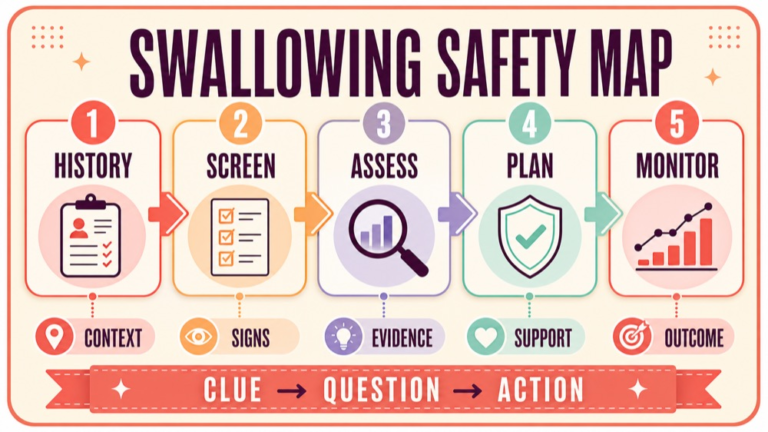
Use the first visual map as a five-step reading routine: history, screen, assess, plan, and monitor. Begin with the person and setting, not with a favorite intervention. Next identify what the screening result can and cannot answer. Then choose the smallest useful set of assessment evidence, connect the plan to the identified need, and define how the outcome will be observed.
| Map step | Question to write in the margin | Common error |
|---|---|---|
| History | What changed, for whom, with what material, and in which routine? | Ignoring the person’s report because the stem includes an observation. |
| Screen | Does the available screen suggest concern or a referral decision? | Treating a brief screen as a complete physiologic assessment. |
| Assess | What evidence answers the unresolved question? | Selecting a tool because it sounds advanced. |
| Plan | What support fits the evidence, preference, and setting? | Choosing a broad restriction without a rationale. |
| Monitor | What observable change will matter in the activity? | Tracking only a test score and not daily function. |
Write a one-line chain for each practice item: clue → clinical question → evidence → action → outcome. If a choice does not fit one link, eliminate it. This chain is especially useful when all four options sound clinically reasonable but belong to different stages of care.
Use a swallowing safety and function review board
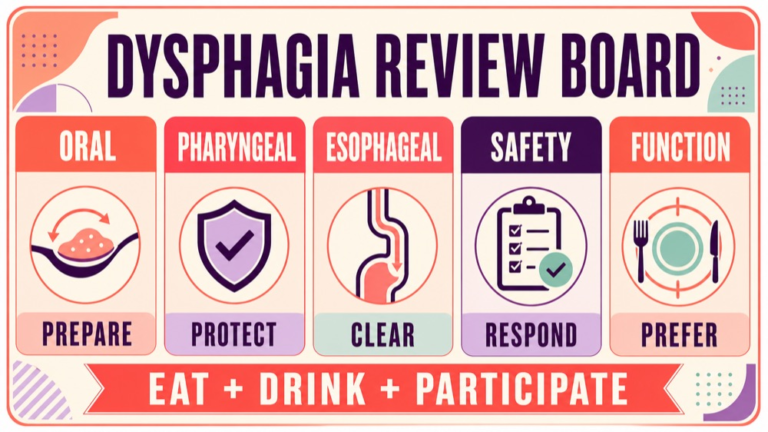
The second visual is a compact review board for five fields: oral, pharyngeal, esophageal, safety, and function. Add one concrete clue to each field, then mark whether the clue is observed, reported, or still unknown. The board helps prevent a common study error: naming the affected phase but forgetting the person’s goal, team boundary, or measurement plan.
| Board field | Write down | Use it to ask |
|---|---|---|
| Oral | Preparation, bolus control, propulsion, dentition, and residue clues | What happens before or during oral transit? |
| Pharyngeal | Timing, airway-protection, voice, cough, and clearance clues | What pattern needs more context or evidence? |
| Esophageal | Transport, sticking, regurgitation, or chest-sensation report | Does the case require medical collaboration or referral? |
| Safety | Respiratory, alertness, posture, assistance, and environment | What condition changes the risk conversation? |
| Function | Meal, medication, hydration, social routine, preference, and outcome | What participation change should be monitored? |
When the board has gaps, the answer should often address the missing evidence or collaboration. When the board has a clear repeated pattern and the question asks for a plan, move to the targeted support and an observable outcome. This is a flexible map, not a substitute for clinical policy or a complete evaluation.
Question 1: screening versus assessment
Practice Question 1. During a brief water screen, an alert adult coughs once after a sip. The person reports no recent swallowing change, has stable breathing, and the setting’s protocol calls for documenting the observation and completing the defined screening sequence. What is the best next reasoning step?
A. Conclude that aspiration occurred and immediately select a long-term texture restriction.
B. Record the event in context, complete the applicable screening protocol, and use the result to determine whether further evaluation or referral is indicated.
C. Begin a strengthening program before gathering any additional swallowing information.
D. Disregard the cough because a single event cannot matter in a swallowing screen.
Correct Answer: B. The stem gives a protocol, a single observed event, and contextual information. The appropriate reasoning is to document the observation, complete the defined screen, and use the outcome to guide the next step. The item does not provide enough information to turn one cough into a definitive conclusion, and it does not support skipping the screen or moving directly to treatment.
Why the Other Options Are Wrong: A overinterprets one sign and jumps to a broad management decision. C selects treatment before the question has been clarified. D makes the opposite error by ignoring evidence rather than interpreting it in context. The key distinction is between identifying concern and completing a comprehensive assessment.
Exam Trap: A vivid airway-protection sign can pull attention away from the action requested. Underline “best next reasoning step” and “screening sequence.” The answer should preserve the protocol and the possibility of further evaluation without claiming more certainty than the case supplies.
Question 2: signs and context
Practice Question 2. An adult has a new wet vocal quality after several bites, repeated throat clearing during the meal, and a caregiver report that meals have become longer over the last week. The person also has a respiratory history and says the change is worse when tired. Which interpretation is best supported?
A. The wet voice by itself identifies one specific physiologic impairment.
B. The pattern raises a swallowing concern that should be interpreted with history and assessment evidence, including fatigue, respiratory context, and functional change.
C. The longer meal by itself does not establish that the person needs to avoid all solid food.
D. The caregiver’s report should be excluded because only direct observation is relevant.
Correct Answer: B. Multiple observations and reports point to a meaningful change, but the correct conclusion is a careful assessment question rather than a single impairment label or universal restriction. Fatigue, respiratory history, material, timing, and meal efficiency are relevant context. The next step should gather and coordinate evidence through the appropriate clinical pathway.
Why the Other Options Are Wrong: A reduces a cluster to one sign. C uses a broad food restriction without evidence that it fits the person or answers the clinical question. D rejects useful collateral information even though caregivers may observe patterns across ordinary meals. B respects both direct observation and functional history.
Exam Trap: When a stem gives several signs, do not count them as a diagnosis. Ask what they collectively justify: concern, focused assessment, referral, treatment planning, or monitoring. The requested stage still controls the answer.
Question 3: functional swallowing planning
Practice Question 3. An adult wants to continue a weekly family breakfast. During observation, oral residue increases near the end of the meal, the person reports fatigue, and a family member provides rapid reminders that interrupt the routine. The team has not yet agreed on an outcome measure. Which plan best matches the information?
A. Replace the family breakfast with a fixed schedule chosen without asking the person about preferences.
B. Focus only on residue location and omit fatigue, partner behavior, and participation because they are outside swallowing.
C. Coordinate a person-centered plan that addresses the defined meal conditions, pacing or support needs, partner communication, and a measurable safety, efficiency, or participation outcome.
D. Tell the family member to stop helping and wait for the person to complete every step independently.
Correct Answer: C. The case includes a meaningful activity, a change across the meal, partner behavior, and an unfinished measurement plan. A useful response connects the evidence to the routine, coordinates support with the team and family, and defines what will be monitored. It can respect independence without treating assistance as inherently wrong.
Why the Other Options Are Wrong: A removes the person’s stated participation goal. B narrows the problem to one finding and misses fatigue and the communication environment. D imposes an all-or-nothing view of assistance and does not create a safe, measurable plan. C is the only choice that integrates safety, efficiency, support, and function.
Exam Trap: “Person-centered” does not mean choosing preference without evidence. It means combining the person’s goal with assessment findings, team boundaries, feasible supports, and an outcome that can be observed in the activity.
Review common swallowing distractors
Swallowing distractors often fall into recognizable categories. Some choices are too certain, some skip the requested stage, some confuse a screening result with a diagnosis, and some ignore context. Label the distractor before deciding whether the underlying action could be useful at a different point in care.
| Distractor pattern | Why it sounds attractive | Correction |
|---|---|---|
| One sign equals one conclusion | It uses a familiar clinical association. | Look for timing, repetition, material, baseline, and corroboration. |
| Advanced test for every case | It sounds thorough and precise. | Match the evidence source to the unanswered question and pathway. |
| Immediate broad restriction | It appears cautious. | Ask whether the stem supports that scope and whether the question asks for it. |
| Treatment before assessment | The technique may be relevant in general. | Honor the sequence requested by the item. |
| Ignore function | It keeps the answer narrowly physiologic. | Include the activity, preference, support, and outcome when the stem supplies them. |
| Ignore collaboration | It feels faster to make one professional’s decision. | Identify which team member or policy governs the missing piece. |
Use the phrase “right action, wrong stage” when reviewing. A referral, treatment strategy, or outcome measure may be reasonable but still be wrong for a stem that asks what to assess next. That phrase helps you distinguish clinical plausibility from test-task alignment.
Build a swallowing practice block
A focused study block is more productive when it mixes pathway knowledge with decision sequencing. Start with a short recall pass, then work through cases that require context and function. Finish by explaining why each distractor belongs to a different stage or ignores a specific clue.
- Spend five minutes drawing oral, pharyngeal, and esophageal columns plus safety and function rows.
- Review ten signs and write one context question beside each sign.
- Complete the three original questions on this page without looking at the rationales.
- Write one new stem that changes only the setting or the person’s goal.
- Answer the new stem using clue, question, evidence, action, and outcome.
- Check the current ETS and ASHA pages if your study notes contain dated exam or clinical details.
Change one variable at a time when generating your own cases. For example, keep the sign constant but vary fatigue, material, alertness, respiratory context, or the requested decision. This exposes whether your reasoning is tied to the evidence or to a memorized association.
Track swallowing reasoning and confidence
Track the reason you selected an answer, not only whether it was correct. A learner can choose the right option for the wrong reason and repeat the error when the stem changes. Use a simple log with the question stage, strongest clue, missing evidence, eliminated distractor, and confidence before and after reviewing the rationale.
| Log field | Example entry | What it reveals |
|---|---|---|
| Stage | Screening versus clinical assessment | Whether the answer matched the requested sequence. |
| Strongest clue | Repeated change after several bites with fatigue | Whether you used a pattern rather than a vivid word. |
| Missing evidence | Material, timing, baseline, or respiratory context | What data should guide the next step. |
| Distractor type | Broad restriction without supporting evidence | Which answer pattern to recognize next time. |
| Confidence | 60% before rationale, 85% after explanation | Where review improves transfer. |
Every few sessions, revisit low-confidence questions even when they were correct. Then write a short explanation in your own words. Retrieval, comparison, and explanation make the swallowing map more flexible than repeating a list of signs.
Swallowing Praxis practice questions checklist
Use this checklist before you submit an answer or move to another topic. It is designed for study, not for making an individualized clinical decision without the responsible team, setting policy, and current evidence.
- Did I identify whether the stem asks about foundations, screening, assessment, planning, implementation, or evaluation?
- Did I organize the clues by oral, pharyngeal, esophageal, safety, and function fields?
- Did I consider timing, material, fatigue, baseline, and respiratory context?
- Did I separate observed information from reported information and missing information?
- Did I avoid treating one sign as a complete conclusion?
- Did I choose evidence that answers the actual uncertainty?
- Did I respect referral, medication, nutrition, and team boundaries?
- Did I include the person’s activity, preference, language, and support context?
- Did I state an observable outcome rather than a vague improvement?
- Did I explain why each distractor is wrong for this stage or evidence pattern?
If you can answer these questions consistently, you are practicing the reasoning pattern behind many swallowing vignettes: interpret the evidence, choose the appropriate stage, and connect the plan to a real activity. Keep the checklist next to your question log and mark the step where your reasoning broke down.
Sources and next steps
For current clinical framing, review ASHA’s Adult Dysphagia Practice Portal. For the broad 5331 content frame, review ASHA’s Speech-Language Pathology 5331 content page. For current test identity and administration information, use ETS Speech-Language Pathology 5331 and the ETS practice-test page. Live pages should control any date-sensitive exam detail.
This page’s maps, rationales, and A-D practice questions are original educational material. They are separate from the live ETS test and do not reproduce test material. They are also not individualized medical advice. Use your program’s current clinical policies, supervision, and interdisciplinary procedures when applying swallowing knowledge to real people.
For your next review, complete one timed set using the five-link chain: clue → clinical question → evidence → action → outcome. Then revisit the item with the swallowing safety and function board and write one sentence explaining how the person’s preferred activity changes the plan.
Continue your preparation: Explore the SLP Study Center learning resources.