
how many questions are on the speech pathology praxis is a current-fact question, not a number to copy from an old study post. The answer should come from the current ETS Speech-Language Pathology Praxis page, and the number should be read together with the listed testing time, selected-response format, and scoring notes.
At the time this guide was checked, ETS listed 132 questions and 150 minutes for Praxis 5331 and noted that some questions may not count toward a score. Those details can change. Use this article to understand how to verify the live information and turn it into a pacing plan, not as a substitute for the current ETS page or Study Companion.
Why question count needs context
A question count answers only one part of the test-taking problem. You also need to know how the questions are delivered, how much time is listed, what response behavior is expected, which content areas are sampled, and what current ETS materials say about scoring. A count without context can make a study plan too relaxed, too rushed, or focused on the wrong task.
Question count can also be confused with several different ideas:
- Listed questions: the number shown on the current ETS test description.
- Scored questions: the questions used in the score calculation under the current test design.
- Practice questions: items in a preparation resource that may not match the live assessment.
- Question topics: the knowledge and professional decisions represented across the blueprint.
These are not interchangeable. A practice set can contain more or fewer items than the live test. A question that appears in the test session may not be used in the score under the current ETS design. A count does not tell you whether the next task concerns assessment, intervention, professional responsibility, or another domain.
Verify the current count and timing
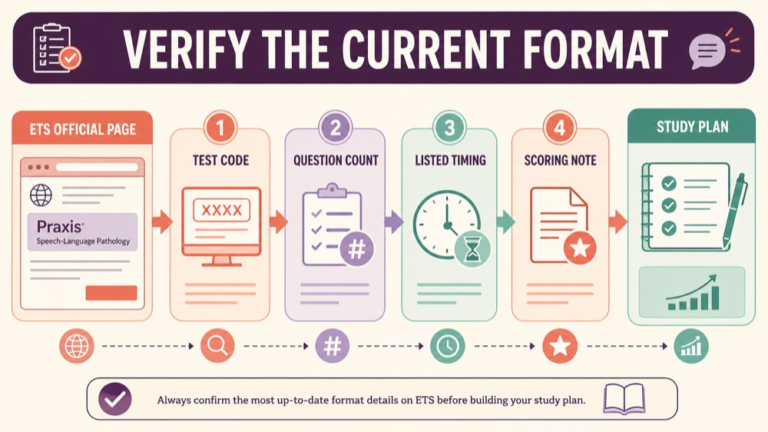
Begin with the current ETS Speech-Language Pathology Praxis 5331 page. Check the page title, test code, listed question count, timing, delivery information, and any note about scoring or unscored questions. Then compare the description with the current Study Companion. Record the date you checked if you are building a longer study plan.
| Fact to verify | What to do with it |
|---|---|
| Test name and code | Make sure your notes describe the intended Speech-Language Pathology Praxis test. |
| Question count | Use it to design a timed practice block, not to predict a score by itself. |
| Listed timing | Use it to practice reading, deciding, and reviewing at a controlled pace. |
| Delivery | Prepare for the current test-center or at-home setting shown for your appointment. |
| Scoring note | Do not treat every displayed question as a simple scored-point calculation. |
| Blueprint and materials | Map the content areas and decisions you need to study. |
Use the current page as the source of truth for changing administration facts. A third-party article can help you recognize the question, but it may have been written for an earlier version of the test. When two numbers conflict, do not average them. Check the current ETS page and the current Study Companion.
Read the scoring note carefully
ETS notes that some questions may not count toward a score. That statement is a reason to avoid a simplistic calculation such as one point per displayed question. It does not tell you which question is unscored or invite you to identify a special category during the test. For study purposes, focus on responding carefully to every task according to the current instructions.
The note also changes how you interpret practice results. If your practice set has a different number of items, its raw percentage is a description of that set, not a direct translation into a Praxis score. Use practice results to identify knowledge gaps, wording errors, pacing problems, and decision habits. Keep score interpretation tied to the current ETS information and the receiving organization’s requirements.
When you explain the question count to another student, include the boundary: the live ETS page currently lists the count and timing, but the design and scoring details must be verified before the appointment. That is more accurate than presenting a frozen number as a permanent rule.
Turn question count into pacing
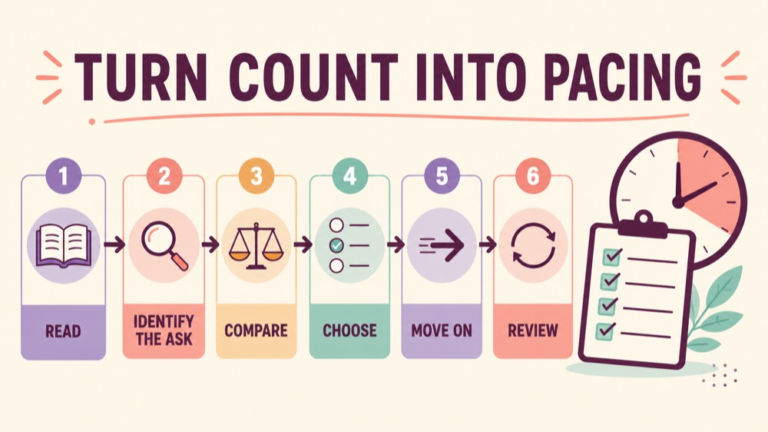
Use the listed count and time to establish a starting pace. The simple arithmetic can give you an approximate average, but it should not become a rigid rule for every task. Some questions will be faster, while others require careful comparison. Your pacing plan needs a checkpoint and a recovery strategy.
- Read the task: identify what the question is asking before scanning for a familiar phrase.
- Extract the decisive details: note the age, setting, goal, evidence, safety issue, and professional context that change the choice.
- Compare the options: ask which response best answers the stem and fits the evidence.
- Choose deliberately: make the best-supported selection rather than searching for certainty that the stem cannot provide.
- Move on: use the current interface tools and instructions for an item that needs later review.
- Check progress: compare time and remaining questions at planned points.
For a 150-minute session with 132 listed questions, the simple average is a little over a minute per displayed question. Treat that as a planning reference, not a promise that every question should take exactly the same time. Build timed practice that includes reading, option comparison, occasional flags, and a final review when the current interface allows it.
Analyze the cause of a slow item. Was the concept unfamiliar? Did the stem contain a decisive detail you missed? Did two options require a scope comparison? Did anxiety lead to repeated rereading? Each cause needs a different correction. More flashcards will not fix every pacing problem.
Practice the decision task
Question count is useful only when it changes how you practice. Use the current ETS Study Companion to identify the blueprint areas. For each study block, mix content review with short sets that require a reasoned choice. After each set, label the error:
- Knowledge gap: I did not know the relevant concept or distinction.
- Task gap: I answered a different question from the one the stem asked.
- Evidence gap: I ignored an age, setting, goal, or safety detail.
- Option gap: I could not compare two plausible responses.
- Pacing gap: I spent too much time or rushed without a review rule.
- Confidence gap: I changed a supported answer without new evidence.
Keep practice content clearly labeled as practice. Do not represent a preparation item as a live or remembered exam question. Do not use claims about leaked material or purported test content as a study method. The responsible focus is the reasoning skill and the source-grounded blueprint.
Common question-count mistakes
- Quoting a question count without checking the current ETS page.
- Confusing listed questions with scored questions.
- Dividing time evenly and forcing every item into the same number of seconds.
- Using a practice-set percentage as a direct prediction of a Praxis score.
- Ignoring the test code while copying a number from another exam page.
- Studying the count instead of the blueprint content and professional decisions.
- Practicing untimed items and discovering the decision task is slow under pressure.
- Treating a difficult question as a reason to abandon a controlled pacing plan.
The correction is simple: verify the source, read the note, plan a starting pace, practice the response task, and analyze errors. The number is a planning input, not the whole exam.
Quick count review
Before your next timed study block, answer these questions:
- What count and timing does the current ETS page list today?
- Did I verify the test name and code?
- What does ETS say about questions that may not count toward a score?
- What average pace will I use as a starting reference?
- When will I check progress?
- What is my rule for a question that takes too long?
- How will I label mistakes after practice?
- Which blueprint area needs the next focused review?
A good answer to how many questions are on the Speech-Language Pathology Praxis includes the current ETS number, the listed timing, the scoring boundary, and a reminder to verify before test day. Add your pacing plan only after you have identified the source-grounded facts.
Sources and next steps
Check the current ETS Speech-Language Pathology Praxis 5331 page for question count, timing, delivery, and current administration details. Use the ETS Study Companion for scope and preparation context, and review ASHA’s Praxis information for certification context. Recheck live information before your appointment.
Continue your preparation: Explore the SLP Study Center learning resources.