
speech pathology praxis free questions can be useful when “free” means accessible, original practice material that helps you explain decisions—not a promise of a score or a substitute for current exam information. The strongest free set gives you a scenario, plausible choices, a rationale, a distractor analysis, and a way to apply the rule to a changed context.
Use the current ASHA Speech-Language Pathology 5331 content page to frame the study domains and the live ETS 5331 page for current exam identity and administrative information. The ASHA Practice Portal adds topic-specific clinical context. The questions, rationales, evidence maps, and checklist below are original learning material, separate from live test material and not individualized clinical advice.
Free practice is most valuable when it reveals how you reason. Use each question to name the decision verb, mark the decisive clue, compare choices, check language and access, respect safety and professional boundaries, and write the next review. Recheck live sources whenever a detail about the exam or professional practice may have changed.
What speech pathology Praxis free questions can do for your study
A free question is not automatically a good question. Its study value comes from the reasoning it makes visible. A useful item asks you to select an action from evidence, then gives you enough explanation to see why the selected choice fits better than the alternatives. That process builds a review record that is more useful than a list of answer letters.
| Study purpose | What to practice | Useful output |
|---|---|---|
| Foundations | Identify the communication, health, development, learning, or participation concept that frames the case. | A concise concept statement. |
| Evaluation | Define the referral concern, choose representative evidence, and interpret limits without expanding the conclusion. | A question-to-measure match. |
| Treatment | Connect a target, cue, activity, partner, and outcome to the person’s functional goal. | A supported action with a reason. |
| Professional practice | Notice consent, privacy, competence, supervision, collaboration, and documentation boundaries. | A safe sequence or handoff. |
| Access and culture | Check language, dialect, communication mode, hearing, environment, culture, and partner conditions. | An accessible interpretation or next step. |
| Transfer | Change one variable and decide whether the same answer still fits. | A rule that survives new wording. |
Rotate the purpose of your practice. A learner who completes only familiar assessment vocabulary may feel comfortable while missing treatment transfer, communication access, safety, or professional sequencing. A small set can cover several purposes when every rationale connects the technical decision to the person, activity, setting, and next step.
Start with the current 5331 frame
Begin by checking the current source frame rather than treating an old outline as permanent. The ASHA 5331 content page and ETS 5331 page are the practical starting points for confirming the exam identity, content context, and current preparation links. Use those sources for date-sensitive notes, then use topic-specific ASHA guidance for clinical concepts.
Do not confuse a search result or a competitor’s free quiz with an authoritative specification. Search results can show that learners want free practice questions, but they do not establish clinical truth, current scoring information, or professional requirements. Read the source plan behind your study note and record the checked date when you save an administrative fact.
The practice set on this page is designed to train decisions across evaluation, treatment, professional practice, foundations, and access. It does not claim to reproduce a live test or predict what an individual will encounter. The durable skill is explaining the evidence and the boundary that support an answer.
Choose free questions by decision type
Classify each item by the action it asks you to take. “Assess,” “interpret,” “treat,” “refer,” “monitor,” “document,” and “collaborate” require different answer shapes, even when the topic vocabulary overlaps. Mark the verb before looking for the most familiar technical term in the choices.
| Decision type | Look for | Common mismatch |
|---|---|---|
| Clarify | A precise referral question, goal, concern, or missing history. | Jumping to a tool before defining the need. |
| Assess | Representative evidence, accessible conditions, measure fit, and interpretation limits. | Treating one structured result as the whole picture. |
| Interpret | A conclusion proportional to the evidence, context, and measurement limits. | Using a broad label when the case supports a narrower observation. |
| Treat | A functional goal, target, support, activity, partner, and outcome. | Choosing an exercise with no connection to participation. |
| Refer or hand off | Safety, urgency, scope, role, communication, and continuity. | Continuing a task after the scenario gives a stop clue. |
| Monitor | A defined outcome, time point, condition, and reason to adapt. | Collecting data without a decision rule. |
| Collaborate | The person’s priorities, team roles, communication, and shared plan. | Assuming one professional owns every decision. |
When two choices sound reasonable, return to the verb and the sequence. The better answer usually addresses the requested decision at the appropriate level, includes the most relevant evidence, and respects the boundary stated in the scenario.
Check the quality of a free question set
Before spending hours with a free bank, inspect its structure. A page that supplies many short prompts but no rationales may provide recognition practice without showing how to reason. A page with dramatic wording or unsupported certainty may create habits that do not transfer to careful clinical decision-making.
| Quality check | Ask yourself | Study response |
|---|---|---|
| Source boundary | Does the page distinguish original educational items from current testing information? | Keep the exercise clearly labeled as original practice. |
| Specific stem | Does the scenario include a person, activity, context, evidence, and decision? | Prefer a decision that can be defended from the details. |
| Balanced choices | Are the options plausible without relying on trick wording or an extreme claim? | Compare fit, evidence, sequence, access, and safety. |
| Complete rationale | Does the explanation address the best answer and the distractors? | Write the missing step or mismatch for each alternative. |
| Functional relevance | Does the question connect a clinical action to participation or communication? | Name what changes for the person, partner, or activity. |
| Current context | Are date-sensitive exam details linked to current ETS or ASHA pages? | Recheck live sources before updating notes. |
| Transfer prompt | Can one variable be changed without rewriting the whole case? | Use a changed setting, partner, support, or decision verb. |
Also check whether the source clearly separates education from clinical care. Practice examples can teach a decision pattern, but they do not establish an individual diagnosis, treatment plan, scope-of-practice answer, or legal requirement. Keep local policy, supervision, informed consent, and current professional guidance in view when a scenario depends on them.
Read the scenario before scanning the choices
Choices are written to sound attractive. A familiar word can pull you toward an answer before you have identified the task. Read the scenario once for the overall situation and once for the details. Write a short spine with the person, activity, setting, partner, language or mode, evidence, decision, and urgency.
| Stem field | Question to ask | Why it matters |
|---|---|---|
| Person | Who is communicating, learning, eating, working, or receiving care? | Avoid assuming a profile that the case does not provide. |
| Activity | What does the person need, want, or need support to do? | Function keeps the answer connected to daily life. |
| Context | Where, with whom, in what language or mode, and under what demands? | Context can change opportunity and interpretation. |
| Evidence | What is reported, observed, measured, or changed with support? | Use the evidence actually present in the stem. |
| Decision | Is the item asking you to clarify, assess, interpret, treat, refer, document, or monitor? | The verb controls the type of answer. |
| Boundary | Is there a safety, consent, privacy, competence, or local-process clue? | A boundary can change the order of action. |
Do not invent absent facts. If the case does not state hearing history, language history, consent, or a safety procedure, note that the missing information may guide the next step. You can identify uncertainty without filling it with an assumption. That distinction keeps the rationale tied to what the scenario actually supports.
Separate evidence from an attractive distractor
Most distractors are not random. They often represent a real action placed at the wrong time, a correct concept applied to the wrong context, a narrow result treated as a broad conclusion, or a support removed before its function is understood. Label the mismatch instead of merely calling the choice wrong.
- Fit: Does the choice answer the question that was asked?
- Evidence: Which fact in the stem supports or weakens it?
- Sequence: Is this action appropriate now, or does another step come first?
- Access: Does the choice give the person a fair way to communicate or demonstrate the skill?
- Function: Does it connect to the person’s activity and priority?
- Boundary: Does it respect safety, consent, privacy, competence, and collaboration?
When a choice sounds technically impressive, ask whether it is proportionate. Free questions are excellent opportunities to practice restraint: state what the evidence supports, what it leaves open, and what you would check before making a larger decision.
Keep language, access, and function in the frame
Communication performance is shaped by the conditions in which it is observed. Read for language history, dialect, culture, mode, hearing, vision, motor access, technology, partner behavior, noise, fatigue, health, and task demands when the case includes them. These details can change what the result means and which next step is reasonable.
The ASHA Multilingual Service Delivery resource supports attention to language history, exposure, use, dialect, access, and collaboration. The ASHA Cultural Responsiveness resource supports reflective and person-centered interaction. Use current topic guidance rather than turning one study shortcut into a universal rule.
- Ask whether the person had an accessible way to understand the directions.
- Separate a language or communication difference from a disorder conclusion.
- Keep the person’s goals, preferences, language, culture, and partner visible.
- Connect a measure to the activity in which the person needs to communicate.
- Notice whether support changes opportunity, effort, accuracy, or participation.
- Pause for a safety, consent, privacy, competence, supervision, or handoff clue.
Context is not an optional paragraph after the answer. It is part of deciding which evidence is representative and which action is proportionate. If the options ignore an important access condition, that omission may be the reason the choice is weak.
Write a rationale that transfers
After choosing, write a rationale without copying the page’s wording. Explain the decision, the decisive clue, the fit of the best answer, the weakness of each distractor, the boundary of the evidence, and the condition you would change for transfer. A rationale can be concise while still showing the reasoning chain.
| Rationale part | Sentence starter | Quality check |
|---|---|---|
| Decision | The question asks me to… | Did I answer the requested action rather than a nearby topic? |
| Decisive clue | The most important detail is… | Did I quote or accurately paraphrase a case fact? |
| Fit | The selected option fits because… | Did I connect the clue to the action? |
| Distractors | The other choices are weaker because… | Did I identify a sequence, evidence, access, or boundary problem? |
| Limit | This result does not establish… | Did I avoid a broad conclusion from a narrow observation? |
| Transfer | If the setting or support changed… | Can I state what I would reconsider next? |
Use a “because” sentence to connect evidence to action: “Because performance changes when the partner and setting change, the next step should examine the communication demand before a broad conclusion.” If you cannot write that connection, the item deserves another review even if the selected letter was correct.
Build a Free Question Evidence Map
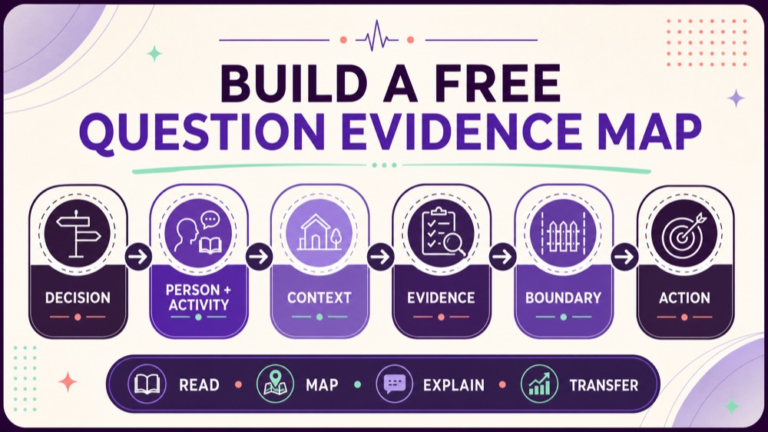
The evidence map turns a free question into a compact reasoning record. Put the decision at the center, then connect the person, activity, context, evidence, boundary, and next step. The map is helpful when an item feels familiar but the answer choices differ by sequence or by the amount of conclusion they claim.
| Map node | Write one line | Example prompt |
|---|---|---|
| Decision | The action the item requests. | Am I clarifying, assessing, treating, referring, or monitoring? |
| Person and activity | Who needs what communication outcome? | What activity or priority is named? |
| Context | Language, mode, partner, setting, support, and time. | What condition changes performance or access? |
| Evidence | Report, observation, measure, response, or missing information. | What does the case actually show? |
| Boundary | Safety, consent, privacy, competence, or local process. | What must happen before the next step? |
| Action | The proportionate next move and what it will answer. | Why is this choice the best fit now? |
Keep the map small. Its purpose is to make the reasoning visible before you reopen the answer key. On the second pass, cover the original choices and use the map to state your answer. On the third pass, change one node and see what needs to change.
Turn Free Questions Into a Review Plan
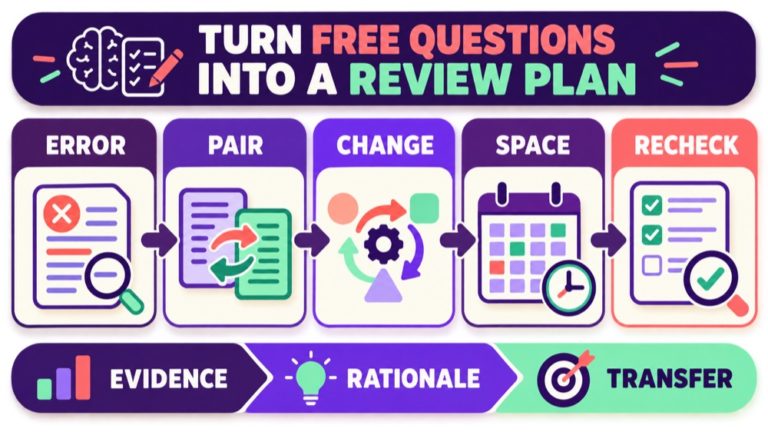
A free question becomes a review plan when it tells you what to do next. Record whether the miss came from reading, evidence, access, sequence, function, professional boundaries, transfer, or confidence. Then choose a paired item or changed scenario that targets that category rather than rereading an entire textbook chapter.
| Result | Next review | Evidence of improvement |
|---|---|---|
| Wrong answer, clear confidence | Rebuild the stem spine and identify the missed clue. | You can explain the distractor that pulled you away. |
| Right answer, weak rationale | Write the evidence-to-action sentence and name the limit. | You can defend the answer without the letter. |
| Right answer, low confidence | Compare the best choice with the strongest distractor. | You can state why technical wording does not control fit. |
| Miss caused by context | Create a paired case with a changed language, partner, setting, or mode. | You preserve access checks in the revised answer. |
| Miss caused by sequence | Put clarify, assess, act, monitor, and handoff on a timeline. | You identify the proportionate next action. |
| Miss caused by transfer | Change one variable while keeping the core evidence stable. | You can explain what changes and what stays consistent. |
Do not turn a review log into a judgment about your ability. It is a map of decisions under particular conditions. The goal is to make the next study action specific enough that you can observe a change in reasoning.
Question 1: an evaluation decision
Practice Question 1. A preschool teacher reports that a child uses short phrases during play but becomes difficult to understand during a fast group routine. The teacher asks for a broad language score before the clinician has reviewed hearing, language exposure, or the activity demands. What is the best next step?
- A. Choose the broadest available test immediately because a score is the fastest way to answer the referral.
- B. Conclude from the teacher’s report that the child has a global language disorder.
- C. Clarify the communication concern, review language and hearing context, observe representative routines, and select evidence that answers the refined question.
- D. Use the quiet play sample as the final description because it provides the cleanest testing condition.
Correct Answer: C. The contrast between play and a fast group routine is the decisive clue. A careful next step defines what the teacher needs to know and examines language history, hearing, partner demands, rate, noise, and representative activity before selecting a measure or making a broad interpretation.
Why the Other Options Are Wrong: A starts with a tool before the question is clear. B turns one report into a global conclusion. D treats a less demanding context as the full functional picture. C uses context and evidence to choose proportionate evaluation steps.
Exam Trap: A request for a score does not replace a defined referral question. Look for the condition under which communication changes.
Question 2: a treatment decision
Practice Question 2. An adult produces a speech target more accurately in structured drills with a visual cue, yet still avoids introducing themself during work meetings. Which response best connects the practice result to a functional treatment plan?
- A. Count the drill accuracy as evidence that the meeting goal is complete.
- B. Remove every visual cue at once so the next session measures unaided performance only.
- C. Keep the useful cue while adding supported meeting practice, tracking cueing and effort, and monitoring target performance together with participation.
- D. Replace the communication goal with a new target without examining the meeting activity.
Correct Answer: C. The structured gain is relevant, but the unchanged work participation shows that transfer conditions still need attention. The plan can preserve an effective support while introducing the listener, setting, timing, and participation demands that matter to the adult’s goal.
Why the Other Options Are Wrong: A treats a narrow drill measure as the entire outcome. B removes support before learning how it helps and how it might be faded. D changes the target without solving the named activity. C connects target, support, practice, and function.
Exam Trap: A support can be part of effective treatment. Compare performance, effort, cueing, and participation instead of treating independence as the only useful outcome.
Question 3: a professional-practice decision
Practice Question 3. During a facility-approved swallowing screen, a patient becomes less alert and develops a new vocal change after a trial. The local process requires the screen to stop and the team to be notified. What is the best professional-practice response?
- A. Continue with additional trials so the clinician can collect a fuller screen result.
- B. Record the earlier trial as the final result and continue the meal as planned.
- C. Stop under the local process, communicate the change, document the conditions and response, and arrange qualified follow-up for the broader question.
- D. Ask an untrained support person to finish the trials while the clinician completes other work.
Correct Answer: C. The change in alertness and voice is safety-relevant information within the stated process. Stopping, communicating, documenting, and arranging qualified follow-up respects the local boundary and preserves continuity without turning a screen into a broader evaluation.
Why the Other Options Are Wrong: A ignores the stop instruction. B treats earlier performance as final after conditions changed. D transfers a safety-sensitive task without appropriate competence or oversight. C follows the stated sequence and keeps the handoff visible.
Exam Trap: When a stop rule is part of the scenario, the item is testing sequence and communication. More observations are not automatically a better answer.
Question 4: a communication-access decision
Practice Question 4. A bilingual student understands a classroom lesson in the home language but gives brief answers in English during a monolingual task. The record lacks a language history and the teacher is unsure whether the student understood the directions. What should guide the next step?
- A. Interpret the brief English answers as sufficient evidence of a language disorder.
- B. Repeat the same English task with more difficult vocabulary to obtain a clearer result.
- C. Gather language history, clarify the student’s strongest languages and communication opportunities, confirm accessible directions, and use appropriate bilingual or collaborative assessment planning.
- D. Exclude the home language from the evaluation because the classroom instruction is in English.
Correct Answer: C. The missing language history and uncertain direction access limit interpretation. A defensible next step examines the student’s languages, exposure, use, dialect and cultural context, then plans assessment with appropriate resources and collaboration rather than treating English output alone as the construct.
Why the Other Options Are Wrong: A makes a broad interpretation from a limited condition. B increases task difficulty without repairing access. D removes information needed to understand communication across contexts. C protects valid interpretation and participation.
Exam Trap: Language of instruction is one context, not a complete description of language ability. Ask whether the task gave the student a fair way to show the skill.
Use missed free questions as a study map
Missed questions are useful when you classify them accurately. “I need to study evaluation” is broad; “I missed the difference between a referral question and a test selection” points to a repair. Choose one error category, write the missing reasoning sentence, and find a new item that changes the wording but preserves the same decision.
| Error category | What happened | Repair for the next session |
|---|---|---|
| Missed the verb | Answered an assessment question with a treatment action, or a monitoring question with a conclusion. | Underline the action word before reviewing the content. |
| Missed context | Treated language, mode, hearing, partner, noise, fatigue, or culture as background detail. | Write how the condition changes access or interpretation. |
| Overread one measure | Treated a structured result as the complete functional picture. | Add a representative activity and outcome. |
| Jumped the sequence | Selected a later intervention or broad conclusion before clarifying the question or safety. | Write the safest proportionate next step. |
| Ignored boundaries | Forgot consent, privacy, competence, supervision, handoff, or local process. | Add the role and continuity requirement. |
| Changed too much | Created a new case so different that the original rule could not be tested. | Change one variable and hold the evidence steady. |
| Lucky answer | Selected the best choice but could not explain why it fit. | Rewrite the rationale in your own words. |
| Confidence drift | Changed a defensible choice because another option sounded more technical. | Return to the decisive clue and compare fit. |
After several sessions, look for patterns across domains. Repeated access errors may call for language and communication-mode review. Repeated sequence errors may call for a decision timeline. Repeated confidence errors may call for slower comparison of evidence rather than more question volume.
Build a seven-day free-question plan
A seven-day cycle creates variety without making a permanent claim about exam weighting. Use a small number of original questions each day and spend enough time on rationales and transfer. Adjust the sequence to the current ASHA content frame and your own error categories.
- Day 1: clarify referral questions, goals, and the difference between a concern and a decision.
- Day 2: review language, dialect, culture, mode, hearing, and accessible directions.
- Day 3: connect treatment targets, cues, activities, partners, and outcomes.
- Day 4: practice screening, safety signals, stop rules, referral, and handoff.
- Day 5: review professional practice, consent, privacy, competence, supervision, and collaboration.
- Day 6: solve a cross-domain scenario with one changed context variable.
- Day 7: revisit misses, low-confidence answers, and rationales without looking at the original key.
Use the live ETS and ASHA sources when you update administrative or professional notes. Use your free-question log to decide which topic deserves another item. The plan is a study structure, not a forecast of the exam’s question distribution or an outcome claim.
Free-question review checklist
Run this checklist before closing a session. It keeps the free resource focused on reasoning, access, function, and responsible source use.
- Did I identify the decision verb before comparing options?
- Did I name the person, activity, setting, partner, language or mode, and urgency?
- Did I mark the decisive clue or contrast?
- Did I separate report, observation, measure, interpretation, and action?
- Did I check whether the task was accessible and representative?
- Did I keep language, dialect, culture, hearing, environment, and support visible?
- Did I notice safety, consent, privacy, competence, supervision, and handoff boundaries?
- Did I explain why the selected answer fits this case?
- Did I explain why each distractor is weaker for this case?
- Did I state what the evidence does not establish?
- Did I change one variable to practice transfer?
- Did I record an error category and schedule delayed review?
- Did I recheck current ETS or ASHA pages for date-sensitive details?
If the answer was correct but the explanation was vague, keep it in the review set. Recognition can arrive before reasoning is stable. A clear evidence sentence and a changed-case answer are better signs of progress than a streak alone.
Sources and next steps
For the current Praxis study frame, review the ASHA Speech-Language Pathology 5331 content page and the live ETS 5331 page. For topic-specific clinical context, use the ASHA Practice Portal. For language and cultural context, review ASHA Multilingual Service Delivery and ASHA Cultural Responsiveness.
For current preparation-resource context, check the ETS practice-test page. The questions, choices, rationales, evidence maps, and checklists here are original educational material, separate from live test material. Recheck current sources before relying on an administrative, scoring, professional, state, school, agency, or facility requirement.
For your next session, choose one question from the set, write the six-node evidence map, compare the strongest distractor, and change one context variable. Then schedule a delayed review and record the rule in your own words.
Continue your preparation: Explore the SLP Study Center learning resources.