
speech pathology clinical reasoning questions are easiest to solve when you treat the stem as a decision problem rather than a vocabulary quiz. Start with the person, the activity, the setting, and the decision that the result must support. Then separate what was observed from what you are inferring, check the conditions that shaped the sample, and choose an assessment, support, treatment, collaboration, or referral step that fits the evidence.
The current ASHA Speech-Language Pathology 5331 content page places assessment, treatment, evidence-based practice, professional practice, and culturally and linguistically responsive service within the study frame. The ASHA Practice Portal supplies topic-specific clinical context, while the live ETS Speech-Language Pathology 5331 page supplies current exam identity. The questions, rationales, maps, and checklists below are original learning material, separate from live test material and not individualized clinical advice.
Clinical reasoning is not guessing the hidden diagnosis from one clue. It is a repeatable way to organize evidence, make uncertainty useful, protect communication access and safety, and explain why the next step is proportionate. The best answer often includes an action that gathers or uses the most decisive missing information.
What speech pathology clinical reasoning questions are testing
Clinical reasoning questions may involve speech, language, fluency, voice, cognition, social communication, AAC, feeding, swallowing, hearing access, or professional practice. The topic changes, but the reasoning work is similar: identify the decision, locate the strongest evidence, account for the person and context, and choose an action that can be defended.
| Reasoning field | What to locate in the stem | Study output |
|---|---|---|
| Referral or concern | What prompted the question, who noticed it, and which activity or safety issue matters? | Restate the decision in observable, functional terms. |
| Person and context | Age, health, language, dialect, culture, hearing, mode, partners, routines, and access conditions. | Which facts change how the performance should be understood? |
| Observation | What the person did, said, understood, initiated, repaired, tolerated, or participated in under named conditions. | What is directly supported by the sample? |
| Interpretation | A cautious explanation that connects converging evidence while identifying what remains uncertain. | What conclusion is proportionate to the data? |
| Action | Assessment, support, treatment, collaboration, referral, documentation, or monitoring that answers the current need. | What is the next responsible step? |
| Review | New information or outcome data that could confirm, refine, or change the plan. | How will the decision be revisited? |
Several options may contain a clinically familiar idea. A cue, standardized test, caregiver report, treatment activity, referral, or safety precaution can be appropriate in one context and poorly matched in another. Read the verbs in the question: identify, screen, evaluate, interpret, treat, refer, document, counsel, or monitor. The verb tells you what kind of answer the stem is seeking.
Also mark the details that limit a conclusion. A multilingual learner, a person using AAC, an adult with fluctuating alertness, a child in a noisy classroom, or a patient with a swallowing risk may require different access and safety reasoning. These details are not decoration. They determine which evidence is interpretable and who should be involved.
Start with the person and the decision
Before looking at the answer choices, rewrite the referral in one sentence. Include who the person is, what activity or concern matters, where the difficulty appears, and what decision the team needs to make. “Does this person have a disorder?” is usually too broad. “What communication support would help this person participate in morning handoff with familiar and unfamiliar partners?” is closer to a usable decision question.
| Stem detail | Clarifying question | Why it matters |
|---|---|---|
| Person | What strengths, modes, preferences, history, language, and health factors are named? | The same task may require different access or support for different people. |
| Activity | What does the person need or want to do in daily life, school, work, or care? | Function keeps the answer tied to a meaningful outcome. |
| Setting | With whom, under what demands, and with which environmental supports does the pattern occur? | Performance can change with noise, partner, time, routine, or task structure. |
| Decision | What will the result be used to decide now? | The decision determines whether screening, evaluation, treatment, referral, or monitoring is proportionate. |
| Urgency | Is there a safety, health, access, or time-sensitive concern? | Immediate risk or access needs change the order of actions. |
Do not let a referral label choose the construct for you. “Attention,” “behavior,” “articulation,” “memory,” and “swallowing” can describe a concern without explaining its source or the precise task. Translate the label into observable performance and then decide which information would distinguish plausible explanations.
When the stem asks for the best next step, prefer the answer that resolves the decision efficiently and responsibly. That may be a targeted history, a communication-access adjustment, a natural observation, a language-matched assessment, a treatment change, a team consultation, or a referral. A broad action with no connection to the stated concern is weaker than a focused action that uses the details provided.
Separate observation from interpretation
Clinical reasoning becomes clearer when you make two columns. In the first, record what happened under named conditions. In the second, record the interpretation you are considering and what evidence would make it more or less plausible. This prevents a conclusion from being smuggled into the description.
| Layer | Example wording | Boundary |
|---|---|---|
| Observation | The student followed a one-step direction in a quiet room and missed a multi-step direction during group work. | Describe task, setting, support, and response. |
| Possible explanation | Language load, working-memory demand, hearing access, partner behavior, or group noise may contribute. | Keep alternatives open until relevant evidence is gathered. |
| Functional impact | The student misses classroom instructions and needs repeated clarification. | Connect the pattern to participation and support needs. |
| Next evidence | Observe the routine, review hearing and language history, and compare accessible instruction formats. | Choose information that can change the decision. |
| Calibrated conclusion | The current sample suggests a context-sensitive difficulty that needs targeted assessment and support. | State what the evidence supports and what remains unknown. |
Words such as “suggests,” “under these conditions,” “is consistent with,” and “additional information is needed” are not evasive when they accurately describe the evidence. They allow the clinician or learner to make a useful decision without treating a single sample as the whole person.
For multiple-choice questions, inspect options that leap from one observation to a global label. Also inspect options that avoid interpretation entirely by collecting unrelated data. The strongest option usually describes the next evidence or action that narrows the uncertainty while respecting the person’s goal and access.
Use a hypothesis-and-evidence loop
A useful reasoning loop is: describe, hypothesize, test, integrate, act, and review. A hypothesis in this context is a working explanation that guides the next observation; it is not a final label. The loop can be used for an assessment vignette, a treatment decision, or a professional-practice scenario.
- Describe. Write the task, response, partner, setting, language or mode, available support, and meaningful consequence.
- Hypothesize. List two or three plausible contributors without ranking one from a single clue.
- Test. Select an observation, measure, interview, collaboration, or access change that distinguishes the possibilities.
- Integrate. Compare formal data, natural performance, report, history, and the person’s own priorities.
- Act. Choose the support, treatment, referral, documentation, or monitoring step that follows from the evidence.
- Review. State what outcome or new fact would lead you to adapt the plan.
Questions often reward the option that completes a missing part of this loop. If a choice names an intervention before the target is clear, it skips description. If it recommends a broad conclusion from one low score, it skips integration. If it gives a referral with no handoff or safety plan, it skips action planning. If it records data without a review point, it skips learning from the outcome.
Use the loop under time pressure by writing six short labels in the margin: D-H-T-I-A-R. Then place each answer choice under the label it addresses. The option that is technically true but belongs to a later or different step may not be the best answer to the question being asked.
Check language, culture, and communication access
Language and access are part of the evidence, not a final add-on. Review language history, exposure, use, dialect, communication mode, hearing, vision, motor access, technology, health literacy, cultural context, and the person’s preferred partners. When an interpreter or other collaborator is needed, plan the role and communication process rather than treating the person’s language as an obstacle.
The ASHA Multilingual Service Delivery resource supports a language- and dialect-responsive process. The ASHA Cultural Responsiveness resource supports ongoing reflection, accessible interaction, and attention to the person’s context. These sources do not turn one translated task or cultural checklist into a universal interpretation.
- Ask which languages, dialects, modes, and communication partners the person uses across routines.
- Check whether the task samples the skill the question names or adds an unfamiliar language, literacy, motor, hearing, or cultural demand.
- Use accessible directions, response options, materials, and communication supports so the person can show what they know.
- Interpret scores and observations within their language, norming, administration, and context limits.
- Invite the person and relevant family or team members to identify meaningful routines, priorities, and barriers.
- Document adaptations, collaboration, interpretation limits, and the reason the selected method fits the decision.
A low performance in one language or response mode may be important, but its meaning depends on the question and the evidence around it. Likewise, an accurate response in a structured task may not describe participation in a busy routine. Avoid both extremes: do not treat a language difference as a disorder, and do not discard a communication concern simply because the person uses more than one language or mode.
Choose proportionate assessment evidence
Assessment evidence should be selected for the decision, not for its prestige or length. A screening procedure, a comprehensive evaluation, a progress measure, a language sample, a caregiver interview, a dynamic probe, and a natural observation serve different purposes. The best answer makes the purpose explicit and acknowledges what the method cannot answer.
| Evidence source | Useful role | Interpretive question |
|---|---|---|
| History and report | Onset, change, priorities, routines, health, language experience, hearing, devices, and partner observations. | Use it to frame the question, not to replace direct evidence. |
| Natural observation | Communication or swallowing in a meaningful setting with the relevant task, partner, and supports. | Use it to connect skill to activity and participation. |
| Formal measure | A tool or procedure selected for its construct, population, language, response demands, and decision purpose. | Interpret the score within administration and validity limits. |
| Dynamic probe | A structured change in cue, model, task, or support followed by an observation of response. | Use the response to plan support; do not treat one probe as a complete profile. |
| Team evidence | Information from educators, caregivers, nurses, physicians, audiology, interpreters, or other relevant partners. | Clarify roles, consent, communication channels, and the question each source can answer. |
| Outcome evidence | Change in skill, activity, participation, safety, effort, preference, or partner support over time. | Use it to adapt the plan and document the reason for the change. |
Reliability and validity are related to use. A measure may produce consistent scores yet still be a poor fit for a different population, language, construct, or decision. A natural observation may be highly relevant to participation yet require careful description of context and support. Strong reasoning integrates different forms of evidence instead of using one type as a shortcut.
When results disagree, investigate the disagreement. Check the construct, response demand, language, hearing, fatigue, motivation, environment, partner, timing, and measurement conditions. The answer is rarely to average unlike observations without explaining their differences. Variation can reveal which conditions support or constrain performance.
Connect treatment choices to function
Treatment reasoning begins with the person’s goal and the activity that matters. Then identify the target, select an intervention that fits the target and evidence, plan access and cueing, practice under meaningful conditions, and monitor response. A technique name alone does not explain why the plan is appropriate.
| Treatment field | Question to ask | What to document |
|---|---|---|
| Goal | What activity, partner, role, or participation outcome matters to the person? | Person-centered priority and functional context. |
| Target | What observed skill or barrier is connected to that activity? | Baseline, response, and reason for selecting the target. |
| Method | Which intervention and practice conditions fit the target, evidence, and preferences? | Materials, task, dose description as appropriate, and rationale. |
| Support | What cue, device, partner, environmental change, or access support helps the person participate? | Type and level of support plus a plan for adaptation. |
| Outcome | Which skill, activity, safety, effort, preference, or partner outcome will guide the next decision? | Conditions, response, interpretation, limitation, and review date. |
Look for transfer. A gain in a structured drill may be useful but may not answer whether the person can use the skill in conversation, class, work, home, or care. A cue may enable participation without representing independence. A strong answer keeps the support available while measuring how it affects access and planning thoughtful changes.
Protect safety, scope, and collaboration
Some questions contain a safety or professional-boundary clue. Treat that clue as part of the decision. In feeding and swallowing, a risk signal may require the setting’s stop, notification, precaution, and referral process. In a communication-access question, a barrier may call for an accommodation or collaboration before a test conclusion. In supervision or documentation, the answer should match competence, oversight, privacy, consent, and current requirements.
Scope is not just a list of practice areas. It includes the clinician’s education, training, experience, supervision, current competence, setting, and the needs and risk of the person served. Collaboration can strengthen care, but it does not erase role clarity or documentation. When an option expands beyond competence, transfers an interpretive decision without appropriate oversight, or ignores a safety handoff, treat it as a serious distractor.
- Name the immediate risk or boundary in plain language.
- Pause or modify the activity when the setting’s safety process requires it.
- Notify the responsible person or team and communicate the information accessibly.
- Refer or collaborate for the question that exceeds the current role or evidence.
- Document the observation, action, communication, limitation, and follow-up.
Use current ASHA guidance and applicable state, payer, employer, school, facility, and law requirements for real decisions. Praxis preparation can teach the reasoning pattern, but a practice page cannot replace a local policy, an individualized assessment, or professional judgment.
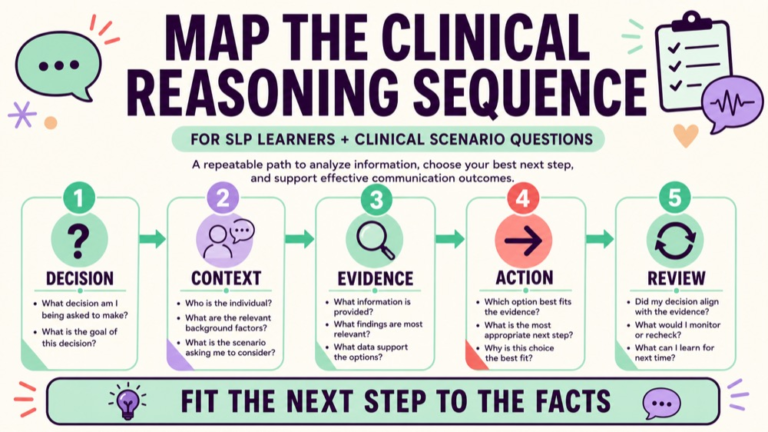
Map the Clinical Reasoning Sequence
Use this five-part map when an item feels crowded with details. First name the decision. Next identify the person, task, language or mode, and context. Then separate observation from interpretation, choose the evidence or action that addresses the question, and state how you will review the result. The map helps you resist a vivid but low-value clue.
| Map step | Margin note | Distractor to question |
|---|---|---|
| 1. Decision | What must be decided now? | Is this answer solving a different problem? |
| 2. Context | Who, where, with whom, in which language or mode? | Did the option ignore access or setting? |
| 3. Evidence | What is observed and what remains unknown? | Did the option leap from one clue? |
| 4. Action | What proportionate next step uses the evidence? | Is the action too broad, too narrow, or out of sequence? |
| 5. Review | What outcome or new fact changes the plan? | Does the option end without monitoring? |
Practice the map with one-variable changes. Keep the communication pattern but change the language history. Keep the score but change the functional decision. Keep the treatment target but change the partner and setting. If the changed fact affects access, validity, safety, or transfer, the best answer should change with it.
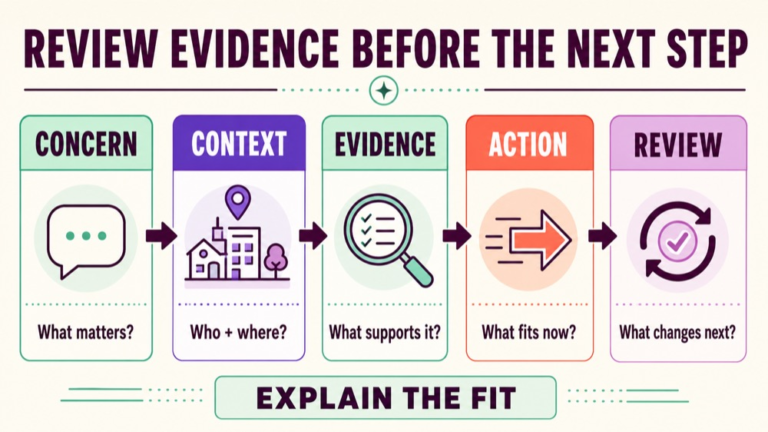
Review Evidence Before the Next Step
This review board is useful after you answer an item. Fill one card for the concern, one for the person and context, one for the evidence, one for the action, and one for the review point. If a choice has a convincing technique but no target, a precise score but no decision, or a referral with no handoff, identify the missing card.
| Review card | Write down | Question it answers |
|---|---|---|
| Concern | The activity, change, risk, or professional question. | Why is this decision needed? |
| Person and context | Strengths, priorities, language, mode, partner, health, setting, and access. | Whose experience and conditions are represented? |
| Evidence | History, observation, measure, report, probe, team input, and limitation. | What does the evidence actually support? |
| Action | Assessment, support, treatment, referral, collaboration, or documentation. | What is proportionate and useful now? |
| Review | Outcome, new information, responsible person, and timing. | How will the plan be adjusted? |
A review board makes your rationale visible. It also helps distinguish a wrong answer from an incomplete answer. An option may name a legitimate procedure but still be weaker because it ignores language access, fails to answer the stated decision, or makes a conclusion beyond the available evidence.
Question 1: referral, context, and next evidence
Practice Question 1. A middle-school student is referred because the student “does not follow directions.” In a quiet individual activity, the student follows short directions with a visual cue. During a noisy group project, the student misses multi-step directions and watches peers before starting. Which next step best demonstrates clinical reasoning?
A. Conclude that the student has a broad receptive-language disorder based on the teacher’s referral wording.
B. Administer the longest available language battery without observing the group-project demands.
C. Clarify the direction types and classroom demands, review hearing and language history, observe the routine, and compare accessible instruction conditions before selecting targeted measures.
D. Tell the teacher to give visual cues in all situations and close the referral because the student responds to a cue.
Correct Answer: C. The contrast between short directions in a quiet setting and multi-step directions in noise narrows the question but does not determine its cause. The next plan should examine language load, hearing access, working-memory demand, visual support, partner behavior, and environmental conditions. Targeted observation and history can guide a proportionate assessment.
Why the Other Options Are Wrong: A turns a referral label into a global conclusion. B may gather information but does not first define the construct or represent the meaningful context. D may be a useful support, but it does not answer why the difficulty occurs or whether further assessment is needed. C uses the facts to refine the decision and protect interpretation.
Exam Trap: When performance changes by task and setting, do not select the answer that treats the referral phrase or the easiest sample as the whole profile. The context contrast is the clue.
Question 2: language history and interpretation
Practice Question 2. A multilingual adult receives a low score on an English naming task. The clinician has not collected language history, does not know which languages the adult uses at work and home, and has not asked whether the response format is accessible. What is the most responsible next reasoning move?
A. Treat the low score as sufficient evidence of a language disorder and begin treatment for naming.
B. Disregard all communication concerns because multilingual adults cannot be assessed fairly.
C. Gather language and communication history, examine the task and response demands, use appropriate language-access collaboration, and integrate additional evidence before making a broad interpretation.
D. Translate the item list informally and report the translated result as if it had the original measure’s norms.
Correct Answer: C. The score describes performance under a particular language and task condition, but missing language history and access information limit its interpretation. A responsive process gathers context, chooses appropriate methods, and considers functional communication across relevant routines.
Why the Other Options Are Wrong: A overgeneralizes one task and skips construct and language-experience questions. B confuses the need for responsive methods with an inability to assess. D assumes an informal translation preserves the measure’s meaning, administration, and reference frame. C protects access and calibrated interpretation while keeping the communication concern visible.
Exam Trap: When language history is missing, the best answer usually improves the assessment process and states the score’s limits. It neither accepts nor discards one result automatically.
Question 3: safety, scope, and follow-up
Practice Question 3. During a brief feeding and swallowing screen in a medical setting, a patient becomes less alert and shows a new change in vocal quality after a trial. The local protocol requires the screen to stop and the team to be notified. Which action best fits the information?
A. Continue with more trials until the clinician can decide whether the patient has a specific swallowing disorder.
B. Record a pass because the patient completed earlier trials without a visible problem.
C. Stop according to the protocol, communicate the change to the responsible team, document the conditions and response, and arrange the appropriate comprehensive follow-up.
D. Ask an untrained support person to finish the screen while the clinician moves to another patient.
Correct Answer: C. The change in alertness and vocal quality is a risk signal within the stated protocol. The screen is not the place to stretch a rapid risk-identification process into a full physiologic evaluation. The appropriate next step protects safety, communicates the result, records the limitation, and connects the patient to the responsible follow-up process.
Why the Other Options Are Wrong: A continues after a stated stop condition and asks a screen to answer a broader question. B ignores the changed condition and treats earlier performance as the final result. D transfers a safety-sensitive task without appropriate competence and oversight. C follows the local pathway and makes the boundary visible.
Exam Trap: A safety clue changes the order of operations. Stop, communicate, document, and refer or evaluate according to the setting’s process before seeking a more detailed explanation.
Review common clinical reasoning distractors
Distractors are often built from a true statement placed in the wrong sequence or detached from the person and decision. Use the table below to name the shortcut before you choose.
| Distractor pattern | Why it sounds persuasive | Reasoning correction |
|---|---|---|
| The longest test battery | More data sound more thorough. | Define the decision, then select evidence that can answer it. |
| The first label | A diagnostic-sounding label feels efficient. | Describe the observed pattern and check alternatives before naming a conclusion. |
| One score | A number appears objective and easy to compare. | Review construct, language, access, conditions, and functional relevance. |
| A familiar technique | A known intervention or cue is easy to recall. | Match the action to the person’s goal, target, response, and setting. |
| A single informant | One report may be detailed and urgent. | Compare perspectives and observe the task that matters. |
| A universal rule | A simple rule reduces uncertainty. | State the boundary and verify current setting or jurisdiction requirements. |
| More certainty in the wording | Strong language sounds confident. | Use calibrated language that fits the evidence and names the next check. |
| No follow-up plan | The answer seems finished after a recommendation. | Specify monitoring, communication, documentation, and a review point. |
When two options both sound reasonable, compare them on four questions: Which one answers the stated decision? Which one accounts for access and context? Which one stays within the evidence and role? Which one includes a useful review or follow-up point? The stronger answer usually has the better fit across all four, not merely the more technical wording.
Do not confuse caution with inaction. A calibrated answer can still recommend a clear action: observe the relevant task, adjust access, gather history, select a targeted measure, pause a risky procedure, consult a qualified colleague, begin a functional support, or schedule a review. The boundary tells you how to act responsibly; it does not remove the need to act.
Build a clinical reasoning practice block
A focused practice block should mix domains and decision verbs. Complete one referral question, one assessment-interpretation question, one treatment question, one safety question, and one professional-practice question. After selecting an answer, explain the evidence rather than memorizing the letter.
- Underline the person, activity, setting, partner, language or mode, and urgency clue.
- Rewrite the stem as one decision sentence.
- Separate direct observation from possible explanation.
- Label each option as assessment, support, treatment, referral, documentation, or monitoring.
- Use the D-H-T-I-A-R loop to find the missing reasoning step.
- Write why each distractor is out of sequence, too broad, inaccessible, unsafe, or unsupported.
- State one fact that would change your answer and one outcome that would trigger review.
- Complete the three original questions on this page again after a delay.
Use contrast pairs to build transfer. Keep the same score but change the language history. Keep the same speech pattern but change the activity. Keep the same swallowing sign but change alertness and protocol context. Keep the same treatment target but change the partner and environment. These controlled changes force you to explain why the next step changes.
Track reasoning errors and confidence
A useful error log records the decision and the reasoning failure, not only the correct answer. Mark whether you missed the referral question, the construct, the language or access condition, the safety boundary, the evidence limit, the role, or the follow-up plan.
| Log field | Example entry | What it reveals |
|---|---|---|
| Decision | Choose the next evidence for a context-sensitive direction concern. | Whether the task was defined. |
| Strong clue | Performance changed between quiet individual work and noisy group work. | Whether the meaningful contrast was noticed. |
| Missing fact | Hearing and language history are incomplete. | Which uncertainty should be reduced. |
| Chosen action | Observe, review history, and select targeted measures. | Whether the action matches the question. |
| Error type | Referral label treated as a diagnosis. | Which shortcut to repair. |
| Confidence | 52% before rationale, 89% after explaining the evidence. | Whether the rule transfers beyond one item. |
| Review trigger | Different results across an accessible and inaccessible condition. | When the plan should be revisited. |
Review correct but low-confidence answers too. Say what the evidence supports, what it cannot establish, and which next fact would change the plan. That three-part explanation builds a more durable reasoning skill than counting correct letters.
Clinical reasoning checklist
Use this checklist before committing to an answer. It is a study aid and does not replace current professional guidance, applicable law, supervision, local policy, or individualized clinical judgment.
- Did I identify the person’s activity, priority, partner, and participation or safety concern?
- Did I define the decision instead of accepting the referral label as the construct?
- Did I separate observation from interpretation and list the most relevant alternatives?
- Did I check language, dialect, culture, communication mode, hearing, motor access, technology, and health literacy?
- Did I select evidence that can answer the decision rather than the longest or most familiar procedure?
- Did I interpret formal scores within construct, administration, validity, and context limits?
- Did I connect treatment choices to a functional goal, target, support, practice condition, and outcome?
- Did I recognize a safety clue, stop condition, scope boundary, consent issue, or need for collaboration?
- Did I communicate and document the relevant observation, action, limitation, and handoff?
- Did I state what new information or outcome would cause a review or adaptation?
- Did I explain why the alternatives fail for the facts in the stem?
- Did I avoid presenting this original practice material as live test content or individualized clinical advice?
If you can answer those questions consistently, you are practicing the central sequence: define, contextualize, observe, interpret cautiously, act proportionately, and review.
Sources and next steps
For the exam study frame, review the current ASHA Speech-Language Pathology 5331 content page and the current ETS 5331 page. For clinical reasoning across assessment, treatment, communication access, and professional practice, use the relevant ASHA Practice Portal topic. For language and cultural context, review ASHA Multilingual Service Delivery and ASHA Cultural Responsiveness.
For current preparation-resource context, use the live ETS practice-test page. These maps, questions, rationales, and checklists are original educational material. Recheck the live sources before relying on exam administration details, state or agency requirements, or a clinical policy.
For your next review, choose one case and write two explanations: one sentence describing the evidence and one sentence describing the next responsible action. Then change one context variable and explain what should change in the plan. That exercise turns clinical reasoning from a test-taking shortcut into a transferable professional habit.
Continue your preparation: Explore the SLP Study Center learning resources.