
speech language pathology praxis passing score is easiest to understand when you separate four things: the current public requirement, the score-report fields, a practice result, and your next preparation action. A speech language pathology Praxis passing score belongs in a source-checking workflow. The current requirement, a score report, a practice result, and a study goal answer different questions, so combining them can create avoidable confusion. Build a simple score-check routine that protects against stale details and uses your own result as a study signal without treating it as a credential forecast.
Use the current ASHA Speech-Language Pathology 5331 content page for the study frame and the live ETS 5331 page for current exam context. The ETS passing-score resource can help you identify what to verify on a report. Requirements can change, so record the date of every administrative check.
This guide explains a process for reading score information and planning review. It does not replace the source that sets a current requirement, and it does not predict a credential result. Keep clinical examples educational and separate from an individual person’s diagnosis, treatment, or legal situation.
What speech language pathology praxis passing score means
A search for a passing score can be asking several different questions. One reader may want the current minimum for a named exam. Another may be comparing a score report with a state or employer process. A third may be asking how a practice result should change study time. Identify which question you are answering before you copy a number into your notes.
| Item | What it answers | Where to check |
|---|---|---|
| Current requirement | What score or condition applies to the relevant process? | The current authority or jurisdiction source. |
| Score report | What did the report display for this administration? | The report and its explanatory fields. |
| Practice result | How did I perform under one study condition? | Your timed set and review log. |
| Study target | What should I practice next? | Your pattern of errors, confidence, and transfer. |
| Professional process | What must be submitted or confirmed next? | The program, state, employer, or agency instructions. |
These categories can inform one another without being interchangeable. A practice percentage is not the same field as a reported scaled score, and a current requirement may belong to a different process than the one you first had in mind.
Separate current score facts from study notes
Create two columns in your notebook. Put source-based facts on the left with a URL and checked date. Put your interpretation and study response on the right. This prevents a personal estimate or an old screenshot from becoming an unmarked administrative claim.
- Write the exact exam name and number.
- Record the source URL and the date you checked it.
- Copy only the field or statement you need.
- Mark whether the note concerns registration, scoring, reporting, or licensure.
- Keep practice percentages in a separate section.
- Label uncertainty instead of filling it with an assumption.
- Set a reminder to recheck details before an application or retake.
- Ask the responsible program or agency when its process controls the next step.
Source hygiene is part of preparation. A study plan can be excellent and still be built on the wrong requirement if the note was never dated or if a general search result was treated as the controlling source.
Start with the exam and jurisdiction
Confirm that the page you are reading names the relevant speech-language pathology exam and the process you need. The exam provider may explain score reporting, while a state board, graduate program, employer, or agency may define how a score is used in its own workflow.
Do not assume that a number copied from another candidate’s timeline applies to your situation. Check the institution, jurisdiction, credential stage, and date. If two sources appear to differ, record the conflict and contact the responsible authority rather than averaging the numbers.
| Check | Why it matters | Note |
|---|---|---|
| Exam identity | Similar names can refer to different tests or versions. | Write the full name and number. |
| Process | Testing, reporting, certification, and licensure are different steps. | Name the step you are checking. |
| Jurisdiction | A local requirement may add its own instruction. | Link the responsible board or program. |
| Date | Administrative details can change. | Add a checked date and review trigger. |
| Contact | A source conflict needs a responsible answer. | Record who should confirm it. |
Read a score report as a set of fields
Read the report from top to bottom before interpreting one number. Look for exam identity, administration date, reported score, status language, score recipients, and any explanatory notes. Use the provider’s own definitions for fields that have a technical meaning.
Then ask what the report does not tell you. It may not explain every reasoning error, the context in which a practice item was missed, or which study resource will help next. Use your own review log for those questions.
- Confirm the name and number of the exam.
- Confirm the administration or reporting date.
- Identify the displayed score field.
- Read surrounding notes and status language.
- Check where a report was sent or must be sent.
- Save a private copy according to the applicable policy.
- Write questions beside the field instead of editing the report.
- Use the provider or responsible agency for clarification.
Use scaled-score language carefully
Scaled-score language describes how a provider reports performance; it should not be treated as a simple conversion from the percentage on a homemade practice set. Different question sets, conditions, and scoring systems can make direct comparisons misleading.
When you explain a result, name the source and the limit: “This practice set showed…” is different from “My report displayed…”. If you need a current passing requirement, go back to the current source instead of inferring it from a practice percentage or a discussion post.
| Statement | Safer interpretation |
|---|---|
| My practice percentage changed. | The study condition or reasoning pattern changed; review the log. |
| My report shows a scaled score. | Read the provider’s explanation and the process that uses it. |
| A friend used a different target. | Their exam, date, or jurisdiction may differ. |
| One result was lower. | Classify the conditions and errors before changing everything. |
| The source is unclear. | Pause the administrative conclusion and verify it. |
Look for patterns without overreading one result
A score signal becomes more useful when you add conditions. Record whether the set was timed, whether you reviewed explanations, which domains were sampled, and whether you answered with high or low confidence. A single result can start a question; a pattern across comparable sessions can guide a more focused repair.
- Compare like with like when checking timing.
- Separate content misses from reading or pacing misses.
- Review correct but low-confidence answers.
- Notice whether context and access details were included.
- Track the closest distractor and why it lost.
- Change one study variable at a time when possible.
- Return after a delay to test retention.
- Use a changed-context item to test transfer.
Keep the tone descriptive. “I missed several items involving sequence under time pressure” leads to a different action than “I am not ready.” The first statement contains an observable repair target; the second is too broad to guide the next session.
Connect score signals to clinical reasoning
Score review is strongest when it returns to the reasoning underneath a question. Ask whether the item required you to clarify, assess, interpret, treat, monitor, refer, document, or collaborate. Then identify the person, activity, evidence, context, access condition, and professional boundary.
For language and cultural context, review the ASHA Multilingual Service Delivery resource and the ASHA Cultural Responsiveness resource. Use them to make access and person-centered reasoning visible in your notes when the case calls for it.
The goal is not to attach a clinical label to a percentage. The goal is to know which evidence-to-action relationship needs more practice and which source can support that review.
VERIFY THE CURRENT PRAXIS SCORE REQUIREMENT
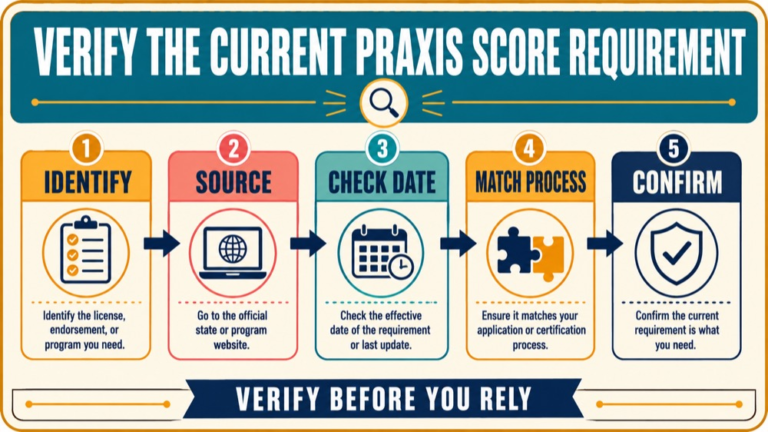
Use the first map whenever a score page, report, or search result leaves you unsure. Follow the sequence from source and exam identity to report field, process, and next verification. Keep your own study interpretation in a separate lane so it cannot silently replace the current requirement.
| Map step | Write | Output |
|---|---|---|
| Source | URL, owner, and checked date. | A traceable fact. |
| Exam | Full name and number. | The right frame. |
| Report | Field and displayed wording. | A precise observation. |
| Process | Testing, certification, licensure, or employer step. | The responsible workflow. |
| Question | What remains unclear? | A focused clarification. |
| Review | What study action follows? | A dated next step. |
This workflow is deliberately small. It is easier to repeat before registration, after receiving a report, and when updating a study guide that contains administrative language.
SEPARATE SCORE FACTS FROM STUDY SIGNALS
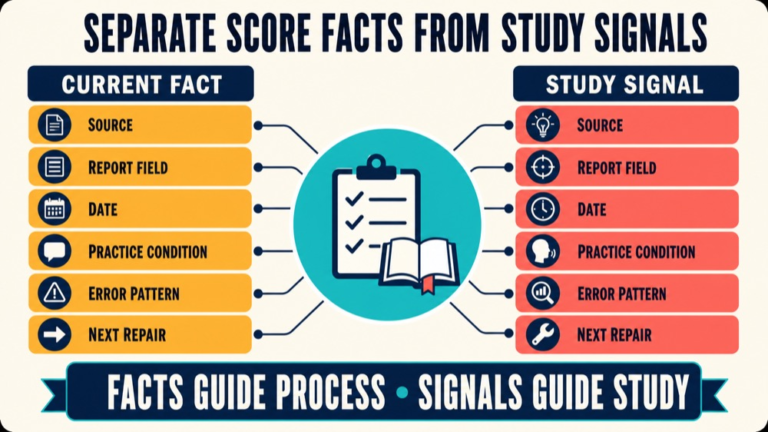
The second map separates a score fact from a study signal. A current source answers what the process requires; your log answers what happened under your practice condition; the repair plan answers what you will do next.
- FACT: cite the current source.
- FIELD: quote or describe the report field.
- CONDITION: record timing, content mix, and environment.
- PATTERN: classify repeated errors and confidence.
- REPAIR: choose one targeted study change.
- TRANSFER: solve a changed-context item later.
Do not let the study signal become a forecast. It is a planning input that should be revisited when the condition or the source changes.
Build the next study cycle
Choose the next cycle from the strongest pattern in your notes. If pacing is the issue, use checkpoints and a return rule. If evidence reading is weak, require an evidence-to-action sentence. If access and function disappear, add those fields before looking at the options.
- Review: select a small mixed set.
- Record: mark confidence, clue, distractor, and boundary.
- Repair: choose one category and one resource.
- Transfer: change one context detail after a delay.
- Compare: review the reasoning record across sessions.
Keep the next action concrete and dated. “Study more” is not a useful plan. “Review evidence and context errors for 30 minutes, then solve three changed-context items on Friday” gives you a condition you can inspect.
Decide what to verify before a retake
Before changing a test date or planning a retake, verify the current provider and responsible-program information. Check registration, reporting, score-recipient, timing, and local process details directly. Then examine whether your preparation plan addresses the pattern you recorded.
If a score report is unclear, preserve the report and ask a specific question. Include the field name, the date, and the process you are trying to complete. Avoid posting private score information in a public study group when a direct channel is available.
Protect access and professional context
Score preparation should remain accessible. Consider language, disability access, technology, hearing, vision, fatigue, environment, and scheduling when you evaluate your own study conditions. A result collected under a barrier may need a better condition before it becomes a useful comparison.
Keep professional boundaries visible in clinical examples. A study article can teach evidence, context, function, safety, consent, privacy, competence, supervision, and handoff without making a claim about one person’s care or one jurisdiction’s complete process.
Score-check worksheet
Copy this compact worksheet into your notes:
- Exam name and number:
- Source URL and checked date:
- Process or jurisdiction being checked:
- Score-report field I am reading:
- Exact question I still have:
- Practice condition and content mix:
- Most common error category:
- Lowest-confidence correct pattern:
- One targeted repair:
- One changed-context transfer prompt:
- Next review date:
Complete the source fields first and the study fields second. That order makes it clear which statements are current facts and which are your own preparation decisions.
Common questions to take to the source
Use these questions to guide a source check:
- Which exam and number does this requirement name?
- Which process uses the score?
- Who owns the current requirement?
- What date was the page or document checked?
- What does each score-report field mean?
- Where should a report be sent?
- What changes if the jurisdiction or program is different?
- What should I do if two public sources conflict?
- Which part is a study signal rather than an administrative fact?
- When should I revisit the source?
Sources and next steps
For the current study frame, review the ASHA Speech-Language Pathology 5331 content page and the live ETS 5331 page. Use the ETS passing-score resource for current public score context, and use the ASHA Practice Portal for clinical topic context.
For language and cultural context, review the ASHA Multilingual Service Delivery and ASHA Cultural Responsiveness resources. Recheck current state, program, employer, agency, school, facility, and professional requirements before relying on an administrative detail.
Next, complete the worksheet, verify the current source, classify one score signal, and schedule one targeted repair with a changed-context review.
Continue your preparation: Explore the SLP Study Center learning resources.