speech language pathology clinical scenario questions are designed to test how you move from a crowded clinical vignette to one defensible next decision. First identify whether the scenario is asking you to clarify, screen, assess, interpret, treat, support, refer, document, or monitor. Then sort the clues by communication domain, access, urgency, function, and professional responsibility.
The current ASHA Speech-Language Pathology 5331 content page provides a professional study frame that includes screening, assessment, treatment, evidence-based practice, and professional practice. The ASHA Practice Portal supplies topic-specific clinical context, while the current ETS 5331 page supplies exam identity and changing administrative context. The scenarios, answer choices, rationales, and visual maps below are original learning material, separate from live test material and not individualized clinical advice.
Good scenario reasoning is not a hunt for one dramatic symptom. It is a disciplined sequence that keeps the person, task, language, mode, partner, setting, safety, competence, and follow-up visible. An answer can be cautious and still decisive when it names the action that best reduces uncertainty or protects the person now.
What speech language pathology clinical scenario questions are testing
A clinical scenario question may look like a diagnosis question, but the tested task can be different. The stem may ask for the next assessment step, the best treatment plan, the safest response, the most appropriate referral, or the meaning of a result under certain conditions. Read the task verb and then organize the scenario around it.
| Scenario task | Clue to locate | Reasoning output |
|---|---|---|
| Identify | What communication, swallowing, access, or professional issue is described? | State the concern without adding a label. |
| Screen | Is the question whether further evaluation or referral may be needed? | Choose a brief risk or next-step process. |
| Assess | What construct, activity, or condition needs a fuller description? | Select evidence that represents the decision. |
| Interpret | What do the score, observation, report, or response to support mean here? | Separate evidence from a broad conclusion. |
| Treat or support | Which target, goal, method, cue, partner, or environmental change fits? | Connect the action to function and outcome. |
| Refer or collaborate | Which question, safety issue, or role exceeds the current evidence or competence? | Make a clear, timely, documented handoff. |
| Monitor | What outcome or new information will guide the next decision? | Name the review point and adaptation rule. |
Several answer choices may be compatible with good care in a different situation. For example, a language sample, standardized measure, partner training, visual support, referral, or treatment activity can all be useful, but their fit depends on the question. The best answer is the one that matches the information given, the decision requested, and the sequence of responsible action.
Before reading the options, write a short “scenario spine”: person, activity, setting, change or concern, evidence, decision, and review. This keeps an attractive but premature label from controlling your answer.
Name the decision type first
Start by asking what the clinician or team must decide now. “What is the diagnosis?” may not be the scenario’s real task. It could be “Should the screen stop?”, “What evidence is needed to understand the classroom difficulty?”, “Which mode supports the work activity?”, or “How should the treatment plan change when structured accuracy improves but participation does not?”
| Decision verb | What it asks you to do | Common mistake |
|---|---|---|
| Clarify | Turn a broad report into an observable question about task, context, and impact. | Accepting the referral label as the construct. |
| Screen | Use a focused procedure to decide whether further evaluation or action may be needed. | Treating a screen as a complete evaluation. |
| Assess | Select and integrate evidence that describes the relevant skill, activity, or condition. | Choosing a familiar tool without checking fit. |
| Interpret | Explain what data support, what they do not support, and what context shaped them. | Turning one score into a broad conclusion. |
| Treat | Connect goal, target, method, access, practice, and outcome. | Starting with a technique name. |
| Refer | Define the question another professional or team member should address. | Handing off without communication or continuity. |
| Monitor | Compare meaningful outcomes and decide whether to continue, adapt, or investigate. | Collecting data without a review rule. |
When a scenario includes both an immediate and a later decision, separate them. A patient may need an immediate safety response and a later comprehensive evaluation. A student may need an access change now and a fuller assessment after hearing and language history are reviewed. Choosing the later action should not delay the immediate one.
Sort clues by domain and urgency
After naming the decision, classify the clues. A domain clue identifies the communication or professional area. An access clue tells you whether the person could show the skill under the given conditions. An urgency clue changes order or safety. A functional clue explains why the decision matters.
| Clue type | Examples | Question to carry forward |
|---|---|---|
| Communication pattern | Speech, language, fluency, voice, cognition, social communication, or AAC behavior. | What skill or activity is observable? |
| Access condition | Hearing, vision, motor response, device, language, dialect, literacy, environment, or partner support. | Could access change the sample? |
| Health or safety | Sudden change, alertness, respiratory status, nutrition, hydration, pain, fatigue, or risk sign. | Does this change urgency or require a protocol? |
| Functional impact | School, work, home, care, relationships, participation, or communication of basic needs. | Why does the decision matter? |
| Professional process | Consent, privacy, competence, supervision, documentation, collaboration, or local requirements. | Which role and boundary apply? |
| Outcome clue | Change with cueing, task, partner, setting, treatment, or time. | What should be measured or reviewed next? |
Do not treat all clues as equal, and do not erase a clue because it does not fit your first hypothesis. If a patient’s alertness changes, that may affect safety before a detailed interpretation. If a multilingual student performs differently across languages and partners, that may affect method selection before a broad conclusion. If a device enables communication, that may affect the response mode and the functional plan.
- Circle the decision verb.
- Underline the activity, partner, setting, language, and mode.
- Mark any change in time, health, alertness, fatigue, hearing, environment, or support.
- Separate the observed response from the label used by a report.
- Identify the evidence or action that would most directly answer the decision.
This sorting habit turns a long vignette into a manageable grid. It also protects against a common test-taking error: choosing the answer linked to the most memorable term instead of the answer linked to the decisive condition.
Match the method to the scenario
Once the scenario question is clear, choose a method that can answer it. The method can be an interview, observation, screening procedure, formal measure, language sample, dynamic probe, treatment data review, team consultation, or referral. Explain why the method fits and what it cannot establish.
| Scenario need | Method direction | Fit check |
|---|---|---|
| Referral clarification | Vague label or broad concern. | Interview, task analysis, and context-specific observation. |
| Screening | Need for a rapid risk or referral decision. | An approved, purpose-matched screening process with clear follow-up. |
| Comprehensive assessment | Need to characterize a communication or swallowing profile. | Multiple appropriate sources, measures, observations, and collaboration. |
| Functional assessment | Need to understand participation in a real routine. | Natural observation, partner report, activity analysis, and accessible sampling. |
| Treatment review | Need to decide whether a plan is working or should change. | Comparable outcome data with support, task, and partner conditions documented. |
| Safety or referral | Risk, urgent change, or question outside the current role. | Stop or escalate according to protocol, communicate, document, and follow up. |
A method can be valid for its intended use and still be a poor choice for the scenario in front of you. Check construct, population, language, dialect, response mode, administration, environment, burden, and functional relevance. If the scenario changes one of those conditions, the answer may need to change.
When a formal score and a natural sample disagree, do not force them into one number. Ask whether they represent different constructs, tasks, partners, languages, support levels, or time points. The disagreement can be a clue about access, transfer, fatigue, or the need for further assessment.
Use context to interpret performance
Performance is a relationship between a person and a task under conditions. Record what the person was asked to do, which response route was available, who the partner was, how much support was provided, and what the consequence was. The same person can show different performance in a quiet clinic, a group classroom, a work meeting, a family routine, or a medical setting.
| Context variable | How it may shape the sample | Reasoning response |
|---|---|---|
| Language or dialect | Familiarity, exposure, vocabulary, syntax, discourse, or dialect features affect the task. | Gather history, use responsive methods, and state interpretation limits. |
| Communication mode | Speech, gesture, sign, writing, AAC, drawing, or partner-assisted options change response access. | Separate knowledge from output route and honor effective modes. |
| Partner | Prompts, wait time, familiarity, expectations, and interaction style change opportunity. | Describe partner support and include relevant partners in planning. |
| Environment | Noise, visual load, distance, time pressure, routine, and group demands change access. | Observe or adapt the setting that matters. |
| Health and fatigue | Alertness, pain, medications, respiration, nutrition, hydration, and endurance change performance. | Check urgency, safety, timing, and comparability. |
| Task demand | A drill, conversation, explanation, meal, or work task requires different skills. | Match the construct and outcome to the activity. |
Context is not a reason to dismiss a difficult performance. It tells you how to interpret it and what to do next. A student who misses directions in noise may need both access support and targeted assessment. An adult who communicates with a device may need support for one work activity while also needing speech-motor assessment. A patient with a risk signal may need a safety response before a complete profile can be collected.
Move from assessment evidence to action
Do not stop at a score or observation. Ask what the evidence changes. A useful conclusion links the result to function, access, safety, treatment, referral, or monitoring. If the evidence is incomplete, choose the next source that can reduce the most important uncertainty.
- Describe: state the performance and conditions without a global label.
- Interpret: identify the construct or concern the evidence may address.
- Bound: name language, access, measurement, context, or role limits.
- Act: select support, treatment, referral, collaboration, documentation, or monitoring.
- Review: define the outcome or new information that will guide the next decision.
For treatment scenarios, use the chain goal → target → method → support → practice condition → outcome. For assessment scenarios, use decision → construct → method → access and validity → functional action. For safety scenarios, use signal → stop or precaution → notification → documentation → qualified follow-up.
The best answer is often the one that makes the chain visible. A technique without a target is incomplete. A score without a decision is incomplete. A referral without a question or handoff is incomplete. A precaution without communication and documentation is incomplete.
Account for language, culture, and access
Clinical scenarios can hide the decisive fact in language history, dialect, culture, communication mode, hearing, vision, motor access, technology, health literacy, or partner support. Ask whether the scenario gave the person a fair way to show knowledge and participate in the task.
The ASHA Multilingual Service Delivery resource supports attention to language history, exposure, use, dialect, appropriate assessment, and language access. The ASHA Cultural Responsiveness resource supports reflective, accessible, person-centered practice. These resources do not create a single translation rule or a universal cultural checklist.
- Identify which languages, dialects, modes, and partners are relevant to the scenario.
- Check whether the method’s instructions, norms, response demands, and materials fit the person.
- Use an interpreter or qualified collaborator when needed and define the communication role.
- Document accommodations, adaptations, supports, and interpretation limits.
- Include the person’s priorities, values, routines, and preferred communication route.
- Separate a difference or access barrier from evidence of a communication disorder.
Access can change the evidence and the action. If the answer choice removes an effective communication mode, ignores a needed hearing check, or treats a dialectal pattern as a deficit, examine it carefully. If an option adapts the route while preserving the meaningful goal, it may better fit the scenario.
Protect safety, scope, and handoffs
Safety and professional process are part of scenario reasoning. A new risk sign, reduced alertness, sudden communication change, inability to communicate basic needs, privacy issue, consent issue, or question outside competence can change the correct sequence. Follow the relevant setting protocol and involve the responsible team.
Scope includes education, training, experience, supervision, competence, setting, and person risk. Collaboration strengthens care when roles and communication are clear. It does not mean that responsibility disappears after a referral. State what was observed, why the handoff is needed, what should happen next, and how continuity will be maintained.
| Scenario boundary | Reasoning action | Documentation focus |
|---|---|---|
| Safety signal | Stop, modify, or escalate according to the protocol. | Condition, response, notification, precaution, and follow-up. |
| Communication access | Provide or request an accessible route before interpreting the response. | Mode, support, partner, accommodation, and effect. |
| Role or competence | Consult, supervise, refer, or seek training as appropriate. | Question, responsibility, oversight, and handoff. |
| Consent and privacy | Explain purpose, participants, information use, and choices. | Consent process, communication, and privacy boundary. |
| Local requirement | Verify current law, payer, employer, school, facility, or agency rule. | Source, date, decision, and unresolved question. |
A practice question can teach the pattern, but a live decision requires current guidance and local requirements. Do not use an educational scenario as a substitute for a complete assessment, clinical protocol, or individualized professional judgment.
Sort a Clinical Scenario by Decision
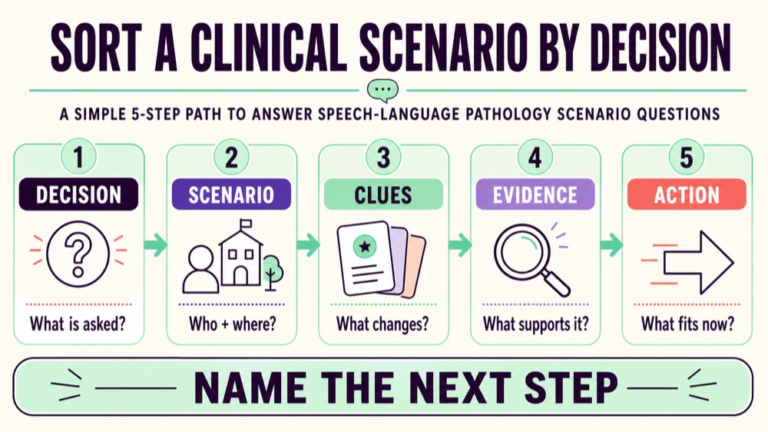
Use this visual sequence when a scenario contains several domains at once. Begin with the decision verb, then sort the person, task, setting, and access conditions. Place the evidence under observation, report, measure, or response to support. End with the action and review point.
| Map step | Margin prompt | Question to ask |
|---|---|---|
| 1. Decision | Clarify, screen, assess, interpret, treat, refer, or monitor? | What does the question actually ask? |
| 2. Scenario | Who, what activity, where, with whom, and when? | Which context changes the meaning? |
| 3. Clues | Domain, access, urgency, function, and professional process. | Which clue is decisive rather than merely vivid? |
| 4. Evidence | What is observed, reported, measured, or changed with support? | What does each source support? |
| 5. Action | What is proportionate now, and what needs follow-up? | Does the choice protect fit, safety, and continuity? |
Try a one-variable contrast. Keep the same communication pattern but change the setting. Keep the same score but change the language history. Keep the same treatment response but change the support level. Keep the same safety sign but change the local protocol. Explain why the best action changes or remains stable.
From Scenario Clue to Safe Action
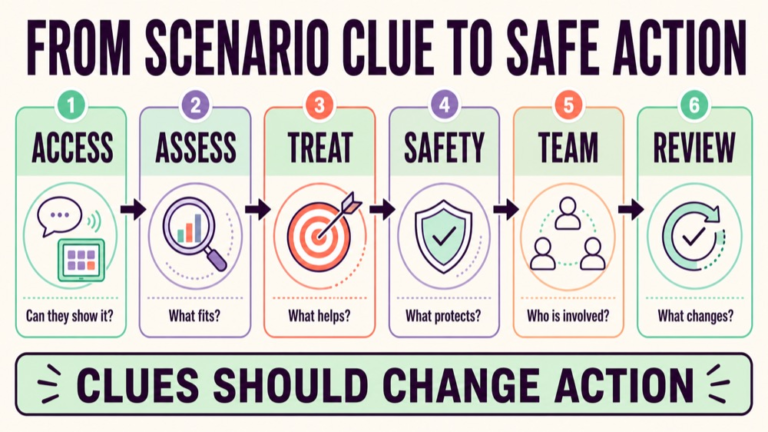
Use this second map for the “what next?” part of the scenario. A clue becomes useful when it changes an action. Sort it into access, assessment, treatment, safety, collaboration, or follow-up, then write the boundary that keeps the decision responsible.
| Scenario clue | Possible next action | Boundary to keep visible |
|---|---|---|
| Performance changes with support | Record the support, compare conditions, and plan access or fading. | Supported performance is not the same field as unsupported performance. |
| Reports disagree | Clarify tasks and settings, then gather comparable evidence. | Do not choose one perspective without checking context. |
| Formal score is low | Review construct, language, administration, and functional relevance. | One score does not answer every decision. |
| Risk or alertness changes | Follow stop, notification, precaution, and referral procedures. | Do not stretch a screen into a different evaluation. |
| Question exceeds role | Consult or refer with a defined question and continuity plan. | Role clarity and documentation still matter. |
| Treatment outcome is mixed | Inspect goal, target, cueing, practice condition, partner, and outcome. | A narrow gain may not represent participation transfer. |
After choosing an answer, complete the sentence: “This option fits because ___; it does not claim ___; I would review ___ next.” That is a compact way to practice both action and evidence boundaries.
Question 1: hearing access and classroom communication
Practice Question 1. A student follows spoken directions in a quiet therapy room but frequently misses instructions during noisy classroom transitions. The student’s teacher reports inconsistent listening, and the student has not had a recent hearing review. Which next step best fits the scenario?
A. Conclude that the student has a receptive-language disorder based on classroom performance.
B. Repeat the quiet-room direction task until the student reaches a passing percentage.
C. Clarify the classroom communication demands, review hearing and language history, observe relevant routines, and select targeted assessment or access supports based on the refined question.
D. Tell the teacher to speak louder and close the communication referral.
Correct Answer: C. The performance contrast points to a context-sensitive question involving noise, hearing access, language load, partner behavior, and classroom demands. A targeted history and observation can guide the next assessment or support. The scenario does not provide enough information for a broad language conclusion, and a louder voice alone does not answer the referral.
Why the Other Options Are Wrong: A turns one setting-specific pattern into a global label. B keeps the task that may not represent the concern and treats a percentage as the main decision. D may change access in one moment but does not check hearing, clarify the task, or determine whether more assessment is needed. C uses the contrast as the evidence clue.
Exam Trap: When a communication pattern changes with noise or distance, look for hearing and access reasoning before treating the pattern as a language conclusion.
Question 2: motor speech, language, and functional evidence
Practice Question 2. An adult after a neurologic event has imprecise speech during a three-minute conversation. The adult uses accurate gestures and a text-to-speech device to explain a work task, but the referral asks whether the adult has a “language problem.” Which response best demonstrates scenario reasoning?
A. Use the conversational speech sample alone to decide that language is impaired.
B. Require speech-only responses so the profile can be compared with a standardized format.
C. Separate speech-motor clarity from language formulation and functional communication, then assess the work task across accessible modes and relevant partners.
D. Ignore the speech sample because the device and gestures are available.
Correct Answer: C. The scenario contains information about speech clarity, language use, motor access, communication mode, and work participation. The next step is to clarify which construct the referral concerns and sample the work activity with accessible modes. Functional success does not erase a speech concern, and imprecise speech does not establish a broad language interpretation by itself.
Why the Other Options Are Wrong: A confuses speech output with the entire language profile. B removes an effective access route and changes the functional question. D discards relevant information about speech clarity and possible support needs. C separates constructs and connects assessment to the person’s work goal.
Exam Trap: A scenario can include a real motor-speech difficulty and effective multimodal communication at the same time. Keep the constructs separate and assess the activity that matters.
Question 3: swallowing risk and professional action
Practice Question 3. During a facility-approved swallowing screen, a patient becomes drowsy and develops a new wet vocal quality after a trial. The local protocol says to stop the screen and notify the responsible team. What is the best next action?
A. Continue with additional trials to decide whether aspiration is present.
B. Record the earlier successful trial as the final result and continue the meal.
C. Stop according to the protocol, communicate the change, document the conditions and response, and arrange the appropriate comprehensive follow-up.
D. Ask a support person without screening competency to complete the remaining trials.
Correct Answer: C. The changed alertness and vocal quality are risk information within the stated protocol. The screen should not be expanded into a full physiologic evaluation, and an earlier trial does not erase a later change. The appropriate action protects safety, communicates the result, records the screen’s limit, and connects the patient to the next qualified evaluation or team process.
Why the Other Options Are Wrong: A ignores the stop instruction and asks a brief screen to answer a broader question. B treats earlier performance as the final result despite changed conditions. D transfers a safety-sensitive task without appropriate competence and oversight. C follows the scenario’s safety and handoff requirements.
Exam Trap: A safety clue changes the sequence. Follow the stated stop and notification process before trying to collect more detail.
Review common scenario distractors
Scenario distractors often contain a true action that is missing the current decision, context, or professional boundary. Use the table to identify the shortcut.
| Distractor pattern | Why it sounds plausible | Correction |
|---|---|---|
| Diagnosis before description | The label appears to solve the case quickly. | Describe the pattern and decision first. |
| Tool before purpose | A familiar test or technique is easy to recall. | Match the method to the scenario question. |
| Pass means no concern | A single result sounds final. | Interpret the result under its conditions and remaining concern. |
| One context represents all contexts | The sample is convenient and clear. | Compare the activity, partner, setting, language, and support. |
| More data without a plan | Additional testing sounds rigorous. | Collect evidence that can change the decision. |
| Support equals independence | The person completed the task with help. | Record cue level and plan for access and transfer. |
| Referral as abandonment | The clinician feels pressure to answer alone. | Use collaboration and continuity to protect care. |
| Urgency ignored | The question is framed as a routine test item. | Follow safety and notification steps before lower-priority analysis. |
When two answers seem reasonable, compare them on decision fit, evidence fit, access fit, safety and role fit, and follow-up fit. An answer that sounds more certain is not automatically stronger. An answer that is more cautious is not automatically better if it fails to provide a useful action. Choose the option with the clearest relationship between the clues and the next step.
Build a clinical-scenario practice block
Practice one scenario from each major decision type: clarify a referral, screen for risk, choose assessment evidence, interpret a result, plan treatment, respond to a safety clue, and coordinate a handoff. Rotate speech, language, fluency, voice, cognition, AAC, feeding, swallowing, hearing access, and professional-practice topics.
- Circle the question verb.
- Write the person, activity, setting, partner, language or mode, and time course.
- Sort the clues into communication, access, urgency, function, and professional process.
- Write the most important missing fact and why it matters.
- Label each answer choice by its action and sequence.
- Choose the option that best fits the evidence and boundary.
- Explain why the other options overreach, skip a step, remove access, or ignore safety.
- Write the review point or outcome that would change the plan.
Use a short rationale format: “The scenario asks for ___. The decisive clue is ___. Therefore ___ is the best next step because ___. The remaining limit is ___.” This keeps the reasoning explicit without copying the answer key.
Track scenario decisions and confidence
Record the clue that drove your answer and the shortcut you avoided. Track low-confidence correct answers as well as misses. A correct letter without a transferable explanation may not hold when the setting, language, partner, or decision changes.
| Log field | Example entry | What it reveals |
|---|---|---|
| Decision verb | Assess the classroom communication concern. | Whether the scenario task was identified. |
| Decisive clue | Quiet-room success contrasted with noisy transition difficulty. | Whether access and setting were noticed. |
| Missing fact | Recent hearing information and classroom task details. | What should be checked next. |
| Action | Review history, observe, and choose targeted measures or supports. | Whether the answer is proportionate. |
| Shortcut | Referral label treated as a global language conclusion. | Which reasoning habit needs repair. |
| Confidence | 57% before rationale, 90% after explaining the contrast. | Whether the rule is explicit. |
| Review trigger | The plan changes when the communication mode or setting changes. | How to transfer the rule. |
Build a personal list of decision rules: identify the task under the label; compare conditions; match method to purpose; keep access visible; respond to safety in sequence; connect treatment to function; and document handoffs. These rules travel across clinical domains.
Clinical-scenario questions checklist
Use this checklist before selecting an answer. It is a study aid, not a replacement for current ASHA guidance, local policy, supervision, applicable law, or individualized clinical judgment.
- Did I identify the question verb and decision type?
- Did I define the person’s activity, partner, setting, language, mode, and priority?
- Did I separate an observed behavior from the referral label or interpretation?
- Did I sort clues by communication domain, access, urgency, function, and professional process?
- Did I choose a method that fits the construct and decision?
- Did I interpret a score or report within language, administration, measurement, and context limits?
- Did I connect treatment choices to goal, target, support, practice, and outcome?
- Did I recognize stop conditions, safety signals, consent, privacy, competence, supervision, and referral needs?
- Did I include the person’s priorities and an accessible communication route?
- Did I explain why the alternatives are out of sequence, too broad, inaccessible, unsafe, or unsupported?
- Did I state what new fact or outcome would change the plan?
- Did I keep this original practice material separate from live test material and individual clinical advice?
The core sequence is: name the decision, sort the clues, check access and urgency, match the evidence, act proportionately, and review.
Sources and next steps
For the Praxis professional study frame, review the current ASHA Speech-Language Pathology 5331 content page and the current ETS 5331 page. For topic-specific clinical context, use the relevant ASHA Practice Portal guidance. For language and cultural context, review ASHA Multilingual Service Delivery and ASHA Cultural Responsiveness.
For current preparation-resource context, use the live ETS practice-test page. The scenarios, answer choices, rationales, maps, and checklists on this page are original educational material. Recheck live sources before relying on exam administration details, state or agency requirements, clinical policy, or a professional decision.
For your next review, take one scenario and change one variable: setting, language, partner, communication mode, alertness, or decision type. Explain which clue changes, which action changes, and which part of the plan remains stable.
Continue your preparation: Explore the SLP Study Center learning resources.