slp praxis what to bring is a practical question with a high-stakes answer: bring the correct physical identification, follow the current appointment instructions, and do not assume that a familiar item is allowed in the testing room. A short checklist can prevent a last-minute trip, an avoidable delay, or a problem at check-in.
This U.S.-focused guide is built around current ETS identification and test-center guidance for Praxis candidates. The current pages say ID requirements depend on testing location and citizenship, the name on your registration must match the primary ID, original physical documents are required, and personal items are restricted. Your Praxis account and the instructions for your exact delivery mode control on test day.
The short answer: what to bring to the SLP Praxis
For a U.S. test-center appointment, start with one acceptable and valid physical photo ID that meets the current ETS requirements. The current ETS test-day page also says to bring a calculator only if it is allowed for your test and a face mask if required. For the 5331, do not add personal study supplies simply because you used them at home; the center controls what enters the room.
- Bring: an original, valid, physical ID that meets the current name, photograph, and signature requirements.
- Bring only when allowed: a calculator or other test-specific item named by the current instructions.
- Prepare in advance: a route, arrival buffer, appointment confirmation, and a plan for storing personal items.
- Ask before registering: if you need equipment, beverages, snacks, or extra or extended breaks for a health-related reason.
- Do not rely on: a phone image of your ID, a photocopy, an expired document, or an old checklist from another exam.
That short list is intentionally conservative. Before leaving, open your Praxis account and read the current details for the exact appointment. The current ETS guidance says candidates should verify the test location in the account and review the important items to bring.
Make an allowed-items checklist
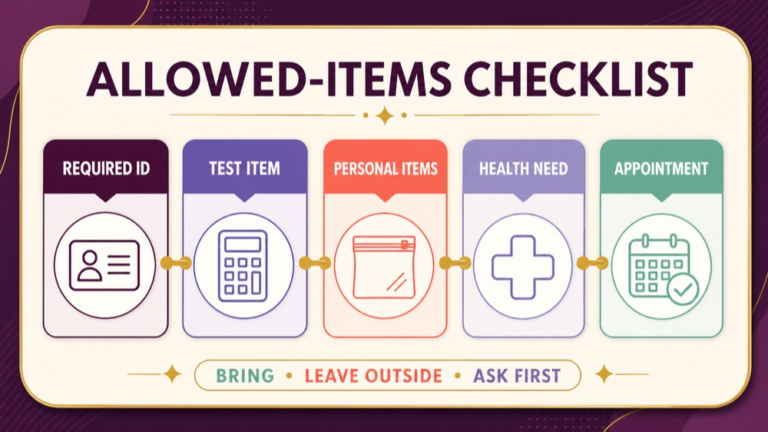
Use a three-column checklist: bring, leave outside, and ask first. This keeps “I might need it” separate from “the current rules permit it.” At a test center, personal items other than ID documents are not allowed in the testing room or during breaks according to the current ETS page. Items you cannot use may need to be stored, and the center may not take responsibility for what you choose to bring.
| Category | What to do | Why it matters |
|---|---|---|
| Required ID | Bring the original physical document and check validity, photo, signature, and name match. | Admission depends on meeting the current ID rules. |
| Test-specific item | Bring a calculator only if the current instructions allow it for your test. | “Helpful for studying” does not mean “permitted in the room.” |
| Personal items | Leave phone, watch, notes, bags, and valuables at home when practical. | Restricted items may need storage and are not available during the test. |
| Health-related item | Ask about accommodations before registering if the item or break changes the testing conditions. | Approval may be required for equipment, beverages, snacks, or extra breaks. |
| Appointment record | Keep the current details accessible for travel and check-in, without assuming it replaces ID. | It helps you verify where and when to go; it is not a substitute for required identification. |
Do not pack a large “just in case” bag. A smaller bag makes the storage step simpler and lowers the chance that you forget a restricted item in a pocket.
Check your primary ID before test day
The current ETS ID requirements page says the document used for admission must be acceptable and valid, with your name, signature, and a recognizable photograph. Documents must be original, not copies, and the ID must be physical rather than displayed on a cell phone or another electronic device. The document cannot be expired or damaged in a way ETS treats as invalid.
For testing in your country of citizenship, ETS currently says one primary ID with your name, photograph, and signature is generally needed. The page lists examples such as a passport, a U.S. passport card with supplemental ID, a valid government-issued driver’s license, a state ID issued by a motor vehicle agency, a national ID, a qualifying provisional driver’s license, and a military ID with limitations for at-home testing. Use the live list for your situation.
| ID check | Question to ask yourself | Action before test day |
|---|---|---|
| Original | Is this the physical document issued by the authority? | Take the physical card or passport; do not bring a copy. |
| Validity | Is it current and undamaged? | Replace or clarify an expired, cracked, hole-punched, or altered document. |
| Photo | Is the photograph recognizable and current enough under the rules? | Use an alternate acceptable ID or contact ETS if uncertain. |
| Signature | Does the document carry a signature, or will a supplemental ID be needed? | Check the current primary and supplemental ID instructions. |
| Physical format | Am I bringing the document itself rather than a phone image? | Put the physical ID in the same safe place you will use on the day. |
If you are testing outside your country of citizenship, the current ETS page says a valid passport is required as the primary ID, with limited additional options in specified situations. That is a different branch from the usual U.S. citizen testing-in-country checklist.
Match your registration name to your ID
Name matching is one of the most important parts of what to bring because a valid document can still create a problem if the registration record uses a different name. ETS says the name used when creating the account and registering must exactly match the name on the primary ID presented on test day. The current page warns that a mismatch can prevent admission and forfeit test fees.
Check the entire first name, last name, hyphenation, and two-part surname. Do not shorten a given name because friends use a nickname. If the ID has two last names, enter them as they appear. The ETS page also describes how a very long name may display in shortened form in the registration system, so read the current explanation before assuming a display difference is an error.
- Compare the registration record with the physical ID character by character.
- Check hyphens, spaces, suffixes, and two-part family names.
- Do not expect a student ID or another document to repair a primary-ID last-name mismatch.
- If your name changed, read the current ETS name-change instructions before the appointment.
- Save the date you checked the account and contact ETS when the records do not match.
Do this check before test day, not at the center desk. A last-minute discovery leaves fewer options, and a different piece of ID may not solve the registration-record problem.
Know when supplemental ID may be needed
A supplemental ID is not a universal extra item that every candidate must bring. It can become relevant when the test administrator questions the primary document or when an otherwise acceptable primary ID lacks a required name, photograph, or signature element. The current ETS page says supplemental ID must contain your name, a clear recent photo, and your signature, with additional restrictions on resolving last-name discrepancies.
If your primary ID does not contain a signature, ETS says you may sign the document or present an acceptable supplemental ID. If the supplemental ID also lacks a signature, a second government-issued photo ID may be required. Check the current list and bring a qualifying backup when your document situation makes that prudent.
| Situation | What the current guidance suggests | Planning move |
|---|---|---|
| Primary ID has name, photo, and signature | One primary document may meet the ordinary in-country requirement. | Still verify validity, physical format, and exact name match. |
| Primary ID lacks a signature | You may need to sign it or provide an acceptable supplemental ID. | Resolve the question before the appointment. |
| Administrator may question the document | A current supplemental ID may be required. | Bring a qualifying backup if the live rules support it. |
| Primary ID has a last-name discrepancy | Supplemental ID does not solve every mismatch. | Contact ETS and correct the registration issue before test day. |
| Document renewal is in progress | Special renewal or extension documents may apply in limited cases. | Read the current ETS rule for the exact document type. |
If you cannot meet the ordinary requirements because of a protected or unusual status, the ETS page gives a separate Office of Testing Integrity process. Follow that process before registering rather than arriving and hoping the center can grant an exception.
Know what stays outside the testing room
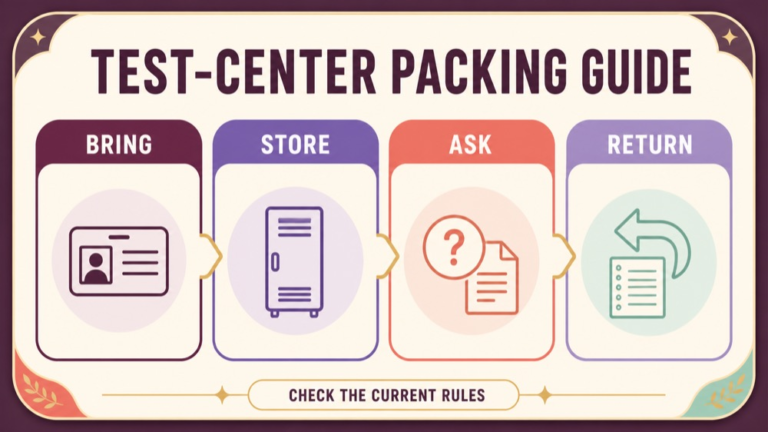
Knowing what not to bring is just as useful as packing the ID. The current ETS test-center page says personal items other than ID documents are not allowed in the testing room or permitted during breaks. You will be instructed where to store restricted items, and access to them is limited while the test is in progress.
- Leave study notes, flashcards, books, and printed outlines at home.
- Do not plan to use a phone, smartwatch, earbuds, or other electronic device in the room.
- Do not bring a personal pencil or scratch paper for use unless the current instructions specifically allow it.
- Do not assume a water bottle, snack, medication, or equipment can enter the room without an accommodation or explicit permission.
- Leave valuables at home when possible because the test center and ETS state they assume no responsibility for personal items brought to the center.
There is a difference between carrying an item into the building and being allowed to use it during the test. Follow the storage instructions and ask staff before making an assumption. A question at check-in is safer than an unapproved item in the testing room.
If you need a health-related item or a special break, do not treat the storage area as a workaround. The current ETS guidance directs candidates to request accommodations before registering when health needs affect equipment, beverages, snacks, or break length.
Plan arrival, check-in, and storage
What to bring works only if you arrive with enough time to complete the steps. The current ETS test-center guidance says to arrive 30 minutes before the appointment and plan to be at the center up to an hour longer than the actual test duration. Build that time into travel, parking, work notifications, childcare, and any ride home.
- Open the Praxis account and verify the test location and appointment details.
- Check the route, building entrance, parking, public transit, and a backup route.
- Place the required ID in an easy-to-reach but secure location.
- Arrive at least 30 minutes early under the current center guidance.
- Follow the administrator’s check-in, photo, visual inspection, sign-in, and storage instructions.
- Ask for help immediately if the computer, room, appointment, or ID process is unclear.
Test-center staff may assign your seat and control the storage area. During check-in, ETS says candidates can expect routine visual inspections, a photograph, and an ID check. Testing security rules begin at sign-in and continue through sign-out, including breaks.
| Time point | Bring or do | Keep in mind |
|---|---|---|
| Day before | Check account, ID, route, and current rules. | Do not rely on an old appointment screen. |
| Leaving home | Take the physical ID and only permitted test-specific items. | Keep restricted personal items to a minimum. |
| Arrival | Reach the center 30 minutes early under the current guidance. | The visit may last longer than the test itself. |
| Check-in | Follow staff instructions for inspection, photo, seat, and storage. | Ask rather than improvising. |
| Departure | Retrieve belongings and sign out as directed. | Return any testing materials first. |
Handle calculators, scratch paper, and breaks
Calculator, scratch-paper, and break rules are test-specific. The current ETS center guidance says to bring a calculator if it is allowed for your test, use only the scratch paper provided by the administrator during the test, and ask for help when you have a computer problem. Do not bring your own materials expecting them to be accepted.
The SLP Praxis 5331 is currently described by ETS as a computer-delivered selected-response test. That does not by itself answer every question about what you may hold, use, or access at a center. Use the current appointment instructions and test-center staff directions for the exact experience.
- Calculator: verify permission for the exact test before bringing or using one.
- Scratch paper: use only what the administrator provides under the current procedure.
- Restroom break: read the current break rule and follow sign-in, sign-out, and storage instructions.
- Food, drink, medication, or equipment: confirm the current allowance or accommodation before registering.
- Technical issue: raise your hand and let the administrator manage the computer problem.
Preparing the rules in advance helps you keep your attention on the questions. It also prevents a familiar study habit, such as reaching for your own notes or paper, from becoming a security issue during the appointment.
Plan for accommodations or special needs
If you need a testing condition that changes what you bring or how you use breaks, start with the current ETS accommodations process. The test-center page specifically says health-related equipment, beverages, snacks, and extra or extended breaks require an accommodation request before registering. The page also links to the current accommodations information.
Write down the question you need answered: “Can I bring this item?” may actually mean “What approval do I need, when must I request it, and where will the approved condition appear in my appointment?” Ask early enough to receive and save the response. Do not rely on a verbal assumption from a friend who tested under different conditions.
- Identify the item, break, or room condition you need.
- Read the current ETS accommodations requirements and lead-time instructions.
- Request approval before registering when the current process requires it.
- Keep the approval or appointment note with your private test record.
- Confirm how the approved condition will be handled at check-in.
For a delivery mode other than a physical test center, use the instructions attached to that appointment. A center checklist is not automatically an at-home checklist, and the current delivery rules control.
Avoid common what-to-bring mistakes
The most common packing mistakes come from using a generic exam list. Praxis tests can have different rules, and identification requirements can depend on location and citizenship. Check these patterns before the night before the appointment.
- Bringing a photo of an ID on a phone instead of the physical document.
- Using a photocopy, expired ID, or damaged document.
- Assuming a credit card, employee ID, birth certificate, or student ID can replace the required primary ID.
- Failing to compare the registration name with the full name on the primary ID.
- Bringing a calculator without checking whether the exact test permits it.
- Packing personal notes, a smartwatch, or other restricted items because they were useful while studying.
- Bringing food, drinks, medication, or equipment without checking the current accommodation or center rules.
- Arriving exactly at the appointment time instead of following the current early-arrival guidance.
- Forgetting that check-in, storage, and sign-out add time to the visit.
- Assuming a backup ID can repair a registration-record last-name mismatch.
- Using a test-center checklist for an at-home appointment without reading the delivery-specific instructions.
The repair is simple: open the current ETS page, compare it with your appointment, and pack only after the ID and allowed-item questions are answered.
SLP Praxis what-to-bring checklist
Use this checklist the day before a U.S. test-center appointment:
- Did I open my Praxis account and verify the exact test, date, time, and location?
- Is my primary ID original, physical, valid, undamaged, and acceptable under the current ETS rules?
- Does the full name on my registration match the primary ID, including hyphens and two-part surnames?
- Does the ID show the required photograph and signature, or do I need to resolve a supplemental-ID question?
- Am I testing in my country of citizenship, or does the current passport rule apply?
- Have I checked whether a calculator is allowed for this exact test?
- Have I left study materials, electronics, and unnecessary valuables at home?
- Have I confirmed the current rule for scratch paper, breaks, food, drinks, medication, or equipment?
- Have I requested any needed accommodation before registering when required?
- Do I have a route and arrival plan that gets me to the center 30 minutes early?
- Do I know where to ask for help if check-in, the room, the computer, or the appointment details are unclear?
- Have I planned enough time for storage, the test, sign-out, and the trip home?
The safest answer to slp praxis what to bring is not a giant bag. It is the correct physical ID, a verified appointment, only permitted test-specific items, and a clear plan for everything else.
Sources and next steps
Read the current ETS Identification Requirements for physical ID, name matching, primary and supplemental documents, and country-of-citizenship rules. Review ETS test-center test-day guidance for what to bring, personal-item storage, arrival, check-in, scratch paper, breaks, security, and end-of-test procedures. Confirm the current test context on the ETS Speech-Language Pathology (5331) page, and use the appointment-specific instructions in your Praxis account.
Continue your preparation: Explore the SLP Study Center learning resources.
Continue your preparation: Explore the SLP Study Center learning resources.