slp praxis test day strategies are about executing a plan when the clock, instructions, and nerves are all present at once. The goal is not to learn an entire field on the morning of the exam. It is to remove avoidable friction, protect your attention, and use a repeatable routine for each selected-response question.
Current ETS guidance says test-center candidates should verify the location in the Praxis account, bring acceptable identification, arrive 30 minutes before the appointment, expect the visit to last longer than the test itself, follow security procedures, and ask the administrator for help when a computer problem occurs. Use your own appointment instructions for delivery-specific details. This guide turns those requirements into a calm execution plan; it does not replace the current ETS rules.
What test-day strategies can control
Test-day tactics cannot replace preparation, and they cannot change the current exam content or a required score. They can control the number of decisions you have to make under pressure. A clear arrival plan, a practiced way to read a stem, and a reset routine can keep one unexpected moment from taking over the whole session.
Think of your plan in three layers. The first layer is logistics: appointment, location, identity documents, permitted items, travel, and check-in. The second is attention: sleep, food, breaks, breathing, and a way to restart after distraction. The third is question execution: read the task, identify the key evidence, compare choices, and manage time.
- Verify: use the current Praxis account and appointment details, not an old email or remembered location.
- Prepare: gather only items allowed by the current instructions and plan the arrival route.
- Practice: rehearse your reading, pacing, marking, and reset routines before test day.
- Protect: keep your attention on the current question instead of predicting what the next section will feel like.
- Decide: use the current score and cancellation instructions carefully before submitting or viewing an unofficial result.
Write the plan on one small page. The page is a prompt for actions, not a substitute for the official bulletin, account, or administrator’s instructions.
Build your test-day control panel
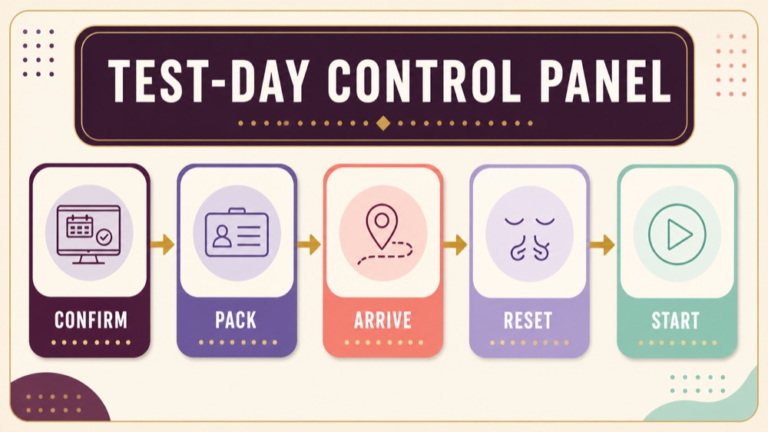
Use a control panel to convert a vague “be ready” goal into five visible checks. Review it the day before and once more before leaving. If you are testing at a center, the current ETS test-day page is the authority for what to bring, arrival timing, check-in, storage, scratch paper, and security. If you are testing at home, follow the current at-home instructions shown for your appointment.
- Confirm: open the Praxis account and verify the test, date, time, delivery mode, and location or launch instructions.
- Pack: prepare the acceptable and valid identification documents and only the other items the current instructions permit.
- Route: plan travel, parking, building entry, or the at-home testing space with extra time.
- Reset: choose a short breathing, stretch, or attention routine that you have already practiced.
- Start: decide how you will read the first instructions and settle into the question routine rather than rushing to feel ahead.
| Control-panel area | Question to answer | Evidence to keep |
|---|---|---|
| Appointment | What exact details does the account show today? | Current confirmation and account view. |
| Identity | Which valid ID documents will I present? | Documents checked against current ETS rules. |
| Arrival | How will I arrive 30 minutes early or meet the delivery check-in? | Route, parking, login, or room plan. |
| Allowed items | What can enter the testing room or be used during breaks? | Current test-day instructions. |
| Help | How will I signal a computer or appointment problem? | Administrator or support channel shown by ETS. |
Keep a second plan for ordinary disruptions: a delayed train, a full parking lot, a missing building sign, a weak internet connection, or a question about identification. The backup does not need to solve every possibility. It needs to tell you the next safe action and whom to ask.
Prepare your body and attention before check-in
Good test-day preparation begins with a normal evening, not a late attempt to replace weeks of study. Use the last night to reduce decisions. Set out the documents, confirm the appointment, prepare a familiar meal or snack if allowed, and choose a sleep window that gives you a chance to arrive alert. A new supplement, an unfamiliar meal, or an all-night review can add uncertainty.
Plan for the fact that the appointment can take longer than the test duration. ETS currently tells test-center candidates to arrive 30 minutes early and plan to be at the center up to an hour longer than the actual test duration. Add travel and building time to that estimate. Tell the person who expects you afterward that the end time may move.
- Use a familiar breakfast or pre-test meal that fits your own routine.
- Bring water, food, medication, or other items only when the current rules and any approved accommodation allow them.
- Wear practical clothing for the room and travel conditions.
- Set one alarm for waking and another for leaving or beginning the check-in process.
- Review your first two question steps, not an entire textbook.
- Plan a calm transition after the appointment instead of stacking an urgent commitment immediately afterward.
If your body feels activated, label the sensation as a cue to use the routine, not as evidence that you are unprepared. A slow exhale, a sip of water when permitted, or a brief grounding exercise can create enough space to read the next instruction accurately.
Use the check-in and tutorial time wisely
Check-in is part of the exam experience. Follow the staff’s instructions, complete the required agreements, and ask a concrete question if something is unclear. ETS states that security procedures begin at sign-in and continue through sign-out, including breaks. Personal items may need to be stored, and staff control the testing-room process.
At a test center, the current ETS guidance says candidates can use the allotted 30 minutes of practice time for the tutorial and other untimed sections before the test. Use that time to learn the navigation, confirm how to move through the screen, and settle your posture. Follow the instructions on your screen and from the administrator; do not assume a tutorial or scratch-paper rule from a different exam.
| Moment | Useful action | What to avoid |
|---|---|---|
| Before entering | Check the appointment and have the required ID ready. | Searching for old screenshots while the line moves. |
| During check-in | Listen for room, storage, and sign-in instructions. | Arguing from a remembered rule for another test. |
| During the tutorial | Practice navigation and notice how the screen marks questions. | Using the tutorial time to panic about one difficult topic. |
| When the test begins | Read the task and start with the routine you practiced. | Racing through the first item to create a false sense of speed. |
If the computer, room, or appointment details create a problem, raise your hand or use the current support path. A silent technical problem can cost more attention than a short request for help.
Use a question-pacing routine
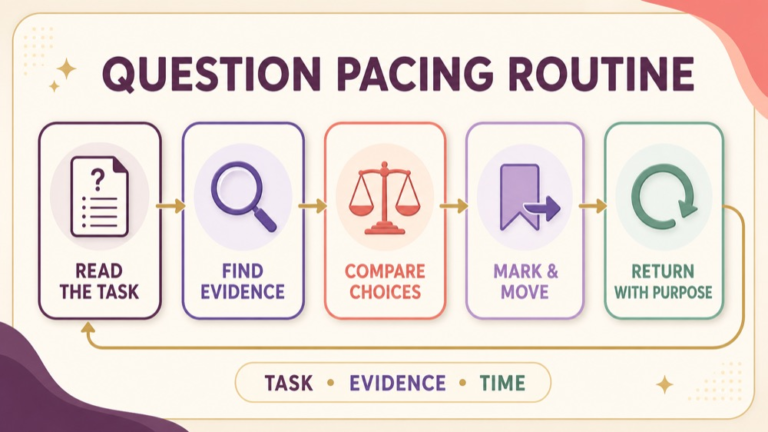
A pacing routine gives each question the same starting structure. The current 5331 page describes a 150-minute, 132-question selected-response exam. That works out to roughly 68 seconds per question as a broad planning reference, but it is not a command to spend exactly the same time on every item. Some questions will be quicker, some will require comparison, and navigation or review also uses time.
- Read the task: identify what the question is asking you to choose, prioritize, infer, or evaluate.
- Find the evidence: notice the client details, setting, time point, goal, or constraint that changes the decision.
- Compare the choices: remove choices that do not answer the task, then compare the remaining options against the evidence.
- Decide or mark: select the best-supported answer, or mark it and move when continued reading is no longer adding value.
- Return with purpose: if time remains, revisit marked questions using the task and evidence rather than a new wave of guessing.
Practice the routine before test day with a timer that is less important than your review notes. After each set, record where the process broke: did you miss the task, overlook a constraint, overvalue a familiar phrase, or spend too long on one choice? Repair the specific step.
| Clock signal | Question behavior | Strategy |
|---|---|---|
| Early in the session | You are reading carefully but moving slowly. | Use the task-and-evidence routine and avoid unnecessary rereading. |
| Middle of the session | You are choosing quickly but confidence is dropping. | Pause for one evidence check before selecting. |
| One item feels sticky | You are repeating the same comparison without new information. | Mark it, choose a next step, and protect the rest of the block. |
| Final review | You see unanswered or marked items. | Follow the current interface and review with a clear reason for changing an answer. |
The best answer is the one that fits the question’s task and evidence. Familiar wording, a dramatic detail, or an answer that sounds compassionate is not enough by itself; connect the choice to the professional decision the item asks you to make.
Handle a difficult question without losing the block
One difficult item can trigger a chain reaction: rereading, self-criticism, time pressure, and rushed choices on the next several questions. Use a three-pass approach. First, identify the task. Second, make the best comparison you can from the available evidence. Third, decide whether another pass is likely to add information. If not, mark it and continue.
- Underline the mental task: best next step, most appropriate, initial action, or strongest explanation.
- Separate the important client or professional facts from decorative details.
- Eliminate options that answer a different question or ignore a stated constraint.
- Compare the remaining options against safety, scope, assessment, treatment, or evaluation logic as appropriate.
- Choose the best-supported option when the item requires a decision, rather than waiting for certainty that the test cannot provide.
- Mark the item only if a later review has a defined purpose, such as checking a missed detail.
ETS’s current test-taking guidance says there is no penalty for guessing on the Praxis exam and advises answering every question. Follow the instructions for your specific appointment and interface, but do not intentionally leave a selected-response item unanswered when the current rules give you an opportunity to respond.
Do not turn a marked question into a personal referendum. It is one decision inside a long session. The strategy is to make the best evidence-based choice, record or mark it as allowed, and keep the next question from inheriting the previous question’s stress.
Protect focus through breaks and interruptions
Read the break rules for your exact exam and delivery mode. The current ETS test-center page says most tests do not include a scheduled break, but candidates have the option of an unscheduled 5-to-10-minute restroom break. It also explains that security rules continue during breaks and that personal items are restricted. Your appointment instructions and administrator’s directions control what you may do.
If you take an allowed break, make it a reset rather than a post-mortem. Use the restroom if needed, breathe, stretch, and return to the next instruction. Avoid reconstructing every prior answer or checking a phone that the current rules do not permit.
- Planned interruption: use the break procedure shown for the exam and return with a short reset phrase.
- Technical problem: raise your hand or use the listed support channel immediately.
- Noise or room issue: follow the center’s process and ask staff for help instead of silently losing focus.
- Weather or delay: listen to the center or ETS instructions and save any new appointment information.
- Attention drift: place both feet on the floor, exhale slowly, reread the task, and continue.
A short interruption is a problem to manage, not a reason to abandon the routine. If the event changes your appointment, document what happened and follow the current rescheduling or support instructions after the session.
Use a quick reset when anxiety rises
Anxiety often becomes more disruptive when you treat it as a question that must be solved before you can continue. Use a 20-second reset that returns attention to the next observable action. The exact length is flexible; the sequence matters more than the number.
- Stop moving the mouse or reading for a moment when the instructions allow it.
- Let your exhale run a little longer than your inhale without forcing a large breath.
- Relax your jaw and shoulders and feel your feet or seat.
- Name the task in plain language: “I need the best next step” or “I need to compare these choices.”
- Read the stem again from the task, then use the evidence and choice routine.
Practice the reset during timed question sets so it feels familiar. A reset does not promise that the item will become easy. It reduces the chance that a physical stress response will choose your pacing strategy for you.
Use supportive self-talk that is specific and credible: “I can follow the next step,” “I can mark and return,” or “I have a process for this.” Avoid adding a new performance demand such as needing to feel completely calm before you answer.
Finish the session and make the posttest decision
As the session ends, follow the current screen and administrator instructions. Return scratch paper as directed, retrieve stored items, sign out when required, and make sure you know whether you are being shown an unofficial result before you click through a decision screen.
The current ETS test-center page says a candidate may have the option to cancel scores at the end of the test but before viewing the unofficial score. The current score guidance explains that a canceled score cannot be reinstated and that a score report is not refundable. This is a high-consequence choice. Read the live wording, pause, and make the decision based on the current policy rather than on a feeling from one difficult item.
| After the last question | Check | Why it matters |
|---|---|---|
| Before submitting | Review unanswered or marked items if time and the interface allow. | Avoid losing an answer through an avoidable navigation step. |
| At the result screen | Read whether the next screen shows an unofficial result or a cancellation choice. | Know the consequence before selecting an option. |
| At sign-out | Return materials and follow staff instructions. | Testing security continues through the end of the appointment. |
| After leaving | Record the date, delivery mode, and any follow-up question. | Use accurate details when checking score reporting or contacting support. |
Do not try to estimate an official outcome from your emotions immediately afterward. Follow the current ETS score-reporting instructions for the report date and use the account to check the official result when it becomes available.
Avoid common Praxis test-day mistakes
Most avoidable test-day problems happen before the first scored question or between two questions. Run this list during your final preparation so the exam session is not the first time you think through the issue.
- Relying on a saved location or appointment email without checking the current Praxis account.
- Bringing an ID that does not match the current acceptable-document rules.
- Arriving at the appointment time instead of planning for the current early-arrival guidance.
- Assuming the test center, at-home, or another Praxis exam uses identical procedures.
- Carrying personal items into a restricted area or ignoring a staff instruction.
- Using scratch paper, a calculator, or a break in a way the current rules do not allow.
- Spending so long on one question that the next several answers become rushed.
- Changing an answer without identifying the evidence that changed your reasoning.
- Using a break to replay the entire exam instead of resetting attention.
- Clicking a score-cancellation or result option before reading the current wording.
- Leaving without recording a support or score-reporting question that still needs an answer.
The repair is a small pre-test control panel and a practiced question routine. You are trying to make the important actions ordinary before the appointment starts.
SLP Praxis test-day strategies checklist
Use this checklist with the current ETS instructions for your appointment:
- Did I verify the exact test, date, time, delivery mode, and location or launch details in my Praxis account?
- Did I confirm the current acceptable identification requirements?
- Did I check what items, breaks, scratch paper, calculator, and accommodations are permitted?
- Do I have a travel, parking, building-entry, or at-home check-in plan with extra time?
- Have I practiced a short breathing or grounding reset?
- Do I know the first step in my question routine: read the task and find the evidence?
- Have I practiced marking and returning without letting one item control the session?
- Do I know how to ask staff for help with a technical or room problem?
- Have I planned how to review unanswered or marked items if the interface allows?
- Will I read the current score or cancellation wording before selecting an option?
- Do I know how I will check the official score-reporting information after test day?
The most useful slp praxis test day strategies are simple enough to use under pressure: verify the logistics, follow the rules, read the task, compare the evidence, manage the clock, reset when needed, and make post-test choices only after reading the current instructions.
Sources and next steps
Review the current ETS test-center test-day guidance for arrival, identification, personal items, check-in, security, scratch paper, breaks, and end-of-test procedures. Use the ETS Speech-Language Pathology (5331) page for the current test format, question count, and duration. Read ETS test-taking strategies and study tips for written plans, breaks, practice, and question familiarity, and consult ETS test-day tactics for general pacing, instruction-reading, and answering guidance.
Continue your preparation: Explore the SLP Study Center learning resources.
Continue your preparation: Explore the SLP Study Center learning resources.