
If you are building an slp praxis study plan, begin with a learning system rather than a calendar copied from someone else. A useful plan connects the current ETS scope, your starting evidence, concept learning, clinical distinctions, original practice, error review, and the logistics you must verify. The number of study days matters, but the quality of the decisions inside those days matters more.
This guide gives you a flexible sequence for starting from scratch, returning after an uneven attempt, or moving beyond passive reading. It is not an official ETS schedule and it cannot predict an individual result. Use the current ETS Speech-Language Pathology 5331 page as the control point for changing scope and administration details, and use ASHA’s Praxis preparation guidance to keep the plan connected to the exam content and your own knowledge.
What a good study plan is designed to do
A plan is useful when it changes your next action. “Study assessment” is a topic label, not yet a task. “Explain the purpose of a selected assessment, identify the evidence it provides, compare it with a nearby choice, and answer a fresh scenario with a written rationale” is a task you can complete and review.
Build your plan around five outputs:
- Coverage: a visible map of what the current scope asks you to learn.
- Retrieval: the ability to explain important concepts without copying notes.
- Distinction: the ability to separate plausible options by purpose, evidence, timing, or boundary.
- Application: original practice that requires a decision in context.
- Adjustment: an error log that tells you what to do next.
These outputs keep a plan from becoming a race through pages. A learner who reads quickly but cannot explain a concept has a retrieval problem. A learner who knows definitions but chooses a nearby distractor has a distinction or application problem. A learner who keeps repeating the same missed idea has a review-loop problem. The plan should identify the problem before assigning more material.
Start with a baseline and a current scope map
Before choosing a weekly target, record two kinds of evidence: the current source and your current performance. Save the ETS page or companion information you used, note the date you checked it, and then complete a modest original diagnostic set. The diagnostic is not a prediction; it is a way to find where your first study decision should begin.
| Baseline question | What to record | What it changes |
|---|---|---|
| What does the current source cover? | Domain labels, task language, and items that can change. | The boundaries of your study map. |
| What can I retrieve? | Concepts you can explain without notes. | Which topics need active recall rather than rereading. |
| Where do I confuse choices? | Pairs of concepts or decisions that blur together. | Which comparison cards or scenarios to write. |
| Why do I miss items? | Knowledge, task-reading, application, timing, or careless errors. | The repair action for the next block. |
| What must I verify later? | Registration, delivery, score, or pathway details. | The date for a current-source recheck. |
Keep the baseline small enough to review. For each uncertain or missed item, write the task the prompt asked, the evidence that mattered, the reason your choice was tempting, and the concept that should transfer to a new situation. A raw percentage without that explanation is too thin to design a study plan.
Turn each domain into a learning task
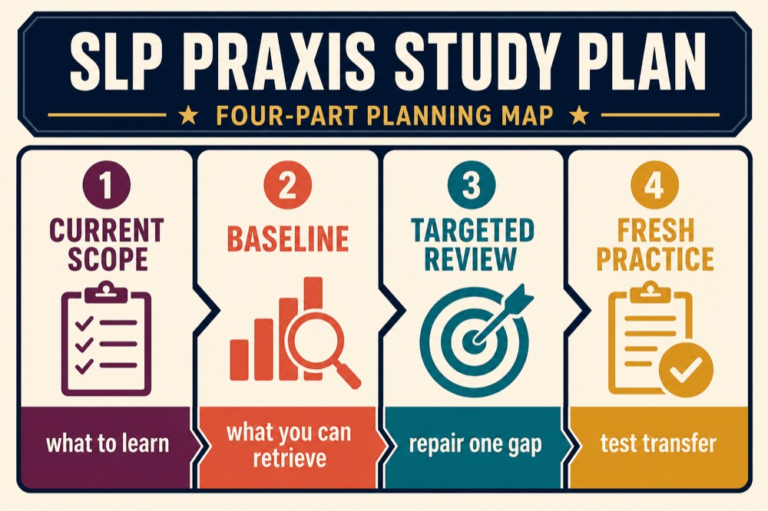
Use a four-part row for every major area in your map:
- Know: What terms, principles, or patterns must be understood?
- Distinguish: Which nearby idea, assessment, intervention, or professional choice could be confused with it?
- Apply: What original scenario would require a decision?
- Check: What evidence would show that the idea is becoming usable?
For example, a topic about assessment should not become a list of instruments. Ask what decision the assessment supports, what information it can and cannot provide, how context affects interpretation, and what a responsible next step would be. A topic about intervention should not become a collection of technique names. Ask how the goal, evidence, participation need, communication partner, and response to treatment affect the decision. The questions create clinical reasoning practice without turning the article into an official practice bank.
Use short notes with a boundary sentence. “This concept helps answer X; it does not by itself establish Y” is a useful pattern for avoiding overinterpretation. It also gives you a reason why a distractor may be less appropriate, which is more durable than memorizing a single answer.
Build retrieval and clinical-distinction practice
After a concept pass, close the book and retrieve. Write a plain-language definition, one example, one limitation, and one comparison. Then use a fresh prompt that does not reuse the wording of your notes. If you can answer only after looking at the explanation, mark the idea as developing rather than secure.
- Use a two-minute recall before opening the reference.
- Explain the deciding evidence in one sentence.
- Compare the best answer with the closest alternative.
- Return to the concept in a different client, setting, or task context.
- Record whether the miss came from knowledge, retrieval, distinction, task reading, or timing.
Imagine an original scenario that includes a communication goal, a small amount of assessment evidence, and a professional constraint. The point is not to imitate a live test item. The point is to practice identifying the task, selecting the evidence that carries weight, and explaining why another plausible option answers a different question.
Use a weekly review loop that can adjust
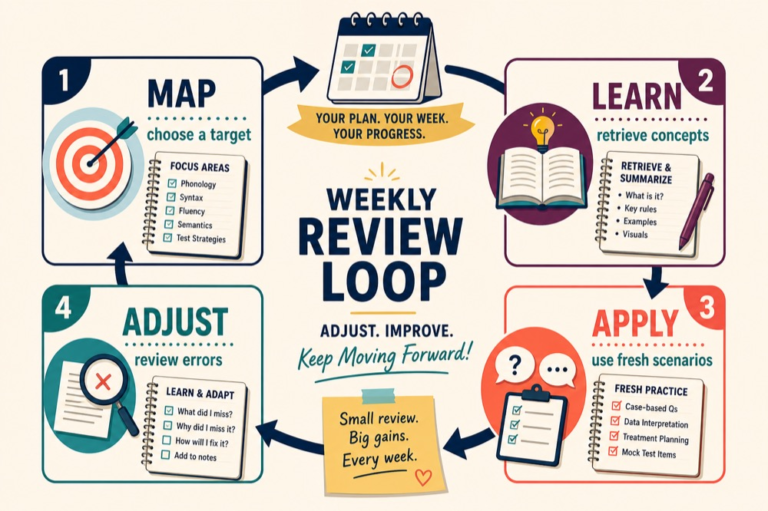
A weekly plan should be a loop, not a promise that every week will look identical. Start each cycle by choosing one coverage target, one distinction target, one practice block, and one review block. End by looking at the error pattern and adjusting the next cycle.
| Study block | Primary action | Evidence to save |
|---|---|---|
| Map | Review the current scope and choose a narrow target. | One completed map row and one source date. |
| Learn | Build concept notes with examples and boundaries. | A closed-book explanation. |
| Apply | Complete fresh scenarios or mixed questions. | Answer, rationale, and distractor comparison. |
| Repair | Revisit recurring errors in a new context. | Updated error category and next action. |
| Review | Mix older and newer topics with deliberate timing. | Trend notes, not a single promised score. |
Use spaced review by returning to a concept after a gap, not by repeating it until it feels familiar in one sitting. Add mixed practice after focused review so that you must identify which concept applies. If timing causes rushed reading, practice the task-reading step separately before increasing the set size.
Choose resources by the job they do
Study guides, flashcards, videos, question sets, and courses are tools. Select them by the output you need, not by the strongest marketing label. A resource is a good fit when it gives you enough explanation to learn, enough variation to apply, and enough structure to review errors.
- For scope: choose a current source-linked outline.
- For concepts: choose explanations with examples and limitations.
- For distinctions: choose comparisons and scenario rationales.
- For retrieval: choose prompts that require a closed-book explanation.
- For application: choose original questions with complete reasoning.
- For adjustment: choose a place to record errors and revisit them.
If you want a structured preparation resource, you can review the SLP Study Center Complete Prep page and match its current materials to the job you need next. Treat any product as one part of your system, not as a replacement for checking the current ETS source or for reviewing your own reasoning.
Verify logistics and run a readiness check
Put current logistics on the plan early enough to act. Check the exact test identity, registration information, appointment or delivery details, identification and accommodation instructions, score reporting guidance, and the requirements of the state, agency, or pathway that will use the result. The current ETS page and your account control changing details; a saved screenshot or old study group message may not.
At the end of a cycle, ask:
- Can I name the current source and the date I checked it?
- Can I explain the main concepts without copying the notes?
- Can I distinguish close options using decisive evidence?
- Can I classify my most common error?
- Have I repaired that error in a new context?
- Do I know the next narrow study action?
If several answers are no, do not respond by adding every resource at once. Choose the smallest repair that will produce evidence: one comparison, one retrieval prompt, one fresh scenario, or one current logistics check.
Common study-plan mistakes
Watch for these patterns:
- Copying another learner’s calendar without checking your own baseline.
- Reading the blueprint once and never using it to choose a task.
- Counting practice questions without reviewing the reasoning behind misses.
- Studying only definitions while avoiding close-concept comparisons.
- Turning a practice percentage into a predicted reported result.
- Leaving current registration and test-day details until the final evening.
- Changing resources whenever a topic feels difficult instead of diagnosing the gap.
- Trying to cover everything every day and retaining little.
A strong slp praxis study plan is therefore a feedback system: map the current scope, diagnose your starting point, learn concepts with boundaries, practice decisions, repair errors, and recheck changing logistics. Keep the plan flexible enough to respond to evidence, and let the next study action be specific enough to complete.
Continue your preparation: Explore the SLP Study Center learning resources.