
slp praxis study guide is a useful starting phrase, but a useful guide is more than a long outline of speech-language pathology terms. It should show what the current exam scope includes, explain the underlying concept, demonstrate how that concept changes in a case, and help you find what you still cannot explain. The strongest guide is a learning tool with an evidence trail, not simply the document with the most pages.
This article explains how to evaluate and use a guide for Speech-Language Pathology Praxis 5331 preparation. It focuses on blueprint mapping, concept notes, application, practice-question review, source currency, and the choice among a guide, flashcards, practice questions, and a full course. The current ETS page controls changing exam scope; ASHA preparation guidance supports the planning principles. No study format can promise a particular result, and no general article can replace a current source check or individualized academic advice.
Table of Contents
- What a useful SLP Praxis study guide should contain
- How to map the guide to the current ETS blueprint
- How to turn concept notes into application
- How to use practice questions as decision checks
- How to audit source currency
- How to choose the right learning format
- Common study-guide traps
- Quick evaluation checklist
What a Useful SLP Praxis Study Guide Should Contain
A study guide earns its place when it reduces the distance between knowing a term and making a defensible decision. It should help you identify an objective, understand the concept, recognize it in context, distinguish it from a nearby idea, and retrieve the reasoning later. A page that only lists definitions may feel productive while reading, but it gives little evidence that you can use the information when the wording or case changes.
Think of the guide as a feedback system. The content tells you what to learn, the example shows what the idea looks like, the distinction protects you from a mix-up, and the review check reveals whether you can retrieve the rule without leaning on the page. When you inspect a candidate guide, look for:
- Scope alignment: the chapter map can be compared with the current ETS test page and Study Companion.
- Clear definitions: important terms are explained precisely and in plain language.
- Concrete examples: concepts appear in profiles, observations, or decision situations rather than only vocabulary lists.
- Distinction teaching: nearby concepts are compared by the evidence that separates them.
- Application: the learner must use the concept, not only recognize a matching phrase.
- Retrieval: brief checks or practice expose uncertainty.
- Error repair: missed items lead back to a concept, source, or reasoning step.
- Source currency: the guide records what was checked, when, and what needs another review.
A guide is doing the full job when you can close one section, explain its rule, apply it to a new scenario, and name the nearby confusion. If you cannot, keep the page as a reference but mark the missing learning action.
Map the Guide to the Current ETS Blueprint
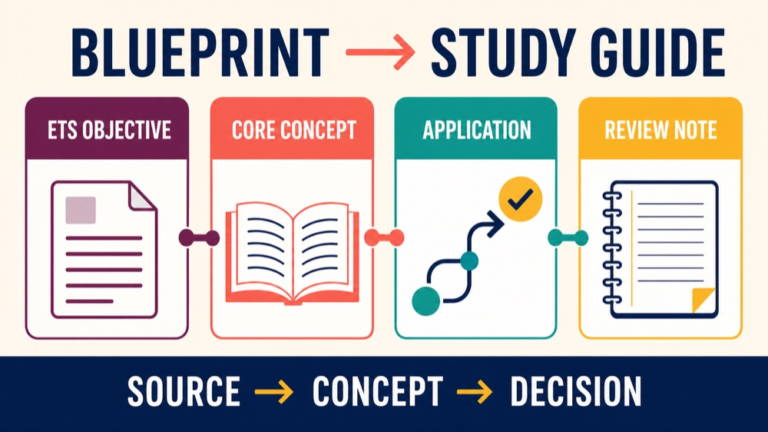
The current ETS Speech-Language Pathology 5331 page is the starting point for scope. Use the ETS 5331 test page and its current linked materials to capture the exact objective labels for your study cycle. Do not substitute a remembered chapter list, shared spreadsheet, or undated guide for that check. ASHA’s Praxis preparation guidance also supports planning from exam content and your knowledge in each topic area.
Mapping creates a traceable connection between an ETS objective and the pages, examples, practice items, and review actions that support it. The blueprint tells you what belongs in the map; your baseline, missed-item log, available time, and confidence ratings help you decide where to spend more effort.
- Capture objective labels. Copy the wording or a faithful short label from the current ETS material and record the check date.
- Mark teaching locations. Add page or section references for the definition, example, distinction, and review check.
- Separate knowledge from performance. Mark whether the guide offers a concept note, application example, original practice item, retrieval check, or only a mention.
- Test uncovered rows. If an objective appears in the blueprint but not in the guide, label the gap instead of guessing from a familiar heading.
- Prioritize from evidence. Use practice errors and confidence ratings to choose another explanation, example, or timed application.
- Recheck the map. Confirm before the study cycle ends that the scope, source note, and study action still agree.
| Blueprint connection | What the guide should provide | How the learner checks it | Boundary to record |
|---|---|---|---|
| Current ETS objective | A page or section that names and teaches the objective. | Explain it without looking, then locate it in a new case or task. | Current ETS materials control scope; an old guide may need revision. |
| Core concept | Definition, plain-language meaning, and a concrete example. | State the rule and identify the decisive detail. | A study note is not topic-specific clinical guidance. |
| Nearby distinction | A comparison that explains why plausible interpretations lead to different choices. | Name the feature that would change your decision. | A single sign or phrase is not enough for individualized interpretation. |
| Application and retrieval | Original practice content, a rationale, and a review action. | Record the objective, evidence, reasoning, and repair step. | Original practice content is illustrative and not from ETS. |
For an illustrative study-design model, imagine an ETS objective involving an evaluation or intervention decision. A useful guide would define the relevant concept, give a short profile, identify the evidence that matters, show a nearby alternative, and ask you to justify the choice. This model does not claim that a particular current question uses that wording.
Turn Concept Notes Into Application
Concept notes are valuable when they are compact enough to review and rich enough to support transfer. Build each note in a repeatable sequence: definition, plain-language meaning, concrete example, distinction, application, and quick retrieval. If you can define a term but cannot distinguish it from a neighbor, the repair is different from a missing definition.
In an SLP learning context, a concrete example might describe an observation, a communication demand, the relevant context, and the decision that still needs more information. Keep the example educational rather than diagnostic. A finding can matter without settling the whole interpretation, so the learner should ask what evidence is missing, what source applies, and what professional boundary matters.
Original practice content — written for illustration and not from ETS: A page defines three related terms and lists their features. A learner can repeat the list but misses a new scenario because the decisive evidence is not identified. Which repair most directly supports transfer?
- A. Read the same definition several more times.
- B. Add another list while leaving the comparison unchanged.
- C. Add a new scenario, identify the decisive evidence, compare the nearest alternative, and explain the choice.
- D. Replace the page with a longer glossary entry.
Answer and reasoning: C is the best repair because it connects the concept to evidence, distinction, and a decision. A may improve familiarity, B adds vocabulary without improving discrimination, and D adds reference detail without testing transfer. This is a study-design illustration, not a clinical conclusion or a test item.
Keep the note and application task together. Read the note, close it, state the rule from memory, and complete the scenario. If you cannot explain the choice, label the break as vocabulary, concept, distinction, evidence selection, or reasoning. That label makes the next review shorter and more useful.
Use Practice Questions as Decision Checks
Practice questions are most useful after the guide has given you a concept to apply. They should not become a separate collection of scores. Before answering, identify the objective or learning job. After answering, explain the evidence for your choice and the mismatch in each nearby alternative.
Use original practice content with a clear label, source boundary, and full explanation. A credible item explains why the selected answer fits the presented evidence and why the other options do not. It should not imitate protected wording or imply that a familiar-looking item represents the live exam. If an item depends on a clinical claim, check that claim against the relevant current ASHA source.
- Attempt the item without opening the notes.
- Write the blueprint objective or concept family it tests.
- Restate the decisive evidence in the scenario.
- Explain why the selected answer fits.
- Explain why the nearest alternative does not fit as well.
- Record whether the error was knowledge, discrimination, reading, or reasoning.
- Return to the smallest source-backed note that repairs the error.
- Try a changed scenario later to test transfer.
A low practice percentage is not a complete readiness judgment, and a high percentage on repeated items does not establish transfer. Review the pattern behind the result. Choosing by familiar wording suggests a distinction gap; knowing the concept but overlooking the task suggests stem-reading practice; running out of time suggests a different scheduling and application routine.
Audit Source Currency Before You Trust a Page
A guide can be well written and still be out of date. The research packet for this article was checked on August 22, 2026. That date shows when the links were reviewed, not a permanent edition label. Before a new study cycle, revisit the current ETS page and the relevant ASHA guidance.
Use three source layers. ETS controls exam scope and changing test information. ASHA Praxis preparation guidance supports planning around content and personal knowledge gaps. Topic-specific ASHA Practice Portal, policy, or evidence resources should support clinical and professional statements. The general ASHA Practice Portal is a starting index; open the relevant current topic page rather than treating a broad landing page as support for every detail.
| Audit question | What to record | Boundary |
|---|---|---|
| What source controls the claim? | Source ID, direct URL, page title, and supported claim. | One source does not support an unsourced neighboring claim. |
| When was it checked? | Checked date and version or page state if available. | A prior check does not guarantee the page is unchanged. |
| When should it be checked again? | Before publication, a new exam cycle, or a source update. | A review date does not create personal advice. |
| What is the claim boundary? | Exam scope, planning, clinical context, policy, or evidence role. | It does not permit a diagnosis or individualized treatment decision. |
Flag a page with no source list, a current claim without a check date, frozen exam logistics, copied clinical statements, or a practice item that cannot identify its decisive evidence. This article teaches a way to audit a resource; it does not settle individual eligibility, credential, clinical, or accommodation questions. Use the responsible current authority or qualified professional for those decisions.
Choose the Right Format for the Learning Job
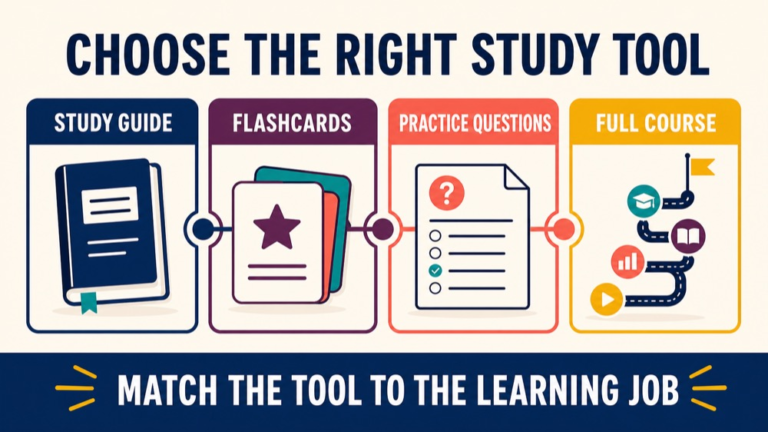
A guide, flashcards, practice questions, and a full course solve different problems. If you are missing the map, start with a guide. If you know the material but cannot retrieve it quickly, flashcards may help. If you can recite rules but cannot use them in a case, application practice matters more. If you need a sequenced path with instruction, practice, and review, a full course may organize that work.
| Format | Best learning job | Common limitation | Useful companion |
|---|---|---|---|
| Study guide | Build a source-aligned map of concepts, distinctions, examples, and review. | Reading alone can create familiarity without transfer. | Original application practice and an error log. |
| Flashcards | Retrieve terms, short rules, contrasts, and compact facts. | Cards can flatten context or hide decision evidence. | A guide page and changed scenarios. |
| Practice questions | Test discrimination, evidence selection, reasoning, and timing. | A score without rationale can hide the cause of an error. | Concept notes and source review. |
| Full course | Follow a sequence combining explanation, guided application, and review. | The learner still needs to verify current scope and retrieve actively. | A blueprint matrix and weak-area log. |
Choose the format that addresses the biggest bottleneck. When you cannot tell what to study, map the blueprint. When you cannot explain it, strengthen the note. When you explain it but miss the case, use application. When you forget after several days, add spaced retrieval. Collecting every format at once can hide the real problem.
If you are comparing structured next steps, you can review the SLP Study Center Complete Prep option and use the current inclusion details on that page to decide whether its format matches the work you need. The product page should not replace the ETS or ASHA source check.
Common Study-Guide Traps
Even a polished resource can become inefficient when it is used for the wrong job. Screen for these traps:
- Page-count thinking: assuming a longer guide covers current scope more accurately.
- Chapter-title confidence: treating a familiar heading as proof that an objective is fully taught.
- Definition-only review: memorizing a term without an example or nearby distinction.
- Score chasing: repeating questions without identifying the evidence or error type.
- Blueprint drift: studying an old domain arrangement because it is easy to remember.
- Source blending: combining scope, planning, and clinical claims without recording support.
- Format collecting: opening several resources before identifying the bottleneck.
- Unlabeled practice: failing to mark original practice content as illustrative.
- Clinical overreach: turning a teaching example into a conclusion about a real person.
- Late auditing: waiting until the final week to review sources and objectives.
The repair for most traps is a small record: objective, source, check date, evidence rule, and next action. A missing example needs an example; a stale scope claim needs a source check.
Quick Evaluation Checklist
Use this checklist before committing to a guide. A yes answer is useful evidence, not a promise about a future score.
- Can I trace the guide’s scope to the current ETS 5331 page or linked blueprint material?
- Does each major unit include a definition, plain-language explanation, and concrete example?
- Does it teach a nearby confusion by comparing decisive evidence?
- Can I find application or original practice content for the concepts I must use?
- Does each practice item include a rationale and next repair action?
- Are source IDs, direct links, checked dates, and update triggers visible?
- Does the guide separate exam-scope claims from clinical or professional claims?
- Can I mark an objective as learned only after retrieving and applying it?
- Does the resource fit my biggest bottleneck and available study time?
- Do I know which details must be rechecked before my study cycle?
For a final source review, open the current ETS page, read the ASHA Praxis preparation guidance, and check the relevant ASHA topic source for any clinical statement you plan to retain. If the guide conflicts with a current authoritative source, record the conflict and resolve it before using the claim as a study rule.
Quick Review and Next Step
A useful SLP Praxis study guide defines the target, maps it to current ETS scope, shows an example, teaches a distinction, asks for application, and closes with retrieval and error repair. Its source trail tells you what was checked and when it must be checked again. Its value comes from the decisions it helps you make, not from page count.
Keep the formats separate: the guide builds the map, flashcards strengthen retrieval, practice questions test reasoning, and a full course organizes a broader sequence. Choose the tool that addresses the next bottleneck, label original practice content clearly, and preserve a source-review boundary for changing exam and clinical claims.
References
- ETS Speech-Language Pathology 5331 — current test scope and linked materials; verify changing details before use.
- ASHA Praxis Preparation — planning guidance based on exam content and personal topic knowledge.
- ASHA Practice Portal — starting point for current topic-specific clinical guidance and source review.