slp praxis sample questions are most useful when they show more than a correct letter. Use each item to practice reading the task, identifying the evidence, comparing answer choices, explaining the rationale, and naming the closest distractor. That record turns a free practice set into a repeatable study tool.
The current ETS Speech-Language Pathology (5331) page describes a computer-delivered selected-response test with 132 questions and 150 minutes. Use the live ETS page and your account for changing details. ASHA preparation guidance also supports practice questions, timed work, and a plan shaped by individual strengths and weaknesses.
What sample questions should teach
A sample question should reveal a reasoning relationship that can transfer to a new case. The useful unit is not only the answer letter. It is the connection between the task, the decisive clue, the clinical purpose, the option that fits, and the reason a related option does not fit as well.
| Practice layer | What to record | Why it matters |
|---|---|---|
| Task | The action requested by the stem. | Defines the answer target. |
| Evidence | The detail that changes the decision. | Separates clues from background. |
| Rationale | Why the selected option fits. | Builds a reusable rule. |
| Distractor | Why the closest alternative is weaker. | Improves close-choice comparison. |
| Next action | What to review or practice next. | Connects the miss to a plan. |
A correct answer can still reflect an uncertain process, while a wrong answer can identify a valuable gap. Record confidence before checking the answer, then compare your reasoning with the rationale. This makes review more honest than changing an answer after seeing the explanation.
Use original educational items and legitimate preparation resources. Do not treat recalled secure test content as a study strategy. The aim is to strengthen decision-making across unfamiliar cases while keeping current administration facts connected to the responsible official source.
Confirm the current 5331 source
Begin with the current ETS Speech-Language Pathology (5331) page. Use it to confirm the subject identity, current delivery and timing information, broad content direction, question count, duration, and preparation links. The page currently lists 132 questions and 150 minutes for a computer-delivered selected-response exam, so date your administration note.
Use the ETS practice-test page to search for current preparation material by subject. Read the resource description before assigning a set to learning, review, or simulation. Use ASHA’s Praxis preparation guidance for practice planning, timed work, and a strengths-and-weaknesses review cycle.
- Verify the subject: confirm Speech-Language Pathology (5331).
- Record the source: note provider, title, date, and format.
- Label the condition: identify untimed, timed, supported, or independent work.
- Separate administration facts: use ETS for current delivery and appointment information.
- Protect originality: use legitimate preparation material rather than purported secure content.
Keep practice notes separate from changing test instructions. A rationale teaches a reasoning relationship, while the live responsible source controls current administration details. Clear source roles make your study record easier to update when official information changes.
Use a rationale-first sample-question routine
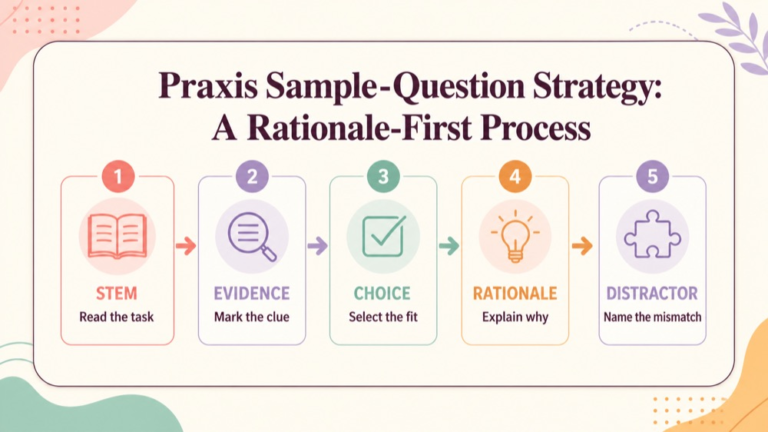
Use a five-part routine for every item: state the task, mark the evidence, predict the answer type, compare the options, and write a short rationale. Add the closest distractor only after you have selected an answer. This sequence limits the influence of a familiar word in one choice.
| Step | Prompt | Record |
|---|---|---|
| 1. Task | What am I being asked to choose? | One-sentence restatement. |
| 2. Evidence | Which detail changes the decision? | Relevant clue and context. |
| 3. Prediction | What answer type should fit? | Information, measure, action, or interpretation. |
| 4. Choice | Which option best fits the task? | Letter and confidence. |
| 5. Rationale | Why is the closest alternative weaker? | Specific mismatch. |
Practice the routine without a strict timer while learning it. When the record becomes consistent, shorten the prompts for a light-timing block. The abbreviated process should preserve task and evidence, not replace them with a guess based on the first familiar term.
Keep the rationale concise enough to reread. Two or three sentences can identify the clinical purpose, connect it to the case, and explain the distractor. A long paragraph that repeats the stem may feel thorough without clarifying the decision.
Read the stem before the answer choices
The final request often defines the answer target. It may ask for the next step, the most appropriate measure, the best interpretation, a treatment action, or a professional response. Restate the request before the options begin to shape your thinking.
| Request type | Restatement frame | Option check |
|---|---|---|
| Next information | What remains unknown that changes the plan? | Does the option gather that information? |
| Assessment action | What should be done for this purpose? | Does the method match the decision? |
| Treatment action | What response fits the target and condition? | Does the action address function? |
| Interpretation | What pattern is supported by the facts? | Does the option stay within the evidence? |
| Professional response | What action fits the role and context? | Does the response match responsibility? |
A clinically true statement can still be the wrong answer when it solves a different task. Record that distinction during review. It is especially important when one option names a familiar procedure but the stem asks for information before the procedure is selected.
When the final request is dense, underline its action words and stage words, then read the case again with that target in mind. The goal is to connect wording to the process, not to memorize isolated signals.
Identify the clinical decision
Before evaluating a choice, name the decision that the question is testing. The decision may concern what to learn next, how to interpret a pattern, which support matches a goal, or how to respond within a professional role. Naming it keeps the rationale anchored to purpose.
| Decision family | Useful question | Common error |
|---|---|---|
| Information | What missing fact would change the plan? | Choosing an intervention first. |
| Measurement | What should be compared or quantified? | Using a broad impression. |
| Interpretation | What does the described pattern support? | Adding an unsupported cause. |
| Action | What step fits this stage? | Selecting a later step early. |
| Communication | What response fits the listener and role? | Ignoring context or consent. |
Write the decision in a neutral phrase before you commit to a letter. For example, “choose the information needed to plan the next evaluation step” gives you a target that can be tested against each option. It is more reliable than repeating a phrase from a tempting answer.
If two options both seem reasonable, ask which one answers the named decision with fewer assumptions. The strongest option usually uses the facts supplied, fits the sequence, and serves the function described in the stem.
Mark evidence and missing information
Separate direct observations from conclusions. Mark what the case explicitly states, then list the information that is missing but relevant to the decision. This helps you notice when an answer choice depends on a fact that has not yet been established.
| Evidence type | Prompt | Rationale language |
|---|---|---|
| Goal | What outcome matters? | The option addresses the stated function. |
| Context | Where and with whom does it occur? | The option matches the setting and partner. |
| Observation | What was directly described? | The option stays within the data. |
| Missing fact | What is not yet known? | The option gathers or respects the gap. |
| Stage | What has already happened? | The option belongs at this point in sequence. |
Write evidence as a relationship rather than a list of nouns. “The communication demand changes by setting, so context information should guide the next step” is more useful than copying five details. The relationship can be tested again when a new sample question changes the setting.
If a choice depends on information the case does not provide, mark the unsupported assumption. Ask whether that choice could become appropriate after the missing fact is gathered. This creates a precise boundary without treating the option as unrelated.
Sort answer choices by role
Answer choices often represent different roles in the clinical process. One may gather information, another may interpret data, another may implement an action, and another may address a later follow-up. Sorting choices by role can reveal a sequence mismatch even when several choices sound clinically familiar.
| Choice role | What it usually does | Check before selecting |
|---|---|---|
| Information step | Reduces uncertainty. | Is the needed fact still unknown? |
| Assessment step | Measures or observes a target. | Does the method answer the stated question? |
| Interpretation | Explains supported findings. | Does the case support the conclusion? |
| Intervention | Changes a skill or participation outcome. | Has the target and plan been established? |
| Follow-up | Checks response or transfer. | Is there a result to review yet? |
This role sort is a study aid, not a substitute for clinical judgment. The same phrase can serve a different purpose in a different case. Always return to the task, evidence, context, and process stage supplied by the question.
When you review a distractor, describe its role before describing its flaw. “This is a plausible intervention, but the stem asks for missing information” creates a transferable explanation. “It is wrong” does not show what to notice next time.
Build a sample-question review bank
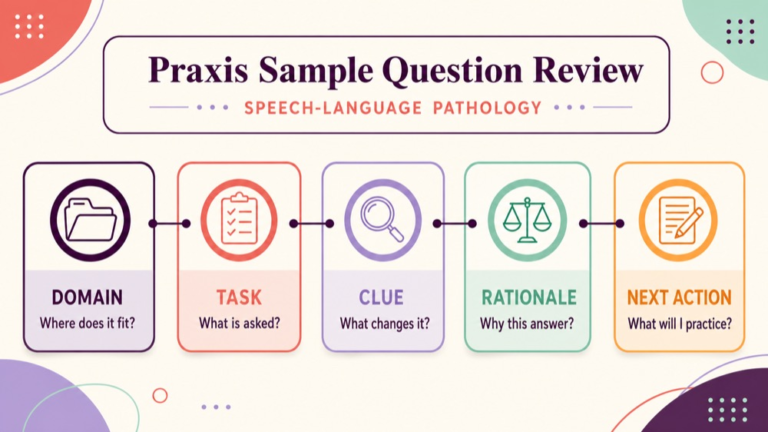
Organize sample questions by the reasoning task they test, not only by diagnosis or disorder label. A review bank makes it easier to find patterns such as choosing treatment before assessment, overlooking context, or accepting a broad statement that does not answer the final request.
| Bank field | Example entry | How to use it |
|---|---|---|
| Domain | Foundations, evaluation, or treatment. | Balance the week. |
| Task | Next step or best measure. | Group comparable decisions. |
| Decisive clue | Setting-specific performance. | Practice evidence selection. |
| Correct rationale | Why the answer serves the task. | Review the decision rule. |
| Closest distractor | Related action at the wrong stage. | Practice sequencing. |
| Next action | Review one concept or redo one item. | Keep errors actionable. |
Use a small tag vocabulary so the bank stays searchable. Tags such as task-reading, missing-information, measurement, sequence, functional-goal, and professional-response can describe the reasoning challenge without pretending that one question represents an entire topic.
After several items, look for repeated tags and repeated distractor types. If “later action chosen too early” appears often, schedule a short sequence review and then complete a new set. The bank should change what you do next, not become another collection that you never revisit.
Question 1: language sample and functional context
Question 1: An elementary student follows one-step classroom directions but often misses the second part of a multi-step direction. The teacher reports that performance drops during group activities with more language and distractions. Which action best gathers information for planning the next evaluation step?
- A. Administer an articulation screening only.
- B. Collect a language sample or functional observation across relevant classroom conditions.
- C. Begin oral-motor exercises before gathering additional information.
- D. Recommend an augmentative communication system immediately.
Correct Answer: B. Collecting a language sample or functional observation across relevant conditions can clarify how language load, setting, and distractions relate to the described difficulty. The action is connected to the planning question because it gathers information before a narrower intervention decision is made.
Why the Other Options Are Wrong: A focuses on articulation even though the described concern involves following multi-step language in context. C jumps to an intervention without establishing the relevant target. D may be considered only after a broader communication assessment and functional need are understood, so it is premature for this question.
Exam Trap: Do not confuse a noticeable performance problem with a confirmed disorder target. The teacher’s observation is important evidence, but the question asks what information to gather next. A functional observation can connect the reported difficulty to context without assuming a cause.
Question 2: cueing and measurement
Question 2: An adult following a stroke has word-retrieval difficulty during conversation. The clinician wants to determine whether structured cues improve naming before selecting a treatment emphasis. Which measure would best answer that question?
- A. Count spontaneous naming attempts without recording cue level.
- B. Compare naming performance across a consistent cueing hierarchy.
- C. Ask a family member to choose the treatment approach without collecting performance data.
- D. Begin fluency drills because the client pauses while searching for words.
Correct Answer: B. Comparing naming performance across a consistent cueing hierarchy directly examines the relationship between support and response. It produces information that can guide a treatment emphasis while keeping the measure tied to the question being asked.
Why the Other Options Are Wrong: A may describe baseline performance but does not test whether cues change the response. C includes useful perspective but does not replace a structured performance measure. D treats pauses as a fluency target even though the stated decision concerns word retrieval and cue responsiveness.
Exam Trap: A measure can be relevant to a broad clinical picture and still fail to answer the specific decision. Look for the option that changes one meaningful condition, records the response, and matches the target described in the stem.
Question 3: setting-specific information
Question 3: A preschool child uses short phrases to request and comment at home, while a caregiver reports much less communication during daycare routines. The clinician wants to understand the difference before selecting a language-support plan. What is the best next step?
- A. Conclude that language is typical because communication is successful at home.
- B. Gather setting-specific language samples and information about communication partners, routines, and demands.
- C. Choose an articulation target without collecting language information.
- D. Select a treatment schedule before clarifying the daycare communication demands.
Correct Answer: B. Setting-specific samples and partner information can clarify whether routines, opportunities, language demands, or interaction supports relate to the difference. The step respects the evidence from both settings and gathers information before a plan is chosen.
Why the Other Options Are Wrong: A gives one setting more weight than the other and closes the question before the difference is explained. C selects a different target without evidence. D chooses logistics before identifying the functional communication conditions that the plan needs to address.
Exam Trap: Do not treat a successful performance in one context as proof that a concern in another context is irrelevant. When the question highlights a setting contrast, the contrast is likely part of the evidence and should shape the next information step.
Review rationales after every sample question
Check the answer only after you have written a prediction and a short rationale. Then compare three things: what you noticed, what the official or provided explanation emphasizes, and where the closest distractor diverges. This process shows whether the miss came from reading, knowledge, sequencing, or option comparison.
| Review question | Useful note | Repair direction |
|---|---|---|
| Did I answer the task? | My restated request was accurate or not. | Practice final-sentence reading. |
| Did I use the clue? | The decisive evidence was included or missed. | Practice evidence marking. |
| Did I choose the right stage? | The action was early, current, or later. | Review process sequence. |
| Did I explain the fit? | The rationale named purpose and context. | Write two-sentence rationales. |
| Did I reject the closest option? | The mismatch was precise or vague. | Compare one filter at a time. |
Keep the explanation proportionate to the item. A short rationale is enough when the contrast is clear. Use a longer note when the answer depends on a subtle distinction such as purpose versus sequence, direct observation versus inference, or a general skill versus functional participation.
If your answer was correct for the wrong reason, mark the item as uncertain rather than fully mastered. Revisit it later with a changed surface detail. Transfer matters because a repeat question with the same wording can reward recognition without showing that the reasoning is stable.
Turn distractor errors into study actions
Distractors are useful when they are classified. A close alternative may be wrong because it answers another question, uses a later step, requires unsupported information, misses the setting, or names a broad goal without the requested action. Identify the type before choosing a resource.
| Distractor pattern | What it sounds like | Study action |
|---|---|---|
| Different task | A true statement that answers another request. | Underline the final request. |
| Wrong sequence | A reasonable later action selected early. | Map the process stages. |
| Unsupported assumption | An option that needs a missing fact. | List the information gap. |
| Context mismatch | A choice that ignores setting or partner. | Compare conditions. |
| Broad but vague | A general goal without a decision step. | Rewrite it as an action. |
Use a repair sentence for each pattern. For example, “This option may be reasonable later, but the current question asks for information before treatment planning” captures both the value and the mismatch. Such sentences are easier to retrieve than a long list of isolated facts.
Do not turn every missed question into a complete textbook review. First identify the smallest repair that would change the answer next time. Then use a new sample question to test that repair under a different surface story.
Use sample questions across Praxis domains
The ETS 5331 scope includes broad areas such as foundations and professional practice, screening and evaluation, and planning, implementation, and evaluation of treatment. Use sample questions across these areas, while remembering that a practice set is a study aid rather than a promise about the distribution of future items.
| Study area | Question lens | Rationale emphasis |
|---|---|---|
| Foundations and professional practice | What response fits the role, context, and responsibility? | Professional purpose and boundaries. |
| Screening and evaluation | What information or measure answers the decision? | Evidence, validity, and sequence. |
| Treatment planning | What action matches the target and conditions? | Functional fit and support. |
| Implementation | What change makes the plan usable? | Context, partner, and participation. |
| Evaluation of treatment | What result should be reviewed? | Comparison, response, and transfer. |
Balance domain tags with reasoning tags. A question can be about evaluation but still test sequence, missing information, or functional fit. Recording both tags helps you avoid studying only by disorder name when the more useful repair concerns how the decision was framed.
Check the current ASHA 5331 content page for the responsible content outline, then use your practice bank to identify personal gaps. Do not infer current exam logistics from a third-party outline when ETS is the responsible source.
Create a weekly sample-question cycle
A weekly cycle can include learning, review, and light simulation. Start with a small set that allows full rationales, then add time pressure after the comparison process is consistent. The goal is to build accuracy and usable pacing without letting the clock erase evidence review.
- Plan: choose a domain tag and one reasoning tag.
- Learn: complete a small untimed set and write rationales.
- Review: classify each distractor and record confidence.
- Repair: study one gap and complete a different item that tests it.
- Check: use a light-timing block and compare pace with rationale quality.
Keep the set size small enough to review in the same session. Ten carefully reviewed items can reveal more about your process than a larger set whose answer letters are checked without explanations. If the review queue grows, schedule it rather than carrying every miss into the next study block.
At the end of the week, summarize patterns rather than only percentages. Note which tasks took longest, which distractor types repeated, and which repairs held on a fresh item. Use that summary to select the next week’s sample questions and source material.
SLP Praxis sample questions checklist
Use this checklist before you mark a sample-question session complete. It keeps the work focused on reasoning and makes the next session easier to design.
- I confirmed the resource is for Speech-Language Pathology (5331) or clearly labeled as general practice.
- I recorded whether the set was untimed, timed, supported, or independent.
- I restated the task before comparing answer choices.
- I marked the decisive evidence and any relevant missing information.
- I wrote why the selected option fits the purpose, stage, and context.
- I explained why the closest distractor is weaker.
- I classified the error or uncertainty with a searchable tag.
- I chose one specific repair action for the next study block.
- I tested the repair on a new item rather than rereading only the original answer.
- I checked changing administration details on the live ETS source.
A checklist is valuable when it changes behavior. If a session repeatedly ends without a distractor explanation, shorten the set or reserve review time before starting. If rationales are clear but pace is slow, add a light-timing block while preserving the task-and-evidence notes.
Sources and next steps
Use the live ETS Speech-Language Pathology (5331) page for current exam identity, format, duration, question count, and changing test information. Use the ETS practice-test selector to locate current official preparation options, and use ASHA preparation guidance to shape practice around strengths and weaknesses.
Next, choose a small set of legitimate sample questions and create one rationale record for each. Begin untimed, review the closest distractor, repair one repeated pattern, and then test the repair in a fresh case. That cycle makes sample questions a source of decisions rather than a pile of answer letters.
For a structured preparation path, see the SLP Study Center Complete Prep resource. Keep the article’s original questions separate from any current administration instructions, and revisit the official ETS page before relying on a new date, delivery detail, or preparation resource.