
Choosing an slp praxis review course is a learning decision, not only a shopping decision. A course may give you structure, explanations, practice, deadlines, or support, but those features matter only when they solve the problem you actually have. The right question is not “Which course is most popular?” It is “What evidence do I need to produce next, and which format can help me produce it?”
Use the current ETS Speech-Language Pathology 5331 page to anchor scope and changing administration details. ASHA’s Praxis preparation guidance also supports matching preparation to the exam content and your knowledge in each area. This article does not rank named providers or repeat course claims. It gives you a practical way to compare self-study, a review course, and a hybrid plan.
Start with the learning problem, not the course name
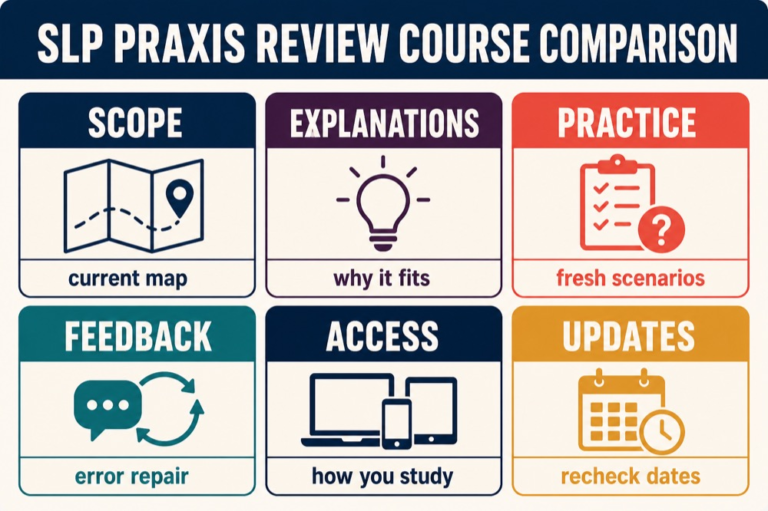
Before comparing products, complete a short self-audit. Write down what is currently difficult and what would count as improvement. A learner who has not built a scope map needs organization and coverage. A learner who knows the terms but misses close scenarios needs explanation and decision practice. A learner who studies consistently but cannot keep a schedule may need accountability or a more structured sequence.
- Coverage problem: I do not know what to study or how topics connect.
- Concept problem: I recognize terms but cannot explain them without notes.
- Distinction problem: I confuse nearby assessment, intervention, or professional choices.
- Application problem: I understand the chapter but struggle with new scenarios.
- Review problem: I complete practice but do not repair recurring errors.
- Structure problem: I need a realistic sequence and checkpoints.
- Support problem: I need a place to ask questions or receive feedback.
One course may help with several problems, but no format removes the need for active retrieval and error review. If you cannot name the problem, you may choose based on a polished sales page rather than educational fit.
What to evaluate in an SLP Praxis review course
Use the current ETS scope as the first test of coverage. Then evaluate how the course teaches and checks learning. A long video library may be less useful than a shorter sequence with clear explanations and fresh application. A large question count may be less useful than a smaller set with rationales that identify the decisive evidence and explain why a nearby alternative is less appropriate.
| Criterion | Look for | Evidence to request or inspect | Warning sign |
|---|---|---|---|
| Scope coverage | Current source or blueprint mapping. | A dated outline showing what each module does. | Undated claims that one list covers everything. |
| Explanation quality | Definitions, examples, boundaries, and clinical reasoning. | A sample lesson or rationale that explains the decision. | Answer labels with little reasoning. |
| Practice quality | Original, varied prompts across focused and mixed practice. | A sample item and full explanation, not just a count. | Repetition without transfer. |
| Feedback | Rationale, error categories, office hours, or a support route. | Clear response time and what feedback includes. | “Support” with no process or boundary. |
| Access | Device, caption, download, schedule, and expiration details. | Current access and refund language. | Important restrictions hidden until checkout. |
| Updates | A visible method for reviewing scope and content changes. | Update date, version note, or change policy. | Fixed exam details with no recheck instruction. |
Also inspect whether the format respects the difference between exam preparation and clinical truth. A course can teach an exam-relevant distinction, but professional concepts should still be grounded in current, credible sources. Avoid materials that present unsupported certainty, treat one observation as a diagnosis, or imply access to live test content.
Compare self-study, course, and hybrid prep
There is no universal winner among the three formats. The useful comparison is the amount of structure, explanation, feedback, and flexibility each format gives you relative to its cost and your current evidence.
| Format | Often fits when | Strength to test | Risk to manage |
|---|---|---|---|
| Self-study | You can map scope, schedule sessions, and diagnose errors independently. | Flexibility and control over depth. | Unnoticed gaps or passive rereading. |
| Review course | You need a sequence, curated explanations, or external structure. | Organization and guided coverage. | Watching without retrieving or applying. |
| Hybrid | You want a structured spine but need targeted independent review. | Course structure plus personalized repair. | Paying for overlapping resources and creating overload. |
The format should change your behavior. If self-study already produces a clear map and error log, a course may add little unless it fills a specific explanation or accountability gap. If independent study repeatedly stalls at organization or comparison, a structured course may be worth evaluating. If only two domains are weak, a hybrid approach may be more efficient than replacing everything.
Choose a format that matches your evidence

Use a simple decision path:
- Can you identify the current scope and your weak areas? If not, prioritize a source-linked map or structured orientation.
- Can you explain concepts but miss applied scenarios? Prioritize varied practice, comparisons, and complete rationales.
- Do you know what to do but fail to follow a schedule? Prioritize a sequence, checkpoints, or accountability.
- Are only a few domains unstable? Consider targeted self-study or a hybrid plan rather than maximum coverage.
- Do you need feedback that a course does not provide? Check what questions, office hours, or review support actually includes.
Make the decision with a budget and an access check. Confirm the current price, payment terms, expiration, device requirements, captions, downloads, schedule, refund policy, and update policy on the provider’s current page. These details are product facts, not permanent truths, so save the date you checked them.
Questions to ask before you buy
- Which current ETS source or blueprint does the course use, and when was it checked?
- How are clinical concepts explained beyond a definition?
- Are practice questions original, varied, and accompanied by full rationales?
- Does feedback explain the deciding evidence and the tempting alternative?
- Can I study asynchronously, live, or through a combination?
- How long do I keep access, and what happens if the scope changes?
- Are captions, transcripts, downloads, and mobile access available?
- What support is included, and what response time should I expect?
- What is the current refund or cancellation policy?
- Which part of my self-audit will this course improve?
A sample lesson is often more informative than a large feature list. Look for whether the sample asks you to retrieve, compare, apply, and explain. A polished presentation is valuable, but the learning job is the deciding factor.
Make the course work after enrollment
Enrollment does not create learning automatically. Turn each module into an active cycle: preview the target, retrieve what you already know, study the explanation, answer a fresh prompt, record the error pattern, and schedule a return. Keep a separate list of current logistics to verify from ETS rather than treating a course slide as the final authority for changing details.
- Write one question before opening a lesson.
- Close the lesson and summarize the concept in plain language.
- Complete practice without looking at the rationale first.
- Record why the tempting alternative was less appropriate.
- Revisit the concept in a new context after a gap.
- Mix older and newer topics so that you must select the rule.
If you want a structured resource within that kind of system, you can review the SLP Study Center Complete Prep page. Match the current materials to the gap you identified rather than treating the product label as a complete plan.
Common course-selection mistakes
- Choosing by question count instead of explanation quality.
- Assuming the newest-looking design proves current scope coverage.
- Buying several overlapping resources before completing a baseline.
- Confusing watching a lesson with retrieving its content.
- Using a course percentage as a universal score prediction.
- Ignoring access, caption, expiration, or refund details.
- Relying on an undated slide for current exam administration facts.
- Accepting unsupported claims about live, recalled, or guaranteed content.
Sources and next steps
Review the current ETS Speech-Language Pathology 5331 page and ASHA’s Praxis preparation guidance before finalizing a study resource. The best slp praxis review course is the one whose current content, explanations, practice, access, and support solve the learning problem your own evidence has revealed.
Continue your preparation: Explore the SLP Study Center learning resources.