
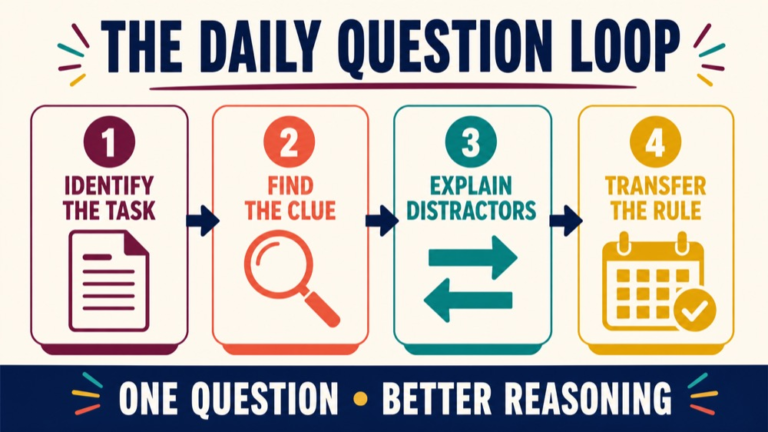
Using an slp praxis question of the day can make exam preparation more consistent, but the value is not in collecting another answer letter. The value is a small reasoning loop: identify the task, find decisive evidence, compare nearby concepts, explain distractors, and record the next repair.
This article uses that one-question-per-day rhythm. It gives you four original A-D mini questions with full rationales and an exam-trap takeaway. The questions are original practice content, not official ETS material and not recalled content. For current exam scope or administration details, check the current ETS Speech-Language Pathology 5331 page. For clinical boundaries, use the relevant topic guidance in the ASHA Practice Portal.
This is study content, not individual medical advice. A short vignette cannot replace a complete history, assessment, collaboration, referral, or local safety protocol, but it can help you practice disciplined reasoning and notice where a real clinical decision would require more information.
Table of Contents
- What this format should train
- How to use an SLP Praxis question of the day
- How to record reasoning errors
- Original questions: four mini cases
- Common confusions that change the answer
- Quick review and the next daily step
What This Format Should Train
A daily practice question is a small retrieval-and-reasoning unit. It asks for one bounded decision and then lets you inspect the path you took. That differs from a full practice test, whose learning jobs may include endurance, pacing, broad content sampling, and performance review. A daily item should be narrow enough to finish carefully and rich enough to expose a repeatable thinking error.
For an SLP learner, identify the decision class before naming a sophisticated diagnosis. Is the stem about screening, comprehensive evaluation, a motor-speech pattern, a safety-focused next step, communication access, or intervention planning? Once the purpose is clear, test every option against the same question.
A concerning observation may raise a hypothesis while the question tests whether you recognize the need for follow-up data. Another stem may provide enough functional context for a treatment or access decision. Ask what the evidence supports, not what the most memorable term suggests.
A productive question-of-the-day session therefore has four features:
- One primary decision: the item should make clear what kind of judgment is required.
- One decisive evidence path: the best answer should follow from stated facts, not an unstated assumption.
- Specific distractor analysis: each wrong option should fail for a named reason, such as a scope leap, mismatched purpose, or unsafe sequence.
- A transfer rule: the learner should leave with a sentence that applies to a new vignette.
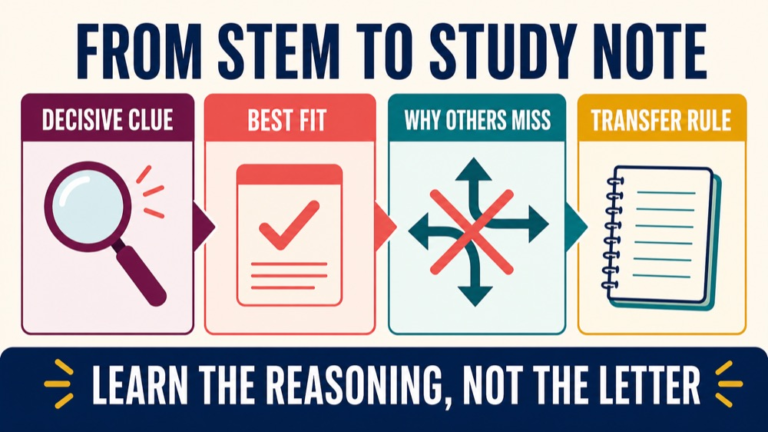
If you cannot explain why the correct answer wins and each alternative loses, the item is not finished when you circle a letter. The explanation is the learning asset.
How to Use an SLP Praxis Question of the Day
Use the same routine each day. It can take 10 to 20 focused minutes; the important part is the order: commit before reading the rationale, then use feedback to repair your reasoning.
- Read for the task. Restate the question in your own words and write a label such as screening interpretation, assessment next step, motor-speech distinction, safety follow-up, or communication-access planning.
- Find the strongest cue. Note the one or two facts that should control the answer, separating them from background details. Explain why a repeated pattern, safety sign, communication goal, or data limit matters.
- Commit to one option. Choose A, B, C, or D before reading the explanation. Add one sentence beginning with because; if unsure, record the uncertainty.
- Defend and reject. For every distractor, name the exact mismatch. Is it too definitive, too early, too narrow, aimed at the wrong purpose, or dependent on missing information?
- Transfer the rule. Write one variation that would change the answer, such as additional evidence or missing context that would alter the assessment decision.
| Pass | Question to ask yourself | What to record |
|---|---|---|
| Task | What decision class is being tested? | A short task label |
| Evidence | Which stated fact carries the most weight? | One decisive cue and why it matters |
| Choice | Which option best fits without adding assumptions? | Letter plus a because sentence |
| Distractors | What specific mismatch eliminates each alternative? | One reason for A, B, C, and D |
| Transfer | What change in the case would change the answer? | A portable rule or follow-up prompt |
Keep the first attempt separate from the explanation. Reading the rationale first can create recognition without retrieval; committing first makes the explanation feedback on a real decision. On a difficult day, reduce content rather than skipping reasoning. On an easier day, add a transfer variation or teach the item aloud.
How to Record Reasoning Errors
A score tells you whether the final letter matched the key; an error log tells you why. Record the date, topic, chosen answer, correct answer, decisive evidence, error code, and repair action. Consistent codes make patterns visible after several days.
- Task miss: You answered a nearby question, such as naming a disorder when the stem asked for the safest next step.
- Evidence miss: You noticed an important cue but gave more weight to a vivid background detail.
- Concept blend: You mixed related constructs, such as screening and comprehensive evaluation or speech output and language comprehension.
- Scope leap: You turned a suggestive pattern into a diagnosis, definitive finding, or complete treatment decision without enough information.
- Sequence error: You selected an intervention, device, or diet change before the assessment, collaboration, trial, or protocol step.
- Distractor attraction: You chose an option because it sounded familiar, advanced, or compassionate even though it missed the stated purpose.
- Explanation gap: You chose the correct letter but could not state the decisive evidence or eliminate every other option.
A learner might mark the swallowing item correct but log an explanation gap if the reason was simply cough equals aspiration. The repair is to distinguish a concerning screening observation from a definitive conclusion and review the follow-up step supported by context. At week’s end, count error codes: use the most common one to choose the next review target.
Original Questions: Four Mini Cases
These four items are original practice content. They use A-D formatting to rehearse clinical reasoning, but they are not official or recalled material and do not predict a live test item. Read each scenario, commit to one answer, and then study the complete rationale.
Question 1: Screening or Comprehensive Evaluation?
Scenario: A preschool teacher reports that Maya frequently misses multi-step classroom directions. A brief language screener is administered, and her score falls just above the screener cutoff. The teacher reports the concern across several routines, and a parent describes similar difficulty at home. What is the best next step?
Correct Answer: B. Use the consistent concerns across contexts to justify follow-up and, as appropriate, a comprehensive evaluation rather than treating the screener as the final decision.
Why This Answer Is Correct: A screening tool helps identify whether further attention may be warranted; it is not a complete diagnostic evaluation. The strongest evidence is the repeated functional concern across school routines and home, not only the score. That pattern supports follow-up and consideration of a comprehensive evaluation that can examine history, communication across contexts, relevant language domains, and other explanations. B selects the next reasoning step without declaring a disorder.
Why the Other Options Are Wrong:
- A. A score just above a cutoff cannot erase consistent concerns or convert a brief screen into a full evaluation. It treats a screening result as final clearance.
- C. Immediate treatment protocol selection skips information needed to define the communication need, goals, context, and supports. Follow-up data should shape the decision.
- D. A teacher report is valuable referral information, but one report does not establish a diagnosis. The option leaps from concern to label.
Exam Trap: Do not make the cutoff do more work than the tool was designed to do. Portable rule: a screening result informs the need for follow-up; it does not, by itself, close the evaluation question.
Question 2: Motor-Speech Pattern or Language Conclusion?
Scenario: An adult recovering from a left-hemisphere stroke produces slow, effortful speech. Across repeated attempts, some multisyllabic words are accurate and others are inconsistent. The clinician also notes visible groping and disrupted prosody, while the scenario does not describe a primary weakness pattern. Which interpretation and action are best?
Correct Answer: B. Consider possible motor-planning or motor-programming involvement and complete a comprehensive motor-speech assessment while interpreting the pattern in context.
Why This Answer Is Correct: Effort, inconsistency across attempts, groping, and prosodic disruption can raise a motor-speech hypothesis. B preserves that hypothesis as an assessment direction rather than presenting it as confirmed from one sign. A comprehensive motor-speech evaluation can examine the pattern across tasks and consider co-occurring language, cognitive, neurologic, and functional factors. The option connects evidence to the right decision class without claiming excess certainty.
Why the Other Options Are Wrong:
- A. Groping is a clue, not a stand-alone diagnostic conclusion. The option skips pattern analysis and contextual interpretation.
- C. Variable errors do not automatically make the problem phonological. The stem emphasizes motor-speech features and a post-stroke context, so this selects a nearby but mismatched construct.
- D. Effortful speech describes output and motor execution; it does not establish a comprehension problem. The option confuses speech production evidence with receptive-language evidence.
Exam Trap: A memorable sign can make a label feel obvious. Portable rule: use a cluster of task-relevant features to select the next assessment direction, but keep a suggestive pattern distinct from a confirmed diagnosis.
Question 3: Swallowing Screening and Safety
Scenario: During a clinical swallowing screen, an older adult coughs repeatedly after thin liquids, and the voice sounds wet. Which next step best fits a safety-focused clinical reasoning question?
Correct Answer: C. Stop or modify the screening according to the local protocol and arrange timely comprehensive swallowing evaluation or appropriate medical follow-up.
Why This Answer Is Correct: Repeated coughing and wet vocal quality during a screen are concerning observations that should change the immediate safety response and prompt follow-up. They do not establish physiology, severity, cause, or a long-term plan. C respects both parts of the scenario: act within the applicable safety protocol and obtain the fuller assessment or medical follow-up needed for an individualized decision. It is a process answer, not a universal diet order.
Why the Other Options Are Wrong:
- A. Continuing the same challenge despite repeated concerning signs ignores the immediate safety implication and does not provide a reasoned next step.
- B. Coughing and wet voice may raise concern, but the vignette lacks enough evidence for a definitive physiologic conclusion. This is a scope leap.
- D. A texture modification has benefits and tradeoffs and should be considered with a complete evaluation, goals, preferences, and medical factors. It is not a substitute for assessment.
Exam Trap: Do not confuse a warning sign with a completed diagnosis or an immediate safety response with a permanent intervention plan. Portable rule: follow the relevant protocol and obtain the assessment needed for the next individualized decision.
Question 4: AAC as Communication Access
Scenario: A school team is discussing AAC for an eight-year-old whose speech is difficult for unfamiliar listeners to understand. The child is motivated to communicate, understands classroom language, and has sufficient hand control for direct selection. Which next step best reflects person-centered AAC reasoning?
Correct Answer: C. Conduct a collaborative AAC assessment of communication needs, contexts, language, access, and partner supports, then match and trial options.
Why This Answer Is Correct: AAC reasoning starts with communication access and the person’s purposes, partners, environments, language, and access method. The stem shows a current need, motivation, and possible access route, but it does not identify one universal device or finished system. A collaborative assessment and trial process can compare options against meaningful communication functions and support needs. C keeps the person and communication contexts at the center.
Why the Other Options Are Wrong:
- A. Waiting makes current communication access depend on a future change in speech and ignores present participation needs.
- B. Cost is not a clinical decision rule. A useful match depends on access, language, environments, communication partners, and functional goals, not price alone.
- D. Requesting is one possible function, but limiting AAC to requests narrows communication and omits comments, questions, social interaction, repair, and classroom participation.
Exam Trap: Device-first and last-resort thinking can miss the decision: how will this person communicate across contexts? Portable rule: assess the person, purposes, partners, environments, and access method before matching and trialing AAC options.
Common Confusions That Change the Answer
Many difficult items place two related ideas in the options. The answer turns on the boundary between them.
- Screening versus evaluation: screening helps identify risk or the need for more attention; evaluation gathers fuller information for characterization, diagnosis, planning, or eligibility decisions.
- Suggestive pattern versus diagnosis: observations can guide the next assessment question without proving a disorder from a short vignette.
- Immediate safety response versus long-term plan: a concerning sign may require a protocol-based change now, while the durable intervention decision still depends on assessment and context.
- Speech output versus language knowledge: effort, intelligibility, or motor execution does not by itself reveal receptive-language ability.
- Communication access versus device selection: AAC is a participation and communication decision before it is a product decision.
- Familiar wording versus decisive evidence: an option can sound sophisticated and still answer a different question from the one in the stem.
When two answers remain plausible, return to the question verb: identify, interpret, screen, evaluate, recommend, follow up, or select. Defend the option using only the information supplied; the best match is usually purpose, evidence, sequence, and scope.
Quick Review and the Next Daily Step
Before you close today’s question, complete this checklist:
- State the decision class in five words or fewer.
- Name the strongest cue in the stem.
- Write the correct letter and the complete option.
- Explain why the correct option fits the stated purpose.
- Give one specific mismatch for each distractor.
- Mark your reasoning error code, even if you selected the correct answer.
- Write one portable rule without using an unsupported absolute claim.
- Write one new fact that would change the answer.
- Schedule a short revisit and a later transfer question.
Tomorrow, start with the most recent error code. If today tested a scope boundary, change the available evidence in a new question. If it tested a clinical distinction, explain the two concepts in opposite directions. That is how one question becomes a learning loop instead of a daily score.
If you want a more structured preparation routine beyond this free resource, you can explore the SLP Study Center Complete Prep page and decide whether it fits your study needs. This article does not promise a score outcome.
Sources and Review Boundary
For changing exam information, consult the ETS Speech-Language Pathology 5331 source. For clinical concepts and professional boundaries, consult the relevant pages in the ASHA Practice Portal. Competitor pages in the local research packet informed search-intent coverage only; no competitor wording, questions, examples, illustrations, or proprietary structure was used here.
Independent human academic review remains pending. Before publication, a qualified reviewer should verify the four original items, rationales, clinical scope language, and current exam references against the live source pages. The reviewer should also confirm that changing exam facts are not implied by the article.