An slp praxis question bank should do more than store a growing number of answer letters. Build it so every item has a domain, a reasoning task, a decisive clue, a rationale, a closest distractor, and a next review date. That structure turns practice history into a study plan.
The current ETS Speech-Language Pathology (5331) page describes a computer-delivered selected-response test with 132 questions and 150 minutes. Use the live ETS page and your account for changing details. ASHA preparation guidance also supports practice questions, timed work, and a plan shaped by individual strengths and weaknesses.
What a question bank should capture
A useful question bank captures the reasoning around an item, not just the item itself. Store enough context to understand the decision later, while keeping the record short enough that you will actually review it. The fields should answer what happened, why, and what comes next.
| Bank field | Question it answers | Study value |
|---|---|---|
| Domain | Where does the content fit? | Supports balance. |
| Task | What is the stem asking? | Improves reading accuracy. |
| Evidence | Which clue changes the decision? | Builds case reading. |
| Rationale | Why does the answer fit? | Creates a decision rule. |
| Distractor | Why is the closest option weaker? | Improves comparison. |
| Next review | When and how will I revisit it? | Prevents passive collecting. |
Keep a separate confidence field so a correct guess does not look identical to a well-supported answer. Confidence is not a score prediction. It is a prompt to decide whether an item needs another explanation, a changed case, or a short recall check.
Use original questions and legitimate study sources. A question bank can contain links, notes, and your own summaries without becoming a storage place for purported secure content. The bank is meant to develop adaptable reasoning across cases.
Confirm the current 5331 scope
Start with the current ETS Speech-Language Pathology (5331) page. Use it to confirm the subject identity, current delivery and timing information, broad content direction, question count, duration, and preparation links. The page currently lists 132 questions and 150 minutes for a computer-delivered selected-response exam, so date your administration note.
Use the ETS practice-test page to search for current preparation material by subject. Read each resource description before adding it to the bank. Use ASHA’s Praxis preparation guidance for practice planning, timed work, and a strengths-and-weaknesses review cycle.
- Confirm subject: label Speech-Language Pathology (5331).
- Record source: add provider, title, date, and link.
- Mark condition: identify untimed, timed, supported, or independent work.
- Separate logistics: use ETS for current delivery and appointment details.
- Review scope: compare your tags with the responsible content outline.
A question bank is a personal study system, not a replacement for current official instructions. When the live source changes, update the administration note without rewriting every reasoning tag in the bank.
Design the question-bank fields
Choose fields that support decisions. A spreadsheet, note database, or paper index can work if you can sort by domain, reasoning task, confidence, and review date. The format matters less than the ability to retrieve a small set that matches your current repair goal.
| Field group | Recommended entries | Why it helps |
|---|---|---|
| Identity | Source, item label, date. | Preserves context. |
| Content | Domain, topic, population. | Supports targeted review. |
| Reasoning | Task, evidence, sequence, fit. | Shows the decision process. |
| Outcome | Answer, confidence, time. | Separates pace from accuracy. |
| Repair | Distractor type, next action, date. | Turns results into practice. |
Do not add fields simply because a system allows them. If a field is rarely completed, merge it with a nearby field or remove it. A compact record that is reviewed will support more learning than a detailed form that is left blank.
Use consistent wording for tags. For example, choose one form such as “wrong-sequence” instead of alternating among “sequence,” “premature,” and “too early.” Consistent tags make patterns visible when you review a week of questions.
Build a domain-balanced question bank
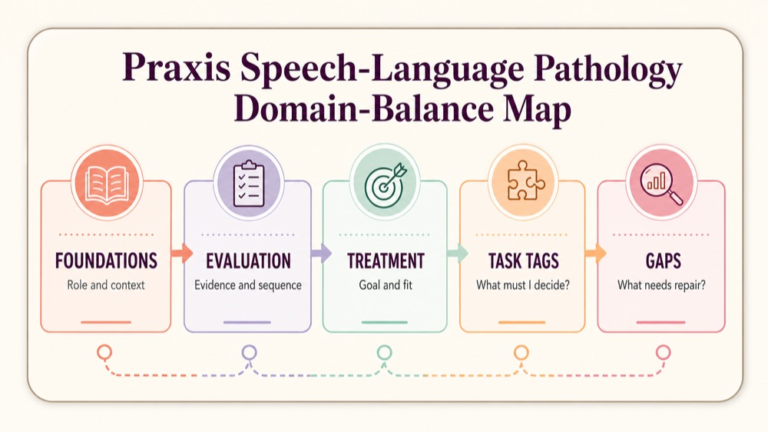
Balance the bank by broad content area and by reasoning task. The ETS 5331 materials describe foundations and professional practice, screening and evaluation, and treatment planning, implementation, and evaluation as broad areas. Use those labels as organizing shelves, then add a narrower task tag for the actual decision.
| Bank shelf | Example task tags | Review emphasis |
|---|---|---|
| Foundations and professional practice | role, ethics, collaboration, responsibility. | Context and professional judgment. |
| Screening and evaluation | next information, measure, interpretation. | Evidence and sequence. |
| Treatment planning | goal, method, support, functional fit. | Purpose and participation. |
| Implementation | partner, setting, cue, adaptation. | Usability and transfer. |
| Treatment evaluation | response, progress, generalization. | Comparison and next decision. |
Do not force every question into one content shelf when the item genuinely crosses areas. Add a primary shelf and a secondary tag. The primary shelf helps with balance, while the secondary tag preserves the reasoning relationship.
Check the bank monthly for overrepresented topics. A large pile of familiar diagnosis questions can create a false sense of coverage if the bank contains few professional-practice or process-stage decisions. Use the gap to select the next source and set.
Tag the reasoning task
Content labels tell you what a question mentions; task labels tell you what you must decide. Add both. A question about dysphagia may test the next assessment step, a safety-related response, an interpretation, or treatment evaluation. The task tag tells you which reasoning practice to repeat.
| Task tag | Core prompt | Closest distractor pattern |
|---|---|---|
| Next information | What fact would change the plan? | Intervention chosen first. |
| Best measure | What should be observed or compared? | Broad impression. |
| Interpretation | What pattern does the evidence support? | Unsupported cause. |
| Best action | What step fits this stage and goal? | Later step selected early. |
| Professional response | What response fits role and context? | Helpful intention without boundary. |
Use the task tag when you choose a review set. If you missed three next-information questions, you need a decision set that practices missing facts, not simply three more questions with the same disorder name.
When you are unsure how to tag an item, write the final request in your own words. The restatement usually reveals whether the item asks for information, measurement, interpretation, action, or a professional response.
Record evidence and confidence
Record the decisive clue in a short phrase, then add the confidence you had before viewing the key. This makes the question bank useful for both knowledge gaps and process gaps. A low-confidence correct answer deserves a different review than a high-confidence wrong answer.
| Result | Likely issue | Bank action |
|---|---|---|
| Correct, high confidence | Reasoning appears stable. | Schedule a transfer item. |
| Correct, low confidence | Recognition or partial reasoning. | Write the rule and revisit. |
| Wrong, high confidence | Misread task or overgeneralized rule. | Contrast the distractor. |
| Wrong, low confidence | Knowledge or evidence gap. | Study the narrow target. |
| Unclear key | Source limitation. | Verify or quarantine the item. |
Time can be useful, but record it only with the condition. “One minute” means something different in an untimed learning block, a supported set, and a light simulation. The context lets you interpret pace without turning one number into a personal label.
Use confidence as a review filter. Start a session with low-confidence correct items and high-confidence misses when you have limited time. Those items are more likely to change how you approach the next set than familiar, fully explained successes.
Map a question-bank review loop
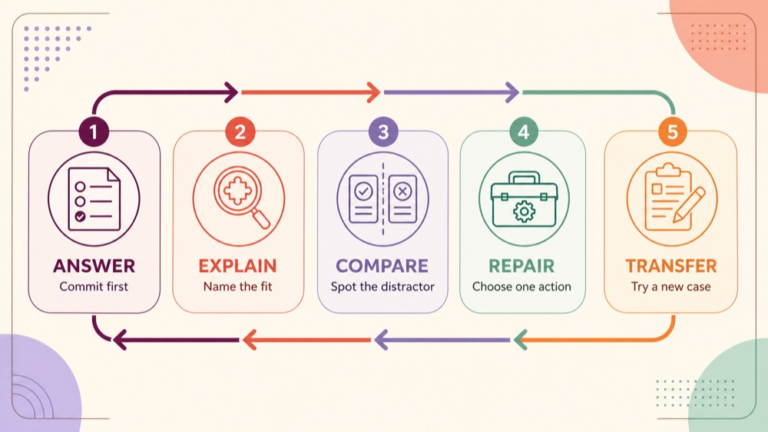
Move each item through a loop: answer, explain, compare, repair, and transfer. The loop is complete only when you test the repair on a new or altered case. Rereading the original explanation can help, but it does not show whether the reasoning survives a changed surface detail.
| Loop stage | Action | Completion signal |
|---|---|---|
| Answer | Commit before checking. | Letter and confidence recorded. |
| Explain | State why the choice fits. | Purpose and evidence named. |
| Compare | Describe the closest distractor. | Specific mismatch recorded. |
| Repair | Study the narrowest gap. | One next action selected. |
| Transfer | Try a changed case. | Rule adapts or is revised. |
Keep the repair small. “Review all of neuro” is not a usable next action. “Compare two cueing measures in a new case” or “map the sequence from missing information to treatment planning” gives you a task you can complete and evaluate.
When a transfer item changes the answer, update the rule instead of marking the original as useless. The change may show that context, purpose, or stage was the variable you needed to include in the first rationale.
Schedule spaced question-bank review
Use review dates to create spacing without making the system complicated. Revisit an item after the original session, then again after a gap, and later in a changed context. The interval can be adjusted to your schedule and confidence; the important feature is a planned return.
| Review pass | What to do | What to update |
|---|---|---|
| First pass | Read the rationale and distractor note. | Clarify the decision rule. |
| Second pass | Answer without the explanation. | Confidence and pace. |
| Third pass | Use a changed case or setting. | Transfer result. |
| Repair pass | Return to the repeated tag. | New source or practice action. |
Do not schedule every item for the same day. Use a queue with today, this week, and later review groups. This keeps the bank from becoming a long list of overdue cards and makes it easier to choose a realistic set.
Retire an item from frequent review when you can explain the task, evidence, fit, and distractor in a changed case. Keep the record for reference, but use your active queue for unresolved or recently repaired reasoning patterns.
Question 1: screening and next information
Question 1: A child passes a brief classroom screening, but a teacher reports that the child misses important information during noisy group instruction. The clinician needs to decide whether additional evaluation information is warranted. Which action best fits the question?
- A. Conclude that no concern exists because the brief screening was passed.
- B. Gather information about performance during the noisy group routine and compare it with the functional concern.
- C. Begin an articulation treatment program without examining the reported listening condition.
- D. Select a long-term treatment schedule before clarifying the classroom demand.
Correct Answer: B. The classroom observation and context information address the difference between the brief screening condition and the functional concern. The action gathers evidence that can guide the next decision without treating one screening result as a complete explanation.
Why the Other Options Are Wrong: A gives the brief screening more weight than the context-specific report. C chooses a target not established by the case. D sets treatment logistics before the clinician understands the communication demand. Each alternative moves away from the information question in the stem.
Exam Trap: A screening result and a functional report can answer different questions. When a stem highlights a condition difference, record the difference as evidence and choose the next information step that can clarify it.
Question 2: treatment goal and context
Question 2: An adult uses a communication strategy successfully during a structured clinic task but does not use it during a workplace conversation. The stated goal is improved participation in workplace meetings. Which next action best fits the treatment decision?
- A. Declare the strategy ineffective because clinic performance does not match the workplace result.
- B. Practice and measure the strategy within a relevant workplace-like interaction, then adjust support based on the goal.
- C. Add more clinic repetitions without observing the participation context.
- D. Replace the functional goal with a clinic-only accuracy target.
Correct Answer: B. A workplace-like interaction can show which environmental, partner, or task demands affect strategy use. Measuring that performance keeps the treatment decision connected to participation and gives the clinician information for adjusting support.
Why the Other Options Are Wrong: A treats a context difference as proof that the strategy has no value. C increases clinic practice without addressing the setting named in the goal. D changes the goal to match the easiest measurement rather than the client’s stated participation outcome.
Exam Trap: Do not confuse clinic acquisition with functional transfer. If the stem gives a participation goal and a setting contrast, select an action that brings measurement and support into the relevant context.
Question 3: professional judgment and scope
Question 3: A colleague asks an SLP student to post a screenshot of a paid question bank in a private study group. The colleague says the group is small and educational. Which response best fits responsible professional judgment?
- A. Post the screenshot because a private group is not public.
- B. Decline to share the protected material and suggest creating original notes or using a licensed resource.
- C. Remove the provider name and post the same screenshot.
- D. Share the answer letters while withholding the question text.
Correct Answer: B. Declining to distribute material without permission and offering original notes or a licensed alternative respects the resource boundary while keeping the study goal practical. The setting does not automatically establish permission to reproduce the material.
Why the Other Options Are Wrong: A treats privacy as permission. C removes attribution but does not resolve reproduction rights. D still shares content derived from the paid resource. A responsible answer identifies the boundary and offers a legitimate next step.
Exam Trap: Separate good intent from authorized action. Professional judgment questions often ask for a response that protects the boundary while preserving collaboration, rather than a response that simply maximizes access.
Use rationales to update the bank
Rationales should change the record. After reviewing an explanation, update the task tag if your first reading was wrong, add the decisive evidence, and write the closest distractor mismatch. A rationale that stays outside the bank becomes easy to forget and difficult to retrieve.
| Rationale note | Weak version | Stronger version |
|---|---|---|
| Task | It is the best answer. | The stem asks for missing information before action. |
| Evidence | The client has a problem. | The setting-specific difference changes the next step. |
| Fit | This is clinically appropriate. | This option measures the stated functional target. |
| Distractor | The other choices are wrong. | The closest option is a later step or needs an unstated fact. |
Use the updated rationale to create a one-line rule. “When the case gives a setting contrast, investigate the contrast before choosing a broad plan” can guide a new question. The rule should be conditional rather than a slogan that ignores context.
If a source explanation conflicts with an authoritative source or the facts in the stem, mark the item for verification. A high-quality question bank includes uncertainty labels; it does not hide them to make the dashboard look cleaner.
Separate content gaps from reading gaps
Two wrong answers can look identical in a score report while needing different repairs. A content gap means you need to study a concept or process. A reading gap means you did not identify the task, clue, stage, or context. Use the rationale record to distinguish them.
| Gap type | Clue in your review | Repair |
|---|---|---|
| Content | You cannot explain the concept after rereading the stem. | Study a focused source section. |
| Task reading | Your answer solves a different request. | Restate final sentence. |
| Evidence | You noticed background but missed the decisive clue. | Mark evidence before options. |
| Sequence | Your option belongs later in the process. | Map stages and prerequisites. |
| Comparison | You know both options but cannot name the mismatch. | Use a two-column contrast. |
Tag the primary gap and keep the secondary one in the note. A question can require content review and task-reading practice, but choosing one primary repair makes the next action manageable.
Recheck the same tag across several items before making a broad conclusion. One unusual miss may be noise. A repeated pattern across different topics is stronger evidence that your study process needs a specific adjustment.
Use the bank for timing without losing review
Use the question bank to build small timed sets after the rationale process is stable. Choose items from more than one domain, record the start and finish, and review the decisions afterward. Timing data should tell you where the process slows, not simply whether you moved quickly.
- Choose: select a mixed set with a clear reasoning target.
- Set: define a light time condition and protect review time.
- Answer: record confidence without opening explanations.
- Audit: compare pace, task reading, and distractor quality.
- Adjust: practice the slow step in a smaller block.
If timing reduces the quality of your rationales, lower the set size before raising the pressure. A small block that preserves evidence and comparison can reveal more than a larger block completed through unsupported guesses.
Use the current ETS page for changing administration details. Your personal timing block is a training condition; it should not be presented as a live promise about the test beyond the official source.
Create a weekly question-bank dashboard
At the end of each week, review a small dashboard: items completed, domains touched, reasoning tags repeated, high-confidence misses, low-confidence correct answers, and next actions due. The dashboard should guide selection for the coming week rather than reward the largest count.
| Dashboard signal | Question to ask | Planning decision |
|---|---|---|
| Domain balance | Which shelf has little recent work? | Choose a gap domain. |
| Task pattern | Which decision type repeats? | Build a focused set. |
| Confidence | Where are guesses hiding? | Schedule rationale review. |
| Distractor pattern | Which mismatch recurs? | Write a repair rule. |
| Timing | Which step consumes time? | Practice that step separately. |
Keep the dashboard compact. Five meaningful signals are enough to choose the next action. A dashboard filled with metrics that do not change your plan turns review into another data-entry task.
Make one decision at the end: what will you practice first next week? The answer should be tied to a tag or repeated pattern in the bank. That link is what makes the question bank cumulative.
SLP Praxis question bank checklist
Use this checklist when you add a new item or close a review session.
- I labeled the source, date, and practice condition.
- I assigned a broad domain and a reasoning task.
- I recorded the final request in my own words.
- I marked the decisive evidence and relevant missing information.
- I recorded the answer and confidence before reading the explanation.
- I wrote why the selected option fits the purpose and context.
- I explained why the closest distractor is weaker.
- I tagged the primary gap or uncertainty.
- I scheduled a review date or transfer prompt.
- I chose one next action that can be completed in the next study block.
A question bank becomes valuable through retrieval and revision. If an item has no rationale, no tag, and no next review action, it is only stored content. Complete the smallest missing field before adding another question.
Sources and next steps
Use the live ETS Speech-Language Pathology (5331) page for current exam identity, format, duration, question count, and changing test information. Use the ETS practice-test selector to find current preparation options, and use ASHA preparation guidance to shape practice around strengths and weaknesses.
Next, create five bank fields, add a small set from one domain, and tag each item by task. Review rationales, classify distractors, schedule a transfer item, and use the repeated pattern to choose the next set. The bank should make your study decisions clearer each week.
For a structured preparation path, see the SLP Study Center Complete Prep resource. Keep current administration instructions tied to ETS and use your question bank for original reasoning practice, review history, and targeted repair.