Short answer: slp praxis prep is most useful when it names a learning system rather than a single book, course, calendar, or practice-score target. A strong system connects six jobs: mapping the current ETS scope, learning concepts, separating nearby clinical decisions, completing original practice, reviewing errors, and verifying test-day logistics.
This guide is designed for learners at different starting points. You may be beginning with a blank page, returning after an uneven first pass, or already doing practice items but not learning enough from the misses. The sequence can flex around that starting point. It is not a fixed study plan, a substitute for the current ETS information, or a prediction of an individual result.
Use the current ETS Speech-Language Pathology 5331 page as the control point for scope and time-sensitive logistics. ASHA’s Praxis preparation guidance can help you orient to preparation resources, but the live ETS page and account remain the place to verify details that can change.
Table of Contents
- What SLP Praxis Prep Means as a Learning System
- Map the Current ETS Scope Before Choosing Materials
- Learn Concepts, Then Train Clinical Distinctions
- Use Original Practice to Expose Reasoning Gaps
- Turn Errors Into a Review Loop
- Choose a Flexible Sequence for Your Starting Point
- Verify Logistics Without Freezing Current Exam Numbers
- Choose Resources by Learning Job, Not by Marketing Label
- Readiness Audit: Can You Show Evidence of Preparation?
- Common Traps and Quick Review
What SLP Praxis Prep Means as a Learning System
Preparation is not simply the amount of time you spend with SLP material. It is the chain between an exam requirement and a learner action. If you cannot say what a resource is helping you do, it is difficult to tell whether you are building coverage, retrieving knowledge, practicing judgment, or just accumulating pages and percentages.
A practical prep system has six connected jobs:
- Scope mapping: translate the current ETS information and blueprint into a visible list of content areas, decisions, and review priorities.
- Concept learning: build an accurate explanation of each important idea, including what it is used for and what it does not answer.
- Clinical distinctions: compare nearby concepts, assessment choices, evidence patterns, and professional decisions so that a plausible distractor has a clear reason for being less appropriate.
- Original practice: use newly written scenarios or practice prompts to apply a concept without relying on memorized wording.
- Error review: classify the reason for a miss and assign a small corrective action instead of merely recording a score.
- Logistics verification: check the current test identity, registration details, delivery requirements, and deadlines from the responsible source.
Map the Current ETS Scope Before Choosing Materials
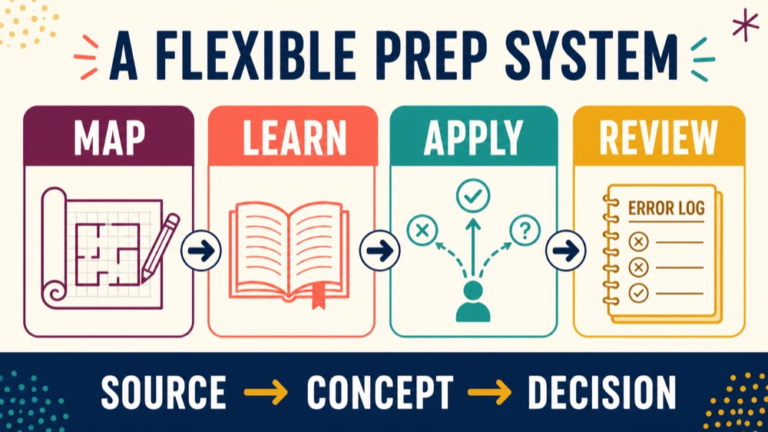
The current ETS page and its associated scope information should be the first checkpoint in your map. Start by recording the page date you reviewed and the version or document that controls your preparation. Avoid building your entire plan from a book’s chapter order or a search-result summary. Those may be useful navigation aids, but they are not a reliable substitute for the current ETS source.
Mapping does not require you to freeze every exam detail in a spreadsheet. It means turning the authoritative scope into a set of learnable questions. For each broad area named by the current source, ask what a learner must recognize, explain, compare, apply, or verify. A map is valuable when it changes what you do next.
- Capture the source: save the current ETS page and any associated blueprint or preparation document with the date checked.
- Break broad labels into decisions: turn a heading into smaller prompts such as purpose, evidence, interpretation, next action, or professional boundary.
- Mark your evidence: label each prompt as secure, partly retrievable, confusing with a nearby concept, or not yet studied.
- Attach a learning job: choose concept review, comparison practice, original application, error repair, or logistics verification.
- Schedule a recheck: note what must be verified again because it can change, especially test-day and registration details.
For example, suppose the current scope contains a broad assessment-related area. A weak map would simply repeat the word “assessment.” A stronger map would ask: What decision is the assessment meant to support? Which evidence is relevant to that decision? What limitation should prevent overinterpretation? Which neighboring choice could look reasonable but answer a different question? Those prompts create study actions without pretending that one label contains the entire reasoning process.
Learn Concepts, Then Train Clinical Distinctions
Concept learning answers, “What is this?” Distinction learning answers, “How is this different from the nearby answer that could also sound reasonable?” Both matter in speech-language pathology preparation, because many difficult decisions are not between an obviously correct answer and an unrelated one. They are between options that fit part of the situation but differ in purpose, timing, evidence, or scope.
Begin with a compact concept card or note. Include the definition, the job the concept performs, one concrete example, and one boundary. Then add a comparison note for the closest concept. This creates a bridge from recall to judgment. The boundary is especially important: it keeps a learner from treating a single observation as enough to support a broad conclusion.
Use questions like these when building a distinction:
- What exact decision is the prompt asking me to make?
- Which fact in the scenario carries the most weight for that decision?
- What would make the nearby option less appropriate, even if it is generally useful?
- What context, timing, or client goal changes the choice?
- What information is missing, and what can I responsibly conclude without it?
- Which professional or scope boundary limits the action?
Original practice example—not an ETS item
Scenario: A learner chooses an intervention technique after reading a prompt whose main task is to identify the next assessment decision. Two answer choices sound professionally reasonable, but only one addresses the decision requested in the scenario.
Original practice question: Which review action is most useful after this miss?
- Read another unrelated chapter before reviewing the item.
- Record the task, decisive evidence, and why the selected alternative answered a different question.
- Memorize the wording of the answer choices for later recognition.
- Complete a larger number of random items without writing an explanation.
Best review action: B. This is original practice content, not an ETS item. The point is not to memorize a particular scenario; it is to identify the mismatch between the question’s decision and the learner’s response. That explanation can transfer to a new item with different wording and content.
Use Original Practice to Expose Reasoning Gaps
Practice is most useful when it reveals how you are deciding. A percentage can show that something happened during a set, but it does not tell you whether the miss came from missing knowledge, a confused distinction, rushed reading, weak retrieval, or an unverified assumption about the test. Original practice content gives you a clean place to rehearse the reasoning process without treating a copied item or a familiar phrase as proof of readiness.
Use a three-pass approach. First, answer without looking at notes and state the task in your own words. Second, identify the evidence that made your choice stronger than the alternatives. Third, review the explanation and write what you would notice next time. If your answer was correct for the wrong reason, record that as a review need rather than counting it as fully secure.
- Tag the scope: connect the prompt to the map row or learning job it tests.
- Name the task: decide whether the prompt asks for definition, interpretation, comparison, application, or professional judgment.
- Choose with evidence: write the clue that supports the answer before checking the rationale.
- Compare alternatives: explain why the closest distractor answers another question or requires evidence not present.
- Set the next action: assign a short concept review, distinction drill, fresh scenario, or source check.
Do not let practice volume outrun explanation quality. If you can complete many items but cannot explain your misses, add a review block before adding another large set. The objective is not to create a dramatic number of attempts; it is to make the reasoning behind the next attempt more precise.
Turn Errors Into a Review Loop
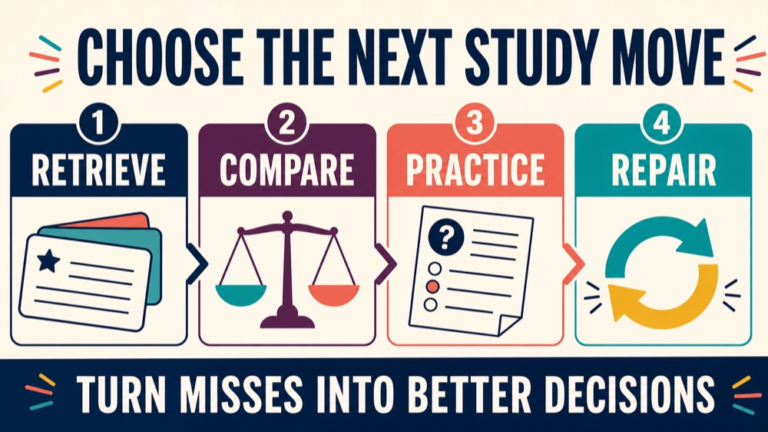
Error review is the part of preparation that turns practice into learning. A missed item is not one kind of event. Classifying it prevents you from prescribing the same remedy for every problem. More reading may help a concept gap, but it will not automatically repair a habit of answering the wrong task. More timed practice may help pacing, but it will not replace a missing distinction.
| Error type | What it looks like | Repair action |
|---|---|---|
| Knowledge gap | You cannot explain the concept even after rereading the prompt. | Return to a trusted explanation, write a plain-language definition, and create one new example. |
| Distinction gap | You know both options but cannot state why one fits the task better. | Build a compare-and-contrast note using the decisive evidence and boundary. |
| Task-reading gap | Your answer addresses a different question from the one asked. | Underline the requested decision in your own notes and restate it before answering. |
| Retrieval or timing gap | You understand the reasoning later but could not access it under the practice condition. | Use shorter retrieval sets, then repeat the same concept in a new context. |
| Logistics gap | You relied on an old assumption about registration, timing, delivery, or reporting. | Return to the live responsible source and record the date of verification. |
A simple review loop has five moves: capture the miss, classify it, explain the decisive evidence, assign one repair, and revisit the concept in a new form. The last move matters. A correction that is never retrieved again may feel clear on the day it is written and disappear later.
Use these review prompts after a practice block:
- Which misses were caused by missing information, and which were caused by choosing between close options?
- Did I select any answer correctly for a weak or accidental reason?
- Which distractor was most tempting, and what specific evidence made it less fit?
- What one sentence would I want to remember before seeing a new scenario?
- What small practice task will test the repair without repeating the same wording?
- Does any part of my note depend on a current ETS or ASHA page that needs a new check?
Choose a Flexible Sequence for Your Starting Point
A flexible sequence begins with evidence about your current state. It does not assume that every learner should begin with a full content review or follow the same number of weeks. Choose the first job that removes the biggest uncertainty, then cycle through concept learning, distinction practice, original application, and error review as the map changes.
| Starting point | First useful move | What to do next |
|---|---|---|
| New or unstructured | Build a dated map from the current ETS scope. | Learn the highest-priority concepts, add distinctions, then begin small original practice sets. |
| Some coursework, uneven recall | Run a short readiness audit and mark secure versus uncertain map rows. | Repair high-risk concepts and use comparison prompts before increasing practice volume. |
| Already practicing often | Analyze the error log instead of starting another random set. | Target recurring reasoning gaps, mix fresh scenarios, and verify logistics separately. |
| Close to a planned test date | Confirm current logistics and identify the few learning jobs with the highest uncertainty. | Use targeted review, timed application, error repair, and a final source recheck. |
Think in study blocks rather than a rigid calendar. One block might map a topic and write two distinctions. Another might use original practice and complete an error loop. A later block might mix areas so that you must identify the task before choosing a response. The block is complete when it produces evidence, not simply when the clock stops.
ASHA’s preparation guidance points candidates toward preparation information and ETS materials. That supports a useful sequence rule: begin with the current authoritative scope, then choose resources that make the next learning job easier to perform. If a resource cannot be connected to a map row, a concept explanation, a distinction, a practice rationale, an error repair, or a logistics check, pause before adding it to the stack.
Verify Logistics Without Freezing Current Exam Numbers
Logistics are part of preparation because a learner can study from an accurate concept map and still work from an outdated administrative assumption. The research packet’s search results included time-sensitive exam details, but this article intentionally does not convert those snippets into fixed statements. Check the current ETS page and account for the information that controls your own registration.
Before treating the logistics side as complete, verify the following from the live responsible source:
- The exact test title and code selected in the account.
- The current registration and appointment information available to you.
- The displayed test length, item format, and any other current test specifications.
- The delivery setting, location, identification, arrival, technology, or room requirements that apply to your appointment.
- The current score-reporting or recipient instructions relevant to your pathway.
- Accommodation procedures and any lead time that applies to your situation.
- Fees, rescheduling, cancellation, refund, and change rules shown at the time of registration.
- The deadlines set by your program, employer, credential pathway, or state authority.
Choose Resources by Learning Job, Not by Marketing Label
Books, courses, flashcards, question sets, videos, and checklists can all be useful, but their labels do not tell you what they will change. Choose by output. A resource is a better fit when you can describe the evidence it should produce after a study session.
| Learning job | Look for | Evidence after use | Warning sign |
|---|---|---|---|
| Scope mapping | Current source references and clear coverage labels. | You can point to what is covered and what still needs work. | An undated outline treated as the current exam. |
| Concept learning | Explanations, examples, limits, and retrieval prompts. | You can explain the idea without copying the source sentence. | Definition-only pages with no application. |
| Clinical distinctions | Comparisons, scenarios, and rationale that identifies decisive evidence. | You can explain why a nearby alternative is less fit. | Lists of terms with no decision context. |
| Original practice | Fresh prompts and complete reasoning feedback. | Your answer includes the task and supporting evidence. | A score with no explanation of misses. |
| Error review | A way to classify misses and assign repairs. | Recurring gaps become specific next actions. | More random practice used to avoid review. |
| Logistics verification | Links to current responsible sources and dated checks. | You can confirm the details that apply to your appointment. | Fixed numbers or policies without a recheck date. |
If you want to continue with a structured set of preparation materials, you can review the SLP Study Center Complete Prep page. Treat it as one possible resource within the system, check its current contents, and match it to the learning job you need next.
Readiness Audit: Can You Show Evidence of Preparation?
A readiness audit is a snapshot of evidence, not a promise about what will happen on test day. It asks whether your preparation system is producing the outputs that matter. Complete it with your current map, a recent original practice set, your error log, and the live logistics pages you have checked.
- I can identify the current ETS scope or blueprint source I used and the date I checked it.
- I can explain the major concepts I reviewed in plain language, with an example and a boundary.
- I can distinguish close options by naming the decisive evidence rather than relying on familiarity.
- I can state the task a practice prompt is asking before choosing an answer.
- I can explain why my answer fits and why the closest alternative is less appropriate.
- I can classify a miss as a knowledge, distinction, task-reading, retrieval, timing, or logistics problem.
- I have assigned a concrete repair to recurring errors and revisited at least some repairs in new contexts.
- I can work through mixed original practice without depending on memorized wording.
- I have verified current registration and test-day details from the source that controls them.
- I know the next learning job for my next study block and the evidence that will show progress.
If several answers are uncertain, that is useful information. Return to the map and choose the smallest next task that will make the uncertainty visible. For example, write one comparison, complete one fresh scenario, or verify one current logistics question. A readiness audit is valuable because it turns a vague feeling into a list of decisions you can act on.
Common Traps and Quick Review
Preparation can look busy while leaving the important reasoning untouched. Watch for these common traps:
- Confusing volume with coverage: many pages or items do not show that the current scope has been mapped.
- Memorizing old exam facts: a saved number or policy is not a current verification.
- Using a fixed plan for every learner: the right first job depends on your evidence and starting point.
- Studying definitions without distinctions: knowing two terms is different from choosing between them in context.
- Increasing practice before reviewing errors: new attempts can reproduce the same reasoning gap.
- Counting a lucky answer as secure: correct reasoning should be explainable, not merely correct.
- Letting a resource label make the decision: choose the material by the learning output it produces.
- Leaving logistics until the end: verify current administrative details early enough to act on them.
For a final quick review, ask yourself five questions:
- What current source controls my exam scope and logistics?
- Which concept or distinction is most uncertain right now?
- Can I explain the decisive evidence in a new scenario?
- What error pattern will my next study block repair?
- Which current detail must I verify again before registration or test day?
That is the core of a flexible SLP Praxis preparation system: source first, learn for understanding, practice for decisions, review errors for transfer, and verify logistics when the facts can change. Keep the process evidence-based and adaptable, and let the current ETS and ASHA pages—not an old summary—settle time-sensitive questions.
Continue your preparation: Explore the SLP Study Center learning resources.