
Preparing with an slp praxis practice test is most useful when you review the reasoning behind each answer, not just the letter you selected. A strong practice session asks you to identify the clinical task, find the decisive evidence, separate nearby concepts, and explain why the other choices do not fit.
This focused set includes four original single-best-answer questions for learners reviewing speech-language pathology concepts. The scenarios cover motor speech, aphasia and dysarthria, swallowing evaluation, and phonological patterns. They are written for learning and review, not as a substitute for current ETS instructions, ASHA guidance, supervised clinical judgment, or a complete evaluation of any person.
Table of Contents
- How to Use This SLP Praxis Practice Test
- Clinical Distinctions This Practice Set Tests
- Original SLP Praxis Practice Test Questions
- Score Your Reasoning, Not a Pass Prediction
- Quick Review Checklist
- References and Current-Fact Check
How to Use This SLP Praxis Practice Test
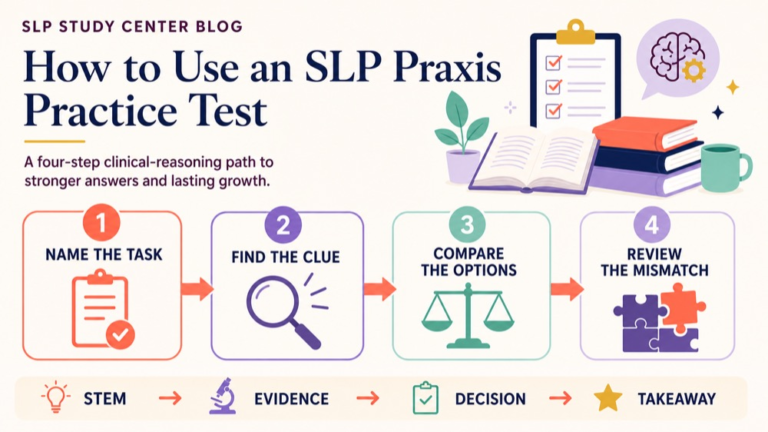
Start with a deliberate attempt. Read the whole stem, name the decision the question is asking for, and choose one answer before opening the rationale. If you look at the explanation first, you may recognize a familiar term without practicing the retrieval and discrimination that a selected-response item requires.
For each question, write a short evidence note. One useful format is: task, decisive clue, best concept, boundary. For example, a stem may ask for the next assessment step rather than a diagnosis. The decisive clue may be inconsistency across repeated productions, while the boundary is that the clue guides further assessment but does not settle the case by itself.
- Identify the task: Decide whether the item asks for an interpretation, an assessment step, a treatment principle, a measurement choice, or a professional action.
- Mark the evidence: Notice timing, pattern, consistency, modality, setting, communication partner, and the information the stem deliberately gives you.
- Classify the distinction: Ask whether the choices contrast language with speech, screening with evaluation, risk with confirmed physiology, or a pattern with an isolated sound error.
- Reject overreach: Remove answers that convert one observation into a diagnosis, a universal recommendation, or a promise about outcome.
- Review the mismatch: Explain what each distractor would require that the stem does not provide, or which question the distractor answers instead.
For timing practice, use the current ETS Speech-Language Pathology 5331 page to verify the present test format, administration details, and other time-sensitive facts. The goal of a home practice set is to rehearse decisions under realistic attention demands while keeping the facts about the live examination tied to the current source.
Clinical Distinctions This Practice Set Tests
Many challenging SLP exam items place two reasonable ideas next to each other. The winning answer is usually the one that fits the level of the question. Screening can identify a need for more evaluation, but it is not the same as a comprehensive evaluation. A motor speech clue can justify a targeted assessment, but it does not erase the need to consider language, hearing, cognition, participation, and context.
| Distinction | Decisive clue to look for | Boundary to remember |
|---|---|---|
| Screening vs. evaluation | A brief screen asks whether more information is needed. | A screen does not answer every diagnostic or treatment-planning question. |
| Aphasia vs. dysarthria | Aphasia concerns language processing; dysarthria concerns motor execution of speech. | One person may have more than one communication disorder after neurologic injury. |
| Apraxia concern vs. confirmed diagnosis | Inconsistent sequencing, groping, or prosodic disruption can guide motor-speech assessment. | A few speech samples do not replace a complete, differential assessment. |
| Phonological pattern vs. isolated articulation error | Predictable substitutions across a sound class suggest a pattern-level question. | Target selection still depends on the learner, stimulability, intelligibility, and functional context. |
| Swallowing risk vs. aspiration finding | Coughing, wet voice, history, and respiratory status can raise a management question. | Clinical signs alone may not answer every physiologic question; instrumental assessment may be warranted. |
Use the table as a reading lens rather than a list of automatic rules. The same behavior can have different meaning depending on the population, task, reliability of the sample, and purpose of the decision. On a practice item, first identify what the stem lets you conclude, then select the option that makes the smallest justified leap.
Original SLP Praxis Practice Test Questions
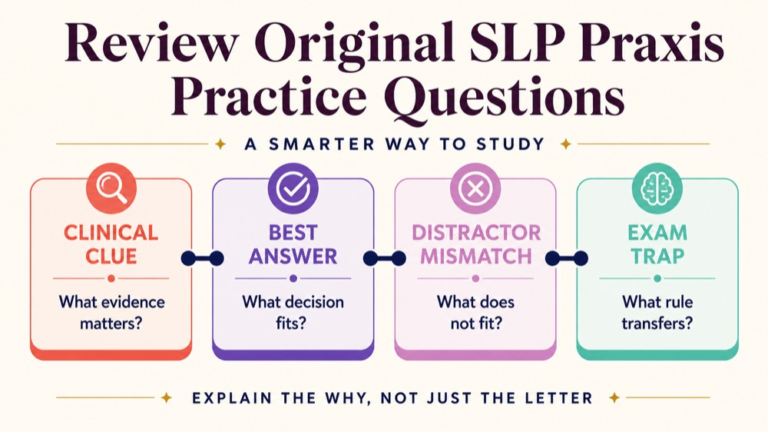
Attempt each item before reading its explanation. Every question below is newly written for this learning page and uses four answer choices with one best response. The rationales model how to connect a clinical clue to a decision without treating a vignette as a complete case record.
Practice Question 1: Motor-Speech Assessment
Scenario: A 7-year-old produces the same multisyllabic word differently across three attempts. Errors become more noticeable as word length increases, and lexical stress is inconsistent. A brief oral mechanism check does not reveal an obvious strength problem. The clinician is deciding what information to collect next, not assigning a diagnosis from this short observation.
Question: Which next step best matches the clinical question?
Correct Answer: B. Collect structured motor-speech samples that vary word length, repeated productions, transitions, and prosody, alongside broader assessment data.
Why This Answer Is Correct: The decisive evidence is inconsistency across repeated attempts, increasing difficulty with length, and disrupted stress. Those observations make a targeted motor-speech assessment a logical next step because it can examine planning and sequencing demands across tasks. The wording still matters: it asks for information to collect, so the answer preserves the need for a broader differential assessment instead of naming a disorder from three productions.
Why the Other Options Are Wrong: A narrows the problem to one sound and skips the sequencing and prosody question. C treats one feature as a rule-out for an entire disorder class, which the stem does not support. D makes hearing screening the whole response; hearing information may be relevant, but it cannot answer the motor-speech assessment question by itself.
Exam Trap: Do not turn a supporting feature into a final diagnosis. When the stem asks what to do next, choose the assessment that directly tests the observed pattern while keeping the clinical differential open.
Practice Question 2: Aphasia and Dysarthria
Scenario: An adult is three weeks after a left-hemisphere stroke. The person follows multistep directions and names common objects accurately, but conversational speech is slow, imprecise, and difficult to understand. The same imprecise articulation pattern appears across repeated productions of familiar words. The question is about the most appropriate assessment emphasis.
Question: Which interpretation best fits the evidence provided?
Correct Answer: C. A dysarthria-focused motor-speech evaluation is appropriate while language and cognition continue to be considered.
Why This Answer Is Correct: The stem gives preserved comprehension and naming, plus slow, imprecise, relatively consistent articulation. Those clues point toward a speech-motor execution question, so a dysarthria-focused evaluation is the best emphasis. The answer also avoids an artificial either-or choice: a neurologic event can affect several communication domains, and the full assessment should continue to examine language, cognition, function, and the person’s communication priorities.
Why the Other Options Are Wrong: A confuses reduced speech intelligibility with impaired receptive language and ignores the preserved direction-following information. B treats a broad neurologic history as if it were a voice diagnosis and does not address articulation precision. D substitutes a label for assessment; stroke history alone cannot distinguish apraxia, dysarthria, aphasia, or co-occurring conditions.
Exam Trap: Match the impairment class to the evidence. Speech execution clues support a motor-speech assessment, while language clues involve comprehension, naming, formulation, or discourse; reduced intelligibility by itself does not settle the distinction.
Practice Question 3: Swallowing Evaluation
Scenario: An older adult recovering from pneumonia coughs twice during a water trial and has a wet-sounding voice afterward. The person is alert and can follow directions. The clinician must decide how to respond to the possible safety concern and what information is needed for management.
Question: Which action is the best next step?
Correct Answer: A. Complete a comprehensive clinical swallowing evaluation and determine whether instrumental assessment is warranted for the management question.
Why This Answer Is Correct: Coughing and a wet voice after a trial are clinically important signals that should prompt careful evaluation, especially alongside a recent pneumonia history. A comprehensive clinical swallowing evaluation gathers history, respiratory status, oral findings, alertness, functional goals, and observed performance. If the remaining question concerns physiology or management that a clinical exam cannot answer, an instrumental study may be appropriate.
Why the Other Options Are Wrong: B overstates what the bedside signs establish and skips the assessment process. C applies a restrictive intervention to every meal without confirming the person’s needs, goals, tolerance, or the question that must be answered. D starts an exercise before addressing immediate safety and does not show that the exercise matches the suspected impairment.
Exam Trap: Separate a risk signal from a confirmed physiologic finding. The best answer often names the evaluation and the reason for considering instrumental information instead of jumping from one sign to a universal diet order.
Practice Question 4: Phonological Pattern Analysis
Scenario: A preschooler consistently says /t/ for /k/ and /d/ for /g/ in many words. The substitutions occur across contexts, and a recent hearing screen was passed. The family asks the clinician to work on one incorrect word at a time, but the clinician is selecting an assessment-informed treatment direction.
Question: Which interpretation best guides the next planning step?
Correct Answer: A. Analyze the pattern as a likely fronting contrast and consider targets that address the sound distinction in functional words.
Why This Answer Is Correct: Replacing velar sounds /k, g/ with alveolar sounds /t, d/ across many words is a pattern-level contrast commonly described as fronting. The repeated relationship matters more than the individual word list, so analysis should inform target selection and activities that help the learner hear and produce the contrast. Stimulability, intelligibility, development, participation, and the learner’s response still guide the individualized plan.
Why the Other Options Are Wrong: B treats a predictable sound-class relationship as unrelated word errors and misses the value of phonological analysis. C proposes a nonspeech exercise without showing that it addresses the speech sound contrast or the learner’s functional need. D confuses a passed hearing screen with the absence of a speech sound disorder; hearing is one part of assessment, not a rule-out for every speech difficulty.
Exam Trap: When substitutions follow a repeatable relationship, ask whether the question is about a phonological pattern rather than an isolated articulation placement error. Then check that the proposed plan remains assessment-informed and functional.
Score Your Reasoning, Not a Pass Prediction
A practice result is most useful as a map of reasoning habits. It can show whether you missed the task, overlooked a decisive clue, confused neighboring constructs, or selected an answer that sounded familiar but exceeded the evidence. It should not be treated as a promise about performance on a future administration or as an individual clinical conclusion.
After each item, record the answer you chose, the evidence you used, the concept that controlled the correct answer, and the boundary you missed. This turns a four-question set into a reusable review loop. If your answer was clinically plausible but answered a different question, write that difference in one sentence; that is often the most valuable correction.
- Task error: You answered with a treatment choice when the stem asked for an assessment step.
- Evidence error: You noticed a background detail but missed the clue that separated language, speech, swallowing, or voice.
- Level error: You chose a diagnosis when the available evidence supported only a screening result, risk statement, or next-step recommendation.
- Scope error: You selected a universal action without considering the person, setting, goals, safety, or need for referral.
- Transfer error: You knew a definition but could not apply it to a new pattern, repeated production, or functional decision.
For the live examination’s current content outline, registration rules, timing, and score-related information, use the current ETS and ASHA pages linked below. If a page, course, or study schedule contains a dated number, verify it at the source before relying on it. This keeps your practice reasoning stable while allowing time-sensitive administration facts to be refreshed.
Quick Review Checklist
Use this checklist after completing the questions or when building the next study block. The purpose is to make your review specific enough to change the next attempt. A correct answer without an explanation is fragile; a wrong answer with a precise mismatch can become a durable learning point.
- Can I state the question’s decision in plain language before looking at the options?
- Can I point to the single most decisive clue and explain why it outweighs the background details?
- Can I separate screening, evaluation, diagnosis, treatment planning, and outcome measurement?
- Can I distinguish language impairment from speech-motor execution and motor planning concerns?
- Can I recognize a repeatable phonological pattern instead of treating each substitution as unrelated?
- Can I explain why a swallowing sign raises a safety question without overclaiming the physiology?
- Can I name the missing information that would change the next clinical decision?
- Can I explain why every distractor answers a different question or requires evidence not present in the stem?
- Can I verify changing ETS and ASHA facts from the current source rather than an old study note?
The portable rule is simple: read for the decision, anchor the answer to evidence, and keep the conclusion proportional to the information provided. Repeat the process with new original items and revisit the distinction that caused the error instead of memorizing a letter pattern.
References and Current-Fact Check
Use the current ETS Speech-Language Pathology 5331 page for the exam scope, administration, and other changing test facts. Use ASHA’s Praxis certification context for current credentialing information, the ASHA Practice Portal for clinical topic guidance, ASHA policy resources for professional boundaries, and ASHA Evidence Maps for evidence summaries. Recheck these sources before publication and whenever a source owner updates the relevant page.
This learning page is designed for study and review. It does not replace the current source pages, an individualized evaluation, supervision, or professional judgment in a specific setting.
Continue your preparation: Explore the SLP Study Center learning resources.