
An slp praxis practice test with rationales is most useful when the rationale explains a decision rather than simply naming a key. Read the task, connect the relevant evidence to the choice, identify the closest mismatch, and write when the same rule would need to change.
The current ETS Speech-Language Pathology (5331) page describes a computer-delivered selected-response test with 132 questions and 150 minutes. Use the live ETS page and your account for changing details. ASHA preparation guidance also supports practice questions, timed work, and a plan shaped by individual strengths and weaknesses.
What a rationale should explain
A useful rationale connects the question task, the evidence in the stem, and the selected option. It also explains why the nearest alternative is weaker and identifies a boundary for the rule. Without those links, a rationale can become a sentence to recognize instead of a decision process to reuse.
| Rationale part | Question to ask | What it teaches |
|---|---|---|
| Task | What action or interpretation was requested? | Defines the comparison. |
| Evidence | Which details change the decision? | Prioritizes relevant clues. |
| Fit | Why does the selected option answer the task? | Builds a decision rule. |
| Mismatch | Why is the closest option weaker? | Improves close-choice comparison. |
| Boundary | What changed detail could alter the choice? | Protects against overgeneralizing. |
Read rationales as explanations of relationships, not as isolated facts. A rationale that says a step comes first should also tell you what information that step supplies and which later decision it supports. Those relationships are what you need when a new case changes the surface details.
Mark confidence beside your original answer. Stable confidence with a weak rationale can show a hidden shortcut. Uncertain confidence with a correct answer can show a rule that needs more transfer. Both deserve review before you increase practice volume or add a strict time condition.
Confirm the current 5331 source before reviewing rationales
Begin with the current ETS Speech-Language Pathology (5331) page. Use it to confirm subject identity, current delivery and timing information, broad content direction, question count, duration, and preparation links. The page currently lists 132 questions and 150 minutes for a computer-delivered selected-response exam, so date any administration note you keep.
Use the ETS practice-test page to identify current preparation options by subject. Read each resource description before deciding what role it should play. A practice question, a rationale review block, and a long simulation can provide different evidence about your preparation.
- Verify the subject: confirm Speech-Language Pathology (5331).
- Record the source: note provider, title, date, and format.
- Label the condition: identify independent, supported, untimed, timed, or simulation work.
- Separate logistics: use ETS for current delivery and appointment information.
- Protect originality: use legitimate preparation material rather than purported secure content.
For planning principles, review ASHA’s Praxis preparation guidance. Keep preparation guidance distinct from current ETS administration facts. This separation helps you update a study note without accidentally treating a practice rationale as a changing test instruction.
Build a rationale-first study workflow
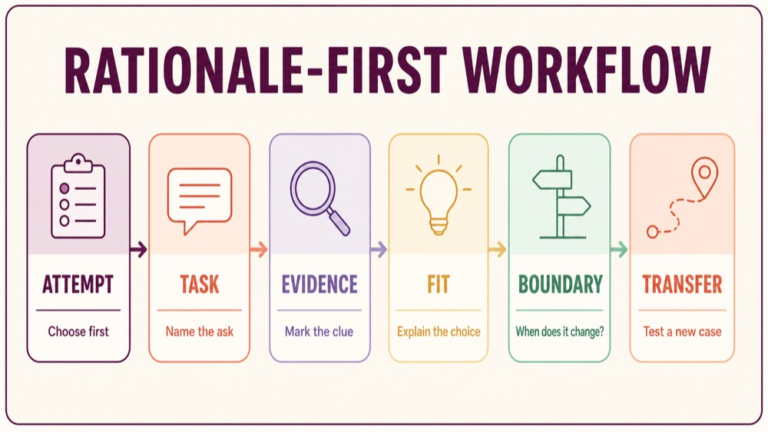
Set the review sequence before opening the answer key. Make an independent choice, state the task, mark the relevant evidence, read the rationale, compare the nearest distractor, and write a transfer question. The sequence turns passive answer checking into a small study workflow with visible steps.
| Step | Action | Record |
|---|---|---|
| 1. Attempt | Choose before looking at help. | Option and confidence. |
| 2. Task | Restate what the stem requests. | One-sentence task. |
| 3. Evidence | Mark the details that matter. | Relevant clue and relationship. |
| 4. Rationale | Read why the key fits. | Rule in your own words. |
| 5. Contrast | Explain the nearest mismatch. | Purpose, sequence, or evidence mismatch. |
| 6. Transfer | Change one meaningful detail. | Fresh check question. |
Use one primary learning purpose for a block. You may be studying assessment sequencing, treatment fit, professional practice, or interpretation. A focused purpose makes the rationale easier to evaluate because you know which relationship you are trying to understand.
Keep the record concise enough to repeat across several questions. A short rule with a boundary is more useful than a full page of copied explanation. Add detail only when it clarifies the evidence or shows why the closest alternative is weaker.
Save your first reasoning before reading the rationale
Your first response is the baseline for review. Record the selected option, confidence, task interpretation, and one supporting detail before opening the rationale. If you changed your answer while rereading, mark that change because it may point to task recognition, evidence selection, or decision confidence.
| Baseline field | Example | Why it helps |
|---|---|---|
| Choice | Option C, uncertain. | Shows how strongly the answer was held. |
| Task | Choose information before selecting a measure. | Creates a comparison target. |
| Evidence | History detail creates the gap. | Shows what guided the decision. |
| Attraction | Option B named a familiar procedure. | Explains the distractor pull. |
Do not replace the first note with the rationale. Put the updated understanding below it. The difference between the two versions can show whether you learned a missing fact, corrected the task, repaired a sequence error, or discovered that a related option had a narrower fit.
Label any reference support or peer discussion. A supported correction can teach a great deal, but it still needs a fresh independent check. Clear conditions make the rationale record more trustworthy and help you decide which practice format should follow.
Identify the task and the decision stage
Before asking why an answer is correct, ask what the stem wants you to choose. It may request an assessment action, the next information, a treatment response, an interpretation, or a professional practice decision. The same clinical fact can point to different answers depending on the task and stage.
| Task family | Restatement frame | Rationale connection |
|---|---|---|
| Next information | What is unknown and could change the plan? | Key closes an information gap. |
| Assessment action | What should be done for this purpose? | Key fits the decision being measured. |
| Treatment action | What response fits the target and condition? | Key connects method to function. |
| Interpretation | What pattern is supported by the evidence? | Key stays within the details supplied. |
| Professional response | What action fits the role and concern? | Key matches responsibility and context. |
A rationale should help you see why a true statement can still be the wrong response. If an option belongs to a later stage or answers a different verb, record that mismatch. This is one reason close distractors are educational: they show how a fact can be relevant without being the best fit for the task.
Underline task words when the stem is dense, but do not rely on a word in isolation. Connect the requested action to the population, goal, evidence, and sequence. That full relationship is more stable than a shortcut built from one signal word.
Connect evidence to option fit
Strong rationale reading asks which details change the decision and how they change it. Mark the relevant clue, then write the relationship between that clue and the selected option. If you cannot describe the relationship, the rationale may still be a sentence you recognize rather than a rule you can apply.
| Evidence type | Question | Useful connection |
|---|---|---|
| Functional goal | What outcome is being considered? | Links the action to purpose. |
| Context | Where and with whom does the pattern occur? | Defines the condition of the choice. |
| Observed finding | What was directly described? | Separates observation from inference. |
| Missing detail | What remains unknown? | Guides the next information step. |
| Sequence cue | What has or has not happened yet? | Places the action in order. |
Rewrite evidence in your own language rather than copying a phrase from the stem. “The classroom demand changes the communication context, so context information should guide the next step” is a reusable relationship. A list of words from the stem is harder to transfer.
When the rationale emphasizes a detail you ignored, ask what option that detail rules in or rules out. This keeps the review focused on decision impact. It also helps you avoid over-weighting a vivid symptom or familiar term that does not determine the requested action.
Find the closest distractor mismatch
After reading why the key fits, identify the option that could work in another context. Then name the mismatch that makes it weaker here. It may have the wrong purpose, sequence, population, evidence requirement, or scope. A precise mismatch turns the distractor into a study clue.
- Purpose mismatch: the option addresses a related goal rather than the requested goal.
- Sequence mismatch: the option belongs before or after the stage in the stem.
- Evidence mismatch: the option assumes a detail the case did not establish.
- Population mismatch: the option fits a different client or setting.
- Scope mismatch: the option makes a broader claim than the evidence supports.
Write the comparison as a sentence. “The procedure is related, but the stem asks for information before the procedure is selected” is clearer than “the procedure is wrong.” The sentence preserves when the option might become relevant and why it does not win this comparison.
Review the closest distractor even when you selected the key. Correct answers can hide a weak comparison if you chose the right option for the wrong reason. The nearest alternative often reveals whether your rationale has a boundary or has become a broad shortcut.
Read a rationale for fit and boundaries
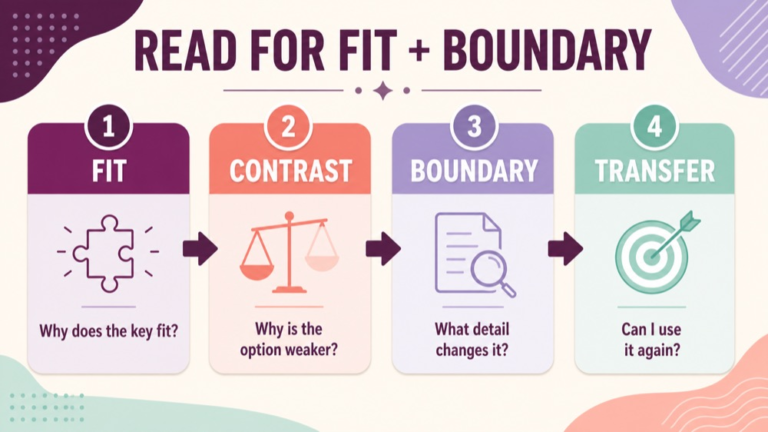
Use a four-part rationale reading pass: why the key fits, why the nearest option is weaker, what detail could change the choice, and how to test the rule on a fresh case. The fourth part matters because a rationale without a boundary can be over-applied to a different task.
- Fit: connect the selected option to the task and evidence.
- Contrast: name the nearest distractor’s mismatch.
- Boundary: identify a changed detail that could alter the decision.
- Transfer: write a new case or question that tests the rule.
For example, a rationale may support gathering context before choosing an assessment measure. The boundary is that once the relevant context is established, a different question may ask you to select the measure itself. The rule is about sequence and purpose, not a blanket preference for one action.
Close the rationale before writing the transfer prompt. If you can only repeat its wording, change the setting or functional goal and try again. A fresh case shows whether you understood the relationship among task, evidence, and option fit.
Try three original rationale-review questions
The following items are original educational examples created for this article. They are not copied from ETS and are not presented as secure test material. Answer first, then use the rationale to identify fit, closest mismatch, boundary, and transfer.
Question 1: Explain the purpose fit
Scenario: A child uses a communication device inconsistently across classroom activities. The stem asks what information should be gathered before choosing an implementation goal. Which response best fits the task?
Correct Answer: B. Why This Answer Is Correct: The question asks for information before an implementation goal is chosen. Activity, partner, access, and opportunity details describe the conditions that shape use. B addresses the information gap and creates a clearer basis for a functional goal.
Why the Other Options Are Wrong: A begins intervention before the context and goal are defined. C makes a broad interpretation from one behavior. D selects a feature before identifying the participation conditions. Each alternative may become relevant later, but B has the strongest fit for the stated first step.
Question 2: Explain a sequence boundary
Scenario: A learner selects a treatment technique because it is associated with a target disorder, but the stem asks what should be confirmed before selecting the technique. Which review statement is most precise?
Correct Answer: B. Why This Answer Is Correct: The task is about what should be confirmed before the technique is chosen. Target and functional fit provide the boundary for selecting an action. B explains why the associated technique is not the response to this stage, even if it could be considered later.
Why the Other Options Are Wrong: A treats association as sufficient evidence. C ignores the sequence requested by the stem. D assumes that a label supplies the functional information needed for the plan. B keeps the rationale tied to task, evidence, and order.
Question 3: Explain a distractor boundary
Scenario: A question asks for the next step after a baseline has been gathered. One option proposes gathering the same baseline again, while another selects an action that uses the baseline to set a functional target. Which rationale is strongest?
Correct Answer: B. Why This Answer Is Correct: The stem establishes that baseline information is available and asks what follows. B uses the existing evidence to set a functional target. The repeated baseline may be appropriate if the information were incomplete, but the stated condition gives it a weaker fit here.
Why the Other Options Are Wrong: A ignores the condition that the baseline has already been gathered. C treats broad relevance as equal to sequence fit. D avoids the comparison instead of using the evidence supplied. B explains the boundary that makes the next action appropriate.
Rewrite the rationale as an if-then rule
Convert the explanation into an if-then rule that includes a boundary. For example, “If the stem asks for information before selecting a measure, then identify the missing context that changes the measure choice; once that context is established, move to the measure decision.” The boundary prevents the rule from becoming a shortcut.
| Rule part | Prompt | Example |
|---|---|---|
| If | What task and condition are present? | If the stem asks for the next information… |
| Then | What action addresses that task? | Then identify the missing context… |
| Because | What evidence connects them? | Because the context changes the choice… |
| Boundary | When would the action change? | Once the context is established… |
| Transfer | What fresh case can test it? | Change setting or target and re-answer. |
A rule should be concise enough to recall and specific enough to compare. Avoid writing a broad slogan such as “assess before treatment.” Add the task, evidence, and condition that make the rule relevant. Those details are what allow you to distinguish a similar-looking case.
Keep the original rationale for reference, but use the rewritten rule in a fresh check. If the rule fails when a detail changes, decide whether the boundary was incomplete or the new case asks a different task. Updating the rule is part of learning, not evidence that the review failed.
Separate content retrieval from case application
A rationale can clarify a concept without repairing your ability to apply it. Test the difference by closing the explanation and stating the principle in plain language. Then apply it to a new case with changed details. If the concept is known but the choice changes incorrectly, the next repair should focus on application, sequence, or distractor comparison.
| Pattern | What it suggests | Next block |
|---|---|---|
| Concept unavailable | Retrieval needs support. | Plain-language rule and delayed recall. |
| Concept known, case fit weak | Application needs practice. | Two contrastive fresh scenarios. |
| Right action, wrong stage | Sequence needs review. | Order steps with each purpose. |
| Related option wins | Distractor comparison needs precision. | Closest-option mismatch notes. |
| Rule works, pace slows | Process may be the variable. | Short light-timing comparison. |
Use the rationale as evidence for your label, but keep the label provisional until a fresh item supports it. Several factors can contribute to one miss. Selecting the primary repair first makes it easier to see what changed in the next result.
Do not add a strict timer to every unresolved rationale. First make the rule reproducible. Then use a small timed block if the question is whether speed changes the quality of the comparison. Keeping the stages separate gives each result a clearer meaning.
Use rationales to plan a fresh check
Every reviewed rationale should end with a fresh check that changes the surface details while preserving the reasoning principle. Change the setting, population detail, functional goal, or sequence request in a controlled way. The change should require application rather than recognition of the original wording.
- Keep the principle: preserve the relationship the rationale explained.
- Change one detail: alter a setting, goal, condition, or stage.
- Answer independently: record choice and confidence before help.
- Compare again: explain the closest distractor mismatch.
- Update the boundary: state when the rule changes.
A fresh check should be small enough to review completely. One or two well-designed cases can tell you more about transfer than a large block where explanations are skimmed. Keep the task, evidence, fit, mismatch, and boundary fields consistent across the original and fresh item.
Pair the two records instead of replacing the original. The pair shows whether your repair improved the decision itself, the explanation quality, the distractor comparison, or confidence. That pattern can guide the next study block more precisely than a raw percentage.
Add timing after rationale quality is stable
Timing is a separate condition from rationale learning. Once you can state why the key fits and why the nearest option is weaker, use a small timed block to see whether the clock changes rereading, task recognition, evidence selection, or commitment. Keep the same rationale template so the conditions remain comparable.
| Stage | Condition | Compare |
|---|---|---|
| Rationale learning | Time open, answer key delayed. | Rule, evidence, mismatch, and boundary. |
| Fresh transfer | Changed case details, no clock. | Application and task fit. |
| Light timing | Small set with a flexible boundary. | Rereads, hesitation, and explanation quality. |
| Long practice | Use after a review plan exists. | Stamina and process patterns. |
If the rationale is stable without a clock but weakens under light timing, record a process hypothesis. If the same reasoning problem appears in both conditions, keep the content, sequence, or application repair active. The comparison tells you whether time is the main variable or only one part of the pattern.
Do not use a long simulation to answer every question at once. A short, controlled timing block can show what changed while keeping the review manageable. Increase duration after the record shows a clear reason for doing so.
Avoid rationale-review traps
- Reading the rationale before saving an independent first response.
- Copying the explanation without identifying the task.
- Recording the key but not the relevant evidence.
- Ignoring the closest distractor because it is not the answer.
- Turning one rationale into a broad rule without a boundary.
- Repeating the original wording until recognition replaces transfer.
- Changing source, content lane, and practice condition together.
- Calling every miss a knowledge gap.
- Calling every slow decision a pacing problem.
- Using practice percentages as official score information.
- Using a practice resource for changing appointment or administration details.
- Studying purported secure content rather than legitimate preparation material.
The correction is a repeatable chain: answer first, identify the task, connect evidence to fit, explain the nearest mismatch, state the boundary, test a fresh case, and add timing only when the rationale is reproducible. Each step turns the rationale into an action.
SLP Praxis practice-test-with-rationales checklist
Use this checklist with an slp praxis practice test with rationales:
- Did I confirm Speech-Language Pathology (5331) through the current ETS page?
- Did I record the practice source, date, and condition?
- Did I make an independent first choice before reading the rationale?
- Did I restate the task and decision stage?
- Did I identify the evidence that changes the choice?
- Did I explain why the selected option fits?
- Did I explain why the closest distractor is weaker?
- Did I rewrite the rationale with an appropriate boundary?
- Did I separate retrieval, application, sequence, distractor, and process issues?
- Did I test the rule with fresh wording?
- Did I keep supported and independent results separate?
- Did I add timing only after rationale quality was stable?
- Did I keep practice evidence separate from official score and logistics claims?
A rationale is worth studying when it helps you make and explain a decision on a new case. Read for fit and boundaries, not just confirmation. Then use the fresh check to decide what should be repaired next.
Sources and next steps
Use the current ETS Speech-Language Pathology (5331) page for subject identity, format, duration, question count, broad content direction, and preparation links. Search the ETS Praxis practice-test page for current subject options. Review ASHA’s Praxis preparation guidance for preparation materials, practice questions, timed work, and using strengths and weaknesses to guide review.
Continue your preparation: Explore the SLP Study Center learning resources after you complete the rationale record and choose a fresh transfer check.