
An slp praxis practice test review should explain what happened in each uncertain decision and what you will do next. Checking the percentage is only the first layer. A strong review revisits the task, identifies the decisive evidence, compares the rationale with the closest distractor, and assigns one targeted repair.
The current ETS Speech-Language Pathology (5331) page describes a computer-delivered selected-response exam with 132 questions and 150 minutes. Use the live ETS page for changing test information. ASHA preparation guidance supports practice questions and study planning shaped by strengths and weaknesses, while the review method below is an original way to organize your own learning evidence.
What review should do
Review has a different job from answering. Answering asks you to commit to one option under a stated condition. Review asks why that option fit or failed, which detail controlled the decision, and what future case would test the rule. Keeping these jobs separate helps you learn from a miss without turning the explanation into a passive reading exercise.
| Review job | Question to ask | Useful output |
|---|---|---|
| Reconstruct | What was the item asking? | Task restatement. |
| Locate evidence | Which detail should control? | One decisive clue. |
| Explain | Why does the best option fit? | Reusable rule. |
| Compare | Why is the closest distractor weaker? | Mismatch statement. |
| Transfer | Where else should the rule apply? | Changed case. |
| Act | What should I practice next? | Small repair block. |
A review note is complete when it changes what you will do, not when it merely repeats the answer letter. If you cannot write a next action, the explanation may still be too broad. Narrow it to a task type, a sequence step, an evidence clue, or a screen habit that can be tested in new items.
Review the decisions that were wrong, uncertain, or correct for a weak reason. High-confidence misses can expose an overgeneralized rule. Low-confidence correct answers can reveal recognition without explanation. Both belong in a useful SLP Praxis practice test review because both influence how stable your reasoning will be in a new case.
Confirm what was reviewed
Before analyzing a result, write down the source, set name, date, item count, and mode. A practice set might be a short quiz, a case-based group, a timed block, or a longer rehearsal. The review plan should match the mode. Immediate feedback can support learning, while delayed feedback gives you a cleaner record of independent commitment.
| Field | Example | Why it matters |
|---|---|---|
| Source | Provider and set title. | Item style can differ. |
| Length | 25 items. | Fatigue and coverage change. |
| Mode | Independent, delayed review. | Support affects interpretation. |
| Timing | Untimed or light timed. | Pace is a separate signal. |
| Support | Notes, reference, or none. | Shows the study condition. |
| Interruptions | Connection or attention break. | Explains unusual results. |
Check that the set actually matches the Speech-Language Pathology (5331) subject or label it as general SLP review. Do not use an unrelated practice set to make a precise claim about a 5331 result. Source fit is part of review quality.
If a resource displays a percentage, readiness color, or provider-created score, record the label exactly as supplied. Do not convert it into an official score without a responsible source. Your review can evaluate the learning evidence while keeping administrative and score-reporting information in its own field.
Keep original notes rather than reproducing protected questions. Paraphrase the case, record the concept, and create your own transfer example. This preserves the reasoning work and keeps a private study log separate from unauthorized redistribution.
Use current source-controlled practice wisely
Start with the current ETS Speech-Language Pathology (5331) page when you need to verify the subject, current format, question count, duration, or preparation links. The page currently lists 132 selected-response questions and 150 minutes for the computer-delivered exam. Confirm live details again when your test date approaches.
Use the ETS practice-test selector to identify current options. The live ETS Form 1 page describes a Speech-Language Pathology practice product with timing and feedback features. Read the product details and terms before deciding whether the resource is best for learning, pacing, or a longer rehearsal.
ASHA’s Praxis preparation guidance can help you organize practice around strengths and weaknesses. Keep the roles of the sources distinct: ETS is the place to verify changing test information, while a preparation resource supplies a study experience that you still need to review critically.
- Label the source: record provider, set, access date, and link.
- Label the purpose: identify learning, independent decision practice, pacing, or simulation.
- Label the feedback: note whether rationales were immediate or delayed.
- Label the result: separate correct items, percentage, domain pattern, and any provider label.
- Label the boundary: keep official administration information connected to ETS and certification information connected to the responsible organization.
This source check makes the review more honest. It lets you ask whether an error came from the material, the process, the condition, or a missing concept instead of assigning every miss to a broad lack of knowledge.
Review in three passes
A three-pass review keeps the first explanation from doing all the work. Pass one reconstructs your independent decision. Pass two examines evidence, rationale, and distractors. Pass three creates a changed case or a small action that tests the rule. The sequence is short enough to repeat and detailed enough to produce a useful record.
| Pass | Main question | Record |
|---|---|---|
| Pass 1: decision | What did I see and choose? | Task, answer, confidence. |
| Pass 2: explanation | What makes one option fit? | Evidence, rationale, mismatch. |
| Pass 3: transfer | Can I use the rule in a new case? | Changed detail and result. |
Do not open the rationale before you record your original answer when the block was independent. The first note captures your actual decision path. If you start with the explanation, it becomes difficult to tell whether the issue was knowledge, evidence selection, or a reading shortcut.
Use the third pass even when the answer was correct. Change one feature of the case, such as setting, communication partner, stage, or stated goal. If the answer changes, explain why. If it stays the same, state which evidence remained controlling.
Review in batches when the set is long. A batch of five to ten items can preserve the decision context without making the process exhausting. Keep the same review rule for the whole batch so comparisons remain meaningful.
Start with task and evidence
Many review errors begin because the learner remembers the topic but not the exact request. A stem may mention assessment, treatment, ethics, or anatomy while asking for a narrower decision such as the next information step, the best functional measure, or the most appropriate response at a particular stage. Restate the final request before analyzing the options.
| Task phrase | Review prompt | Common mismatch |
|---|---|---|
| Best next step | What should happen now? | Choosing a later action. |
| Most useful information | What would reduce uncertainty? | Selecting intervention first. |
| Most appropriate | Appropriate for this client and context? | Choosing a general answer. |
| Primary concern | Which issue controls the decision? | Listing every possible issue. |
| Functional goal | Where does participation matter? | Using only a clinic measure. |
Then identify the decisive evidence. It may be a setting contrast, a developmental stage, a communication goal, a safety detail, a pattern across tasks, or a professional boundary. Write one clue rather than copying the entire stem. This makes the review fast and preserves the reasoning relationship.
When the topic is familiar but the answer was wrong, compare your remembered topic with the stated task. You may have answered a different question that the stem could have asked. That is a process repair, not necessarily a request for a new textbook.
Use the task and evidence pair to compare your choice with the correct option. A correct answer is stronger when it fits both. An option that sounds clinically reasonable but ignores the requested stage or evidence is a distractor, even if it could be considered in another context.
Compare rationale and distractors
Rationales are most useful when they explain the decision boundary. Ask what makes the correct option better for this task, at this stage, with this evidence. Then ask what makes the closest distractor weaker. The mismatch may involve timing, scope, setting, measurement purpose, functional relevance, or an unsupported assumption.
| Comparison lens | Correct-option prompt | Distractor prompt |
|---|---|---|
| Task fit | Does it answer the final request? | Does it answer a related request instead? |
| Evidence fit | Does it use the decisive detail? | Does it ignore or overread a clue? |
| Sequence | Is it appropriate now? | Is it too early or too late? |
| Context | Does it match the setting and goal? | Does it use an easier but irrelevant setting? |
| Scope | Does it stay within the stated role? | Does it overreach or skip collaboration? |
Avoid writing the distractor was wrong because it is wrong. Name the mismatch. For example, a choice may be less appropriate because it selects treatment before the evaluation question is clear, measures a clinic task instead of a participation goal, or assumes that one successful condition represents every setting.
If the provider rationale is brief, use a responsible clinical source to verify the underlying concept. Do not let a thin explanation become your only rule for a high-stakes clinical topic. Write the source you checked and keep your own item analysis clearly separate from the source’s wording.
When two options remain plausible, record what additional fact would change the decision. This is a valuable review skill because many clinical questions are sensitive to goal, stage, environment, and available evidence. A changed-case note makes the boundary visible.
Separate content from process errors
Not every missed practice question requires broad content review. First classify the error. A process error may involve missing the task, overlooking a contrast, choosing a later step, or rushing the screen. A content error may involve not knowing a concept or being unable to explain why the correct option fits. The repair depends on the category.
| Error category | Signal in the review | Repair |
|---|---|---|
| Task reading | You answered a related question. | Restate the final request first. |
| Evidence selection | You missed the controlling clue. | Mark one decisive detail. |
| Sequence | You chose an appropriate action too early. | Order the stages. |
| Content recall | You cannot explain the concept. | Review a focused source. |
| Distractor comparison | You know the topic but cannot choose. | Write the closest mismatch. |
| Transfer | The rule worked only in the original setting. | Use a changed case. |
| Screen or timing | Scrolling or pace changed the choice. | Adjust the online condition. |
Use one primary category per row, with a secondary note when necessary. Too many labels can become another form of avoidance. Choose the category that most directly explains why the selected option displaced the better one.
Review repeated categories across the whole block. If five errors share task reading, a larger mixed set may add noise. If one concept remains unclear after the task is correctly restated, focused content work is more appropriate.
Keep the language specific but nonjudgmental. The log is not a record of being careless or bad at a topic. It is a map of a decision behavior that can be observed, rehearsed, and checked again.
Analyze timing and screen friction
Online review should account for the condition under which the answer was produced. A slow answer may reflect careful reasoning, excessive note taking, or a confusing interface. A fast miss may reflect efficient recognition or a skipped final request. Time is useful only when paired with the behavior that created it.
| Timing observation | Review question | Next experiment |
|---|---|---|
| Long stem read | Did I locate the task early? | Read the final request, then scan for evidence. |
| Long option comparison | Did I name a mismatch? | Eliminate the closest distractor in one phrase. |
| Long recall pause | Is the concept missing? | Tag content for a focused review. |
| Slow typing | Are notes larger than the decision? | Use task, clue, confidence. |
| Late fatigue | Did attention change across the block? | Use smaller blocks or a planned pause. |
Record screen size, zoom, browser, and interruptions when they affect the session. Accessibility settings belong in the record too. This information helps you decide whether the next repair should target a content concept or the study environment.
Do not turn a time review into a race. If a faster approach skips evidence, the number does not represent a better process. Reduce the set size, keep the reading sequence, and use light timing only after the decision routine is stable.
When reviewing a long practice block, mark where your pace changed. The first half may show content work, while the final portion shows screen fatigue. A single overall average can hide that difference.
Build a three-pass review routine
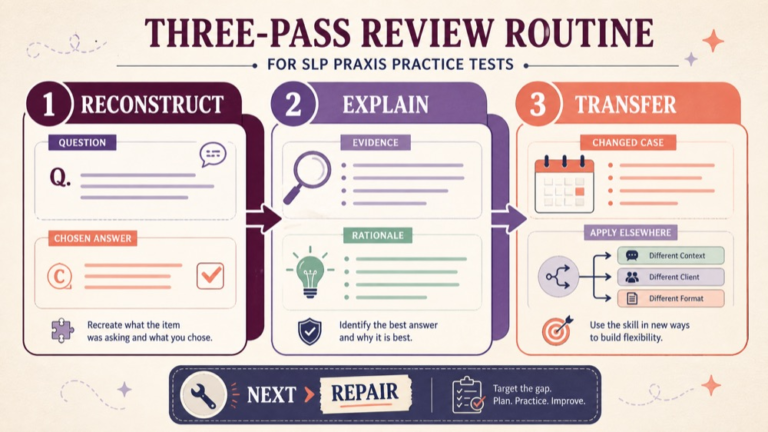
Use the following routine after each manageable online block. It gives every uncertain item a path from independent decision to explanation and transfer. The routine can be completed on paper or in a simple digital tracker; the tool matters less than keeping the order consistent.
- Pass 1, reconstruct: write the task, your answer, and your confidence before opening feedback.
- Pass 2, explain: write the decisive evidence, the rationale for the best option, and the mismatch for the closest distractor.
- Pass 3, transfer: change one case feature and state whether the rule stays the same or changes.
- Assign the repair: choose one focused study or timing action with a clear completion rule.
- Schedule the return: decide when you will review the repair and retest it.
Use the routine on high-confidence misses first. They often deserve closer attention because the incorrect rule felt reliable. Next, review guessed correct answers. If you cannot explain why the choice fit, place it in the log even though the percentage counted it as correct.
Keep the transfer case original and brief. Change a workplace meeting to a classroom discussion, a structured drill to a functional interaction, or a quiet task to a competing-speaker condition. The goal is to test the decision boundary, not to reproduce a commercial item.
At the end of the routine, write one sentence that you can use before the next item. For example, when the stem asks what to gather next, clarify the uncertainty before selecting an intervention. A compact rule is easier to carry into a new set than a paragraph of copied explanation.
Use an error log to choose the next repair
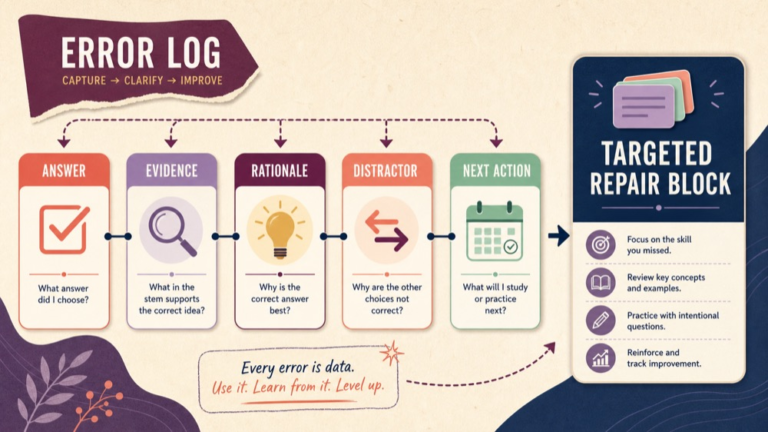
An error log turns review into a sequence of study actions. Use five core columns: answer, evidence, rationale, distractor, and next action. Add a condition field when timing, device, or support influenced the result. Review the log by pattern instead of by the order of the original test.
| Column | What to write | Completion test |
|---|---|---|
| Answer | Choice and confidence before feedback. | Original decision is visible. |
| Evidence | Controlling clue or missed detail. | One fact is named. |
| Rationale | Why the best option fits. | Rule connects task and evidence. |
| Distractor | Closest alternative and mismatch. | Weakness is specific. |
| Next action | Small study or setup experiment. | Action has a finish line. |
Group the next actions into a short repair block. For task-reading errors, use new items and name the final request before considering options. For content errors, review one source and create a transfer example. For screen errors, stabilize the workspace and repeat a similar block.
Do not let the log become an archive with no return date. Add a planned check such as five new items on Friday or one changed case after the concept review. The next check gives you evidence about whether the repair changed the behavior.
Protect privacy and licensing while recording. Use original paraphrases and avoid entering patient identifiers or copying protected question text. An ethical review system can still capture the reasoning that matters for your study.
Question 1: reviewing an evaluation decision
Question 1: During an SLP practice test review, a learner chose a treatment activity because a child had difficulty answering questions. The item actually asked what information should be gathered next, and the stem showed different performance at home and school. Which review note is most useful?
- A. I missed treatment knowledge, so I should read every treatment chapter.
- B. I answered a treatment question instead of the next-information question; I should compare the two settings before choosing an evaluation step.
- C. The answer was difficult because both settings are irrelevant to question answering.
- D. I should choose the longest option next time because it may include both settings.
Correct Answer: B. The review note identifies a task mismatch and preserves the setting contrast as evidence. It also points to a focused repair: restate what information is needed and compare the relevant conditions before selecting a treatment action.
Why the Other Options Are Wrong: A expands the study task without evidence that treatment content caused the miss. C discards the central contrast in the stem. D uses answer length as a shortcut rather than examining task fit. The best note explains the decision error and names a checkable next action.
Exam Trap: A familiar clinical topic can distract you from the verb in the question. In review, write the requested action before deciding whether the error was content, sequence, or task reading.
Question 2: reviewing a treatment decision
Question 2: A learner selected more repetitions of a structured speech strategy because the client was accurate in the clinic. The stem stated that the goal was using the strategy during workplace meetings, where performance remained inconsistent. Which review action best tests the reasoning?
- A. Repeat the same clinic drill and ignore the workplace setting.
- B. Create a changed case that varies the communication setting and measure strategy use in a workplace-like interaction.
- C. Remove the functional goal from the error log because the clinic result was positive.
- D. Conclude that the strategy cannot work in any setting.
Correct Answer: B. The relevant review action examines generalization by changing the setting while keeping the functional goal visible. It tests whether the learner can connect treatment planning to participation rather than treating clinic accuracy as the entire decision.
Why the Other Options Are Wrong: A repeats the condition that already supplied the misleading confidence. C removes the evidence that defines the goal. D makes a broad conclusion from one context difference. The better action uses a changed case to examine transfer.
Exam Trap: Do not confuse acquisition with functional use. When the stem gives a setting-specific participation goal, the review should include a setting-specific measure or practice condition.
Question 3: reviewing a professional-practice decision
Question 3: During review, a learner finds that a commercial practice resource has a helpful explanation and considers uploading screenshots to a private class folder. Which review conclusion best supports responsible study?
- A. Copying is acceptable because only classmates can see the folder.
- B. I can paraphrase the concept in my own log and use licensed access rather than redistribute screenshots.
- C. Removing the provider name makes the screenshots original.
- D. Sharing only the answer letters avoids distributing the resource.
Correct Answer: B. A private folder does not establish permission to reproduce or redistribute commercial material. An original paraphrase, a self-created transfer case, and licensed access preserve the study value without sharing protected content.
Why the Other Options Are Wrong: A treats privacy as permission. C removes attribution but does not resolve reproduction. D still distributes material derived from the resource. The responsible option preserves learning while respecting the source boundary.
Exam Trap: Review includes professional judgment, not only clinical content. When the study method itself creates a boundary question, choose an action that keeps preparation legitimate.
Review correct but uncertain answers
Correct answers can hide an unstable process. If you selected the answer with low confidence, guessed between two options, or recognized a familiar phrase without explaining the evidence, place the item in a light-review category. The goal is not to lower your result; it is to find reasoning that may not transfer yet.
| Correct-but-uncertain signal | Review prompt | Action |
|---|---|---|
| Guess between two options | What separated them? | Write one mismatch. |
| Recognized wording | What evidence supports it? | Paraphrase the rule. |
| Changed answer | What new evidence changed my choice? | Record the reason. |
| Fast answer | Did I read the final request? | Repeat with a deliberate read. |
| Unclear rationale | Can I explain it independently? | Verify a focused source. |
Use a different case to check the rule. If the same reasoning applies after the setting or goal changes, your confidence may be growing from an explainable process. If the answer changes, write the condition that caused the change.
Do not spend equal time on every correct item. Use confidence and rationale quality to prioritize. A confident, well-explained answer can move through review quickly, while a guessed answer deserves a short evidence check even when the percentage includes it as correct.
Build a targeted repair block
Once the error log is grouped, create the smallest block that can test the pattern. The block should have a target behavior, a defined number of items, a condition, and a review rule. This prevents a broad reaction to one score and gives you a clear way to decide whether the repair helped.
| Pattern | Repair block | Evidence to save |
|---|---|---|
| Task mismatch | Restate the final request in five new items. | Task phrase before options. |
| Evidence miss | Mark one controlling clue per case. | Clue and answer link. |
| Sequence error | Order the next information and action steps. | Why the stage matters. |
| Content gap | Review one focused concept, then answer new items. | Rule and transfer case. |
| Distractor issue | Explain the closest mismatch in each item. | Specific comparison. |
| Pacing issue | Use a smaller light-timed block. | Where time accumulated. |
Set a completion rule that measures the behavior, not only the percentage. For example, finish when you have named the requested information before options in five items and explained the closest distractor in each. The percentage can still be recorded, but the repair target remains visible.
Use a source that fits the repair. A clinical concept gap may require a focused reference. A process gap needs new practice items. A screen-friction gap needs a stable setup. Matching resource to error prevents unnecessary volume.
Schedule the block while the error category is clear. Waiting too long can make the repair vague, while rushing into another full test can bury the pattern. A small, deliberate block is a useful bridge between review and the next benchmark.
Retest with changed cases
Retesting the exact same item can show memory, but a changed case provides better evidence about transfer. Change one meaningful feature while keeping the decision task visible. The feature may be setting, age, communication partner, goal, stage, support level, or timing condition.
| Stable element | Changed element | Transfer question |
|---|---|---|
| Task: next information | Setting. | Does the information need change? |
| Functional goal | Communication partner. | Does the measure remain relevant? |
| Clinical stage | Available evidence. | Is the next step still justified? |
| Answer routine | Item domain. | Does the process travel across topics? |
| Review rule | Light timing. | Does pace change the reading? |
Write the changed detail before you answer. Afterward, compare the original and changed cases. If the best option differs, explain the new controlling evidence. If it remains the same, state what stayed stable and why.
A changed-case retest should not be so different that it measures a new topic. Keep the conceptual relationship close enough to test the repair. The purpose is to see whether your rule has become flexible, not to create another unrelated challenge.
Use retest results to choose the next cycle. Strong transfer may support a mixed block. Weak transfer suggests another focused explanation and a simpler changed case. Either result is useful when the condition and decision rule are recorded.
Plan a review week
A review week can move from reconstruction to explanation, repair, and transfer. It does not require a full-length practice test every day. Use manageable blocks and reserve time for analysis. The plan below keeps the score secondary to the behavior you are trying to strengthen.
- Day 1: choose a source, label the mode, and complete a short independent baseline.
- Day 2: review high-confidence misses using task, evidence, rationale, and distractor notes.
- Day 3: group errors and complete one focused repair block.
- Day 4: review correct-but-uncertain answers and create changed cases.
- Day 5: retest the strongest repair with a new item set.
- Day 6: use a light-timed block if pacing or screen friction is part of the pattern.
- Day 7: repeat the baseline condition and compare the review evidence with the first session.
Keep the review workload realistic. If a longer block leaves no time for rationales, a shorter block may provide better learning evidence. If fatigue is the pattern, record the time of day and break plan rather than treating the tired result as a pure content measure.
At the end of the week, choose one priority and one follow-up condition. Keep source-linked official facts separate from your local practice observations. The review week is for shaping your preparation process, not for inventing a score conversion or a universal readiness rule.
SLP Praxis practice test review checklist
Use this checklist after each manageable practice block.
- I recorded the source, set, date, item count, and 5331 relevance.
- I labeled the mode, timing, feedback timing, device, and support.
- I recorded my original answer and confidence before opening the rationale.
- I restated the exact task in my own words.
- I identified the decisive evidence or missed clue.
- I explained why the best option fit the task, stage, and context.
- I explained why the closest distractor was weaker.
- I classified the error as task, evidence, content, sequence, distractor, transfer, screen, or pacing.
- I reviewed high-confidence misses.
- I reviewed correct answers that were guesses or weakly explained.
- I created one changed case or transfer prompt.
- I chose one next block with a completion rule and return date.
- I protected private information and did not reproduce protected resource content.
- I checked changing exam information on the live responsible source.
The checklist keeps review active and contained. You do not need to rewrite an entire textbook after every set. You need a clear task, one controlling clue, a defensible rationale, a distractor mismatch, and a next action you will actually test.
Sources and next steps
Use the live ETS Speech-Language Pathology (5331) page for current exam identity, selected-response format, duration, question count, and changing test information. Use the ETS practice-test selector for current preparation options and the ETS Form 1 page for the features and terms of that product.
Use ASHA Praxis preparation guidance when organizing practice around strengths and weaknesses. The review routine in this article is original educational guidance: label your condition, reconstruct the decision, compare evidence and distractors, and test one repair in a changed case.
For a structured preparation path, see the SLP Study Center Complete Prep resource. Next time you finish an online set, spend the first review pass on what the question asked, the second on why the answer fit, and the third on what you will do with the rule in a new case.