
For a first-time test taker, an slp praxis practice test for first time test takers should do more than produce a percentage. It should make the screen, the question rhythm, the flagging routine, and the review process less unfamiliar. A well-labeled rehearsal gives you information about what to study and how to use the time you have.
The current ETS Speech-Language Pathology (5331) page describes a computer-delivered selected-response exam with 132 questions and 150 minutes. Use the live ETS page for changing test information. ASHA preparation guidance points learners toward preparation materials, practice questions, and study plans shaped by strengths and weaknesses. This guide focuses on the first full rehearsal: what to set up, what to record, and what to do after the final item.
What first-time test takers need from practice
The first rehearsal has several jobs, and you can separate them across sessions. You need to become familiar with the question screen, understand how the provider presents explanations, notice how long reading and comparison take, and identify a small number of study targets. Trying to measure all of those in one uncontrolled run makes the result difficult to use.
| Need | Practice signal | Useful record |
|---|---|---|
| Interface familiarity | Where to select, flag, and return | Screen workflow note |
| Task recognition | What the final request asks you to do | One-sentence restatement |
| Content retrieval | Which concepts are available without notes | Domain and confidence |
| Option comparison | Why the closest distractor is weaker | Mismatch sentence |
| Pacing | Where time accumulates | Reading, decision, and return time |
| Endurance | What changes later in the block | Fatigue and accuracy note |
A first-time test taker can have solid clinical knowledge and still need practice with the selected-response workflow. Conversely, someone can move quickly while lacking a rationale for the choice. Separate those observations so your study plan does not treat every difficulty as the same kind of weakness.
Use a practice test as a rehearsal for decisions, not as a prediction tool. The source, question style, length, and explanation quality can vary across resources. Record the source and condition before comparing one result with another.
Write one question for the session. For example: Can I read the request, identify the controlling evidence, and flag a difficult item without losing the block rhythm? A specific question gives your first run a useful finish line.
Confirm the current 5331 reference
Before you rehearse, confirm that your preparation material is aimed at the current Speech-Language Pathology (5331) exam. ETS is the responsible source for current test identity, listed format, question count, duration, and changing administration information. Use the live ETS page when a detail affects your plan.
| Source | First-time use | Record |
|---|---|---|
| ETS 5331 page | Confirm subject, format, and current overview | Page title and access date |
| ETS practice selector | Locate current preparation options | Resource name and access terms |
| ASHA preparation guidance | Shape study around content and weaknesses | Chosen study targets |
| Practice provider | Run questions and read explanations | Provider, set, and condition |
Do not merge an older guide’s timing note with the current source without checking the difference. Administration details can change, and a practice provider may intentionally use a different length or clock. Put the source date beside every detail you expect to revisit.
Keep the official reference separate from your personal rehearsal method. ETS can define the current exam information; your practice session can define a flag rule, review card, or study schedule. Clear boundaries make the article and your tracker easier to trust.
If you are scheduling the live test, use the responsible registration and test-day information rather than a practice blog. This guide is about rehearsal and preparation; it is not a substitute for current administration instructions.
Choose the purpose of the first rehearsal
First-time test takers often need a low-pressure orientation before they need a score. Decide whether your first session is interface orientation, a content baseline, a pacing rehearsal, or a full simulation. You can use the same question source for more than one purpose as long as each condition is labeled.
| Purpose | Condition | Output |
|---|---|---|
| Orientation | Short set, untimed, workflow notes | Screen and navigation routine |
| Baseline | Independent mixed block | Domain and confidence profile |
| Learning | Untimed with rationale review | Concept and decision cards |
| Pacing | Short timed block with flagging | Time and return notes |
| Simulation | Longer block under planned conditions | Endurance and workflow record |
If the screen itself is unfamiliar, begin with orientation. Learn where the answer choices appear, how the practice tool displays explanations, and how you will record a flagged item. You can then repeat the routine under an independent condition.
If your main concern is content, use a mixed baseline and save the original responses. If your main concern is time, wait until you know the review routine well enough to tell a pacing issue from a content issue.
Write the purpose at the top of the tracker. That single line prevents a short learning set from being judged by the same standard as a full rehearsal.
Learn the practice interface before timing
Interface practice is not wasted time. A first-time test taker can lose attention by searching for a flag button, scrolling through a long stem, or forgetting where an explanation appears. Use a short set to make those actions deliberate before adding a demanding clock.
| Interface action | Rehearsal prompt | Record |
|---|---|---|
| Read the stem | Where is the final request? | Task word |
| Select an option | Can I record the first decision? | Answer and confidence |
| Flag an item | What makes this item worth returning to? | Flag reason |
| Move forward | Can I keep the next item separate? | Transition habit |
| Return | Can I find the flagged item quickly? | Return order |
| Review feedback | Where is the rationale and source note? | Review location |
Use a small block and say the routine quietly if that helps: read, decide, flag when needed, move, return, review. The words are not a script for the live test; they are a way to make the workflow visible while you learn it.
Do not time navigation practice too tightly. The goal is to reduce screen friction so later timed work measures reading and decision behavior more clearly.
Set up a first-time test simulation
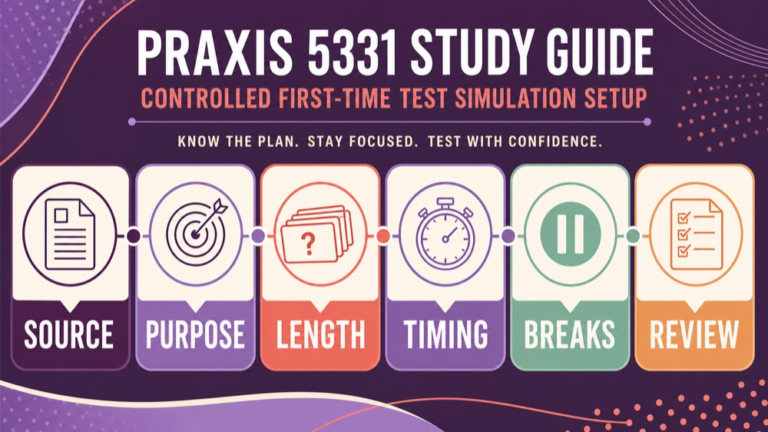
Set up a first-time simulation with enough structure to learn from it. Choose a source, define the block length, decide whether notes are open, set the clock if timing is part of the purpose, and place your tracker nearby. Write down planned breaks and likely interruptions before you begin.
| Simulation field | Example | Why record it |
|---|---|---|
| Source | Provider and set name | Defines item style |
| Length | 20, 40, or longer block | Defines sample size |
| Support | Closed notes or listed support | Defines interpretation |
| Timing | Untimed, light timed, or timed | Separates pace from knowledge |
| Breaks | Planned pause and reason | Shows endurance context |
| Review | Same-day or later answer review | Preserves the workflow |
For a first full rehearsal, choose a time when you can finish the planned block and review at least the most informative items. A shorter complete cycle is more useful than a long session that ends before you record what the result means.
Keep the source’s terms in view. If the provider lists a different time or number of items, use that information for the practice condition and keep the live ETS reference separate. The point is to understand your response process, not to make every resource look identical.
Use one screen or one notebook for the tracker so you do not interrupt the block to reconstruct it later.
Record the condition before starting
A practice result needs context. Note the date, source, block length, support, timing, environment, fatigue, and purpose before the first item. If a condition changes during the block, write the change instead of hiding it.
| Condition | What to note | Interpretation question |
|---|---|---|
| Materials | Notes, textbook, calculator, or none | What support was available? |
| Environment | Quiet room, noise, interruptions | What competed for attention? |
| Time | Clock, pauses, and return window | Where did pace change? |
| Answer state | First choice, changed choice, blank | What caused movement? |
| Confidence | High, medium, low before feedback | Was confidence calibrated? |
| Fatigue | Fresh, moderate, tired | What changed late? |
Record confidence before opening the answer explanation. Otherwise, the explanation can overwrite your memory of how certain the original decision felt. That distinction is particularly useful for first-time test takers because unfamiliarity can look like a content gap.
Use the condition to decide what the result can support. A notes-open block can teach retrieval paths, while a closed-notes block can show independent recall. Both can be valuable when labeled correctly.
Use a flag-and-return routine
Flagging protects the rhythm of a selected-response block. Mark an item when the task is unclear, two choices remain plausible, a fact check would take too long, or the time cost is growing. Then move forward and return according to the window you planned.
| Flag reason | Immediate action | Later review |
|---|---|---|
| Unclear task | Reread the final request once | Write the task word |
| Two plausible choices | Choose the best current option | Compare fit and sequence |
| Missing fact | Make a provisional choice | Verify the concept |
| Time-heavy stem | Record and move on | Check reading behavior |
| Answer changed | Save both choices | Identify the controlling clue |
Do not treat a flag as a personal weakness. It is a workflow tool that gives you permission to protect the rest of the block. Review the reason for the flag later so you can tell whether the repair is content, task reading, comparison, or pacing.
Use a consistent return order. Start with items where one reread or one comparison can settle the choice, then spend deeper review time on items that require a separate source check. This keeps the review window organized.
Review each choice with a clear question
After the block, review the answers that were wrong, guessed, changed, or difficult to explain. Begin with the task, then the decisive evidence, then the best option and closest distractor. A good explanation connects the choice to the details of the stem.
| Review field | Prompt for a first-time test taker | Output |
|---|---|---|
| Task | What did the item ask me to choose? | One-sentence restatement |
| Evidence | Which detail controlled the decision? | One clue in own words |
| Best fit | Why did the correct option respond now? | Rationale sentence |
| Closest distractor | Why was the tempting alternative weaker here? | Mismatch sentence |
| Transfer | What changed detail would test the rule? | New-case prompt |
| Next action | What will I practice next? | Small block and date |
Write the review in your own words. If a provider explanation uses a fact that needs clarification, mark the question and verify it with an appropriate professional or official source before you turn it into a general rule.
Review correct answers with low confidence as well as wrong answers. A first-time test taker may recognize a familiar phrase without understanding the boundary between options. Confidence and rationale quality help locate that hidden work.
Create a first-time test-taker workflow
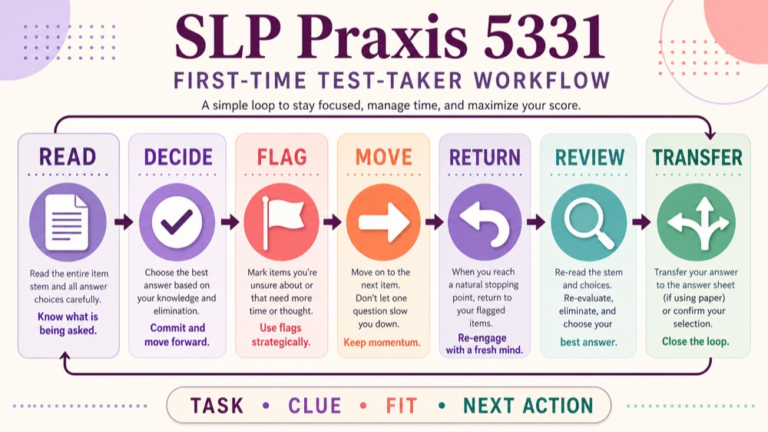
A first-time workflow can be simple: read, decide, flag, move, return, review, transfer. Use the same sequence across short blocks and longer rehearsals. Consistency reduces the number of decisions you must invent while you are learning the content.
| Stage | Action | Finish signal |
|---|---|---|
| Read | Find the final request and key conditions | Task is restated |
| Decide | Choose using evidence and fit | Option recorded |
| Flag | Mark time-heavy or uncertain items | Reason recorded |
| Move | Continue to the next item | Block rhythm protected |
| Return | Revisit flagged items in a set order | Choice finalized |
| Review | Explain answer and distractor | Rationale card complete |
| Transfer | Change one meaningful case detail | New prompt answered |
Keep the workflow separate from any provider’s exact interface. Buttons and labels can vary, but the decision sequence travels across platforms. Practice the behavior you control: task recognition, evidence selection, comparison, flagging, and review.
Use a short verbal or written cue at the top of your tracker. The cue should be brief enough to remember and specific enough to protect the process. For example: task, clue, fit, flag, return.
Build a personal pacing profile
The listed ETS 5331 page gives current reference information about question count and duration; use that live source for updates. Your practice profile should measure where your own time goes. Track reading, decision, flagging, return, and late-block fatigue separately.
| Pacing signal | What it may indicate | Practice repair |
|---|---|---|
| Long first reads | Task or condition is hard to identify | Write one-sentence summaries |
| Long comparisons | Closest distractor boundary is unclear | Use a five-lens comparison |
| Many flags | Content or confidence needs work | Review the flag reasons |
| Few flags and rushed ending | Time control is weak | Set checkpoints and return window |
| Late accuracy drop | Endurance or fatigue affects process | Use longer gradual blocks |
Do not chase speed in isolation. A faster block with weak task summaries may need a deliberate reading repair. A slower block with accurate explanations may need short timed repetitions. Choose the repair from the behavior you recorded.
Use a checkpoint during longer work. Note the item range, time remaining, and number of flags. The checkpoint makes it easier to see whether your pace changes gradually or after one time-heavy item.
Question 1: reading the request
Question 1: A first-time test taker reads a practice item, recognizes the clinical topic, and immediately chooses an option without identifying whether the prompt asks for assessment, treatment, or the next information step. Which review action is most useful?
- A. Choose the option with the most technical vocabulary.
- B. Restate the final request, mark the controlling clue, and compare the choices against that exact task.
- C. Skip the explanation because recognizing the topic is enough.
- D. Change the answer whenever a choice contains a familiar term.
Correct Answer: B. Topic recognition is only the beginning. The final request and the controlling clue determine what the answer must do, so the review should preserve that sequence.
Why the Other Options Are Wrong: A and D use wording familiarity as a shortcut. C removes the opportunity to learn the decision boundary. The useful action makes the task visible before comparing choices.
Exam Trap: A familiar clinical topic can hide a different requested action. Read the final request before treating the topic label as the answer path.
Question 2: rehearsing the condition
Question 2: A learner completes a long practice set with notes open, several unscheduled pauses, and no record of confidence or time. What is the best interpretation of the result?
- A. It is a clean measure of independent performance.
- B. It is a supported learning session that should be labeled, followed by a shorter independent block with condition notes.
- C. It has no value because practice with support cannot teach anything.
- D. It should be compared directly with a controlled timed simulation.
Correct Answer: B. The session can reveal concepts and questions worth reviewing, but open notes and interruptions change what the score means. Labeling it and adding a cleaner comparison protects interpretation.
Why the Other Options Are Wrong: A and D ignore the support and pauses. C dismisses learning information that can still guide study. The best response preserves the session as evidence while choosing a clearer next condition.
Exam Trap: A long set can look like a simulation even when the condition is different. Record support, timing, and interruptions before comparing results.
Question 3: reviewing a practice source
Question 3: A first-time test taker finds answer screenshots from a paid practice resource and wants to place them in a public study folder for classmates. Which action best supports responsible preparation?
- A. Share the screenshots because the intent is educational.
- B. Use an authorized access path, write original paraphrases, and build new changed-case practice from the concept.
- C. Crop out the provider name and share the remaining images.
- D. Share only the answer letters from the screenshots.
Correct Answer: B. Authorized access and original study notes keep the learning purpose while avoiding redistribution of protected resource material. New cases can test the reasoning without copying the source.
Why the Other Options Are Wrong: A assumes educational intent resolves the permission question. C removes attribution but not reproduction. D can still distribute material derived from the resource. The responsible option follows the access terms and creates original practice.
Exam Trap: A classroom or public folder does not define permission by itself. Check the source terms and use paraphrase plus new cases for shared learning.
Use untimed work for learning
Untimed work is useful when a first-time test taker is still learning how to read the request, find evidence, compare choices, and understand rationales. The absence of a clock lets you inspect the decision without adding a pacing variable.
| Untimed goal | Prompt | Later bridge |
|---|---|---|
| Task recognition | What action is requested? | Short timed stem reads |
| Evidence | Which clue controls? | One-clue notes under time |
| Comparison | Why is the closest choice weaker? | Two-option timed contrast |
| Retrieval | Can I explain without notes? | Closed-notes mini-block |
| Transfer | What detail could change the answer? | New-context item |
Label untimed work as learning, not as a failed simulation. Use it to build the decision cards that later support timed work. A first-time test taker benefits from knowing what a careful answer process looks like before compressing it.
Keep the review concise. A task sentence, evidence note, distractor mismatch, and next prompt can teach more than copying a long explanation into a notebook.
Add timed blocks without rushing
When the workflow feels familiar, add a clock to short blocks. Keep the task and evidence routine intact while you observe how much time the clock changes. Use a flag-and-return rule rather than forcing every item to be solved in one uninterrupted pass.
| Timed step | Practice design | Record |
|---|---|---|
| Light timed | Short mixed block | Halfway checkpoint |
| Timed focus | One domain with close distractors | Comparison time |
| Timed mixed | Neighboring topics and flags | Return order |
| Longer rehearsal | Planned breaks and fatigue note | Late-block process |
Do not compensate for a slow first block by removing review. The review explains whether the time problem came from reading, indecision, missing content, or a weak return routine. Keep enough time to capture that information.
Turn the first rehearsal into a study plan
Finish the first rehearsal by choosing the next action. Combine score, confidence, domain, task type, flag reason, and pacing note. Then choose one short study block with a clear completion rule.
| Pattern | Next study block | Finish line |
|---|---|---|
| High-confidence misses | Closest-distractor comparison | Five mismatch sentences |
| Low-confidence correct answers | Closed-notes rationale retrieval | Explain three decisions |
| Domain cluster | Focused concept and case block | One rule plus three applications |
| Slow reading | Task-and-condition summaries | Ten concise summaries |
| Rushed ending | Short timed blocks with checkpoints | Use flag-and-return twice |
Write the next block before you close the results. A plan that says study more is too broad to start. A plan that names the pattern, block size, condition, output, and return date is easy to test.
Choose one meaningful change for the next session. Move from notes-open to closed notes, untimed to light timed, one domain to mixed, or familiar setting to changed setting. One change makes the new result easier to interpret.
Repeat with a new question context
Repeating the same set can show memory for the items, but a first-time test taker also needs evidence that the reasoning transfers. Use a new question or an original changed-case prompt after reviewing the first result. Change one meaningful detail at a time.
| Changed detail | What it tests | Question to ask |
|---|---|---|
| Setting | Context transfer | Which evidence now matters? |
| Goal | Functional alignment | Does the best option change? |
| Stage | Sequence | What belongs at this point? |
| Partner | Communication demand | What support is relevant? |
| Time condition | Workflow and pacing | Can I flag and return? |
Space the retest. Review the explanation in the first session, retrieve the rule later without notes, and apply it in a mixed block after that. Hide the old answer until your new response is recorded.
SLP Praxis practice test for first-time test takers checklist
Use this checklist for your first rehearsal and the sessions that follow.
- I checked the live ETS 5331 reference and recorded the access date.
- I chose a practice source with clear subject, explanation, and access information.
- I wrote one purpose for the session before starting.
- I recorded source, length, support, timing, breaks, environment, and fatigue.
- I learned the interface before adding a demanding clock.
- I saved my original answer and confidence before reading feedback.
- I used a flag-and-return rule for time-heavy or uncertain items.
- I reviewed the task, evidence, best fit, and closest distractor.
- I wrote personal paraphrases instead of copying protected text or screenshots.
- I tagged repeated patterns by domain and decision skill.
- I chose one small next block with a completion rule.
- I changed one meaningful variable in the retest.
- I tracked reading, decision, return, and late-block time separately.
- I used responsive, compressed images and lazy loading on the study page.
The first practice test should leave you with a clearer process, not just a number. Record what the session can support, repair one visible pattern, and rehearse that repair in new context. That sequence gives first-time test takers a practical path toward longer work.
Sources and next steps
Use the live ETS Speech-Language Pathology (5331) page for current exam identity, selected-response format, duration, question count, and changing test information. Use the ETS practice-test selector to locate current preparation options and read each resource’s access terms.
Use ASHA Praxis preparation guidance when organizing practice around exam content and strengths and weaknesses. The rehearsal setup, workflow, tracker, and practice questions in this article are original educational guidance. Verify changing details on the live responsible source.
For a structured preparation path, see the SLP Study Center Complete Prep resource. For your next session, choose one purpose, record the condition, complete a manageable block, and review the decisions that will shape your next study action.