
slp praxis practice questions are most useful when they train a decision rather than reward fast recall. This set gives you four original practice items built around clinical reasoning: identify the referral question, use the strongest evidence in the stem, choose the next action that matches the problem, and explain why the other options miss the task. The items are written for learners preparing for Praxis 5331 or strengthening speech-language pathology review habits.
Use each question in two passes. First, answer without looking ahead and name the evidence that changed your mind. Then read the rationale and compare your reasoning with the explanation for every option. The current ETS page should control changing exam scope and logistics, while current ASHA topic guidance should control clinical claims. This article intentionally does not freeze a current question count, testing time, score rule, or section weighting; verify those details at the source before publication and before test day.
Table of Contents
- What these practice questions should train
- A clinical reasoning method
- Original practice questions with full rationales
- How to review each answer
- Quick review checklist
- References and current-source check
What These Practice Questions Should Train
A practice question is a small clinical decision model. The stem gives you a referral context, selected observations, and a task. Your job is not to diagnose from one attractive sign or choose the most elaborate intervention. Your job is to determine what the question is asking, decide which evidence is decisive, and select the response that is specific enough to address the problem without claiming more than the data support.
That makes this page different from a broad practice-test overview. The four items below stay close to clinical reasoning and show the full path from evidence to action. They sample different kinds of decisions so you can notice the reasoning pattern underneath the topic:
| Question focus | Decision you must make | Common reasoning error |
|---|---|---|
| Screening and hearing | What information or referral should come before interpretation? | Starting treatment or assigning a label before a missing foundational factor is checked. |
| Motor speech | Which assessment plan best tests a clinical hypothesis? | Letting one speech feature stand in for a complete differential assessment. |
| Swallowing | What can bedside observations support, and what needs further evaluation? | Treating a clinical sign as a definitive physiologic finding. |
| Narrative treatment | Which goal and outcome measure match the functional construct? | Choosing an easy-to-count activity that does not measure the stated target. |
Keep the distinction between exam practice and patient care clear. A correct answer on a study item does not replace a full evaluation, consultation, or individualized plan. In an exam stem, the available facts define the decision boundary. In practice, the SLP integrates history, observation, measurement, client priorities, collaboration, and the current evidence base.
A Clinical Reasoning Method for SLP Praxis Practice Questions
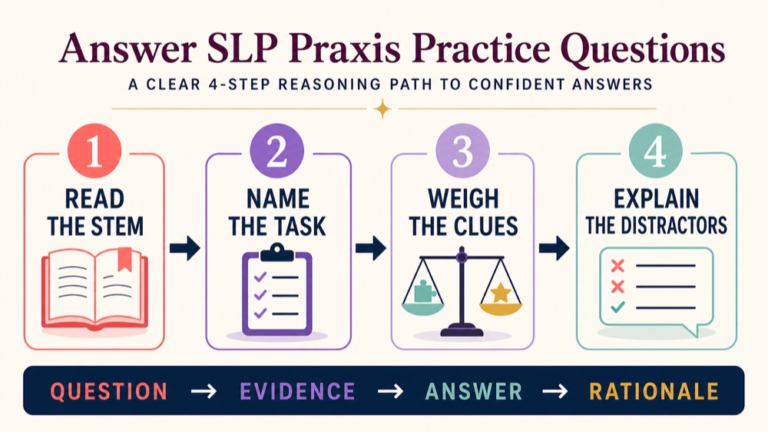
Before you compare A through D, translate the question into a short decision sentence. For example, say, The task is to choose the next assessment step when hearing information is missing, or, The task is to select an outcome measure for narrative macrostructure. That sentence keeps a familiar clinical fact from pulling you toward an answer that solves a different problem.
- Identify the task. Decide whether the stem asks for a screening action, assessment plan, diagnosis-related interpretation, treatment choice, outcome measure, referral, or professional boundary.
- Sort the evidence. Separate direct observations from assumptions. Note whether the stem gives a pattern across contexts, a single sign, a missing history element, or a response to an earlier procedure.
- Choose the decision class. A question about the next evaluation step is not asking for the final diagnosis. A question about treatment measurement is not asking for the most interesting activity.
- Test each option against the evidence. Ask what the option would clarify, what it assumes, and whether it addresses the stated referral question. A plausible fact can still be the wrong answer if it is not the best match.
- State the portable rule. After choosing, write one sentence that could help on a new item. Examples include check hearing before interpreting speech-language performance, or measure the target construct across meaningful contexts.
When two options sound clinically reasonable, look for the one that respects sequence and scope. The best answer often supplies a missing foundation, tests the hypothesis directly, or links the goal to a functional outcome. Be cautious with options that jump from one sign to a label, prescribe a broad intervention before assessment, or use a measure that counts behavior without capturing the intended skill.
Original Practice Questions With Full Rationales
Original practice content: All four items in this section were newly written for this learning article. Work each one before reading the explanation. The source-grounded rationales teach the clinical distinction being tested, but they are not a substitute for the current ETS scope or topic-specific ASHA guidance.
Original Practice Question 1: Screening, Hearing, and the Next Step
Question 1: A preschool child is referred after a community speech screening because unfamiliar listeners understand little of the child's speech. The caregiver also reports several recent ear infections, and no current hearing evaluation is available in the record. Which action is the best next step before interpreting the child's speech-language profile?
- A. Begin an articulation treatment cycle focused on the least intelligible sounds.
- B. Administer a language test and assign a developmental language diagnosis from the result.
- C. Refer for an audiologic evaluation and incorporate the findings into the broader assessment plan.
- D. Give the caregiver home speech drills and wait to see whether intelligibility improves.
Correct Answer: C. Refer for an audiologic evaluation and incorporate the findings into the broader assessment plan. Why This Answer Is Correct: The decisive evidence is the combination of a speech concern, a history that raises hearing questions, and missing current hearing information. Hearing status can affect access to speech and language input, so the SLP should address that foundational variable before interpreting the full profile or selecting a disorder-specific treatment path.
Why the Other Options Are Wrong: A moves directly to treatment without resolving a factor that could be contributing to the speech pattern. B may collect useful language data, but assigning a diagnosis from one test while hearing information is missing overstates what the evidence can support. D gives a home activity without confirming the child's hearing status or defining the referral need, so it delays the information needed for responsible planning.
Exam Trap: The trap is confusing a screening concern with a completed evaluation. When the stem highlights missing hearing information, treat that gap as decisive. A referral for the appropriate assessment is different from assigning a diagnosis, and the best next step may come before the final test battery or intervention plan.
Original Practice Question 2: Motor-Speech Differential Reasoning
Question 2: An adult after a left-hemisphere stroke produces effortful speech with inconsistent sound errors across repeated attempts, visible groping, and disrupted prosody. A brief non-speech oral examination does not show a clear pattern of weakness. Which evaluation plan best addresses the clinical hypothesis raised by these observations?
- A. Use the brief strength screen as the main evidence and label the problem dysarthria.
- B. Examine speech motor planning and programming with repeated productions, sequencing tasks, prosody, and intelligibility across contexts.
- C. Use a confrontation-naming task alone to determine whether the speech problem is language based.
- D. Begin voice treatment because effortful speech is primarily a loudness problem.
Correct Answer: B. Examine speech motor planning and programming with repeated productions, sequencing tasks, prosody, and intelligibility across contexts. Why This Answer Is Correct: Inconsistent errors, groping, and prosodic disruption raise a motor-planning hypothesis, while the limited weakness finding makes a strength-only explanation incomplete. An assessment that samples repeated speech movements and connected speech can test whether the pattern is consistent with a motor-planning or programming difficulty and can also help distinguish neighboring motor-speech explanations.
Why the Other Options Are Wrong: A treats the absence of a clear weakness pattern as if it proved a different disorder and does not examine the planning features in the stem. C measures lexical retrieval and naming, not the full speech motor pattern. D narrows effortful speech to loudness even though the decisive observations concern sound consistency, groping, sequencing, and prosody rather than a primary voice complaint.
Exam Trap: The trap is turning one recognizable sign into a final label. Use the whole pattern and choose an assessment that tests the suspected mechanism. When the stem gives repeated productions, groping, and prosody, an answer limited to strength, naming, or loudness is too narrow for the clinical question.
Original Practice Question 3: Dysphagia Assessment and Physiologic Evidence
Question 3: A patient recovering from a stroke coughs during a bedside water trial and has a wet-sounding voice afterward. The patient is alert and able to follow directions, but no instrumental swallowing assessment has been completed. Which recommendation is the best next step?
- A. Conclude that aspiration has occurred and prescribe permanent thickened liquids immediately.
- B. Stop the evaluation because the cough shows that airway protection is working.
- C. Complete a clinical swallowing assessment and consider instrumental assessment to visualize physiology and guide recommendations.
- D. Focus only on articulation because swallowing complaints fall outside the SLP role.
Correct Answer: C. Complete a clinical swallowing assessment and consider instrumental assessment to visualize physiology and guide recommendations. Why This Answer Is Correct: Coughing and a wet voice are clinically important observations that justify careful follow-up, but they do not by themselves show the complete swallow physiology or establish the safest long-term diet. A clinical assessment can organize the history and observed performance, while an instrumental study may be considered when direct visualization is needed to answer the remaining physiologic question.
Why the Other Options Are Wrong: A converts bedside signs into a definitive aspiration finding and a permanent recommendation without enough information about physiology, risk, goals, or response. B assumes that a cough resolves the safety question and ignores the wet voice and the need to interpret the entire swallow pattern. D incorrectly removes swallowing from the relevant SLP clinical scope and fails to address the referral concern described in the stem.
Exam Trap: The trap is treating a bedside sign as the same thing as an instrumental finding. On a question about swallowing, separate what the observation raises concern about from what the next assessment can establish. Choose the answer that gathers the information needed for a safe, individualized recommendation.
Original Practice Question 4: Narrative Treatment and a Matched Outcome
Question 4: An eight-year-old student produces grammatically correct individual sentences but tells stories that regularly omit the setting, initiating event, and consequence. The teacher wants a progress measure that reflects classroom communication. Which plan best matches the stated target?
- A. Drill isolated articulation sounds and count correct productions in single words.
- B. Teach narrative macrostructure through retell and story-generation tasks, then measure key story elements across more than one meaningful context.
- C. Have the student memorize definitions of setting, event, and consequence without collecting narrative samples.
- D. Track words per minute as the primary outcome because a longer story is automatically a better story.
Correct Answer: B. Teach narrative macrostructure through retell and story-generation tasks, then measure key story elements across more than one meaningful context. Why This Answer Is Correct: The stem identifies a story-organization target rather than a sentence-grammar, articulation, or speaking-rate problem. A matched plan teaches the missing narrative elements and measures whether the student uses them in connected communication. Sampling more than one context helps show whether the skill is becoming functional rather than appearing only in one practiced task.
Why the Other Options Are Wrong: A measures articulation accuracy, which is not the target described. C may teach vocabulary about story parts but does not show whether the student can organize a connected narrative. D counts output speed without capturing the presence, sequence, or relevance of the story elements, so it can change while the target remains weak.
Exam Trap: The trap is choosing the easiest variable to count instead of the construct named in the stem. Match the goal, teaching activity, and outcome measure. If the concern is narrative macrostructure, the evidence should come from narrative performance and the story elements that define that construct.
How to Review Each Answer Instead of Chasing a Score
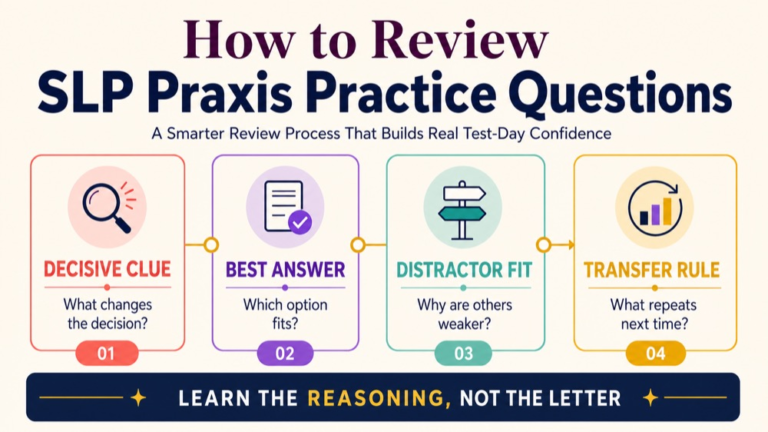
A practice percentage is only a starting signal. The useful information is the type of reasoning error underneath each response. After every item, write the answer you selected, the decisive cue you noticed or missed, the clinical decision class, and one sentence explaining each distractor. This turns a question set into a targeted review tool instead of a series of isolated wins and losses.
| Error pattern | What to ask yourself | Repair move |
|---|---|---|
| Task mismatch | Did I answer the diagnosis when the stem asked for the next step? | Rewrite the question as a decision sentence before rereading options. |
| Single-sign overreach | Did one observation carry more weight than the full pattern? | List what the sign supports and what it still cannot establish. |
| Sequence error | Did I start treatment before the missing assessment or referral step? | Put the clinical actions in order: clarify, assess, interpret, plan, measure. |
| Construct mismatch | Does my chosen outcome measure capture the skill named in the goal? | Replace a convenient proxy with a measure of the target behavior in context. |
| Source drift | Am I relying on an old exam fact or a memorized rule without checking? | Mark current-source questions for review against ETS or ASHA before publication or use. |
- Name the clinical domain before you explain the answer.
- State the referral question in your own words.
- Underline the strongest observation and any missing information.
- Separate what the evidence supports from what it does not establish.
- Explain why the correct option is the best match for the task.
- State the specific mismatch in every distractor.
- Write one portable rule that can transfer to a new stem.
- Retry the item later without looking at the options first.
If the same error repeats, review the concept before adding more questions. For example, repeated confusion between screening and assessment calls for a decision map, while repeated confusion between a target and a proxy measure calls for practice writing goals and outcomes. More items do not automatically repair a reasoning gap; deliberate explanation does.
Quick Review Checklist for Your Next Practice Set
Before you start another set of SLP Praxis practice questions, decide what you want the set to teach. A focused block might cover assessment sequencing, motor-speech distinctions, swallowing evidence, or treatment measurement. Keep the block small enough that you can explain every missed item, then use the checklist below to decide whether the review is complete.
- I answered each item before reading its rationale.
- I identified whether the task was assessment, treatment, outcome measurement, referral, or interpretation.
- I used the entire clinical pattern rather than one memorable sign.
- I distinguished a screening result from a complete evaluation.
- I matched the assessment plan to the hypothesis in the stem.
- I separated bedside observations from physiologic conclusions that may need more evaluation.
- I matched the goal and outcome measure to the same functional construct.
- I explained why every A-D option was right or wrong for that particular task.
- I recorded which claims need current ETS or ASHA verification.
- I chose the next review topic from my error pattern, not from a random score reaction.
For structured preparation beyond a single practice set, the SLP Study Center Complete Prep learning resources can help you connect question review with blueprint study, concept retrieval, and repeated application. Use the product scope and the current ETS source together when deciding what to study next.
References and Current-Source Check
Use these sources as the verification trail for this article. ETS controls current Praxis 5331 scope and logistics. ASHA topic guidance supports clinical reasoning, but the relevant page and evidence should be checked for the learner's setting and question before relying on a claim.
- ETS Speech-Language Pathology 5331 – current test identity, scope, and logistics; verify the live page and Study Companion before using changing exam facts.
- ASHA Practice Portal – clinical practice guidance and topic entry points for assessment, motor speech, swallowing, and treatment planning; confirm the current topic-specific guidance.
Continue your preparation: Explore the SLP Study Center learning resources after you have reviewed the reasoning behind each answer.