
slp praxis practice exam preparation becomes more useful when a full-length rehearsal has a job beyond producing a percentage. The simulation should show how you manage the current test boundary, retrieve clinical knowledge, protect pacing, respond to uncertainty, and review the decisions that need repair.
The current ETS Speech-Language Pathology (5331) page describes a computer-delivered selected-response test with 132 questions and 150 minutes. The live ETS page and account should control changing registration and appointment details. ASHA also recommends becoming familiar with the exam format and content, making a plan around your topic knowledge, and using practice questions to guide preparation.
What a full-length SLP Praxis practice exam can show
A long practice session is a measurement of a particular preparation condition. It can reveal how you combine recall and judgment when the questions are mixed, how fatigue affects reading, whether your move-on rule is usable, and which topics or decision types deserve another study block. It cannot turn a third-party percentage into an official scaled score.
Before choosing a source, define the question your rehearsal should answer. You may want to know whether a content map is broad enough, whether you can sustain attention across a long session, whether you are losing time to a particular item type, or whether a repaired concept transfers when the scenario changes.
| Rehearsal question | Evidence to capture | Useful follow-up |
|---|---|---|
| Do I recognize the scope? | Items that felt outside the source boundary or used unfamiliar terminology | Check the current ETS scope before adding new material. |
| Can I sustain the process? | Time, breaks, fatigue, rushed sections, and unanswered or uncertain responses | Adjust the process rather than simply adding volume. |
| Can I make clinical distinctions? | Close options, missing evidence, and the task each distractor seemed to answer | Build a compare-and-contrast repair block. |
| Does knowledge transfer? | Performance on fresh stems versus familiar wording | Use a new case after a delay and explain the reasoning. |
A useful full-length session therefore has three outputs: a result label tied to the conditions, a set of error causes, and a short list of next actions. If it produces only a percentage, it has not yet completed the learning part of the rehearsal.
Map the current ETS boundary before building a simulation
Start with the current ETS Speech-Language Pathology (5331) page and its official preparation links. Record the date you checked the source, the test identity, the current format information, and the content areas you plan to represent. The ETS practice-test page can then help you locate current practice options by subject.
Do not let a provider’s chapter order define the entire simulation automatically. A commercial outline may be a useful navigation aid, but your rehearsal should still reflect the current responsible source and your own learning goals. Keep a note of what the practice resource covers, what it does not cover, and what it claims about its own format.
- Set the boundary: write the exact test subject and current code you are preparing for.
- List the learning jobs: include recall, clinical interpretation, assessment sequencing, treatment planning, professional judgment, and outcome measurement as relevant to your map.
- Choose a representation: decide which topics or decision classes should appear in the rehearsal and why.
- Mark uncertainty: flag claims that depend on changing ETS logistics instead of treating an old note as permanent.
- Protect originality: use newly written study examples and explanations rather than copying proprietary or purported live content.
The boundary is also a safeguard against overfitting. If every practice block repeats the same vocabulary, you may be measuring recognition of the source rather than flexible clinical reasoning. A full-length plan should contain enough variety to require task identification before answer selection.
Build repeatable conditions before you start
Write the conditions before opening the first item. Include the resource name, date, mode, start time, planned breaks, permitted materials, timing method, and the labels you will use for answers. Repeatable conditions make later comparisons more informative, even when the practice source or question mix changes.
- Purpose: learning, pacing, endurance, transfer, or a broad readiness check.
- Environment: quiet desk, device, notifications, water, and materials within reach.
- Timing: full-session clock, section checkpoints, and a rule for returning to a sticky item.
- Breaks: planned location and length, with the interruption recorded if it changes the attempt.
- Response labels: confident correct, uncertain correct, incorrect, skipped, or rushed.
- Review boundary: no answer explanations or searches during the measured portion unless the session is explicitly learning mode.
- Recovery: what you will do if fatigue, technology, or an interruption changes the conditions.
Separate “simulation” from “learning mode.” In learning mode, pausing to read an explanation may be the point. In a measured rehearsal, that pause changes the evidence. Neither mode is wrong, but the result should be labeled honestly so you do not compare unlike sessions.
Map the full-length rehearsal
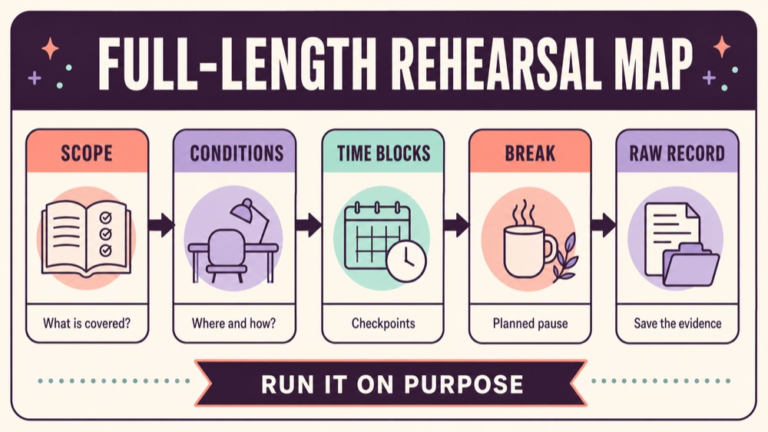
A full-length rehearsal can mirror the current 5331 time and item frame while still using a practical review record. ETS currently describes 132 selected-response questions and 150 minutes; use that information as a planning anchor and verify the live page before you begin. The exact resource may use a different number or format, so record what you actually completed.
| Phase | What to do | What to record |
|---|---|---|
| Launch | Confirm source, purpose, conditions, and timer. | Start time, resource, mode, and expected finish. |
| Block one | Answer mixed items using task, evidence, and constraint. | Checkpoint time and any recurring distractor pattern. |
| Break | Take the planned break and note the actual interruption. | Break length, fatigue, and any changed condition. |
| Block two | Continue with the same decision process and a defined return rule. | Skipped, uncertain, rushed, and changed answers. |
| Close | Stop the measured session before reading explanations. | Raw result, confidence pattern, and immediate observations. |
If your practice source does not contain a full-length form, use a clearly labeled composite. Combine fresh blocks only when you can preserve the source, timing, topic mix, and review boundary. Calling a collection of short quizzes a full simulation without recording the difference can make the result harder to interpret.
Use pacing blocks and a move-on rule
The current ETS frame gives you a useful planning reference, but the average time per question is not a command to spend identical seconds on every stem. Calculate a rough checkpoint for your session, then observe what actually consumes time: rereading, comparing close choices, retrieving a concept, recording notes, or returning to a sticky item.
- Read the final task sentence so you know what decision the item requests.
- Locate the client, setting, timing, performance, or professional detail that changes the choice.
- Eliminate options that answer a different question or require information the stem does not provide.
- Choose the best-supported response when the evidence is sufficient for the stated task.
- Mark an item for return only when a return is permitted and you have a concrete reason to revisit it.
- Protect the next checkpoint instead of allowing one difficult stem to consume the session.
After the rehearsal, compare planned and actual checkpoints. If you were slow early and rushed late, the repair may involve reading and triage. If pacing was stable but explanations were weak, the repair may involve concept distinctions or clinical reasoning. A faster clock is not the only possible solution.
Try four original mini exam questions
The following items are original study examples created for this article. They are not copied from ETS or presented as live test content. Answer each one before reading the rationale, then record the task, deciding evidence, answer confidence, and one reason the closest alternative did not fit.
Question 1: Match the review action to the missed task
Scenario: During a practice exam, a learner chooses a treatment technique even though the stem asks for the next assessment step. Which review action is most useful?
Correct Answer: B. Why This Answer Is Correct: The error is a task-and-sequence mismatch, not simply a missing treatment fact. Rewriting the requested decision and the information needed before acting makes the repair portable to a new stem with different clinical content.
Why the Other Options Are Wrong: A memorizes a word without correcting the decision process. C removes the very task that needs practice. D changes the scoring rule because an option sounds reasonable, even though it does not answer the question asked.
Question 2: Use the missing evidence in a hearing-related referral
Scenario: A child is referred for unclear speech, and the referral notes inconsistent responses to spoken directions but gives no recent hearing information. Which next planning move is strongest?
Correct Answer: C. Why This Answer Is Correct: The stem highlights a missing variable that can affect access to spoken input and interpretation of speech performance. Addressing that gap supports a more responsible assessment sequence without pretending that the referral alone establishes a diagnosis.
Why the Other Options Are Wrong: A overstates what limited referral information can establish. B starts intervention before clarifying a factor that may change the interpretation. D replaces the stated concern with an unrelated testing path and leaves the decisive information unresolved.
Question 3: Match AAC access evidence to the recommendation
Scenario: An adult selects symbols accurately during a short trial but loses accuracy after extended communication. Before finalizing an access recommendation, which evidence should be added?
Correct Answer: A. Why This Answer Is Correct: The decisive issue is whether access remains functional under the conditions that cause fatigue and accuracy loss. Sampling time, position, task length, and partners helps connect the recommendation to individual performance rather than to device popularity or diagnosis similarity.
Why the Other Options Are Wrong: B substitutes clinic familiarity for client fit. C adds content without examining the access problem. D transfers another person’s experience without confirming this client’s performance, context, or support needs.
Question 4: Match the outcome to a narrative goal
Scenario: A student produces grammatically correct sentences but tells stories that omit the setting, initiating event, and consequence. Which outcome best matches the stated concern?
Correct Answer: B. Why This Answer Is Correct: The stated concern is narrative organization, so the outcome should capture the story elements and their use in connected communication. More than one context helps test whether the skill is portable instead of appearing only in a rehearsed example.
Why the Other Options Are Wrong: A measures a different construct. C treats speed as a substitute for story organization. D may show vocabulary about narrative parts but does not show whether the student can use them in an actual connected sample.
Score decisions, not just correct answers
Start with the raw result, but do not stop there. For every incorrect, uncertain, rushed, or unexpectedly correct response, write the decision the item required and the evidence that should have carried the most weight. A review record makes a full-length practice exam useful even when the source does not provide a trustworthy way to generalize its percentage.
| Record field | Example entry | Why it matters |
|---|---|---|
| Answer status | Confident correct, uncertain correct, incorrect, skipped, or rushed | Separates stable reasoning from recognition or time pressure. |
| Task | Choose the next assessment, interpretation, treatment, or outcome | Shows whether the response addressed the question. |
| Deciding evidence | Client goal, timing, setting, performance pattern, or missing history | Connects the choice to the facts in the stem. |
| Cause | Knowledge, distinction, task reading, sequence, distractor, or pacing | Points to a specific repair rather than broad rereading. |
| Next check | New scenario after a delay | Tests transfer instead of immediate answer recall. |
Do not compare a practice percentage with the current ASHA or state passing requirement as if they were the same measurement. Passing requirements and score rules belong to the responsible current sources and pathway. The practice result is best used to choose what to review next.
Review each miss with four labels
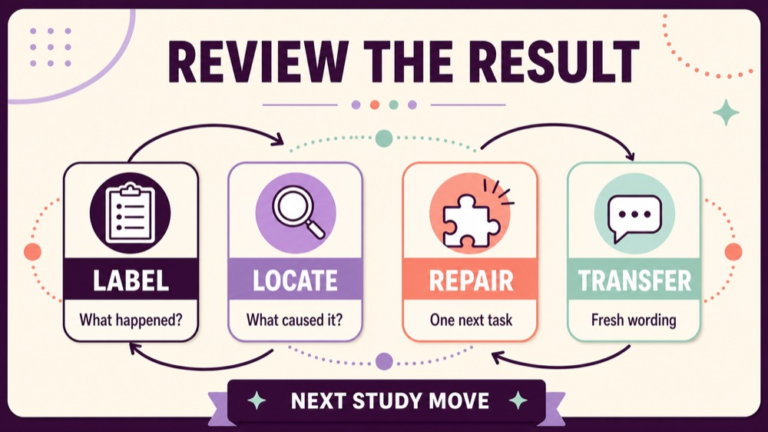
A four-label review keeps the post-exam conversation concrete. Name what happened, identify the cause, choose a repair, and schedule a fresh transfer check. The sequence helps you avoid a common response to a difficult rehearsal: buying or completing another large set before understanding why the first one went poorly.
- What happened? Label the response as incorrect, uncertain correct, rushed, skipped, or confident correct.
- What caused it? Decide whether the gap involved knowledge, distinction, task reading, evidence weighting, sequence, distractor appeal, or timing.
- What repairs it? Choose one action such as a concept card, comparison table, retrieval prompt, fresh mini-case, or source verification.
- What proves transfer? Schedule a new scenario that changes the wording or context and ask for an explanation before checking the answer.
When the same cause appears across several topics, repair the process first. When one concept recurs inside different tasks, repair the distinction. When errors appear only late in the session, review fatigue, breaks, and move-on behavior before deciding that the entire content map is weak.
- Knowledge repair: explain the concept in plain language, add a boundary, and retrieve it without notes.
- Distinction repair: compare the closest choices using purpose, evidence, timing, and limitation.
- Sequence repair: place clarification, assessment, interpretation, planning, intervention, and measurement in the order supported by the stem.
- Pacing repair: use a smaller timed block with one observable move-on rule.
- Transfer repair: write a fresh case with a changed setting, age, partner, or communication demand.
Turn the review into a seven-day plan
A seven-day cycle is long enough to include explanation, retrieval, application, and a new check without treating one practice exam as a verdict. Adjust the days around your schedule, but keep the learning jobs in order so your next full-length rehearsal has a reason to exist.
| Day | Study job | Evidence of completion |
|---|---|---|
| Day 1 | Protect the raw record and classify the largest error patterns. | A short list of three priority causes. |
| Day 2 | Review the highest-impact concept or distinction from a trusted source. | A plain-language explanation and boundary. |
| Day 3 | Complete a small retrieval block without notes. | Answers plus confidence labels. |
| Day 4 | Apply the repair to fresh mini-cases. | Written rationales for the best choice and close distractor. |
| Day 5 | Practice one pacing or sequence behavior in a timed block. | Checkpoint time and observed process change. |
| Day 6 | Mix repaired topics with one or two older areas. | Evidence that you can identify the task before the topic. |
| Day 7 | Run a fresh check or decide whether another full-length session is justified. | A next decision based on evidence, not anxiety. |
If the review shows that your source coverage is incomplete, update the map before adding more timed work. If the map is broad but your answers are slow, train reading and triage. If the result looks strong but confidence is low, use fresh wording to test whether recognition has become portable reasoning.
Verify logistics separately from content readiness
Content readiness and appointment readiness are related but different jobs. Use the current ETS account and pages for registration, delivery, identification, appointment, accommodations, score reporting, and other changing details. A practice exam can rehearse attention and pacing; it cannot update an administrative record for you.
- Confirm the exact test subject and code shown in your account.
- Check the current appointment date, time, delivery setting, and location or at-home requirements.
- Review the current identification and arrival instructions that apply to your appointment.
- Verify accommodation steps and timing through the responsible channel when relevant.
- Record the current rescheduling, cancellation, refund, and score-reporting instructions separately from study notes.
- Use the live ETS page rather than an old practice-provider paragraph when a detail conflicts.
Keeping a dated logistics note prevents an old simulation worksheet from becoming an accidental source of administrative advice. It also lets you focus the full-length rehearsal on learning behavior while a separate checklist handles the appointment details that can change.
Avoid full-length practice exam traps
Long practice sessions can feel authoritative because they are tiring. That feeling is not evidence by itself. Review the design for these traps before treating a result as meaningful:
- Calling a short or interrupted quiz a full-length simulation without recording the difference.
- Using a familiar question bank repeatedly and mistaking recognition for transfer.
- Changing timing, source, break pattern, and environment at the same time.
- Reading explanations during a measured session and then comparing the result with an uninterrupted attempt.
- Spending so long on one difficult stem that later sections become rushed.
- Counting uncertain correct responses as fully secure without reviewing the reasoning.
- Calling a third-party percentage an official scaled score or licensing decision.
- Copying proprietary or purported live content into a study file or public page.
- Adding another large practice set before classifying the errors from the first one.
The strongest correction is usually small and observable. Change one process variable, test it in a short fresh block, and then decide whether a new full-length rehearsal will answer a question you still have. That sequence keeps practice connected to learning rather than fatigue.
Full-length simulation checklist
Use this checklist before and after the next rehearsal. Keep the completed version with the raw result so you can tell whether a later change came from new knowledge, different conditions, better pacing, or simple familiarity with the source.
- I verified the current Speech-Language Pathology (5331) test identity and source boundary.
- I wrote the purpose of the session before starting the timer.
- I recorded the resource, date, mode, environment, timing method, and planned breaks.
- I separated measured simulation from learning mode.
- I used a defined move-on and return rule.
- I labeled confident, uncertain, incorrect, skipped, and rushed responses.
- I recorded the task and deciding evidence for important items.
- I classified causes instead of writing only “need to study more.”
- I explained the closest distractor rather than memorizing the answer letter.
- I assigned one repair task to each priority pattern.
- I scheduled a fresh transfer check after a delay.
- I kept practice evidence separate from current score or licensing requirements.
- I verified appointment logistics from the live responsible source.
A good slp praxis practice exam is a controlled question about your preparation process. It tells you what to review, what behavior to change, and what evidence would justify another full-length rehearsal. That is enough to make the next study decision more precise.
Sources and next steps
Use the current ETS Speech-Language Pathology (5331) page for test identity, format, duration, question count, content areas, and official preparation links. Use the ETS Praxis practice-test page to check current subject options. Review the ASHA Praxis preparation guidance for planning, practice questions, timed work, and topic-area review. For appointment preparation, verify the current ETS test-day instructions.
Continue your preparation: Explore the SLP Study Center learning resources after you have reviewed the full-length simulation record and chosen the next repair task.