If you have searched for slp praxis passing score, you are probably trying to answer a practical question: what number do I need, and how should I read the percentages on my practice tests? The safest answer starts by separating four ideas that are often blended together: the ASHA certification standard, a state or agency requirement, a raw performance result, and a scaled score.
For the current Speech-Language Pathology Praxis test identified as 5331, ASHA’s score page lists a passing score of 162 for purposes of ASHA certification. That is a scaled-score threshold, not a claim that a learner must answer 162 questions correctly. ETS also warns that qualifying scores vary by state or agency, so a candidate’s final verification step belongs with the agency or state that will use the score. This article explains the distinction, gives an original example, and turns the information into a study workflow.
The goal is not to make a practice percentage sound more precise than it is. A practice result can be very useful when it is treated as evidence about preparation, but it cannot be treated as a direct translation of an official reported score.
Table of Contents
- What the SLP Praxis passing score actually describes
- ASHA certification, state boards, and agencies
- Raw performance and scaled score
- Why a practice percentage is not a conversion
- Verification checklist
- How to interpret practice results
- Common traps
- Quick review
What the SLP Praxis passing score actually describes
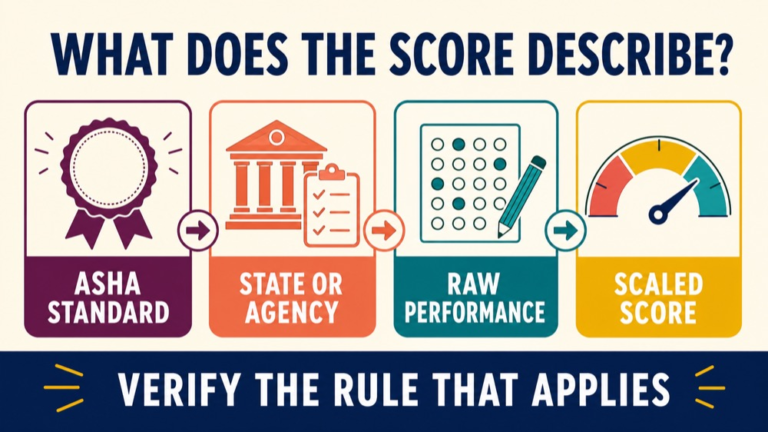
A passing score is a threshold used by a credentialing or regulatory pathway. On the current ASHA Praxis Scores and Score Reports page, the Speech-Language Pathology test, code 5331, is listed with a passing score of 162. The page presents this under current passing scores for ASHA certification. In practical terms, a reported score at or above that threshold meets the score portion of that particular ASHA requirement, subject to the rest of the certification process.
That wording matters. The number 162 is not a percentage, a percentile rank, a number of correct answers, or a guarantee that every state or agency uses the same cutoff. It is a point on the reported score scale. The scale and the threshold answer the question What reported score is being used for this pathway? They do not answer the question How many items can I miss on my particular form?
ASHA’s page also explains that the SLP score is reported on a 100–200 scale in one-point increments. The scale gives the reported result a common frame, but it does not turn the score into a simple percentage. A learner who sees 162 should first identify the test code and the purpose of the requirement before comparing that number with any practice result.
One source detail deserves special attention because it can create a misleading search snippet. The ASHA page has a 170 footnote for older Audiology test codes 5342 and 0342 when that version is required by a state licensing agency. That footnote is not the SLP 5331 passing line. Do not move the 170 figure into an SLP study plan simply because both numbers appear on the same page. Read the test name and code beside the number.
For certification, the score is also only one checkpoint. The ETS-hosted ASHA requirements overview describes receiving a passing SLP Praxis score along with submitting the certification application, required documentation, and dues or fees. The exact pathway should be confirmed with the current certifying body. A passing score is important, but it is not a complete credential decision by itself.
ASHA certification, state boards, and agencies are different checkpoints
Many score questions become confusing because the same Praxis test can be used in more than one professional pathway. ASHA certification, state licensure, and a school-setting agency may all refer to the SLP Praxis, but the controlling requirement is the organization that is evaluating the candidate. A score page or a study guide cannot replace that organization’s current rule.
ETS makes this boundary explicit on its Passing Score Requirements page: passing scores vary by state or agency and are not set by ETS. The page provides a comparison tool where a learner selects a state or agency and a test. That is a better starting point than assuming a number found in a general search result applies to every pathway.
| Checkpoint | What the score question means | What to verify |
|---|---|---|
| ASHA certification | Does the reported SLP 5331 score meet the current ASHA certification standard? | ASHA’s current score page and the remaining application, documentation, and fee requirements. |
| State board or licensing agency | Does the score meet the jurisdiction’s qualifying requirement for the license being sought? | The relevant state or agency entry, test code, effective date, and any additional licensing conditions. |
| School-setting or other agency pathway | Does the score satisfy the agency’s rule for the role or credential? | The agency’s current requirement rather than a score borrowed from another state or credential. |
These checkpoints can happen to use the same threshold, but that coincidence is not a reason to stop checking. A state may adopt the ASHA number, display a different qualifying score, or place the score inside a broader set of requirements. The correct question is not Is 162 the universal answer? It is Which organization is reviewing my result, for which test, and under which current rule?
This distinction also helps when a learner is comparing advice from a university page, a state board page, an agency handbook, and a test-preparation site. Those documents may be answering different questions. Use third-party pages to find terms to investigate, then confirm the requirement at ASHA, ETS, or the relevant state or agency. Keep a record of the page and date you checked.
Raw performance and scaled score are not the same number
Raw performance is the number of points earned from questions answered correctly. ASHA explains that only questions answered correctly count toward the exam score, and that raw points are the number of correct answers. A raw result can therefore be described as a count or a proportion for a particular set of items.
A scaled score is the reported result after the raw points are converted using a scoring process that adjusts for question difficulty. The ASHA explanation is the key boundary: the raw points and the scaled score are related, but they are not interchangeable labels. The 100–200 reported scale is not a 100–200 question count.
The current ETS Speech-Language Pathology 5331 page describes the test as selected-response and notes that some questions may not count toward the score. That is another reason a learner should not build a personal formula from a visible question total, a guessed percentage, and the 162 threshold. The scoring rules belong to the test program, not to a shortcut invented from one practice form.
| Term | Useful definition | What it cannot tell you alone |
|---|---|---|
| Raw points | The number of scoring points earned from correct responses in a particular test context. | The final reported score without the relevant scoring process. |
| Practice percentage | A proportion correct on a particular learning set under particular conditions. | A guaranteed translation to the SLP Praxis scaled score. |
| Scaled score | The reported score on the program’s score scale after the scoring process is applied. | Whether the learner has completed every certification or state requirement. |
| Passing standard | The threshold used by a named certification, state, or agency pathway. | A universal rule for every jurisdiction or test version. |
Consider an original study example. Jordan completes a 100-item practice set and answers 78 correctly. The 78% is a useful description of Jordan’s performance on that set. It can support a review conversation: Which content areas produced the misses? Were the errors caused by unfamiliar knowledge, misreading, rushed selection, or changing a first answer without evidence? It cannot establish that Jordan would receive a 178, a 162, or any other reported Praxis score.
Jordan might later score 78% on a different practice set and feel either better or worse depending on the item mix. If the second set emphasizes a different domain, uses a different difficulty level, or is completed under different timing conditions, the two percentages are not perfectly equivalent measurements. The disciplined interpretation is to compare like with like and then inspect the missed concepts, not to force both results through a single conversion chart.
Why a practice-test percentage is not a score conversion
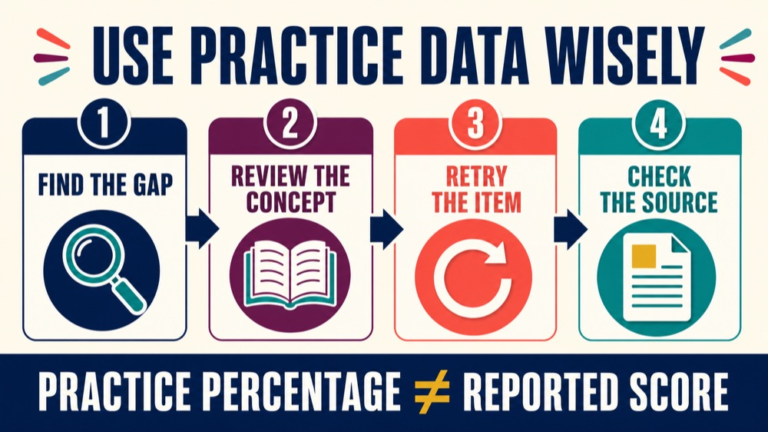
A practice percentage describes what happened on a learning instrument. The official reported score describes what the test program reports after applying its own item and scoring rules. The two measures can inform one another, but the first does not become the second merely because both use numbers.
There are several reasons a fixed conversion is unsafe. A practice provider may use a different item pool, different content balance, different difficulty distribution, different directions, and different scoring conventions. Even when two sets both report a percentage, they may not measure the same sample of knowledge or the same response process. The ETS and ASHA pages explain the raw-versus-scaled distinction, but they do not authorize a universal practice-percentage formula.
That means a sentence such as A certain percentage always equals 162 should be treated as an unsupported shortcut unless the score program itself provides a specific, current conversion for the exact form and conditions. A range can be a private study benchmark, but it should be labeled as a planning rule, not as a prediction of the reported score.
Use practice results as evidence for decisions that the practice set can actually support. For example, a stable pattern of missed questions in swallowing safety may justify more review of that topic. A large swing between timed and untimed sets may justify studying reading speed, pacing, or decision discipline. Neither pattern gives a state board a score, and neither replaces the score report used by the credentialing pathway.
| What your practice result can support | What it cannot support by itself |
|---|---|
| A list of concepts to revisit. | A precise prediction of the reported SLP Praxis score. |
| A comparison of your performance across similar sets and conditions. | A claim that one percentage meets every state or agency cutoff. |
| A decision about whether to change your study sequence or review method. | A conclusion that the certification or licensure process is complete. |
| A conversation with a faculty member, tutor, or study partner about reasoning errors. | A replacement for the current source or the score report. |
The most useful question after a practice set is therefore not What number does this convert to? Ask What does this result tell me about the next study decision? That wording preserves the value of the data while keeping the boundary between preparation evidence and credential evidence clear.
A practical verification checklist before you rely on a number
Before you register, send a score, or tell someone that you have met a requirement, use this checklist. It is intentionally repetitive because score confusion often comes from a small label being dropped between documents.
- Identify the exact test. Confirm that the requirement names Speech-Language Pathology and code 5331, rather than Audiology or a different Praxis test.
- Name the pathway. Decide whether you are checking ASHA certification, a state license, a school-setting credential, or another agency requirement.
- Open the current controlling page. Start with ASHA for the certification standard and use the ETS state or agency comparison page for jurisdiction-specific qualifying scores.
- Read the score label. Note whether the document says passing score, qualifying score, minimum score, or another term. Do not treat a raw count or practice percentage as the same field.
- Check the date and version. Record the page date or your access date and look for language about a revised test, a new rule, or an effective date.
- Read beyond the number. Confirm application, documentation, recipient, licensure, or agency steps that may sit beside the score requirement.
- Resolve a conflict directly. If a university page, search snippet, or handbook disagrees with the current state or agency source, ask the responsible organization which rule applies to your pathway.
A source check is complete only when the test code, pathway, threshold, and effective context match. A screenshot that shows a number without those labels is a lead for further checking, not sufficient evidence for a credential decision.
How to interpret practice results for studying
Practice percentages become more useful when they are part of a small learning record rather than a one-time verdict. Record the set name, date, conditions, percentage, unanswered items, and the reason for each miss. Then connect that record to a content plan. The aim is to learn which kind of problem is recurring, not to make the percentage carry a meaning it was never designed to carry.
A practical review cycle can look like this:
- Describe the result. Write the percentage and the conditions, including whether the set was timed, untimed, interrupted, or completed after a review session.
- Sort the misses. Separate knowledge gaps, evidence-selection errors, question-reading errors, pacing problems, and avoidable changes of answer.
- Return to the concept. Use a trusted source or course note to explain why the best answer fits and why the alternatives do not.
- Write a transferable rule. State the clue or distinction you want to recognize in a new scenario rather than copying an answer key.
- Recheck with new items. Use a different set or a later session to see whether the rule can be applied beyond the original wording.
- Review the trend. Compare similar sets over time, but keep the state or agency verification task separate from the study trend.
The pattern often matters more than a single percentage. A low but stable result may suggest that foundational content needs a planned pass. A high result with many guessed answers may signal fragile recall rather than secure understanding. A large difference between timed and untimed work may point to pacing or reading decisions. A stable percentage with repeated misses in one domain suggests that overall improvement should be paired with targeted review.
| Practice pattern | Study interpretation | Next move |
|---|---|---|
| Repeated misses in the same concept family | The learner may need a clearer rule, contrast, or retrieval routine. | Relearn the distinction, create a short explanation, and apply it to new items. |
| High percentage with frequent guessing | The total may overstate confidence in the underlying knowledge. | Mark uncertain answers and review the reasoning that would make the choice defensible. |
| Large timed-versus-untimed swing | Content knowledge and test-taking conditions may be producing different results. | Practice pacing in smaller blocks while continuing content review. |
| Different results across different sets | Item mix, difficulty, topic coverage, or conditions may differ. | Compare like with like and inspect the errors before changing the study plan. |
Keep two separate notes in your study file. One note can say, My practice evidence suggests I should review motor speech and clinical decision-making. The other can say, I verified the current score requirement for my named pathway on a particular date. Combining those notes into one predicted score creates false precision and makes it harder to notice when a requirement has changed.
If you use 162 as a planning reference for ASHA certification, treat it as a minimum reported-score target to understand, not as a practice percentage to reverse-engineer. A sensible study plan builds knowledge, reasoning, and consistency; the final score decision remains with the test program and the credentialing or regulatory body that accepts it.
Common traps about the passing score
Trap 1: Treating 162 as 162 correct answers. The number is on the scaled score framework. Raw points are a different quantity, and the conversion depends on the scoring process.
Trap 2: Copying a fixed percentage rule. A percentage on one practice form is not a universal line for the reported score. Use it to guide review, then verify the requirement from the named source.
Trap 3: Assuming ASHA and every state use one identical rule. ASHA’s current certification page and the ETS state or agency tool answer related but different questions. Confirm the organization that will evaluate your score.
Trap 4: Transferring the 170 footnote. The ASHA page’s 170 note is tied to older Audiology codes 5342 and 0342. It is not the SLP 5331 passing line.
Trap 5: Treating a practice result as a score report. A provider’s percentage or label may be useful for learning, but it does not replace the reported result used by the relevant pathway.
Trap 6: Treating the passing score as the whole credential. The score may be one requirement among an application, documentation, and other pathway conditions. Read the current requirements instead of stopping at the number.
Trap 7: Trusting an old snippet without checking the page. Search snippets can combine text from different sections or versions. Open the source, read the test code, and record the access date.
Quick review: what to remember
Use these statements as a final self-check:
- For the current SLP Praxis test 5331, ASHA lists 162 as the passing score for ASHA certification when checked on 2026-08-23.
- That 162 is a scaled-score threshold, not a raw count of correct questions and not a percentage.
- ETS says qualifying scores vary by state or agency, so the relevant jurisdiction or agency must be checked separately.
- The 170 footnote on the ASHA page belongs to older Audiology codes, not the SLP 5331 line.
- A practice percentage describes performance on a particular learning set; it does not convert into a definite reported score.
- Use practice results to identify content, reasoning, pacing, and confidence patterns.
- Recheck ASHA, ETS, and the responsible state or agency before making a registration or credential decision.
For a structured next step, you can review the SLP Study Center Complete Prep page and decide whether its learning resources fit your own preparation plan. The source check and the study decision remain yours.