
slp praxis official study companion is a practical starting point for building a source-grounded preparation plan. It can show the intended scope, broad domains, and preparation context more clearly than a collection of forum posts or disconnected flashcards. The most useful way to read it is active: extract the map, turn headings into skills, and practice decisions that fit the scope.
Use the current ETS Speech-Language Pathology Praxis 5331 page for live administration details. The linked ETS Study Companion is the document used for the scope discussion in this guide. Because documents and test information can be updated, check the live page and current PDF before your appointment. This article explains how to use the companion; it is not a substitute for reading the source yourself.
What the Study Companion does
A Study Companion helps define the territory. It can orient you to the test name and code, content scope, broad domains, preparation resources, and other information supplied by the test owner. It is most valuable when it changes your study decisions. A heading should lead to a note, a skill, and an application task.
Do not expect one document to answer every question. Separate the kinds of information you may find:
- Scope: the content areas and domain language that organize review.
- Administration: current timing, delivery, registration, and other appointment details that should be verified on the live ETS page.
- Preparation: suggestions for becoming familiar with the assessment and planning work.
- Professional context: concepts that should be checked against current ASHA standards and resources when they affect clinical reasoning.
This separation prevents an old saved PDF from becoming your only source for changing logistics. It also keeps the document in its proper role: a source for scope and preparation, not a promise about a particular sitting.
Read the document in the right order
Start with the cover, test title, code, and date or edition information. Then read the test overview and domain sections before diving into a list of resources. You want to understand what the document is describing before you decide how much time to spend on any one topic.
Use this first reading routine:
- Identify: confirm that the document matches Speech-Language Pathology Praxis 5331.
- Orient: note the format, broad scope, and any directions about preparation.
- Mark: highlight domain headings, repeated decision verbs, and terms that need clarification.
- Question: write down claims that need a current ETS or ASHA check.
- Plan: turn each marked heading into one study output before opening another resource.
Do not highlight every sentence. Highlighting becomes useful when it helps you retrieve, compare, explain, or apply a concept later. A short margin note such as “match referral question to measure” is more actionable than a page covered in color.
Turn the companion into a study map
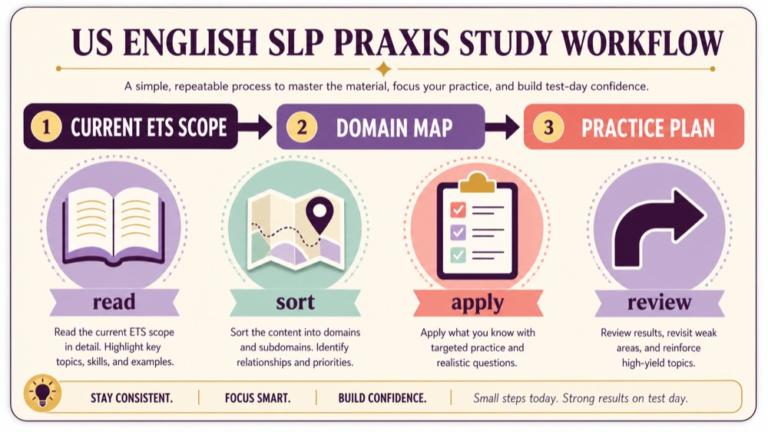
After the first reading, build a one-page map. The current materials checked for this guide describe three broad areas: Screening, Assessment, Evaluation, and Diagnosis; Planning, Implementation, and Evaluation of Treatment; and Foundations and Professional Practice. The Study Companion listed relative emphasis of approximately 50%, 33%, and 17% in the edition checked. Confirm the current document before assigning percentages.
| Map field | What to record | Why it helps |
|---|---|---|
| Domain | The broad heading from the current companion. | Keeps resources organized. |
| Subskill | The decision or ability inside the heading. | Creates a practice target. |
| Source | Where the concept will be checked. | Separates evidence from memory. |
| Output | Map, explanation, case, or error note. | Makes progress observable. |
If the relative emphasis is unchanged, use it as a starting allocation rather than a reason to ignore a smaller area. A ten-hour week might begin with five hours for assessment-related work, three for treatment planning and evaluation, and two for foundations and professional practice. Your error log should refine that allocation.
Translate scope into decision skills
A domain becomes useful when you can describe what you must do with the information. For assessment, a skill might be matching a referral question to the information needed. For treatment, it might be connecting a functional goal to an intervention and progress measure. For foundations, it might be applying an ethical, access, collaboration, or scope boundary.
For each heading, write a card with:
- Situation: what person, setting, or concern is present?
- Task: what decision is being requested?
- Evidence: which detail supports or limits the choice?
- Boundary: what safety, scope, access, or professional issue matters?
- Transfer: how would the same principle look in another context?
That card turns reading into a study loop. You can use it to create an original scenario, compare options, or explain a decision in plain language. The goal is not to memorize the document’s wording; it is to understand the decision structure it points toward.
Use the companion for practice
Let the companion choose the subject of a practice block, but do not let it replace application. Read one scope section, close the document, recall the core idea, and apply it to an original case or a clearly labeled preparation question. Then explain why the leading choice fits and why the alternatives are weaker.
- Choose one domain and one subskill.
- Review the source and write a plain-language rule.
- Create or select a short practice scenario.
- Record task, evidence, choice, and rationale.
- Return to the source only to correct a specific gap.
Keep practice content separate from claims about the live assessment. A preparation item may be useful without representing any released, remembered, or future test content. Focus on the skill that transfers.
Use a four-step companion review cycle
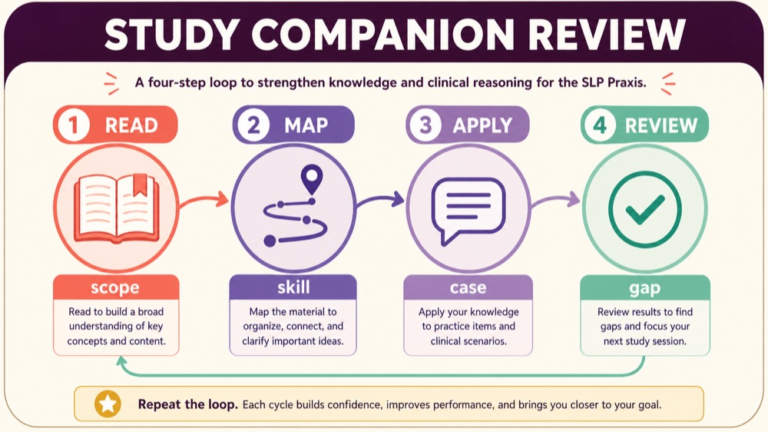
Repeat a simple cycle: read, map, apply, review. In the read step, identify the source-grounded scope. In map, write domain and subskill. In apply, practice a decision. In review, classify the error and choose the next activity. The cycle prevents a document from becoming a one-time download that never affects behavior.
| Step | Question | Output |
|---|---|---|
| Read | What does the current source say? | Short source note. |
| Map | Where does it fit in the scope? | Domain-to-skill card. |
| Apply | Can I use the idea in a new case? | Reasoned practice response. |
| Review | What gap changes my next block? | Specific correction plan. |
Use the cycle weekly and after a timed set. If the same error returns, change the practice task rather than rereading the same page. A concept may need a comparison, a case, or a retrieval prompt before it becomes usable.
Keep current facts separate
Create a small “verify before test day” list for facts that can change: registration steps, available delivery options, timing, question count, score reporting, and appointment rules. Keep the list dated. The Study Companion can provide preparation context, while the live ETS page should be checked for current administration information.
For clinical topics, use current ASHA standards and evidence resources when the decision involves professional responsibilities or practice boundaries. If a forum post conflicts with the current source, do not average the claims. Record the source and the date you checked it.
Common Study Companion mistakes
- Downloading the PDF but never extracting a domain-to-skill map.
- Using a saved edition without checking whether the live ETS page changed.
- Treating broad headings as a complete study plan.
- Highlighting pages instead of writing retrieval prompts.
- Confusing scope guidance with a forecast of future item wording.
- Studying only the largest domain and postponing professional practice.
- Using a practice score as a direct translation of a Praxis result.
- Copying an answer from a preparation source without learning the rationale.
The fix is a dated source check plus the read-map-apply-review cycle. Keep the document close, but make your study outputs do the work.
Study Companion checklist
Before your next study week, answer:
- Does my PDF match the current test name and code?
- What edition or date did I check?
- What broad domains does it list?
- What skill will I practice under each domain?
- Which administration facts must I verify on the live ETS page?
- What ASHA source will support professional context?
- What practice output will show transfer?
- What error will change my next study block?
The best use of the slp praxis official study companion is active and dated: read the scope, map it, apply it, and revisit current sources when logistics or professional guidance may have changed.
Sources and next steps
Open the current ETS Speech-Language Pathology Praxis Study Companion for scope and preparation context. Check the live ETS test page for current administration information, and review ASHA’s Praxis information for certification context. Verify current materials before test day.
Continue your preparation: Explore the SLP Study Center learning resources.