
Slp praxis multiple choice questions can feel difficult when two or three options are clinically related. A clear method helps: read the requested task, mark the evidence, compare option fit, identify the closest mismatch, and check whether your reasoning transfers to a new case.
The current ETS Speech-Language Pathology (5331) page describes a computer-delivered selected-response test with 132 questions and 150 minutes. Use the live ETS page and your account for changing details. ASHA preparation guidance also supports practice questions, timed work, and a plan shaped by individual strengths and weaknesses.
What multiple-choice practice should show
Multiple-choice practice is not only a count of correct letters. It can show whether you understood the task, identified the evidence, recognized the decision stage, and compared the strongest option with a related alternative. Record those layers so a miss produces a specific next action.
| Practice layer | What to record | Why it matters |
|---|---|---|
| Task | The action requested by the stem. | Defines the answer target. |
| Evidence | Details that change the decision. | Separates clues from background. |
| Fit | Why the selected option answers the task. | Builds a decision rule. |
| Distractor | Why the closest alternative is weaker. | Improves close-choice comparison. |
| Confidence | Stable, uncertain, or changed. | Shows how the answer was reached. |
A correct choice can still have a weak rationale, and a wrong choice can contain useful evidence about your reasoning. Review both. The purpose is to make the comparison reproducible when the next case changes the setting, target, or process stage.
Use the selected-response format as a reason to be precise, not as a reason to guess from recognition. Several options may be true in a broad sense. Your task is to identify the option that best fits the question and evidence in the case.
Confirm the current 5331 source before practicing
Start with the current ETS Speech-Language Pathology (5331) page. Use it to confirm subject identity, current delivery and timing information, broad content direction, question count, duration, and preparation links. The page currently lists 132 questions and 150 minutes for a computer-delivered selected-response exam, so date your administration note.
Use the ETS practice-test page to locate current preparation options by subject. Read the resource description before assigning a set to learning, review, or simulation. Use ASHA’s Praxis preparation guidance for practice planning and strengths-and-weaknesses review.
- Verify the subject: confirm Speech-Language Pathology (5331).
- Record the source: note provider, title, date, and format.
- Label the condition: identify untimed, timed, supported, or independent work.
- Separate administration facts: use ETS for current delivery and appointment information.
- Protect originality: use legitimate preparation material rather than purported secure content.
Keep practice notes separate from changing test instructions. A multiple-choice explanation can teach a reasoning relationship, while the live responsible source controls current administration details. Clear source roles make your study record easier to update.
Use a task-first multiple-choice method
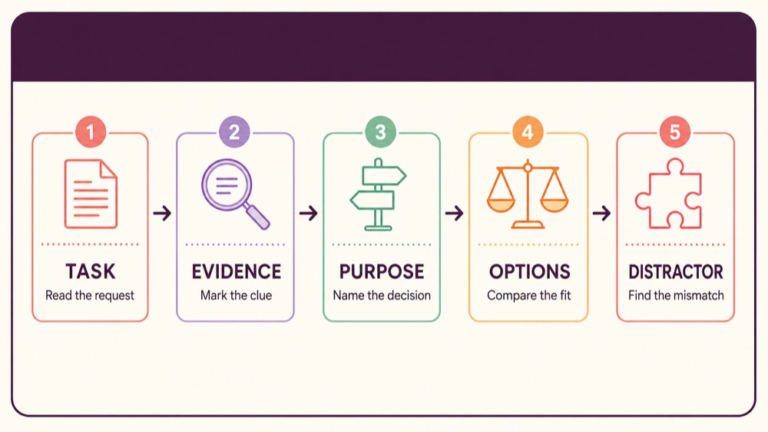
Use a five-step method for each item: identify the task, mark the decisive evidence, predict the answer type, compare the options, and state the closest mismatch. This process reduces the pull of a familiar word because every option has to return to the same question and case.
| Step | Prompt | Record |
|---|---|---|
| 1. Task | What am I being asked to choose? | One-sentence restatement. |
| 2. Evidence | Which detail changes the decision? | Relevant clue and context. |
| 3. Prediction | What type of answer should fit? | Information, measure, action, or interpretation. |
| 4. Comparison | Which option fits purpose and sequence? | Choice and confidence. |
| 5. Contrast | Why is the closest alternative weaker? | Precise mismatch. |
Use the method without a strict timer while learning it. Once the record is consistent, shorten the prompts for a light-timing block. The abbreviated version should preserve the task and evidence, not replace them with a guess based on the first familiar option.
Choose one primary comparison at a time. You may compare purpose, sequence, population, evidence, or function. If you try to solve all comparisons at once, write the strongest mismatch first and use the explanation to add nuance afterward.
Read the final request before the options
The final sentence often defines the answer target. It may ask for the next step, the most appropriate measure, the best interpretation, a treatment action, or a professional response. Restate that request before allowing the options to shape your thinking.
| Request | Restatement frame | Option check |
|---|---|---|
| Next information | What remains unknown that changes the plan? | Does the option gather that information? |
| Assessment action | What should be done for this purpose? | Does the method match the decision? |
| Treatment action | What response fits the target and condition? | Does the action address function? |
| Interpretation | What pattern is supported by the facts? | Does the option stay within the evidence? |
| Professional response | What action fits the role and context? | Does the response match responsibility? |
A clinically true statement can still be the wrong answer when it solves a different task. Record that distinction during review. It is especially important when one option names a familiar procedure but the stem asks for information before the procedure is selected.
When the final request is dense, underline its action words and stage words, then read the case again with that target in mind. The goal is to connect wording to the process, not to memorize isolated signals.
Sort evidence from background detail
Mark the details that change the answer and set the remaining facts aside as context. A setting, partner, functional goal, support condition, or observed behavior may determine option fit. A vivid detail can be memorable without being decisive for the specific task.
| Evidence category | Question | Review use |
|---|---|---|
| Goal | What outcome matters? | Connects option to function. |
| Context | Where and with whom does it occur? | Defines conditions. |
| Observation | What was directly described? | Separates data from inference. |
| Missing detail | What is not yet known? | Guides the next information step. |
| Stage | What has already happened? | Places the action in sequence. |
Write the evidence as a relationship. “The communication demand changes by setting, so context information should guide the next step” is more useful than copying five nouns from the stem. The relationship can then be tested in a fresh question.
If an option depends on information the case does not provide, mark the unsupported assumption. Ask whether the option could become appropriate after that information is gathered. This creates a boundary for the comparison without treating the option as unrelated.
Compare purpose, sequence, and fit
Once the task and evidence are clear, compare the options using three filters: purpose, sequence, and fit. Purpose asks whether the option addresses the requested decision. Sequence asks whether it belongs at this stage. Fit asks whether it matches the population, context, target, and evidence.
| Filter | Question | Typical mismatch |
|---|---|---|
| Purpose | Does the option answer the requested question? | Related goal, different task. |
| Sequence | Is this the right stage? | Later action chosen too early. |
| Population | Does it fit this client or setting? | Rule borrowed from another context. |
| Evidence | Does the case support the option? | Unsupported assumption. |
| Function | Does it address the stated outcome? | Technical action without functional fit. |
Use the strongest filter first. If an option answers the wrong task, you do not need a long content debate to reject it. If two options share the same task, move to evidence, sequence, and functional fit to distinguish them.
Record the filter that decided the comparison. Repeated purpose mismatches call for task practice. Repeated sequence mismatches call for ordered process review. Repeated functional mismatches call for case-based transfer.
Build an option comparison grid
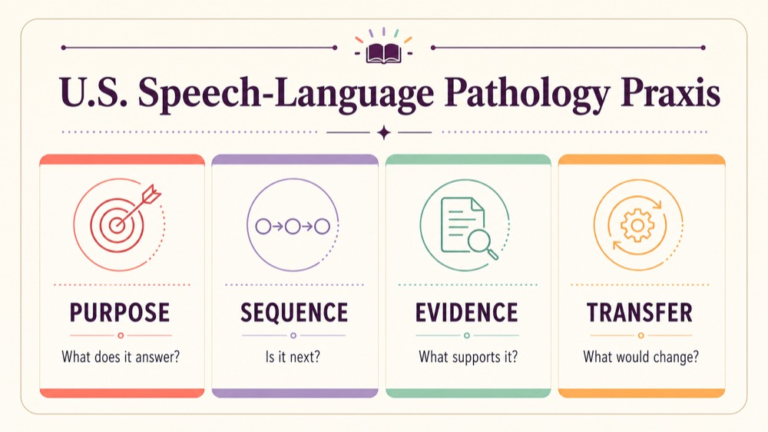
For close items, place the top two options in a comparison grid. Write what each option addresses, what evidence it requires, where it belongs in the process, and what detail makes one fit better. The grid slows down an unstructured preference and produces a rationale you can reuse.
| Grid field | Option A | Option B |
|---|---|---|
| Task addressed | What question does it solve? | What question does it solve? |
| Evidence used | Which case detail supports it? | Which case detail supports it? |
| Sequence | Before, next, later, or outcome? | Before, next, later, or outcome? |
| Boundary | What would make it change? | What would make it change? |
| Fit | Why is it stronger or weaker here? | Why is it stronger or weaker here? |
You do not need a full grid for every easy item. Use it when two options remain plausible, when confidence is low, or when a familiar term is pulling you away from the task. The grid is a learning tool that can later become a short mental comparison.
Keep the rejected option in your notes. A close distractor often reveals the decision boundary that matters most. Writing why it loses can be more educational than rereading why the key wins.
Handle two plausible options
When two options sound reasonable, identify the condition that separates them. One may fit after more information, while the other fits before it. One may address a structured task, while the other addresses functional transfer. One may be related to the case but broader than the evidence allows.
- Ask which option answers the exact verb: information, select, interpret, treat, or evaluate.
- Ask which option uses the strongest clue: do not let a background detail dominate.
- Ask which option belongs at this stage: separate next action from later action.
- Ask what each option assumes: mark information that the case did not supply.
- Ask what would change the choice: write the boundary for transfer.
Commit after the comparison is complete, then record confidence. Endless comparison can consume study time without adding evidence. If uncertainty remains, mark the item for review and write the missing comparison rather than rereading every option without a plan.
Use the explanation to check your comparison, not to replace it. If the rationale emphasizes a clue you ignored, update the evidence note. If it emphasizes sequence, update the process note. The review should tell you what to practice next.
Try three original multiple-choice questions
The following items are original educational examples created for this article. They are not copied from ETS and are not presented as secure test material. Answer each item first, then review the task, evidence, closest distractor, and comparison filter.
Question 1: Choose the information step
Scenario: A student understands one-step classroom directions but often misses multistep directions during group activities. The question asks what information should be gathered before selecting an assessment task. Which answer is best?
Correct Answer: B. Why This Answer Is Correct: The stem asks for information before an assessment task is selected. Direction type, vocabulary, supports, and group context define the information gap and help determine the next assessment decision. B fits the task and uses the case evidence.
Why the Other Options Are Wrong: A begins treatment before the assessment purpose is clear. C makes a broad interpretation from limited details. D selects a tool without clarifying the communication demand. The alternatives may relate to later work, but B is the response that addresses the requested first step.
Question 2: Compare sequence
Scenario: A client produces a target response during a structured activity but has difficulty using it in conversation. The question asks what should guide the next treatment decision. Which option fits best?
Correct Answer: B. Why This Answer Is Correct: The case contrasts structured and conversational conditions. B gathers information about the functional demand and supports that can guide the next treatment decision. It keeps the target visible while examining the condition in which transfer breaks down.
Why the Other Options Are Wrong: A repeats the condition that already showed success and does not explain the conversation problem. C treats one successful condition as the whole outcome. D changes the label instead of examining implementation. B matches the task, evidence, and sequence.
Question 3: Compare evidence and scope
Scenario: A case describes reduced intelligibility in a noisy workplace but provides no information about communication partners or task demands. The question asks what should be clarified before recommending a communication strategy. Which answer is strongest?
Correct Answer: B. Why This Answer Is Correct: The question asks what should be clarified before a recommendation. Partners, tasks, noise, and breakdown patterns define the functional context and identify what the strategy needs to address. B uses the missing evidence and avoids a broader claim than the case supports.
Why the Other Options Are Wrong: A makes an overbroad recommendation without knowing the contexts. C infers a diagnosis from limited information. D chooses a technique before the communication demand is understood. B is the only option that directly addresses the evidence gap before planning.
Review the choice and the rejected options
After checking the key, review your chosen option and the closest rejected option. Write the task each one answers, the evidence each one uses, the stage each one belongs to, and the mismatch that separates them. This creates a clear comparison instead of a simple correction.
- Reconstruct: write your first task and evidence note.
- Confirm: connect the key to the task and decisive clue.
- Contrast: name the closest option’s purpose, sequence, or evidence mismatch.
- Transfer: state one changed detail that could alter the answer.
If you chose the key for the wrong reason, mark that as an uncertain correct answer. If you rejected the key because a related option felt more familiar, mark the distractor pull. Both records can guide practice even when the final letter was correct.
Keep explanations in your own language. A copied rationale can hide whether the decision rule is understood. Rewrite the rule, add its boundary, and test it with a fresh case that changes one meaningful detail.
Turn choice errors into targeted repairs
Match the repair to the comparison that failed. Task mismatch needs final-sentence restatement. Evidence mismatch needs relevant-clue notes. Sequence mismatch needs ordered steps. Distractor mismatch needs a top-two grid. Process mismatch needs a controlled timing comparison after the reasoning is stable.
| Failure pattern | Repair block | Fresh check |
|---|---|---|
| Wrong task | Restate five stems before viewing options. | Correct action named in new items. |
| Missed evidence | Mark the detail that changes the plan. | Evidence linked to choice. |
| Wrong sequence | Order information, action, and outcome. | Next step chosen in a changed case. |
| Closest distractor wins | Compare top two options in a grid. | Mismatch explained precisely. |
| Timing changes choice | Use a short light-timing block. | Same record under a new condition. |
Write a success signal before starting. It might be a task restatement, a relevant evidence sentence, a sequence explanation, a distractor mismatch, or a stable choice under a light boundary. A visible signal makes the repair easier to evaluate.
Keep the repair small. A large mixed set can create more data without answering whether the chosen comparison improved. Use a few fresh items, review them completely, and then decide whether to repeat or expand.
Use untimed and timed multiple-choice practice
Use untimed practice to make the decision process visible and timed practice to inspect efficiency after the process is stable. Keep the task, evidence, fit, distractor, and confidence fields in both conditions so the clock can be compared with reasoning.
| Stage | Condition | What to inspect |
|---|---|---|
| Learning | Time open, rationale delayed. | Task, evidence, and option fit. |
| Transfer | Fresh wording, no strict clock. | Boundary and application. |
| Light timing | Small set with flexible review. | Rereads, hesitation, and answer changes. |
| Long practice | Use after a review record exists. | Stamina and late-session choices. |
If the reasoning works untimed but changes under timing, record a process hypothesis. If the same comparison fails in both conditions, keep the content or task repair active. The comparison tells you what the clock changed and what it did not.
Do not let a strict timer turn every uncertain option into a pacing label. First inspect the task, evidence, sequence, and distractor record. Then choose the smallest timing practice that answers the process question.
Avoid multiple-choice practice traps
- Choosing the first familiar option before naming the task.
- Treating every clinically true statement as equally strong.
- Ignoring the closest distractor after selecting the key.
- Confusing a later action with the next action.
- Using a vivid case detail instead of the decisive clue.
- Copying an explanation without rewriting the decision rule.
- Repeating the original wording until recognition replaces transfer.
- Adding a long timer before the comparison process is clear.
- Changing source, content lane, and condition together.
- Using practice results as official score information.
- Using a practice page for changing appointment or administration details.
- Studying purported secure content rather than legitimate preparation material.
The correction is a task-first chain: identify the request, mark the evidence, compare purpose and sequence, explain the closest mismatch, record confidence, and test the boundary with fresh wording. Selected-response practice becomes more useful when every option has to earn its fit.
SLP Praxis multiple-choice questions checklist
Use this checklist with slp praxis multiple choice questions:
- Did I confirm Speech-Language Pathology (5331) through the current ETS page?
- Did I record the source, date, and practice condition?
- Did I read and restate the final task?
- Did I identify the evidence that changes the decision?
- Did I compare purpose, sequence, population, evidence, and function?
- Did I record confidence and any answer change?
- Did I explain why the closest distractor is weaker?
- Did I label task, retrieval, application, sequence, distractor, or process issues?
- Did I choose a small repair block?
- Did I test the repair with fresh wording or a changed detail?
- Did I add timing only after the reasoning record was clear?
- Did I keep practice evidence separate from official score and logistics claims?
Multiple-choice preparation is not a contest to recognize the most familiar phrase. Read the task, use the case evidence, compare close options, and build a rationale you can transfer to the next question.
Sources and next steps
Use the current ETS Speech-Language Pathology (5331) page for subject identity, format, duration, question count, broad content direction, and preparation links. Search the ETS Praxis practice-test page for current subject options. Review ASHA’s Praxis preparation guidance for preparation materials, practice questions, timed work, and using strengths and weaknesses to guide review.
Continue your preparation: Explore the SLP Study Center learning resources after you complete the option grid and choose a fresh transfer check.