An slp praxis missed questions review should do more than collect wrong answers. It should show what the question asked, which evidence mattered, why the selected option looked attractive, and what small study action can test the pattern again.
The current ETS Speech-Language Pathology (5331) page describes a computer-delivered selected-response test with 132 questions and 150 minutes. Use the live ETS page and your account for changing details. ASHA preparation guidance also supports practice questions, timed work, and a plan shaped by individual strengths and weaknesses.
What missed-questions review should show
A missed item is a small record of a decision made under particular conditions. The useful question is not only whether the choice matched the key. Ask whether you misunderstood the task, missed a relevant clue, recalled the wrong principle, confused sequence, or selected a related option that belonged to another decision.
| Review signal | What to capture | Why it matters |
|---|---|---|
| Task | The action requested by the stem. | Prevents a correct rule from being used on the wrong question. |
| Evidence | Details that changed the decision. | Separates relevant clues from background information. |
| Choice | Your option and confidence. | Shows whether the error was confident or tentative. |
| Distractor | The nearest alternative and its mismatch. | Reveals the comparison that broke down. |
| Condition | Untimed, timed, supported, or interrupted. | Links the error to the practice setting. |
A missed question can point to a content gap, an application gap, a reading problem, or a process problem. Several labels can be present, but choose the primary one first. That decision keeps the next study block focused instead of sending you back to an entire textbook.
Review correct answers that felt uncertain as well. An answer that happened to land on the key can still expose a fragile rule. Marking uncertain correct answers gives you a fuller picture of what needs another check before you increase question volume or add time pressure.
Confirm the current 5331 source and the role of practice review
Start with the current ETS Speech-Language Pathology (5331) page. Use it to confirm the subject identity, current delivery and timing information, broad content direction, question count, duration, and preparation links. The page currently lists 132 questions and 150 minutes for a computer-delivered selected-response exam, so date your notes when you record those details.
Use the ETS practice-test page to locate current preparation options by subject. Read the resource description before deciding whether a set is useful for learning, review, or simulation. A practice bank can help you examine misses, but its results should remain labeled as practice evidence.
- Verify the subject: confirm Speech-Language Pathology (5331).
- Record the source: note provider, title, date, and format.
- Label the condition: identify untimed, timed, open-reference, or independent work.
- Separate administration facts: use ETS for current appointment and delivery details.
- Protect originality: use legitimate preparation material rather than purported secure content.
For planning principles, review ASHA’s Praxis preparation guidance. Keep preparation guidance separate from the current ETS administration record. When a resource or logistics detail changes, a dated source note makes it easier to update the right part of your plan.
Build a missed-question review record
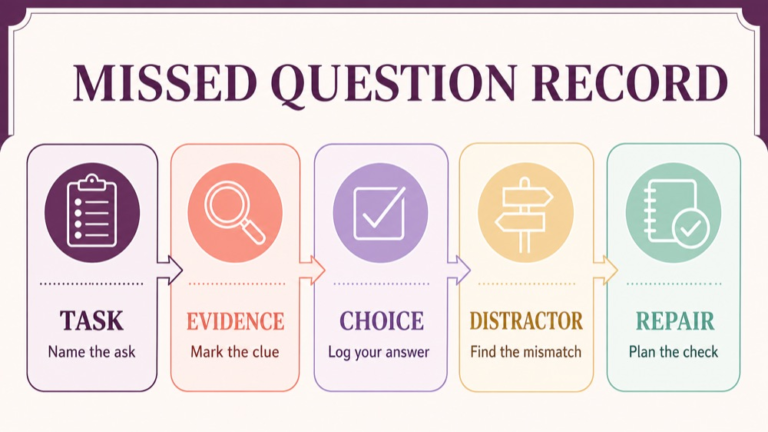
Use one row or one card for each missed or uncertain item. Begin with your first independent interpretation rather than the explanation you saw afterward. Record the question task, selected option, confidence, relevant evidence, closest distractor, and practice condition before writing a repair.
| Field | Example | Review prompt |
|---|---|---|
| Question ID | Source and item number. | Can I find the item again? |
| Task | Choose the next assessment information. | Did my choice answer that task? |
| Evidence | Detail that creates the information gap. | Why does this detail matter? |
| My choice | Option C, uncertain. | What made it attractive? |
| Closest option | Option B, related but later. | What exact mismatch weakens it? |
| Repair | Compare three next-step stems. | What fresh check will follow? |
Keep the record short enough to use repeatedly but detailed enough to show a decision rule. A note such as “I forgot assessment” is too broad to guide study. A note such as “I chose a measure before identifying the information gap requested by the stem” points to a specific repair.
Use a separate line for the answer key or explanation. This preserves the difference between what you initially reasoned and what you learned during review. The distinction is valuable because a supported correction and an independent correction require different follow-up conditions.
Label the error before choosing the repair
Labeling an error is an interpretation, not a permanent identity. Choose the label that best explains the evidence in this item, then test that explanation with a fresh example. If the new example points elsewhere, update the label instead of forcing every miss into the first category you chose.
| Error label | Typical sign | First repair |
|---|---|---|
| Task mismatch | Your answer solves a different question. | Restate the final sentence before viewing options. |
| Content retrieval | The governing concept was unavailable. | Write a plain-language rule and contrast. |
| Application | You knew the concept but missed the case fit. | Compare two fresh cases with changed details. |
| Sequence | Your action belonged earlier or later. | Order the steps and state each purpose. |
| Distractor comparison | You saw relevance but missed the stronger fit. | Name the precise mismatch for the closest option. |
| Process | Rereading or rushing changed the decision. | Run a smaller block with a visible process note. |
Use the stem and your first response as evidence for the label. Do not infer a broad content weakness from one unfamiliar term when the main failure was reading the requested sequence. Conversely, do not call a repeated concept miss a pacing issue simply because it happened in a timed set.
When two labels compete, choose a primary label and write a secondary hypothesis. The next repair should be designed to distinguish them. This turns review into a small experiment that can improve the quality of your next practice block.
Separate knowledge gaps from decision errors
A knowledge gap means the principle or term was not available when you needed it. A decision error means the relevant knowledge was present but was used on the wrong task, in the wrong sequence, or with the wrong evidence. Untimed review is helpful because it gives you enough room to test which explanation fits.
| Question to ask | If the answer is yes | What to do next |
|---|---|---|
| Could I explain the concept after a brief cue? | The issue may be application or recognition. | Use a new case with a changed target. |
| Did I read the final task sentence correctly? | The issue may be task recognition. | Practice restating stems before options. |
| Did I know the steps but place them out of order? | The issue may be sequence. | Build a before-and-after step comparison. |
| Did I choose a related answer without comparing fit? | The issue may be distractor analysis. | Explain the nearest mismatch in one sentence. |
| Did the error appear only after a long block? | The issue may include process or stamina. | Compare a shorter condition before changing content. |
Use a small retrieval check before opening a broad review resource. State the concept in your own words, give one contrast, and apply it to a plain scenario. If that route works, the next step is likely application or task recognition rather than more definition copying.
Clinical reasoning questions often reward a fit among population, goal, evidence, and sequence. A correct fact can still lead to a weak choice when one of those relationships is missing. Write the relationship that failed so your repair targets the connection rather than the vocabulary alone.
Reconstruct the stem task
Before reviewing an answer key, cover the options and write what the question asks you to choose. It may request the next information, the most appropriate assessment step, a treatment action, an interpretation, or a professional practice response. Naming the task reduces the chance that a familiar option will define the question for you.
| Task type | Restatement frame | Evidence check |
|---|---|---|
| Next information | What remains unknown that changes the plan? | Find the information gap. |
| Assessment action | What should be done for this purpose? | Link the action to the decision. |
| Treatment action | What response fits the target and condition? | Match action to functional need. |
| Interpretation | What pattern is supported by the details? | Stay within the evidence supplied. |
| Professional response | What action protects the relevant responsibility? | Identify the role, setting, and concern. |
Compare your original choice with your task restatement. If the choice answered a different task, record a task mismatch even if the choice could be reasonable in another context. This prevents a broad clinical association from replacing the precise question being asked.
When the wording is dense, underline the verbs and timing words that define the action. Terms such as before, next, most appropriate, initial, or best supported can change the comparison. The goal is not to memorize signal words in isolation, but to connect them to the decision pathway described by the stem.
Compare the correct and closest option
After identifying the task, compare the selected answer with the closest alternative. Start with the evidence that supports the stronger fit. Then name the exact mismatch in the alternative: wrong purpose, wrong stage, unsupported assumption, population mismatch, or a response that is too broad for the stem.
- Purpose mismatch: the option addresses a related goal rather than the requested one.
- Sequence mismatch: the option belongs before or after the step in the stem.
- Evidence mismatch: the option assumes information that was not established.
- Population mismatch: the option fits a different client or context.
- Scope mismatch: the option makes a larger claim than the available details support.
Use precise comparison language in the review record. “B is wrong” does not explain the decision. “B could be considered later, but the stem asks for information needed before selecting the measure” preserves the clinical relationship and gives you a rule to test with another item.
Reviewing the closest distractor is especially useful when the original miss felt obvious after seeing the key. The nearby option often shows what your mind prioritized: a familiar procedure, a true definition, a compelling symptom, or a later step that sounded productive.
Review the error before reviewing the answer
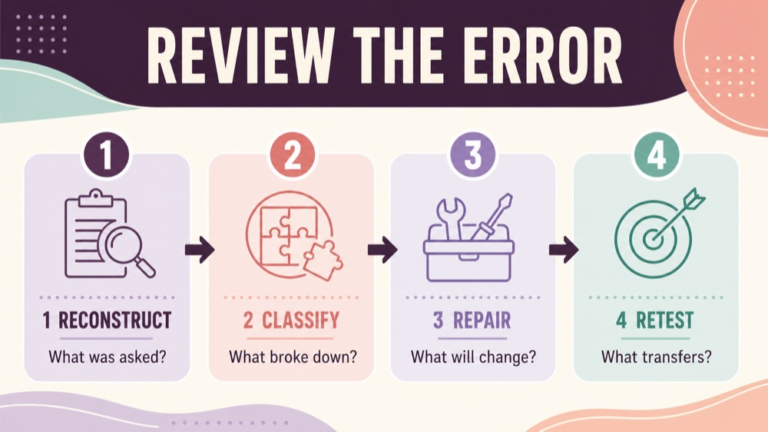
Use a two-pass review. On the first pass, reconstruct the task and evidence from memory without looking at the explanation. On the second pass, compare that reconstruction with the answer rationale and update the error label. This sequence protects the learning value of your first response.
- First pass: write the task, evidence, choice, confidence, and closest distractor.
- Rationale pass: identify what the explanation confirms or changes.
- Mismatch pass: name the precise reason the alternative is weaker.
- Repair pass: select a fresh practice action.
If you look at the key first, the explanation can feel familiar without showing whether you could reproduce it. A delayed rationale creates a clearer baseline. It also helps you distinguish an answer you learned from an answer you independently reasoned through.
Do not copy a long explanation into your notes when a short rule will do. Rewrite the reasoning in your own language, then add one changed detail that could alter the choice. That final step pushes the review toward transfer rather than recognition of the original item.
Try three original missed-question review items
The following items are original educational examples created for this article. They are not copied from ETS and are not presented as secure test material. For each one, answer first, then write the task, relevant evidence, closest distractor, and error label that would guide review.
Question 1: Review a task mismatch
Scenario: A client has reduced intelligibility in a noisy classroom, and the question asks what information should be gathered before selecting a treatment target. Which response best answers the requested task?
Correct Answer: B. Why This Answer Is Correct: The stem asks for information before selecting a target, so context and breakdown conditions are the needed evidence. B gathers details that can shape the target. The other choices move to intervention, diagnosis, or measurement before the information gap has been described.
Why the Other Options Are Wrong: A starts treatment without identifying the functional pattern. C makes a larger interpretation from limited information. D chooses a tool before clarifying its purpose. Each alternative may relate to clinical work, but B is the only response that matches the requested information-gathering step.
Question 2: Review a sequence error
Scenario: A learner chooses a treatment activity before confirming whether the client can recognize the target contrast. The review goal is to identify the error pattern. Which label is most precise?
Correct Answer: A. Why This Answer Is Correct: The scenario gives a clear ordering problem: the learner selected an intervention before confirming information that would guide the target. A identifies the mismatch between the requested planning sequence and the proposed action.
Why the Other Options Are Wrong: B focuses on speed without evidence that time caused the choice. C assumes missing vocabulary rather than examining sequence. D names comparison failure even though the central issue is the order of information and action. A is the most specific label supported by the scenario.
Question 3: Review a distractor mismatch
Scenario: The stem asks for the next piece of information needed to choose an assessment measure. One option names a useful measure, but another option identifies the missing history that determines which measure fits. Which review statement is strongest?
Correct Answer: B. Why This Answer Is Correct: The task is to identify information needed before choosing a measure. The history option addresses that missing evidence and preserves the sequence described by the stem. The measure may become relevant later, but it does not answer the first decision.
Why the Other Options Are Wrong: A confuses concreteness with task fit. C treats general relevance as equal evidence. D reverses the sequence and assumes a tool can be selected without the information the stem says is needed. B explains both the evidence gap and the order of action.
Turn one error into a two-part repair
A useful repair has a learning part and a checking part. The learning part changes the reasoning behavior that failed. The checking part uses fresh material to see whether the behavior transfers. Without the second part, a review note can sound convincing while remaining tied to the original wording.
| Error pattern | Learning part | Checking part |
|---|---|---|
| Task mismatch | Restate five stems before viewing options. | Choose the action in three new stems. |
| Content retrieval | Write a rule and one contrast. | Recall it after a delay and apply it. |
| Sequence error | Order steps with each purpose. | Handle a case with one changed stage. |
| Distractor error | Classify the closest mismatch. | Explain a related option in a fresh item. |
| Process error | Use a small block with a process mark. | Compare pace and reasoning under light timing. |
Keep the repair narrow. If your review identifies task mismatch, do not add a full content chapter, a new question bank, and a long simulation to the next session. Change the smallest variable that can answer whether task recognition improved.
Write the success signal before you begin. It might be a correct task restatement, a relevant evidence note, a sequence explanation, or a clear distractor mismatch. A visible signal makes it easier to decide whether to repeat the repair, adjust it, or move to a different condition.
Use error clusters without overgeneralizing
Clusters can reveal a pattern when the items share a decision type or condition. Five misses from one long session do not automatically represent one content weakness. Group items by content lane, task type, error label, and practice condition before deciding that a pattern deserves a larger study response.
| Cluster dimension | Example | Question to ask |
|---|---|---|
| Content lane | Foundations, assessment, or treatment. | Is the issue concentrated in one lane? |
| Task type | Next step, interpretation, or measure. | Does the same task fail across lanes? |
| Error label | Sequence, retrieval, or distractor. | Does one reasoning behavior recur? |
| Condition | Untimed, timed, supported, or late session. | Does the condition change the pattern? |
Look for repeated evidence before expanding the repair. A single unusual case can be useful, but it should remain a single-item note until a fresh check shows a related problem. This protects your study time from being redirected by one memorable question.
When a cluster appears, choose a representative item and a fresh comparison item. Review both with the same record. If the label holds across changed wording, the repair has stronger support. If it does not, keep the cluster narrow and revise the hypothesis.
Retest with fresh wording
Fresh wording is essential because recognition of a familiar explanation can imitate mastery. Change one or two details while keeping the decision principle stable. For example, change the setting, communication partner, functional goal, or sequence request without changing the reasoning rule you intend to test.
- Keep the principle: preserve the decision relationship under review.
- Change the surface: alter the population detail, setting, or wording.
- Hide the original key: answer from the new stem before checking help.
- Compare the record: look for the same task, evidence, and distractor behavior.
- Update the label: keep, narrow, or replace the original error hypothesis.
Do not make the fresh check so different that it tests an unrelated skill. The goal is controlled transfer. A small change in surface details is often enough to show whether the reasoning is attached to the principle or to the remembered wording.
Record the fresh result beside the original item rather than replacing the first note. The pair shows whether your repair affected task recognition, evidence selection, distractor comparison, or confidence. That comparison can guide the next practice format more accurately than a new raw score.
Add timing only after review
Timing can be a useful later condition, but it can obscure the cause of an error when introduced too early. First make the reasoning route visible in an untimed or lightly supported review. Then use a small timed block to see whether speed changes the task, evidence, comparison, or confidence.
| Stage | Condition | Review focus |
|---|---|---|
| Review | Time open, answer key delayed. | Task, evidence, and distractor reasoning. |
| Light timing | Small set with a flexible boundary. | Rereads, hesitation, and answer changes. |
| Mixed practice | Several lanes under one condition. | Transfer of the repair across topics. |
| Long run | Use after a review plan exists. | Stamina and pacing patterns. |
If a timed miss disappears during untimed review, record a process hypothesis rather than declaring the content fixed. If the same miss appears in both conditions, content, application, or sequence deserves closer attention. Comparing conditions makes the next repair more informative.
Use a light clock for the first comparison. The purpose is to observe what changes, not to create a new pass-or-fail label. Keep the answer record the same across conditions so task and evidence notes remain comparable.
Keep practice records honest and private
Label whether each answer was independent, reference-supported, discussed with a peer, or reviewed after an explanation. This is not a judgment about the session. It is a condition note that prevents a supported correction from being mistaken for an independent result.
- Independent: first choice and rationale made before help.
- Reference-supported: a source clarified the concept after the first attempt.
- Discussion-supported: another learner or instructor changed the reasoning path.
- Fresh check: a changed item completed after the repair.
Keep personal study records free of confidential client information and do not copy purported secure test material into public notes. Use de-identified, original scenarios for review. For changing administration or appointment questions, return to the current ETS source rather than relying on a practice explanation.
Practice performance is evidence from a source under a condition; it is not an official scaled score. Keep the numbers useful for comparison within your plan, and avoid using one set of misses to make a broad claim about readiness.
Avoid common review traps
- Saving only the answer key and losing your original reasoning.
- Calling every miss a content gap without reading the task.
- Calling every late miss a pacing issue without checking the same topic untimed.
- Reviewing the obviously wrong options while skipping the closest distractor.
- Copying an explanation instead of rewriting the decision rule.
- Repeating the same item until familiarity replaces transfer.
- Changing the source, condition, and study topic at the same time.
- Building a large review plan from one unusual question.
- Comparing independent and supported answers without condition labels.
- Using practice percentages as official score information.
- Using a preparation page for changing registration or delivery details.
- Studying purported secure content rather than legitimate preparation material.
The correction is a visible chain: reconstruct the task, mark the evidence, compare the closest option, label the error, select a two-part repair, and retest with fresh wording. A missed-question review becomes useful when it produces a decision you can apply again.
SLP Praxis missed-questions review checklist
Use this checklist for an slp praxis missed questions review:
- Did I confirm Speech-Language Pathology (5331) through the current ETS page?
- Did I record the source, date, and practice condition?
- Did I save my first choice before reading the explanation?
- Did I restate the task in my own words?
- Did I identify the evidence that changed the decision?
- Did I record confidence and whether the answer was supported?
- Did I compare the correct choice with the closest distractor?
- Did I label the primary error pattern?
- Did I separate retrieval from application and sequence?
- Did I choose a learning action and a fresh checking action?
- Did I look for a cluster across related items rather than one memorable miss?
- Did I use fresh wording for the retest?
- Did I add timing only after the reasoning route was visible?
- Did I keep practice evidence separate from official score and logistics claims?
The goal of missed-question review is not to create a longer error list. It is to make each important miss specific enough to repair. Keep the record readable, test the repair under a new condition, and let repeated evidence decide what deserves more study.
Sources and next steps
Use the current ETS Speech-Language Pathology (5331) page for subject identity, format, duration, question count, broad content direction, and preparation links. Search the ETS Praxis practice-test page for current subject options. Review ASHA’s Praxis preparation guidance for preparation materials, practice questions, timed work, and using strengths and weaknesses to guide review.
Continue your preparation: Explore the SLP Study Center learning resources after you finish the missed-question record and choose the next fresh check.