slp praxis free questions can be useful when they are treated as learning material rather than as a shortcut to a score. Before starting a set, screen the source, identify what the item is asking, and check whether the explanation connects the answer to the case. Then record one next action from the result.
The current ETS Speech-Language Pathology (5331) page describes a computer-delivered selected-response test with 132 questions and 150 minutes. Use the live ETS page and your account for changing details. ASHA preparation guidance also supports practice questions, timed work, and a plan shaped by individual strengths and weaknesses.
What free questions can and cannot do
Free questions can give you a low-barrier way to practice reading stems, sorting evidence, and comparing options. They can also reveal whether an explanation is useful. They cannot establish that a resource reflects current administration details or that a short set represents the full 5331 scope.
| Useful role | What it can show | What to verify separately |
|---|---|---|
| Skill warm-up | Whether you can identify the task. | Current test logistics. |
| Reasoning practice | How you compare close options. | Whether the source is authoritative. |
| Gap finding | Repeated distractor or topic patterns. | Whether the set covers every domain. |
| Timing rehearsal | How long a small block takes. | Whether the item style matches your target. |
| Resource check | Whether the rationale is evidence-linked. | Clinical truth from responsible sources. |
Use the word “free” to describe access, not quality. A no-cost item may be well designed, incomplete, outdated, or difficult to audit. Your first task is to decide what the item can teach and what claims it should not make.
Keep official information and independent practice material in separate notes. A free question can teach a comparison method, while ETS controls current test identity and changing logistics. Separating those roles protects your study plan from a page that uses old or unverified administration language.
Confirm the current 5331 source
Begin with the current ETS Speech-Language Pathology (5331) page. Use it to confirm the subject identity, current delivery and timing information, broad content direction, question count, duration, and preparation links. The page currently lists 132 questions and 150 minutes for a computer-delivered selected-response exam, so date your administration note.
Use the ETS practice-test page to search for current preparation material by subject. Read the resource description before assigning a set to learning, review, or simulation. Use ASHA’s Praxis preparation guidance for practice planning, timed work, and a strengths-and-weaknesses review cycle.
- Verify the subject: confirm Speech-Language Pathology (5331).
- Record the source: note provider, title, date, and format.
- Label the condition: identify untimed, timed, supported, or independent work.
- Separate administration facts: use ETS for current delivery and appointment information.
- Protect originality: use legitimate preparation material rather than purported secure content.
A resource can be useful for practice while still being unsuitable for current test instructions. Put the source date in your notes and revisit the live official page before relying on any date, delivery detail, or preparation rule.
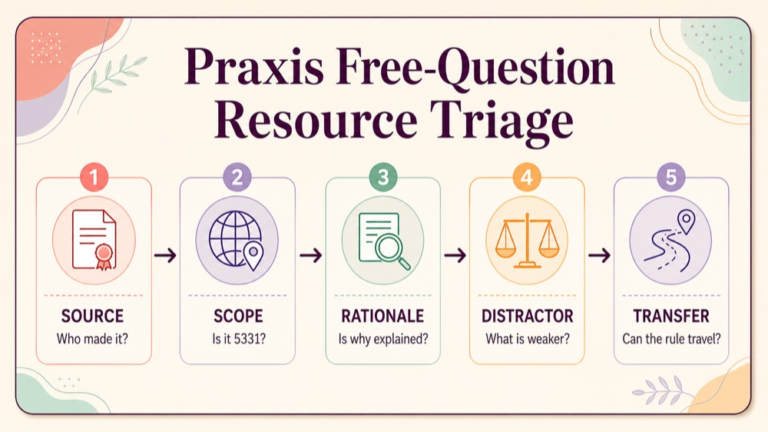
Start with a free-question triage routine
Screen each free set with four questions before you commit study time: What subject does it name? What kind of task does it provide? Does each answer have a reason? Can you tell what the closest distractor misses? This quick triage keeps an attractive page from becoming an unexamined source.
| Triage step | Prompt | Record |
|---|---|---|
| Source | Who created and dated the material? | Provider and access date. |
| Task | What reasoning action does the item test? | Next step, measure, action, or interpretation. |
| Evidence | Which detail should change the answer? | Decisive clue. |
| Rationale | Does the explanation connect choice to case? | Useful, partial, or weak. |
| Transfer | Could the rule work in a new case? | One altered practice prompt. |
Do not require every free item to teach the same thing. One set may be useful for quick recall, while another may be better for clinical reasoning. Label the role before you score the set so a short warm-up is not judged by a simulation standard.
If the answer key gives only letters, create your own brief rationale and mark the item as limited-evidence practice. You can still use it for task reading and option comparison, but you should not treat an unexplained key as a complete clinical review.
Screen a free resource before studying
Read the page around the questions, not just the first item. Look for the named subject, date or update signal, explanation method, and a clear distinction between original educational content and current exam information. These signals help you decide how much trust and time the resource deserves.
| Screening signal | Helpful sign | Follow-up question |
|---|---|---|
| Scope | Subject and exam code are stated. | Does the item fit 5331? |
| Answer key | Correct choice is identified. | Is the reasoning explained? |
| Distractors | Close alternatives are addressed. | Is the mismatch specific? |
| Source role | Official and independent claims are separated. | Which source controls the fact? |
| Accessibility | Questions are readable and usable. | Can you record a rationale? |
Use a simple label such as “warm-up,” “review,” or “simulation candidate.” A resource that has no rationale may still be a warm-up. A resource that includes clear explanations may support review. A simulation candidate should also have a consistent format and a documented purpose.
Notice whether an answer explanation identifies the requested task or merely repeats a clinical definition. Definitions matter, but selected-response items often require a decision in context. An explanation that returns to the task is more useful for practice than one that lists facts without applying them.
Set a purpose for each free-question set
Choose one purpose before opening a set. You might want to warm up a domain, test a reasoning repair, compare two related actions, or practice a short timing block. A clear purpose determines what you record and keeps a free resource from taking over the entire study session.
| Purpose | Best condition | Success note |
|---|---|---|
| Warm-up | Short, untimed, familiar format. | I can identify the task. |
| Concept review | Explanation available after each item. | I can explain the decision rule. |
| Distractor practice | Two or more plausible options. | I can name the closest mismatch. |
| Transfer | A new case changes one detail. | I can adapt the rule. |
| Timing check | Small block with a planned limit. | Pace does not erase review quality. |
Write the purpose in the first line of your study note. “Today I am practicing sequence decisions” will guide your review better than “complete free questions.” It also lets you stop when the purpose has been met instead of continuing because more items are available.
If the set does not match your purpose, change the use rather than forcing the fit. A recall-heavy set can be a warm-up before an explanation-rich set. A short sample can be a transfer check after you review a concept. The value comes from the match between resource and task.
Compare answer and rationale quality
An answer key becomes more valuable when its rationale explains why the correct choice fits and why the strongest alternative is weaker. Review the explanation for purpose, evidence, sequence, context, and the assumptions it makes. If a rationale cannot be followed, record that limitation.
| Rationale feature | Question to ask | Quality note |
|---|---|---|
| Task link | Does it answer the final request? | Clear or missing. |
| Evidence link | Does it use the decisive clue? | Specific or generic. |
| Sequence | Does the step belong here? | Current or premature. |
| Distractor contrast | Is the closest option addressed? | Precise or vague. |
| Transfer rule | Could the reasoning work elsewhere? | Portable or item-bound. |
Use a two-column check when an explanation feels persuasive: “what the rationale says” and “what the stem actually supplies.” This makes unsupported assumptions visible. It also gives you a way to retain a helpful method while declining to adopt a broad claim that the item does not establish.
When a free question contains an unclear or questionable answer, do not build a large study rule from it. Mark it for verification against an authoritative source or set it aside. One uncertain item should not determine your interpretation of an entire domain.
Build a focused free-question block
Use a small block with a beginning, middle, and end. Start with a purpose and a short set, work without checking the key, and finish with rationale review. The block should be short enough that you can complete the review while the decisions are still fresh.
- Choose: select one domain and one reasoning tag.
- Commit: answer without opening explanations between items.
- Record: write confidence and the decisive clue.
- Review: compare the correct rationale with the closest distractor.
- Repair: choose one new item or source section for follow-up.
Use a light timer only after the untimed record is consistent. Timing is a study condition, not the entire skill. If the clock causes you to stop reading the final request or skip the rationale, shorten the block and rebuild the decision process.
Keep the number of questions small enough to support review. A focused block of eight to twelve items can be sufficient for a single reasoning target. Add more only when you know what the extra items will teach and how you will record the result.
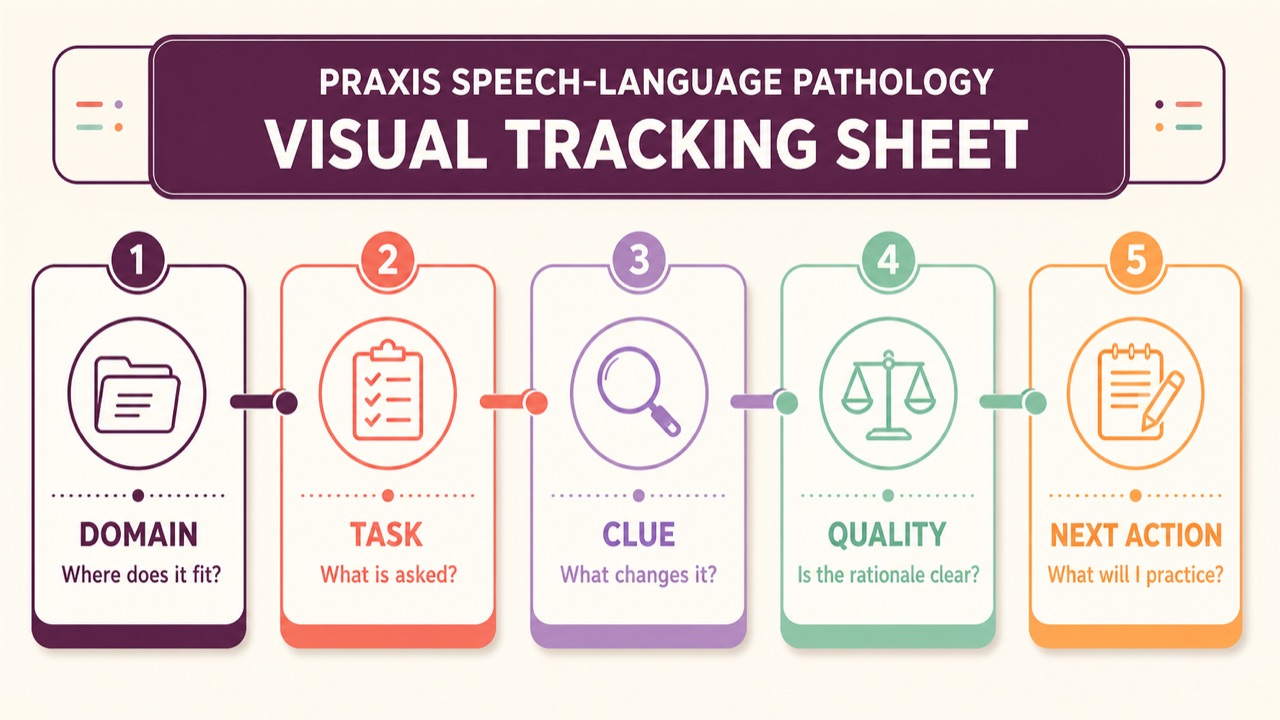
Build a free-question tracking sheet
A tracking sheet turns scattered free resources into a searchable record. The point is not to collect every link. It is to know which question exposed a gap, which explanation helped, and what you will do before the next practice block.
| Field | Example | Next use |
|---|---|---|
| Source | Provider, title, and date viewed. | Recheck or discard. |
| Domain | Evaluation or treatment. | Balance the week. |
| Task | Best measure or next step. | Group similar decisions. |
| Decisive clue | Setting-specific performance. | Practice evidence marking. |
| Explanation quality | Clear, partial, or unavailable. | Choose review depth. |
| Distractor type | Wrong sequence or context mismatch. | Schedule a repair. |
| Next action | Redo a changed case. | Test transfer. |
Use short tags such as task-reading, sequence, missing-information, measurement, functional-fit, and professional-response. A tag should describe the reasoning repair, not claim that one item covers an entire topic.
Review the sheet at the end of the week. Repeated tags matter more than one percentage. If context mismatch appears several times, choose new questions that change the setting. If explanations are weak, use the free set for warm-up and move the rationale work to a source with clearer support.
Question 1: evaluation and functional context
Question 1: An elementary student follows one-step classroom directions but often misses the second part of a multi-step direction. The teacher reports that performance drops during group activities with more language and distractions. Which action best gathers information for planning the next evaluation step?
- A. Administer an articulation screening only.
- B. Collect a language sample or functional observation across relevant classroom conditions.
- C. Begin oral-motor exercises before gathering additional information.
- D. Recommend an augmentative communication system immediately.
Correct Answer: B. Collecting a language sample or functional observation across relevant conditions can clarify how language load, setting, and distractions relate to the described difficulty. The action is connected to the planning question because it gathers information before a narrower intervention decision is made.
Why the Other Options Are Wrong: A focuses on articulation even though the described concern involves following multi-step language in context. C jumps to an intervention without establishing the relevant target. D may be considered only after a broader communication assessment and functional need are understood, so it is premature for this question.
Exam Trap: Do not confuse a noticeable performance problem with a confirmed disorder target. The teacher’s observation is important evidence, but the question asks what information to gather next. A functional observation can connect the reported difficulty to context without assuming a cause.
Question 2: treatment implementation
Question 2: A client is working on producing a target sound in structured words, and accuracy is improving in the clinic. The client has not yet used the sound reliably during classroom conversation. Which next step best checks whether the skill is becoming functional?
- A. Keep increasing drill repetitions without changing the communication context.
- B. Collect a brief sample in a relevant classroom-like interaction and compare performance with the stated goal.
- C. Replace the target immediately because clinic accuracy has improved.
- D. Stop collecting data because structured accuracy demonstrates transfer.
Correct Answer: B. A relevant interaction sample can show whether the skill carries into a context that resembles the stated functional goal. Comparing the sample with the goal keeps the decision connected to transfer rather than assuming that structured performance and participation performance are identical.
Why the Other Options Are Wrong: A may provide more practice but does not answer whether the skill transfers. C changes the target without checking the contextual difference. D treats structured accuracy as proof of transfer even though the case specifically identifies a gap between clinic and classroom performance.
Exam Trap: Separate acquisition from generalization. When a stem contrasts structured performance with functional use, choose the option that measures the target in the relevant context before deciding that the plan has transferred.
Question 3: professional practice
Question 3: A student asks for a copy of a paid preparation resource that another candidate purchased. The student says that sharing it would make study more affordable. Which response best fits a professional and responsible preparation approach?
- A. Share the complete resource because the purpose is educational.
- B. Decline to distribute the paid material and suggest legitimate public or licensed preparation options.
- C. Post the resource anonymously so that no person is identified.
- D. Reproduce the answer explanations while changing the title page.
Correct Answer: B. Declining to distribute material that is not licensed for sharing and directing the student to legitimate public or licensed options respects the resource boundary while still supporting preparation. The response addresses the practical need without treating access as permission to reproduce.
Why the Other Options Are Wrong: A ignores the ownership and license issue. C changes attribution but not the permission problem. D still reproduces protected material even if the title page is changed. The educational purpose does not remove the need to use a legitimate source.
Exam Trap: A helpful intention does not settle a professional responsibility question. Read the requested action, identify the boundary, and choose a response that offers a lawful and practical alternative rather than simply endorsing or condemning the person.
Read explanations after you commit
Answer the free set before opening the explanation. Record the letter, confidence, task, and decisive clue. Then compare your rationale with the available explanation. This order lets you see whether you knew the answer, recognized it after reading, or selected it for a reason that does not transfer.
| Result pattern | What it may mean | Review response |
|---|---|---|
| Correct and clear | Task and evidence aligned. | Test a changed case. |
| Correct but uncertain | Recognition exceeded explanation. | Write the decision rule. |
| Wrong with clear rationale | Knowledge or evidence gap. | Review the narrow gap. |
| Wrong with vague rationale | Task or comparison process gap. | Redo the item untimed. |
| Unclear answer key | Resource limitation. | Verify or set aside. |
Use the explanation as a conversation with the stem. Ask which sentence in the rationale is supported by which detail. If you cannot make that connection, the issue may be the resource rather than your knowledge. Mark the uncertainty and seek a responsible source before expanding the rule.
After review, change one surface detail in your own note. Alter the setting, partner, stage, or functional goal and ask whether the answer would change. This transfer prompt keeps the practice from becoming a memory test for a single free question.
Avoid low-quality free-question traps
Free resources can look polished while offering little review value. Watch for items that use vague stems, answer choices from different categories, unsupported clinical claims, or explanations that repeat a definition without addressing the decision. Label the limitation instead of letting it quietly shape your study rule.
| Trap | Warning sign | Safer response |
|---|---|---|
| Outdated detail | Old logistics presented as current. | Check ETS directly. |
| Unclear scope | No subject or exam code. | Use as general practice only. |
| Letter-only key | No reasoning or distractor review. | Write a limited note. |
| Overconfident claim | Promises about results or exact coverage. | Disregard the promise. |
| Copied-looking item | Secure-content language or attribution gaps. | Choose legitimate original material. |
One weak item does not make every item unusable, but it should change your trust level. Use a questionable set for reading practice only if that role is clear, and keep its claims out of your official exam notes. A study tool should not create uncertainty about the source of a fact.
Be cautious with answer choices that contain several absolute words or broad promises. The better option is usually determined by the task, evidence, sequence, and context rather than by a dramatic phrase. Return to the case before treating tone as evidence.
Use free questions across Praxis domains
The ETS 5331 scope includes broad areas such as foundations and professional practice, screening and evaluation, and planning, implementation, and evaluation of treatment. Use free questions across these areas, while remembering that a small resource cannot establish the future distribution of items.
| Study area | Question lens | What to record |
|---|---|---|
| Foundations and professional practice | What response fits role and responsibility? | Boundary and context. |
| Screening and evaluation | What information or measure answers the decision? | Evidence and sequence. |
| Treatment planning | What action matches the target and condition? | Functional fit. |
| Implementation | What change makes the plan usable? | Partner and setting. |
| Treatment evaluation | What result should be reviewed? | Response and transfer. |
Pair a domain tag with a reasoning tag. A question can be about treatment and still test missing information, sequence, or professional communication. Dual tags make your practice plan more precise than a list organized only by disorder label.
Check the current ASHA 5331 content page for the responsible content outline, then use your free-question tracker to identify personal gaps. Do not infer current administration details from a free resource when ETS is the responsible source.
Create a seven-day free-question cycle
A seven-day cycle can use free material without making every day identical. Start with screening and untimed reasoning, add targeted review, then use a small timing check. End with a source and gap review so the next cycle is based on evidence from your own work.
- Day 1: screen two resources and choose one reasoning target.
- Day 2: complete a short untimed set and write rationales.
- Day 3: review the closest distractors and tag the errors.
- Day 4: study the narrowest repeated gap.
- Day 5: answer a changed-case set to test transfer.
- Day 6: run a small light-timing block.
- Day 7: summarize patterns and choose the next source.
The schedule can be compressed or expanded. Its value is the sequence: screen, answer, explain, repair, and transfer. If a free set offers no usable explanation, place it in a warm-up slot and reserve the review slot for material that supports a rationale.
Track pace and reasoning separately. A faster block is not automatically a better block if it increases unsupported guesses. Use timing to identify where reading or comparison slows you, then practice that step directly.
SLP Praxis free questions checklist
Use this checklist before you count a free-question session as complete.
- I confirmed the item is labeled for Speech-Language Pathology (5331) or marked it as general practice.
- I recorded the provider, title, and date viewed.
- I chose a purpose: warm-up, review, distractor practice, transfer, or timing.
- I answered before opening the explanation.
- I marked the decisive evidence and the final request.
- I checked whether the rationale connects the answer to the case.
- I explained why the closest distractor is weaker.
- I tagged the reasoning gap or uncertainty.
- I selected one specific next action.
- I verified changing administration details on the live ETS source.
Free access should make disciplined practice easier, not make review optional. If the set is short, use the extra time to improve the rationale record. If the answer key is limited, lower the trust level and choose a better-supported source for clinical review.
Sources and next steps
Use the live ETS Speech-Language Pathology (5331) page for current exam identity, format, duration, question count, and changing test information. Use the ETS practice-test selector to locate current preparation options, and use ASHA preparation guidance to shape practice around strengths and weaknesses.
Next, screen one free resource, choose a small purpose-driven set, and write one rationale plus one distractor note for each item. Use your tracker to select a single repair action, then test that repair in a changed case rather than repeating the same wording.
For a structured preparation path, see the SLP Study Center Complete Prep resource. Keep independent practice claims separate from official administration instructions, and revisit the responsible ETS page before relying on a new date, delivery detail, or preparation resource.