
slp praxis exam date planning starts with a deadline and ends with a date that you can realistically support. An open appointment is not automatically a good appointment. You need enough time for current-scope review, application practice, school or clinical responsibilities, score reporting, and any recipient or licensing step that follows.
Use the live ETS registration flow for the dates and delivery options actually available to you. ETS currently identifies Speech-Language Pathology 5331 as a computer-delivered, selected-response exam with a 150-minute test length. This guide gives you a decision process for comparing dates; it does not decide your eligibility or replace the current instructions in your Praxis account.
What good exam-date planning must fit
A date decision has more parts than the appointment itself. You are matching an exam date to preparation capacity, a required score or application deadline, the reporting date shown by ETS, the delivery method you can use, and a backup plan if ordinary life interrupts the calendar. Write those parts down before choosing the first slot the search screen offers.
The current ETS registration page says candidates review test availability, choose at-home or test-center delivery when available, and select a preferred date and time slot. The current test-center page also says availability varies by exam and that real-time locations and time slots appear in the registration process. Use the live account for your actual options rather than a general availability claim.
- Preparation: how much focused review and application practice can fit before the date?
- Deadline: when must a school, state, agency, or certification pathway receive or process the result?
- Reporting: what score-reporting date does ETS show for the selected test and delivery method?
- Logistics: can you meet the check-in, identification, equipment, location, or travel requirements?
- Buffer: what space remains if a class, placement, illness, or appointment change affects the plan?
A date is strong when the plan still works after a normal difficult week. If one missed study session makes the entire runway collapse, the date may be too early for your current capacity.
Start with the deadline that controls you
First identify the deadline with the greatest consequence. It may be a graduate-program milestone, an application cycle, a state licensing step, an employer onboarding requirement, or a certification submission. Ask the organization whether it needs the exam completed, the official score reported, or the score matched to an application by that date. Those are different events.
Write the deadline in the time zone and format used by the receiving organization. Then confirm the required score, test code, documentation, and delivery route. ASHA explains that the Praxis is part of the certification pathway, while states determine their own licensure and teacher-credentialing requirements. Your date must respect the pathway you are actually pursuing.
| Deadline question | Why it matters | Record to save |
|---|---|---|
| What must be complete? | Testing, score release, submission, and processing are not identical. | Written instruction from the organization. |
| Which test is required? | A date for the wrong test does not solve the application task. | Test name and code, including 5331 when confirmed. |
| Who owns the requirement? | ASHA, a state, a school, and an employer can differ. | Agency or program contact and page date. |
| How much buffer is needed? | Reporting and internal matching may take separate time. | Personal target date before the official deadline. |
| What is the consequence of missing it? | The answer changes how conservative your date choice should be. | Written policy or support answer. |
If no one can give you a clear processing timeline, choose an earlier personal target and ask the office how it handles a report that arrives close to the deadline. Keep the answer with your appointment record.
Build your exam-date decision map
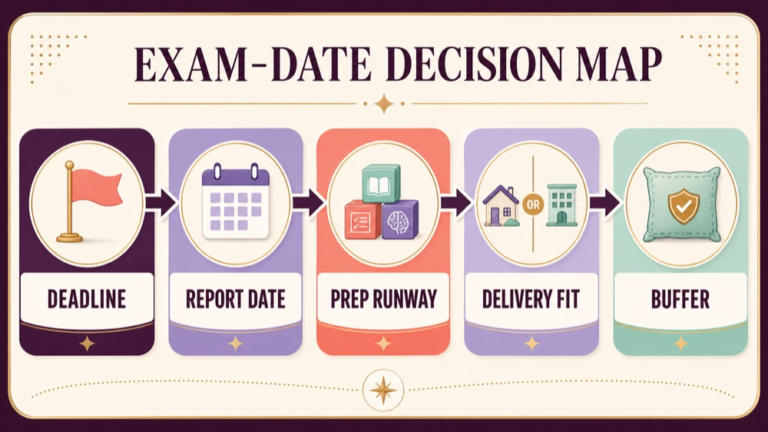
Use a short decision map before you compare calendar slots. Begin with the application or score deadline, subtract the time needed for the report to be available and processed, then reserve a final review period and a preparation runway. Only after that should you compare appointment dates and locations.
Do not treat the map as a rigid mathematical formula. It is a way to expose hidden dependencies. If you need testing accommodations, the approval and scheduling process may need to begin earlier. If you are choosing a retake after a completed attempt, the current ETS same-test waiting rule may change the earliest permissible date. If you missed an appointment, the current missed-test instructions are a different branch.
- Name the exact Praxis test and current code required by your pathway.
- Record the application, score, or school deadline that controls the decision.
- Check the ETS score calendar for the selected test and delivery method.
- Reserve time for official-report access and the receiving organization’s matching process.
- Count backward to create a preparation start date and final review date.
- Compare available appointments only after the earlier steps are visible.
- Save the appointment and the date-specific confirmation in your private record.
If no appointment satisfies the full map, do not hide the conflict. Ask the program, agency, or ETS which condition can change and what documentation it needs. A date chosen without that clarification can create a larger problem than a delayed booking.
Count backward from the date
Once you have a candidate date, build the calendar backward in phases. The first phase establishes the current scope and a baseline. The middle phases repair concepts and practice new case decisions. The final phase integrates the blueprint, uses timed practice, checks logistics, and protects recovery. The length of each phase depends on your baseline and weekly capacity.
Count study blocks, not only weeks. A seven-day week with three usable blocks is different from a seven-day week with ten. Put fixed school, clinical, work, and caregiving commitments on the calendar first. Then place the minimum repeatable study rhythm. If the plan needs every remaining evening, use a later date or reduce the scope of each session.
| Backward phase | Purpose | Checkpoint |
|---|---|---|
| Final days | Source, appointment, identification, delivery, and recovery check | All open logistics questions have an owner. |
| Final practice | Mixed and timed application with error review | Timing and reasoning patterns are visible. |
| Repair cycle | Targeted content review plus new cases | Repeated errors are shrinking or clearly defined. |
| Orientation | Current ETS scope, baseline, and study-map setup | First targets and weekly blocks are scheduled. |
| Before the runway | Confirm the date, deadline, delivery, and support needs | The selected appointment is compatible with the pathway. |
Use the current ETS Study Companion and test page for the content map. The calendar tells you when to work; the official scope tells you what belongs in the work.
Compare delivery and location constraints
When the same test offers different delivery choices, compare the full experience rather than choosing only by convenience. At-home testing may require a suitable environment and equipment that meet current instructions. A test center may require travel, a specific check-in time, and a route plan. Availability, accommodations, and support procedures may also differ.
Use the current ETS registration flow and test-center page to see the options tied to your account. Check the address, time, time zone, identification instructions, arrival or check-in expectations, and any equipment or room requirement shown for the selected mode. A date that looks good on a calendar can be poor if travel or setup makes the start stressful.
- Can you reach the test center with a predictable travel plan and backup route?
- If testing at home, can you meet the current environment, equipment, and check-in requirements?
- Does the selected mode align with an approved accommodation?
- Does the score calendar show a reporting date that fits the receiving deadline?
- Will school, work, or clinical duties make the selected time unusually difficult?
- What support channel will you use if the appointment or delivery details are unclear?
Save the confirmation after selecting the date and mode. Recheck the live instructions as the appointment approaches because logistics pages and account details can change.
Compare dates with a practical checklist

If two or three dates appear possible, score them with the same criteria. A simple comparison reduces the pull of the earliest available slot and makes the tradeoff visible. You do not need a complicated spreadsheet; five or six consistent questions are enough.
| Comparison factor | Date A | Date B | What to decide |
|---|---|---|---|
| Usable study blocks | Number of realistic blocks | Number of realistic blocks | Does the runway support repair and practice? |
| Score-reporting date | ETS calendar result | ETS calendar result | Which date leaves processing room? |
| Delivery fit | Home or center details | Home or center details | Which setting is workable and supported? |
| School or clinical load | Known conflicts | Known conflicts | Which date avoids the hardest week? |
| Recovery and buffer | Space for ordinary disruptions | Space for ordinary disruptions | Which plan can absorb a missed block? |
Choose the date that supports the whole pathway, not just the date that satisfies the first step. If the later date conflicts with a deadline, ask the receiving organization whether an earlier test with a smaller but still realistic runway is acceptable. Document the answer.
Leave a buffer for scores and next steps
Score reporting is part of date planning because the exam result may be needed after test day. The current ETS Getting Your Scores page says the official report is posted in the Praxis account on a score-reporting date that varies by test type and delivery method. It also provides a calendar tool and shows where a pending score report appears in the account.
Build at least two buffers in your personal plan: one before the test for preparation and logistics, and one after the test for official-report access and recipient follow-up. The right size depends on the deadline and the receiving office. Do not promise a school or agency a reporting date copied from a different appointment.
- Write the official deadline supplied by the organization.
- Check the ETS reporting date for the exact test, date, and delivery mode.
- Add time for your own account review and secure report saving.
- Ask the receiving office how it confirms or matches score information.
- Set a personal target earlier than the formal deadline when the pathway allows.
- Keep a follow-up action in the calendar rather than ending the plan on test day.
The buffer is also useful if you need to ask an administrative question. A calm question asked before the appointment is easier to resolve than an urgent request after the deadline has passed.
Understand change and retake boundaries
The current ETS Manage Your Praxis Test Appointment page says rescheduling must be completed at least three days before the scheduled test date, excluding the test day, and describes a current rescheduling fee. It separately describes cancellation, missed-test re-registration, and the 28-day waiting period for a completed retake of the same test. Because these rules carry financial and scheduling consequences, read the live page before changing an appointment.
A missed appointment and a completed test are not the same branch. ETS currently says a candidate who did not take the scheduled test may re-register through the account after the timing shown on the live page, while the 28-day rule applies to a completed attempt at the same test. Do not choose an earlier date by assuming which branch applies; confirm the appointment status first.
- Before booking: check availability, deadline, delivery, and preparation runway.
- Before changing: read the current rescheduling and cancellation timing and fee language.
- After a missed appointment: follow the current missed-test re-registration branch.
- After a completed attempt: apply the current same-test retake waiting rule.
- After any change: recalculate score reporting, recipient, school, and study-plan dates.
Policy details can change with the testing year or appointment type. Keep the date you checked the current source and save the new confirmation after any change.
Plan around school, clinical work, and accommodations
A strong date plan includes the weeks when your attention will be limited. Graduate exams, practicum evaluations, documentation deadlines, onboarding, travel, and family commitments can all compete with preparation. Put those events on the calendar before selecting a Praxis date, then look for a runway that includes ordinary recovery rather than only ideal study days.
If you need accommodations, begin with the current ETS accommodations process before selecting a date that depends on an approval. The appointment and support process may have its own lead time. Ask ETS or the responsible program when a general page does not answer your individual question, and keep the response with your appointment record.
- Mark high-load school and clinical weeks in a different color.
- Protect two or three repeatable study blocks instead of filling every open hour.
- Keep a short fallback task for weeks when a long session is not possible.
- Schedule a weekly reset to move unfinished work without doubling the next day.
- Place the logistics and recovery check before the final study session.
- Record support or accommodation questions early enough to receive an answer.
When the date is compatible with your real responsibilities, the calendar becomes a support system. When it depends on a perfect month, it is a risk signal worth revisiting.
Avoid common date-planning mistakes
Date errors often come from solving only the appointment problem. Candidates pick the first open slot, forget that score reporting follows test day, count a deadline from the wrong event, or assume a missed appointment follows the completed-test retake rule. Look for these patterns before you submit payment.
- Choosing the earliest slot without checking usable study blocks.
- Using a generic score-release expectation instead of the ETS date for the appointment.
- Ignoring the difference between test completion, score posting, and application processing.
- Planning around the state where you test rather than the state or agency that evaluates you.
- Leaving no room for a class, placement, illness, travel, or support question.
- Assuming at-home and test-center logistics are interchangeable.
- Changing an appointment without reading the current deadline and fee terms.
- Applying the 28-day completed-retake rule to an appointment that was never taken.
- Leaving accommodations or recipient questions until the final week.
The repair is a dated comparison: deadline, report date, preparation runway, delivery fit, and buffer. If the date still looks good after those checks, save the confirmation and build the study plan around it.
SLP Praxis exam date planning checklist
Before you finalize an SLP Praxis appointment, confirm:
- Did I identify the correct Speech-Language Pathology Praxis test and code?
- What does my program, state, agency, or certification pathway need, and by when?
- Did I check the ETS availability and score calendar for this exact test and date?
- How many realistic study blocks fit before the appointment?
- Does the delivery mode fit my location, equipment, check-in, and support needs?
- Does the date avoid my heaviest school, clinical, work, or travel conflicts?
- Did I reserve a final logistics and recovery window?
- Did I leave room for the official score report and recipient processing?
- Have I checked current change, cancellation, missed-test, or retake rules?
- Did I save the appointment confirmation and the date I checked the live policies?
The best exam date is the one that lets the full pathway work: prepare, test, receive the official result, and complete the required follow-up. Use the live ETS account for availability and current rules, and use your own calendar to make the decision sustainable.
Sources and next steps
Start with the current ETS registration process and ETS test-center guidance for appointment availability and delivery choices. Use ETS Getting Your Scores for the test-specific reporting date, and read ETS appointment management before rescheduling, canceling, or planning a retake. Confirm the current test identity on the ETS 5331 page and review ASHA’s Praxis context for pathway-specific timing.
Continue your preparation: Explore the SLP Study Center learning resources.
Continue your preparation: Explore the SLP Study Center learning resources.