
slp praxis 5331 practice question of the day works best as a small, repeatable learning routine. One original question can train several skills: identifying the decision verb, locating the decisive clue, checking language and access, comparing answer choices, explaining the rationale, and applying the rule to a changed scenario. The goal is not to create pressure around a daily streak; it is to make reasoning visible and reviewable.
Use the current ASHA Speech-Language Pathology 5331 content page for the professional study frame and the live ETS 5331 page for current exam identity and administrative details. The ASHA Practice Portal provides topic-specific clinical context. The question set, rationales, maps, and checklists below are original learning material, separate from live test material and not individualized clinical advice.
Because test information can change, use this page for a durable review loop rather than a frozen daily calendar or a promise about score outcomes. Pair current source checking with clinical reasoning: define the question, use the evidence, respect access and safety, and explain what you would review next.
What the SLP Praxis 5331 practice question of the day can teach
A daily question is small enough to complete consistently, but it should still contain enough information to practice reasoning. The useful unit is not “I got the letter right.” It is “I can explain which decision the stem asked for, which clue mattered, why the answer fits, why the alternatives fail, and how the rule changes when the context changes.”
| Daily stage | What to do | Output |
|---|---|---|
| Preview | Name the decision verb and predict which evidence should matter. | A one-sentence purpose before seeing the answer. |
| Read | Mark person, activity, setting, partner, language or mode, time course, and urgency. | A concise scenario spine. |
| Choose | Compare options for decision fit, evidence fit, access, safety, and sequence. | One best answer with a reason. |
| Explain | State why the selected option fits and why each distractor is weaker. | A transferable rule, not a letter. |
| Apply | Change one fact or context variable and solve a paired version. | Evidence that the rule transfers. |
| Schedule | Record the error category and set a short review date. | A targeted next question. |
Choose original questions that span assessment, treatment, professional practice, communication access, safety, and functional participation. Avoid using one domain as a substitute for the whole exam frame. A short question can still ask you to integrate multiple domains when the case includes language, partner, setting, or role details.
Build a small daily question routine
Keep the routine short enough to repeat and structured enough to produce evidence. A useful session can take ten to twenty minutes, depending on the question and the depth of the rationale. If you have more time, add a paired scenario instead of racing through more answer letters.
- Preview: read the title or topic and predict the decision you may need to make.
- Answer: read the stem once for the big picture, then reread for the person, activity, context, and boundary.
- Commit: choose an answer before reading the rationale, and mark your confidence.
- Explain: write the evidence for the best option and the error in each distractor.
- Transfer: change one variable such as language, partner, setting, support, urgency, or decision type.
- Schedule: record the error category and set a later review.
On a busy day, complete the answer and one-sentence rationale. On a longer study day, complete the full loop. Consistency matters because spaced retrieval gives you repeated opportunities to recognize the same reasoning rule in different wording.
Read the stem before the options
Answer choices can pull your attention toward familiar vocabulary. Read the stem first and write a compact scenario spine: person, activity, setting, partner, time course, evidence, decision, and urgency. Then look at the options. This makes it easier to notice when a choice repeats a technical word but does not fit the actual task.
| Stem field | Question to ask | Why it matters |
|---|---|---|
| Person | Who is communicating, eating, learning, working, or receiving care? | Strengths, priorities, health, and access vary by person. |
| Activity | What does the person need or want to do? | The functional goal controls the outcome. |
| Setting | Where and with whom does the pattern occur? | Noise, partner, routine, and demand can change performance. |
| Evidence | What is reported, observed, measured, or changed with support? | The answer must stay within the evidence. |
| Decision | What does the question ask you to clarify, assess, interpret, treat, refer, or monitor? | The verb determines the answer type. |
| Boundary | Is there an access, safety, competence, consent, privacy, or local-process clue? | The boundary may change the sequence. |
Do not add facts that the stem does not provide. If the case does not include hearing history, language history, or a safety protocol, you can identify that missing information as a reason for the next step, but you should not invent its result.
Mark the decisive clue
Not every detail in a question carries the same weight. A decisive clue often appears as a contrast: better in quiet than in noise, accurate with a cue but not in conversation, different across languages, changed after a health event, or risky after a new condition. It may also be a professional boundary: the procedure is outside competence, the person has not consented, or the local process requires a stop.
| Clue category | Examples | Next reasoning move |
|---|---|---|
| Decision verb | Clarify, screen, assess, interpret, treat, refer, document, or monitor. | What is the item asking you to do? |
| Functional target | Communication, swallowing, learning, work, care, safety, or participation activity. | Why does the decision matter? |
| Context | Language, dialect, mode, hearing, partner, environment, health, culture, fatigue, or time. | What changes interpretation or access? |
| Evidence | History, report, observation, measure, response to support, outcome, or policy. | What does the source actually show? |
| Boundary | Measurement limit, safety signal, competence, privacy, consent, or local requirement. | What must stay visible? |
| Next step | Assessment, support, treatment, collaboration, referral, documentation, or review. | What action is proportionate now? |
Underline the contrast and write “because” after it. For example: “The student performs differently in noise because the next step must examine hearing and classroom access.” Or: “The target improves with a cue but participation does not because practice needs transfer conditions and outcome data.” The word “because” forces you to connect the fact to the action.
Explain the answer instead of memorizing a letter
A rationale should answer four questions: What decision is being made? Which fact makes the selected option fit? Why do the alternatives fail for this case? What rule transfers to a new case? The explanation can be brief, but it should be specific enough that you could recognize the rule without seeing the original wording.
| Rationale part | Sentence starter | Quality check |
|---|---|---|
| Decision | The question is asking for… | Did I answer the requested verb? |
| Evidence | The decisive clue is… | Did I use a fact from the stem? |
| Fit | The best option fits because… | Did I connect evidence to action? |
| Distractors | The other options are weaker because… | Did I name the missing or unsafe step? |
| Boundary | This does not establish… | Did I avoid a broad conclusion? |
| Transfer | If the context changed to…, I would… | Can I apply the rule again? |
Use “correct but lucky” as an error label when your answer was right but your rationale was weak. That label is not a criticism; it is a prompt to revisit the evidence and write a rule. It helps distinguish recognition from durable understanding.
Use error categories to plan tomorrow
Do not respond to a missed item by rereading everything. Identify the error category, then choose the next review that targets it. A learner may miss a treatment question because the activity was not identified, or miss an assessment question because a language-access condition was ignored. The domain name alone is not specific enough.
| Error category | What happened | Tomorrow’s repair |
|---|---|---|
| Question reading | Answered a different verb or missed the requested decision. | Underline the action word before reviewing content. |
| Evidence | Ignored a condition, report, score limit, or contrast in the stem. | Write the decisive clue and what it supports. |
| Access | Treated language, mode, hearing, environment, or partner as background. | Ask how the person could show the skill. |
| Sequence | Chose a later treatment or conclusion before clarification or safety. | Place the action in the correct order. |
| Function | Selected a narrow task without connecting it to participation. | Name the activity and outcome. |
| Professional boundary | Ignored consent, privacy, competence, supervision, or handoff. | State the role and continuity requirement. |
| Transfer | Could explain the original wording but not a changed case. | Change one variable and solve again. |
| Confidence | Changed a defensible answer because of vague doubt. | Record evidence for and against each option. |
Use a small rotation: question reading, evidence, access, sequence, function, professional boundary, transfer, and confidence. After several days, look for repeated categories. That pattern is more actionable than a single daily percentage.
Keep access, safety, and professional context visible
Daily practice should not train you to ignore context. Check language, dialect, culture, communication mode, hearing, vision, motor access, technology, partner, environment, health, fatigue, consent, privacy, competence, supervision, and local protocol when the scenario includes them.
The ASHA Multilingual Service Delivery resource supports attention to language history, exposure, use, dialect, access, and collaboration. The ASHA Cultural Responsiveness resource supports reflective, accessible, person-centered interaction. Use the current ASHA Practice Portal topic for clinical context rather than turning one rule into a universal shortcut.
- Ask whether the person had an accessible way to show the skill.
- Separate a communication difference or access barrier from a disorder conclusion.
- Keep the person’s goal, preference, language, culture, and partner visible.
- Pause for a safety clue or local stop rule.
- Check role, competence, consent, privacy, supervision, and handoff needs.
- Document what the scenario supports and what remains uncertain.
These checks are not extra points added after the answer. They are part of selecting the answer that best fits the case.
Use spaced review and transfer
Return to a missed or low-confidence question after a delay. On the second attempt, cover the rationale and solve it from the evidence. On the third attempt, change one variable. Spacing and transfer tell you whether the reasoning rule is usable beyond the original phrasing.
- Review the original item after one day without looking at the answer.
- Explain the decisive clue and the strongest distractor.
- Change one context variable and write the new best next step.
- Review again after several days and compare your confidence.
- Move the rule into a different domain, such as assessment to treatment or treatment to professional handoff.
For date-sensitive exam facts, use the live ETS and ASHA pages each time you update the note. For durable reasoning rules, keep the wording general enough to survive a change in format or administrative detail.
Use the One-Question Review Loop
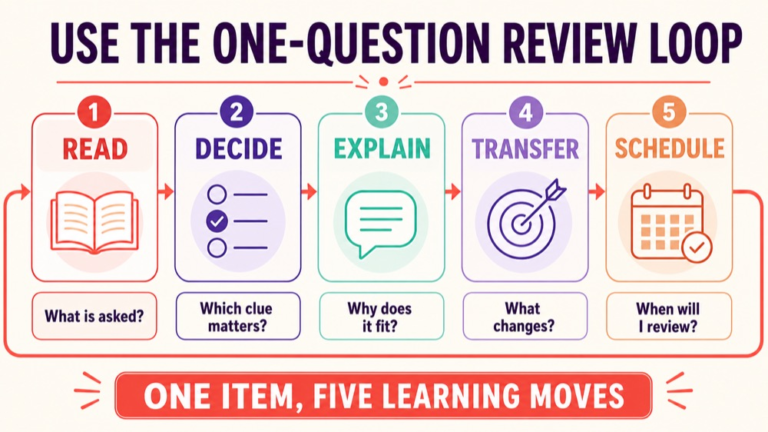
Use the loop shown in the map: read, decide, explain, transfer, and schedule. Add the person, activity, context, and boundary to your notes when the question includes them. A daily item becomes a useful snapshot of your study process—not a prediction of a reported exam result.
| Loop step | Write | Result |
|---|---|---|
| Read | Decision verb and scenario spine. | A clear question. |
| Decide | Answer and confidence before rationale. | A committed choice. |
| Explain | Evidence, fit, distractor error, boundary. | A defensible rationale. |
| Transfer | One changed variable and revised action. | A portable rule. |
| Schedule | Error category and review date. | A targeted next session. |
If you cannot complete the transfer step, return to the context. Often the missing element is language, partner, setting, support level, urgency, or decision verb.
Turn One Answer Into Transfer Practice
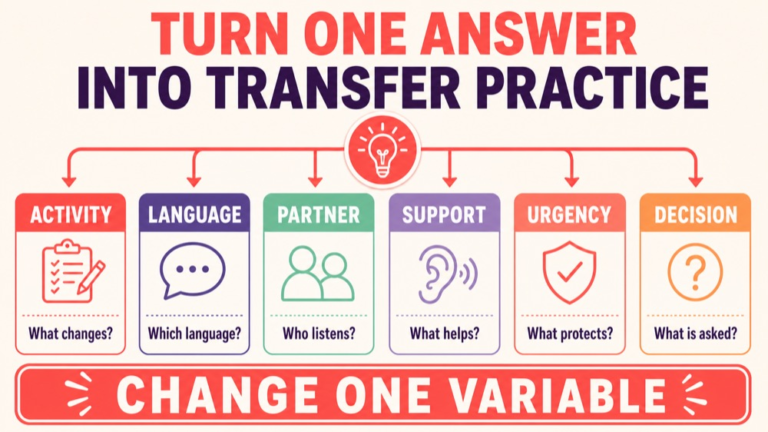
One answer can generate several new questions. Change the activity, language, partner, setting, support, health condition, or professional role. Keep the core evidence stable when you want to study context; change the decision verb when you want to study sequence.
| Change one field | New question | What you learn |
|---|---|---|
| Activity | What if the same skill is needed for work rather than class? | How function changes the outcome. |
| Language | What if the person’s strongest language is not the language of the task? | How access changes interpretation. |
| Partner | What if the listener is unfamiliar or needs training? | How partner conditions affect transfer. |
| Support | What if a visual cue or device is available? | How support changes opportunity and data. |
| Urgency | What if a safety signal appears during the task? | How sequence and handoff change. |
| Decision verb | What if the question changes from assess to treat? | How the same evidence serves a new decision. |
Write the answer in your own words. Do not try to manufacture a harder or more dramatic scenario. The point is to practice how evidence and context alter the action.
Question 1: a daily assessment decision
Practice Question 1. A child follows a short direction in a quiet room but misses multi-step directions during a noisy classroom transition. The teacher requests “a language test today.” What is the best daily-practice answer to the next-step question?
- A. Administer the longest language test immediately because the teacher requested it.
- B. Conclude that the child has a receptive-language disorder from the classroom report.
- C. Clarify the classroom demand, review hearing and language context, observe the routine, and select targeted assessment or access supports that answer the refined question.
- D. Use the quiet-room direction task as the final decision because it is easier to control.
Correct Answer: C. The contrast between quiet individual work and noisy multi-step directions is the decisive clue. The next step should clarify the construct and examine hearing, language load, visual support, partner behavior, and classroom conditions before a broad conclusion or test choice.
Why the Other Options Are Wrong: A follows the requested tool before defining the question. B turns a context-sensitive report into a global conclusion. D uses the least representative condition as the final answer. C uses the clue to choose proportionate evidence and support.
Exam Trap: The request for a test is not the same as a clearly defined assessment question. Find the condition that changes performance.
Question 2: a daily treatment decision
Practice Question 2. An adult’s speech target is more accurate during structured practice with a visual cue, but the adult still avoids phone calls at work. Which daily-review answer best links treatment data to the functional goal?
- A. Count the structured accuracy gain as evidence that the work goal has been met.
- B. Remove the visual cue immediately so the next session measures independence only.
- C. Add supported practice for relevant phone tasks and listeners, record cueing and effort, and monitor both target performance and work participation.
- D. Replace the work goal with a different speech target without reviewing the phone activity.
Correct Answer: C. The structured gain is useful, but the unchanged phone participation shows that the functional outcome and conditions still need attention. The plan can keep an effective visual support while adding meaningful practice and recording the factors that guide adaptation.
Why the Other Options Are Wrong: A treats a narrow measure as the entire outcome. B removes access before checking how support can be adapted or faded. D changes the target without resolving the activity named in the goal. C connects target, support, practice, and participation.
Exam Trap: A correct answer can include both keeping a support and adding a harder transfer condition. Do not confuse support with failure.
Question 3: a daily professional-practice decision
Practice Question 3. During a facility-approved swallowing screen, the patient becomes less alert and develops a new vocal change after a trial. The local process requires the screen to stop and the team to be notified. Which answer best reflects professional reasoning?
- A. Continue with more trials so the clinician can reach a detailed physiologic conclusion.
- B. Record the earlier trial as the final result and continue the meal.
- C. Stop under the local process, communicate the change, document conditions and response, and arrange qualified comprehensive follow-up.
- D. Ask an untrained support person to complete the remaining trials.
Correct Answer: C. The new alertness and vocal change are risk information within the stated process. The safe next step is to stop, communicate, document, and connect the patient to the qualified follow-up that answers the larger question.
Why the Other Options Are Wrong: A ignores the stop instruction and expands a screen into a different evaluation. B treats earlier performance as the final result after conditions changed. D transfers a safety-sensitive task without appropriate competence or oversight. C follows the process and protects continuity.
Exam Trap: When a daily item includes a local stop rule, it is testing sequence and handoff, not how many extra observations you can collect.
Review common daily-practice shortcuts
Short routines can create shortcuts if you only count completion. Use the table to notice what to repair.
| Shortcut | Why it feels efficient | Repair |
|---|---|---|
| Streak over reasoning | A completed question feels like progress. | Require one evidence sentence and one transfer sentence. |
| Letter memory | The correct option is easy to recognize later. | Cover the answer and reconstruct the rule. |
| Speed over reading | More items fit into the session. | Slow down for the decision verb and decisive clue. |
| Score chasing | A percentage gives a simple trend. | Track error categories, confidence, and transfer. |
| One domain only | Familiar content builds comfort. | Rotate assessment, treatment, access, safety, and professional practice. |
| Rationale copying | The explanation is already written. | Write the reason in your own words first. |
| No changed case | The original answer feels mastered. | Change one context variable. |
| Current-fact drift | An old note stays convenient. | Recheck live ASHA and ETS pages when updating dates or format. |
A daily question is successful when it strengthens the quality of your next decision, not only when it adds one more completed item.
Build a seven-day question cycle
A weekly cycle can organize variety without making a permanent claim about the exam. Adjust it to your schedule and current blueprint review.
- Day 1: assessment purpose, referral question, and measure fit.
- Day 2: language, culture, communication mode, hearing, or access.
- Day 3: treatment goal, method, cueing, and functional outcome.
- Day 4: screening, safety, stop rules, and referral.
- Day 5: professional practice, consent, privacy, competence, and collaboration.
- Day 6: a cross-domain scenario with a changed context.
- Day 7: delayed review of misses, low-confidence answers, and transfer rules.
Use the current ASHA and ETS source pages to decide which content needs more attention. The rotation is a study structure, not a claim about domain weighting or test item distribution.
Track the daily loop
Use a compact table or note with one row per question. Include the decision, decisive clue, answer, confidence, error category, and transfer result.
| Field | Example | Why keep it |
|---|---|---|
| Decision | Choose assessment evidence for a classroom concern. | Keeps the question specific. |
| Clue | Performance changes between quiet and noisy settings. | Shows why context matters. |
| Answer | Clarify, review access, observe, then select targeted evidence. | Records the action in your own words. |
| Confidence | 54% before rationale; 88% after explanation. | Shows recognition versus certainty. |
| Error category | Evidence and access. | Targets the next review. |
| Transfer | Changed the partner and kept the access check. | Tests portability. |
| Review date | Three days later. | Creates spacing. |
Review correct but low-confidence answers and incorrect answers that felt easy. Both can reveal a study need. Keep the note focused on reasoning, not self-judgment.
Practice question of the day checklist
Use this checklist before closing the daily session. It is a study aid, not a substitute for current ASHA guidance, ETS information, local requirements, supervision, or individualized clinical judgment.
- Did I identify the decision verb?
- Did I name the person, activity, setting, partner, language or mode, and urgency?
- Did I mark the decisive clue or contrast?
- Did I separate observation, report, measure, interpretation, and action?
- Did I check communication access, language, culture, hearing, environment, and support?
- Did I notice safety, consent, privacy, competence, supervision, or handoff boundaries?
- Did I explain why the best option fits the evidence?
- Did I explain why each distractor is weaker for this case?
- Did I state what the answer does not establish?
- Did I change one variable and practice transfer?
- Did I record the error category and schedule spaced review?
- Did I use current sources for any date-sensitive exam or professional detail?
The daily loop is: read, decide, explain, transfer, schedule. Keep it small enough to repeat and specific enough to teach you something. Treat each response as a study snapshot: it shows how you handled one item under one set of conditions, and it gives you a reason to choose the next review rather than a reason to make a broad judgment about your preparation.
Sources and next steps
For current Praxis context, review the ASHA Speech-Language Pathology 5331 content page and the current ETS 5331 page. For clinical topics, use the relevant ASHA Practice Portal guidance. For language and cultural context, review ASHA Multilingual Service Delivery and ASHA Cultural Responsiveness.
For current preparation-resource context, use the live ETS practice-test page. The questions, rationales, maps, and checklists here are original educational material, separate from live test material. Recheck live sources before relying on an administrative, scoring, or professional requirement.
For your next session, choose one missed question, write its evidence sentence, change one context variable, and solve the paired version. Then add the rule to your review log.
Continue your preparation: Explore the SLP Study Center learning resources.