
An SLP data collection sheet is useful when it helps a team notice a communication pattern and make a practical next decision. The sheet itself is not the intervention. It is a way to record what happened, under what conditions, with what support, and what may need to change.
This guide explains how SLPs, educators, and caregivers can design or use a simple data sheet for speech, language, AAC, social communication, and participation goals. It focuses on information that can be collected consistently without interrupting the learner’s interaction. A qualified SLP should select measures that fit the learner, the goal, the setting, and the team’s responsibilities.
Table of Contents
- What an SLP data collection sheet should do
- Start with a question, not a blank form
- The four fields that make data useful
- A practical observe, record, and decide routine
- Examples across communication goals
- Access, consent, and respectful data collection
- Reviewing data and planning the next step
- Common mistakes and FAQs
What an SLP Data Collection Sheet Should Do
A useful sheet turns an observation into information the team can act on. It can help answer questions such as:
- Did the learner initiate more often during a familiar routine?
- Which support helped the learner respond or repair a message?
- Did a speech sound become more consistent in a phrase or conversation?
- Can the learner use a language skill with a new partner or material?
- Which communication modes did the learner use to participate?
The form should be quick enough to use while the interaction is happening. If a sheet requires so many boxes that the adult stops responding to the learner, it is collecting data at the expense of communication. A short, defined sample can be more useful than a long record with inconsistent definitions.
Data should also represent the learner’s strengths and access needs. Record successful messages, effective supports, and communication across modes rather than counting only spoken answers or errors. A learner may communicate through speech, gesture, sign, writing, AAC, eye gaze, or combinations of modes.
Start With a Question, Not a Blank Form
Before choosing columns, write the decision the data should support. For example:
- “Should we keep the visual choice available during snack?”
- “Is the learner ready to move from single words to short phrases?”
- “Does the learner need a model, or is wait time enough?”
- “Does the story retell structure transfer to a personal event?”
The question determines what to record. If the question is about independence, count independent opportunities and prompt levels. If it is about generalization, record the partner, setting, material, or routine. If it is about speech sound practice, define the word position and speaking context.
Avoid adding a field simply because it appears on another form. Every field takes attention and time. Keep the sheet focused on the target behavior and the information needed to decide what happens next.
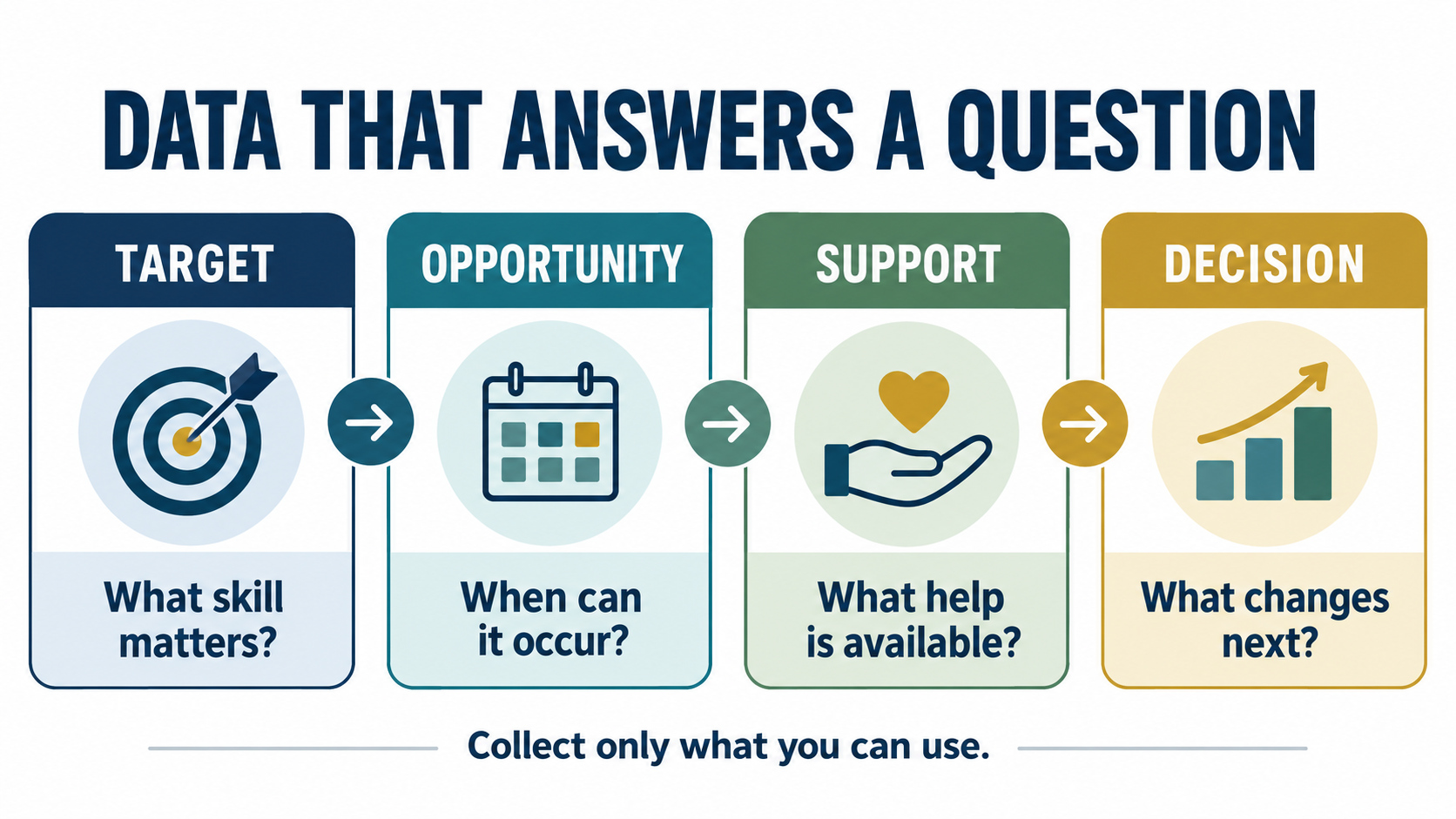
*A focused sheet connects the target, the opportunity to observe it, the available support, and the next decision.*
The Four Fields That Make Data Useful
1. Target
Define the behavior in observable language. “Improve communication” is too broad. A target might be “initiates a request,” “answers a where question,” “repairs a misunderstood message,” “produces the selected sound in initial word position,” or “retells three events in order.”
Include what counts as a response. Decide whether a gesture, AAC selection, spoken word, written message, or combined message qualifies. If the team has not defined the response, two adults may record the same interaction differently.
2. Opportunity
Describe when the behavior could occur. An opportunity might be a choice, a turn in a game, a question during shared reading, a classroom direction, a communication breakdown, or a planned speech-sound attempt. Count only opportunities that are reasonably available to the learner.
Record the routine, partner, material, or setting when that information matters. “Five opportunities in therapy” may not tell the team whether the skill works during recess, a group lesson, or a home routine.
3. Support
Record the type and level of support. The learner may receive a model, visual cue, gesture, verbal cue, wait time, choice, environmental arrangement, or physical access support. Use consistent labels that the whole team understands.
Support is not a failure. It describes the conditions under which participation was possible. A learner who communicates accurately with a visual may be showing a successful access pattern, not a deficit that should be erased from the record.
4. Decision
State how the information will be used. Possible decisions include continuing the target, changing the material, fading a prompt, increasing practice in another setting, adding access support, or asking for more assessment. A sheet becomes more useful when the team can look back and see which decision followed the observation.
A Practical Observe, Record, and Decide Routine
Observe without interrupting the message
Set up the routine so the communication opportunity is real. Keep the learner’s materials and communication system available. Watch what the learner does before adding a prompt. Note the message, the partner’s response, and what changed next.
Record a small defined sample
Choose a short window or a fixed number of opportunities. Use tally marks, quick codes, or a short note. If the learner is telling a story, record whether the target elements appeared and what support was needed. If the learner is using AAC, record the communication function and mode rather than only the number of selections.
Decide while the information is still useful
Review the sample soon enough to adjust the next routine. Ask whether the target was meaningful, whether the support was accessible, and whether the measure matched the question. If the answer is unclear, revise the form before collecting a larger set of data.
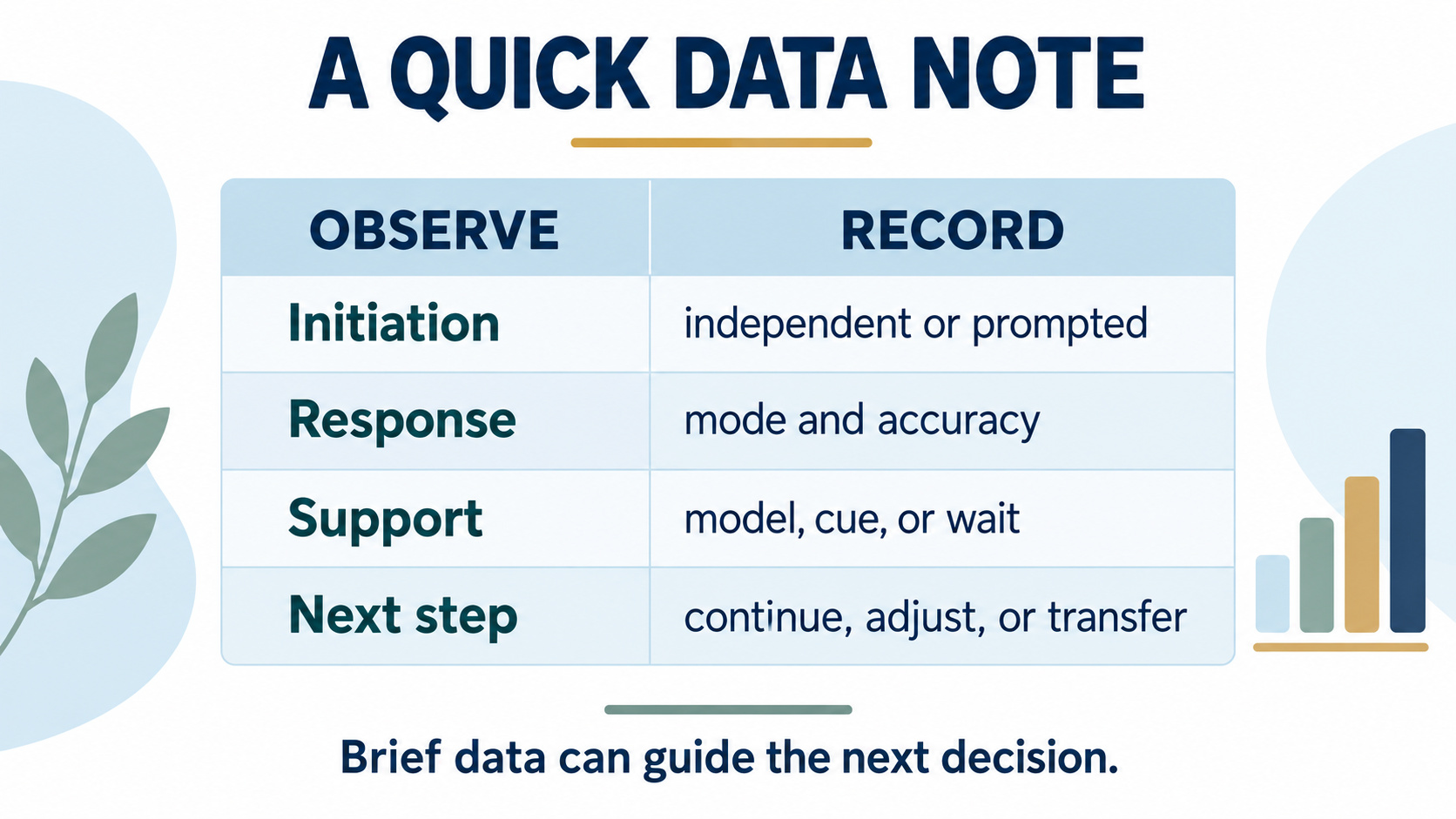
*A short note can capture initiation, response, support, and the next decision without replacing the interaction.*
Examples Across Communication Goals
Speech sound production. Record the target sound, word position, task, production, and cue level. A note might distinguish single words from phrases and familiar practice from conversation. Consider linguistic and dialect differences before labeling a production as incorrect.
Language comprehension. Record the direction or question, the response mode, the level of support, and whether the learner demonstrated understanding in a real routine. If a question is repeated, mark that change rather than treating all opportunities as identical.
Expressive language and narrative. Record the communication function, message content, organization, and listener support. For a story retell, track who, where, action, result, sequence, or repair according to the target—not every possible story element at once.
Social communication. Track initiation, response, topic maintenance, turn-taking, clarification, repair, or closure as relevant. Avoid reducing social communication to eye contact or one preferred interaction style. Record the partner, context, and whether the exchange was meaningful to the learner.
AAC and multimodal communication. Record the message function, mode, access conditions, and partner support. Include refusals, comments, requests for help, and repairs, not only requests for objects. Keep the system available during data collection so the data represent communication access.
Access, Consent, and Respectful Data Collection
Tell the learner what is being practiced when they can understand and participate in that explanation. Use data collection in a way that preserves dignity and privacy. Avoid reading a private note aloud, displaying identifiable information, or turning a brief observation into a public score.
Consider whether the environment makes the target possible. Check seating, noise, lighting, symbol size, device placement, processing time, partner behavior, and the availability of materials. If access is poor, record the barrier and adjust it before interpreting the learner’s performance.
For multilingual learners, collect data in the languages and contexts that matter to the learner. Consider dialect, accent, cultural communication norms, and the difference between a language-learning pattern and a disorder. A data sheet should support fair decision-making, not make a narrow language model look like the only acceptable outcome.
Reviewing Data and Planning the Next Step
Review data with other observations and with the learner’s and family’s priorities. Ask:
- Does the measure describe the intended skill?
- Did the learner have a fair opportunity to communicate?
- Which support helped, and which support was unnecessary?
- Did the behavior appear with another partner, material, or setting?
- What small change should the team try next?
Do not treat one session as a permanent conclusion. Look for patterns across time while staying alert to fatigue, illness, sensory load, topic interest, and changes in the environment. A low score may reflect a mismatch between the task and the learner’s access, not a lack of ability.
Common Mistakes and FAQs
How much data should an SLP collect? Enough to answer the planning question consistently, but not so much that data collection replaces interaction. A short defined sample is often a useful starting point.
Should every response be scored as correct or incorrect? Not always. Some goals require frequency, independence, communication function, listener understanding, duration, or support level. Choose a measure that matches the target.
Can a caregiver or teacher use the same sheet? Yes, if the terms are clear, the observation is reasonable for that setting, and the team agrees on what to record. A simpler version may be more useful outside therapy.
What if the learner uses more than one communication mode? Record the modes that carry meaning and the access supports used. Do not force one mode merely to make the data easier to tally.
How do I know when to change the form? Change it when the target, routine, communication mode, or decision has changed, or when the current fields do not produce information the team can use.
The ASHA Practice Portal provides professional context for assessment and intervention in spoken language disorders. Individualized data decisions should be made with the learner’s qualified team.