
sign up for praxis speech language pathology sounds like one small task, but the phrase covers several decisions that can affect a learner’s timeline. You need to identify the correct Speech-Language Pathology Praxis 5331 test, compare the appointment with your program or credential deadline, enter information that matches your identification, and save the confirmation that proves what you selected. A calm sequence reduces avoidable administrative confusion.
This guide explains how to approach the sign-up process without treating a study article as a substitute for the current ETS account. It also separates registration from a passing score, ASHA certification, state licensure, and graduate-program requirements. The live ETS page and your account control current dates, fees, appointment availability, delivery options, change rules, and score-reporting details.
Table of Contents
- Why signing up is a planning decision
- The core sign-up sequence
- Timing, identity, and appointment details
- Turn confirmation into a study runway
- Registration versus credential decisions
- Common sign-up mistakes
- Quick sign-up review
Why Signing Up Is a Planning Decision
Registration is not just a click at the end of studying. The appointment can shape how much preparation time you have, when a score may be needed, and which logistics deserve attention first. At the same time, an appointment does not answer every question in the credential pathway. A learner can be correctly registered and still need to confirm a graduate-program timeline, score-recipient direction, certification step, or state process separately.
Before opening the payment screen, write down the decision you are trying to make. Are you trying to reserve an exam appointment, understand the current test, protect a deadline, or decide whether you are academically ready? If the answer is “all of these,” keep them in separate notes. That separation makes it easier to verify one fact at a time and prevents an old study-group message from being mistaken for a current ETS rule.
| Decision | What it answers | Where to verify it |
|---|---|---|
| Test identity | Which Praxis title and code you are selecting. | Current ETS test listing and account. |
| Appointment | When, where, and in what displayed format you will test. | Live ETS availability after signing in. |
| Score use | Who needs the result and when. | Current recipient or program instructions. |
| Credential pathway | What else is needed beyond registration. | ASHA, program, and state sources as applicable. |
Sign Up for Praxis Speech-Language Pathology: The Core Sequence
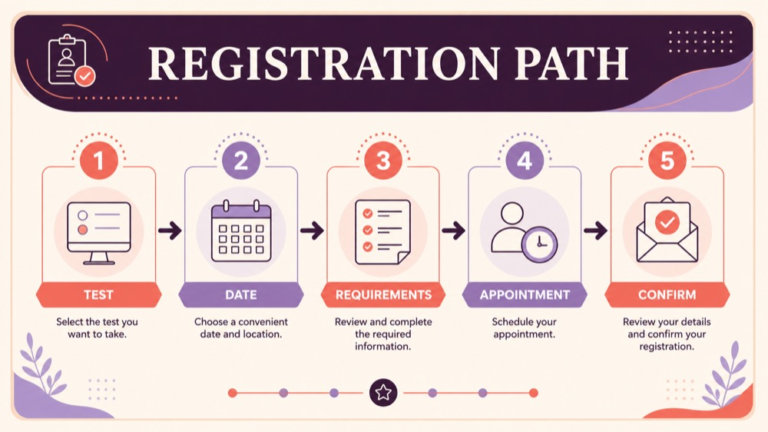
Use the ETS registration process as the administrative starting point, then rely on the current account for the actual transaction. The exact screens can change, so the useful skill is recognizing the order of decisions rather than memorizing a button location.
- Identify the test. Search for Speech-Language Pathology and confirm the 5331 designation before choosing an appointment. Similar wording in a search field is not enough; the title and code should match the requirement you are trying to meet.
- Check your timing. Compare your intended date with coursework, clinical-practicum timing, application deadlines, and the date a receiving organization expects a score. If you need an accommodation or a name correction, raise that issue early rather than treating checkout as the first place to solve it.
- Review current availability. Look at the dates and locations shown in the account. A location search is an option list, not a completed reservation, and availability can differ by account, delivery format, and time.
- Choose an appointment deliberately. Consider travel, arrival time, room or technology requirements, fatigue, and the study runway that remains. The earliest displayed appointment is not automatically the most workable one.
- Enter matching information. Compare your account name and contact details with the identification and email access you expect to use. If the information does not align, pause and use the appropriate ETS support path.
- Review the transaction. Read the test title, code, date, time zone, location, delivery setting, price shown, score-recipient choices, and change language before submitting. Time-sensitive details belong to the live transaction.
- Save the confirmation. Keep the confirmation number, appointment details, account messages, and any remaining action in a secure place. A personal checklist can support memory, but the current ETS account and confirmation are the stronger records.
The sequence gives you a useful stopping rule. If the test identity is unclear, the appointment does not protect the deadline, the name does not match the expected identification, or a required support process is unresolved, do not rush simply because an appointment screen is open. Resolve the uncertainty through the responsible source and return to the transaction with a documented decision.
Check Timing, Identity, and Appointment Details
Good sign-up planning starts backward from the event that matters. That could be a graduate-program completion point, a credential application, an employer timeline, or a personal readiness target. The point is not to create a universal number of study days. The point is to identify the dependency that makes a date useful or risky for you.
- Academic timing: note coursework and clinical-practicum milestones that your program associates with exam readiness.
- Score timing: identify when the receiving program or organization wants a result, then allow room for processing and record updates.
- Identity timing: resolve a legal-name change or document mismatch before the appointment becomes urgent.
- Accommodation timing: read the current ETS process early if you need supported testing conditions.
- Travel timing: plan the route, arrival buffer, parking, or the displayed technical and room requirements.
- Study timing: decide how many sessions remain for content retrieval, application practice, error review, and a final logistics check.
Do not treat a fixed date from an old post as a current promise. Test-center inventory, appointment windows, policies, and displayed options can change. A page that helps you understand the process is useful, but the live ETS account should settle the specific choice. That habit is especially important when a question uses words such as “available,” “latest,” “fee,” “retake,” or “score release.”
Turn the Confirmation Into a Study Runway
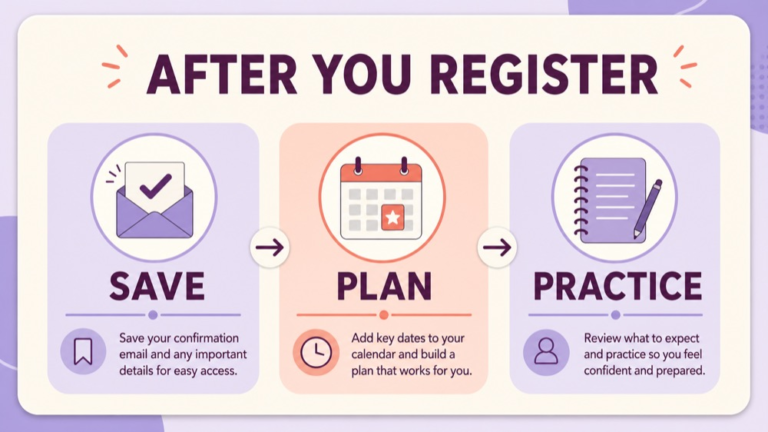
Once the appointment is confirmed, turn the administrative decision into a study plan that can be inspected. Start with the current ETS test listing and study companion, then divide preparation into retrieval, application, and review. Retrieval asks what you know. Application asks what you would do with a clinical or professional scenario. Review asks why a tempting alternative does not fit the evidence or the question’s scope.
A useful runway includes a first pass through the content domains, mixed practice that changes the order of topics, timed work that respects the appointment context, and an error log. The log should record the decision point, the evidence you missed, the reason your first answer looked attractive, and the rule you will use next time. A growing score alone does not explain which reasoning habit needs attention.
Use registration details to make the plan concrete without letting logistics dominate every session. Reserve a short checkpoint for the route or technical requirements, then return to studying. If your date changes, revise the plan rather than trying to preserve an outdated calendar. The purpose of the date is to organize preparation, not to create a false sense of certainty about what a future session will look like.
Separate Registration From Credential Decisions
Signing up for a test is one administrative event. A passing score is a result. ASHA certification, a clinical fellowship, graduate-program completion, and state licensure can involve additional requirements and different decision-makers. The ASHA exam-context guidance is useful for keeping those layers distinct, but it does not replace your program or state authority’s current instructions.
When a study question combines registration with eligibility, identify which part is actually being asked. If it asks how to reserve an appointment, start with ETS. If it asks what a score means for a credential, check the credential authority. If it asks when a learner should test, compare the program timeline, current guidance, and individual readiness rather than inventing a universal rule.
Common Sign-Up Mistakes
- Searching for a familiar phrase without confirming the Speech-Language Pathology Praxis 5331 title and code.
- Choosing the earliest displayed date without checking coursework, score timing, travel, or preparation needs.
- Assuming a test-center search result is a reservation before the account confirms the transaction.
- Entering a name that may not match the identification expected on test day.
- Using an old fee, appointment rule, score code, or change policy as if it were current.
- Confusing a registration confirmation with proof that certification or state licensure requirements are complete.
- Saving only a screenshot and not keeping the confirmation number or account record.
- Building a study schedule that ignores the appointment’s actual time, travel, or support requirements.
Each mistake is a version of the same problem: one piece of information is asked to answer a larger question than it can answer. Correct it by naming the decision, locating the responsible source, recording the current evidence, and noting what remains uncertain. That method is useful for the exam and for real clinical reasoning.
Quick Sign-Up Review
Before you finish the process, write a short record that another careful person could understand:
- Test title and code checked against the current ETS listing.
- Date, time zone, format, and location or displayed delivery setting recorded.
- Name and contact information compared with expected identification and account access.
- Deadline, score-recipient, accommodation, and support questions identified.
- Confirmation number and remaining action saved securely.
- Study runway connected to the current test scope and your available time.
Then ask one transfer question: Which detail would I verify again if ETS changed the account flow tomorrow? The answer should be the live source, not a remembered screenshot. For SLP Praxis preparation, practice separating current administrative facts from durable study habits so that your plan stays useful even when an appointment or policy changes.
Sources and Next Steps
Use the current ETS Speech-Language Pathology 5331 listing for live exam information, the ETS study companion for content-oriented preparation, and ASHA’s exam-context page for credential boundaries. These sources support the learning framework; they do not make an individual registration, score, certification, or licensure decision.
Continue your preparation: Explore the SLP Study Center learning resources.