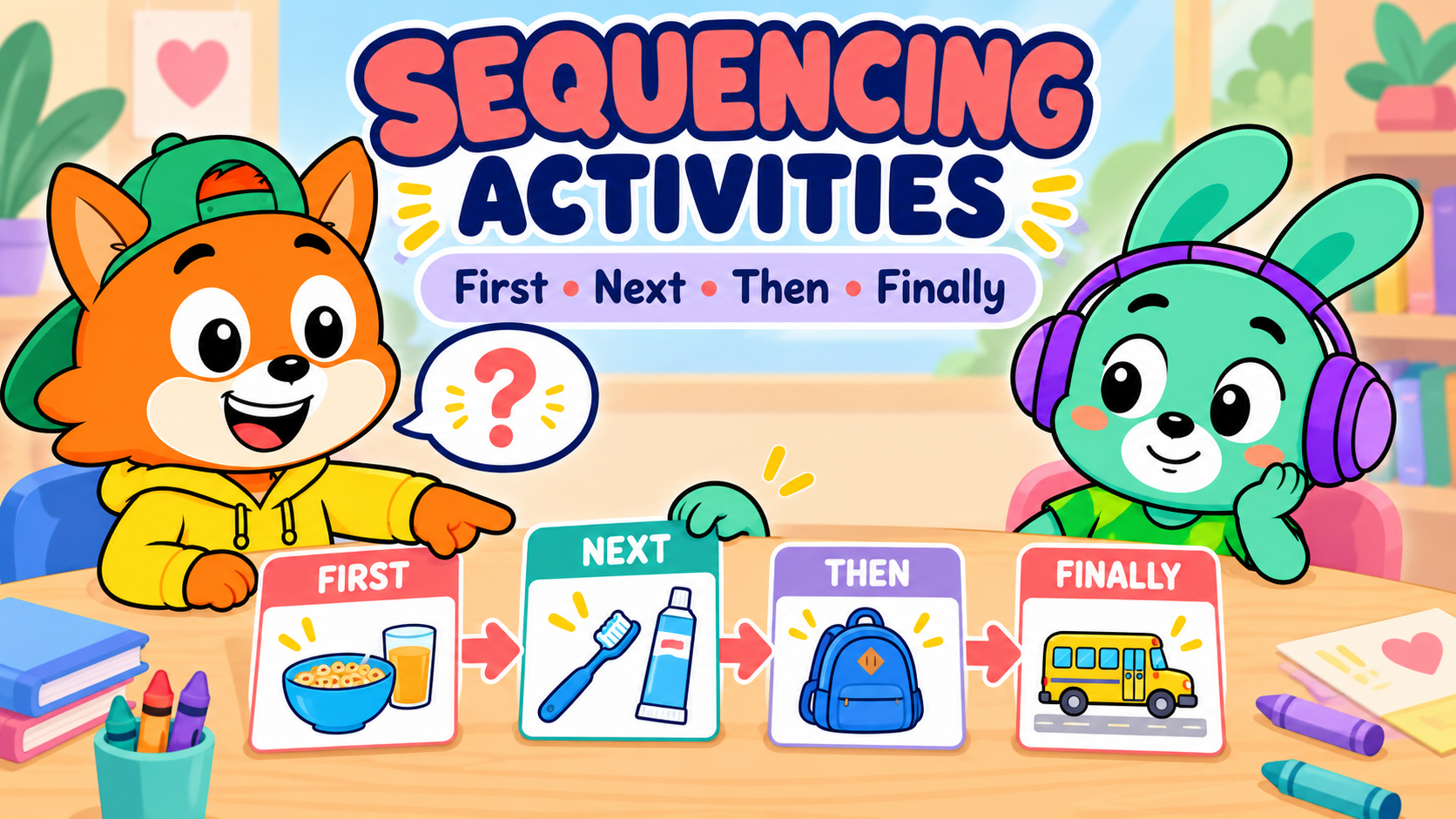
A sequencing activity speech therapy session uses ordered events to support understanding, language, narrative, problem solving, or functional participation. The activity does not have to be a worksheet. A learner can sequence objects, photos, actions, story scenes, personal events, classroom steps, or messages on AAC when the order helps a listener understand what happened or what should happen next.
This guide gives SLPs, educators, and caregivers a flexible routine for planning sequencing practice. It includes materials, prompts, examples, differentiation, progress checks, and transfer ideas. Individual goals and interpretations should be coordinated with the qualified SLP and team. For broader language-planning context, review the ASHA Practice Portal.
Table of Contents
- What sequencing supports in communication
- Choose an activity with a meaningful reason to order events
- Use an experience-order-connect-retell routine
- Prompt and differentiate without taking over
- Collect progress data in context
- Carry sequencing into real routines
- Frequently asked questions
What Sequencing Supports in Communication
Sequencing helps a learner connect events, actions, and information in an order that makes sense. The order may be chronological, procedural, causal, or conversational. A learner may sequence a handwashing routine, retell a picture story, explain how to complete a task, describe what happened at recess, or organize a message so a partner can follow it.
The communication purpose should come before the materials. A learner may need to sequence so a caregiver understands an event, a peer can join a game, a teacher can follow a project step, or the learner can participate in a story discussion. The number of pictures is less important than whether the order supports a useful message.
Possible sequencing targets include:
- arranging two or more actions in a familiar routine;
- using first, next, then, and last to connect events;
- identifying a problem, action, and outcome in a story;
- explaining a procedure to a partner;
- retelling a personal or shared experience;
- predicting what may happen next from the current event; and
- repairing the order when a listener asks for clarification.
Sequence can be communicated through speech, AAC, sign, gesture, writing, drawing, pointing, object arrangement, or a combination. A response should not be treated as incomplete merely because it is not spoken in a full sentence when the learner has communicated the relationship between events.
Choose an Activity With a Meaningful Reason to Order Events
Start with an event or routine that the learner knows or wants to understand. Familiar routines reduce memory demands and let the team focus on the relationship between actions. New stories and classroom tasks can be added when the learner has an accessible way to see, hear, remember, and communicate the events.
Choose materials that match the learner’s access and age. Options include real objects, photos, line drawings, picture scenes, written steps, short videos, books, symbol sequences, or digital cards. Use enough support to make the sequence visible, but leave room for the learner to contribute, question, change, or explain the order.
Before the activity, decide:
- what the learner will order or connect;
- why a partner needs the sequence;
- which response modes and access supports are available;
- what prompt or model will be used first; and
- what observation will guide the next activity.
For example, a cooking routine may target putting ingredients and actions in order so a partner can follow the recipe. A picture story may target connecting a character’s action to an outcome. A classroom transition may target explaining the first step and asking for help when the next step is unclear.
Use an Experience-Order-Connect-Retell Routine
A repeatable routine can support sequencing without turning the activity into a memorized answer. Use the same broad steps across routines, stories, and functional events, then vary the materials, partner, setting, or communication purpose one condition at a time.
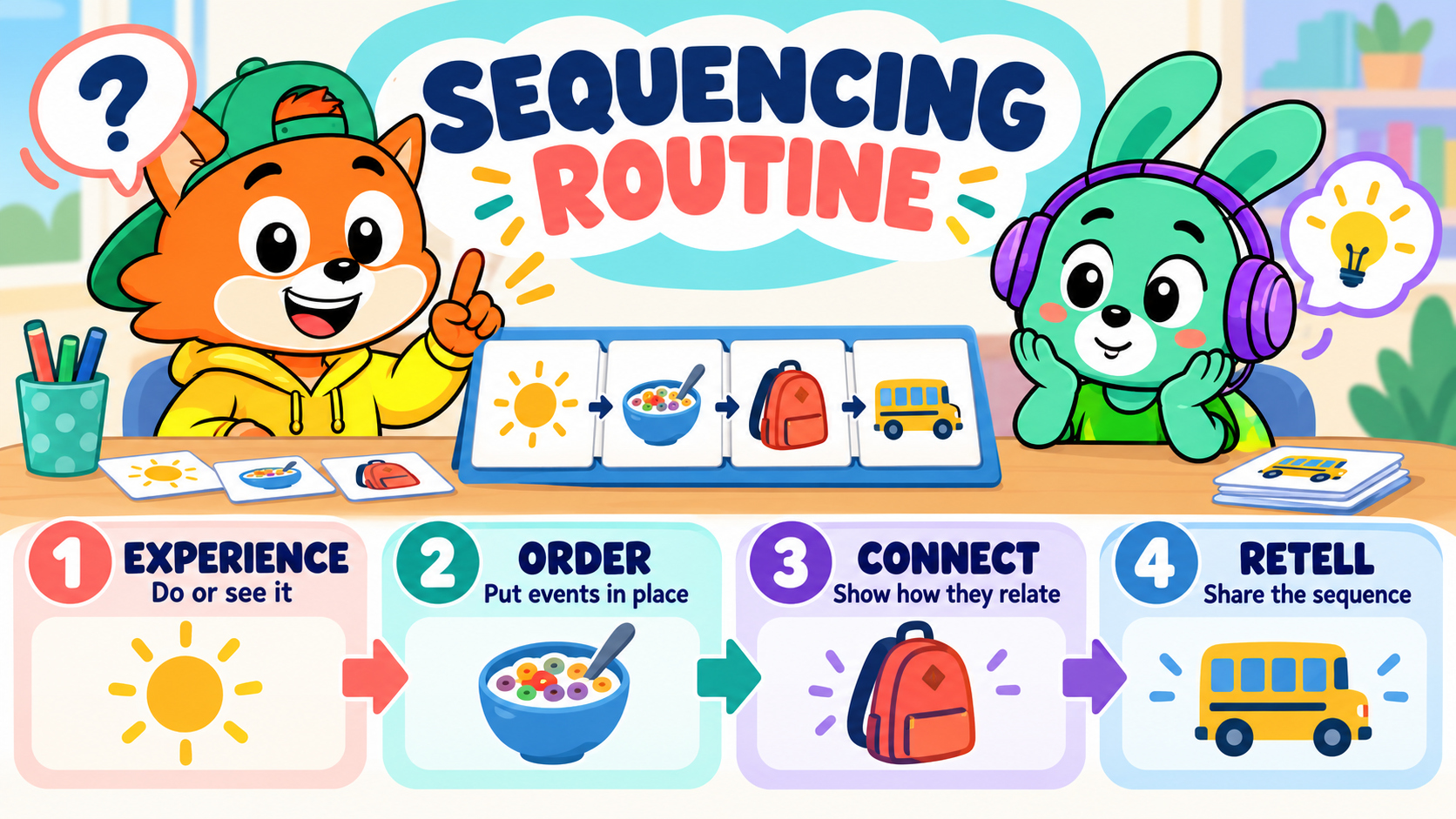
Experience: Let the learner see, handle, hear, or participate in the event when possible. If the activity is a story, preview the scenes and important vocabulary. If it is a routine, make the materials and actions accessible.
Order: Invite the learner to arrange, point to, select, or describe what happened first, next, and last. Begin with two events when the relationship is new, then add complexity when the learner can show the purpose of the order.
Connect: Ask how one event relates to the next. The learner might use because, so, then, after, before, or another available symbol or gesture. A visual arrow, sentence frame, or partner model can support the connection without supplying the entire message.
Retell: Give the learner a listener and a reason to share the sequence. The learner can explain the routine, retell the story, show the steps, or tell a partner what should happen next. Invite a repair when the listener needs more information.
Repeat the routine with one small change. Remove one picture, introduce a new partner, change the final step, or ask for a new communication purpose. Controlled variation helps the team see whether the learner is using a sequence pattern rather than memorizing one page.
Prompt and Differentiate Without Taking Over
Use the least intrusive prompt likely to help the learner access the next action. Start with a pause, visual arrangement, or open invitation. Add a gesture, choice, brief model, or specific question when needed. Record the support so the team can decide whether to keep it for access, vary it for transfer, or fade one part.
Useful prompts include:
- “What happened first?”
- “Which step comes next?”
- “What changed after that?”
- “How could you show your partner?”
- “What could you add so the listener can follow?”
- “What might happen if we change this step?”
For early communicators, use familiar actions, objects, and short sequences. Accept looking, reaching, gestures, symbols, sounds, or words when they communicate an event or choice. Model one relationship at a time and repeat the routine across daily activities.
For school-age learners, add story parts, cause-and-effect links, perspective, and listener knowledge. Ask the learner to explain a procedure to someone who did not see it, or compare two possible orders and identify which one would work better.
For older learners, use age-respectful contexts such as a work task, appointment, community routine, personal experience, or problem-solving event. Sequencing can support a handoff, incident report, self-advocacy message, or explanation to a peer. The topic should reflect the learner’s participation needs rather than a childish presentation.
For multilingual and multimodal communicators, consider the languages and modes used in real life. A learner may understand the order while still developing the language of the activity. Provide the response route that gives the learner access to the message, and coordinate interpretation with the broader team.
Collect Progress Data in Context
Data should answer what the learner can sequence under the recorded condition. Note the number and type of events, response mode, support, partner, setting, and whether the learner connected or repaired the message. A percentage without those details can hide a change in task demand.
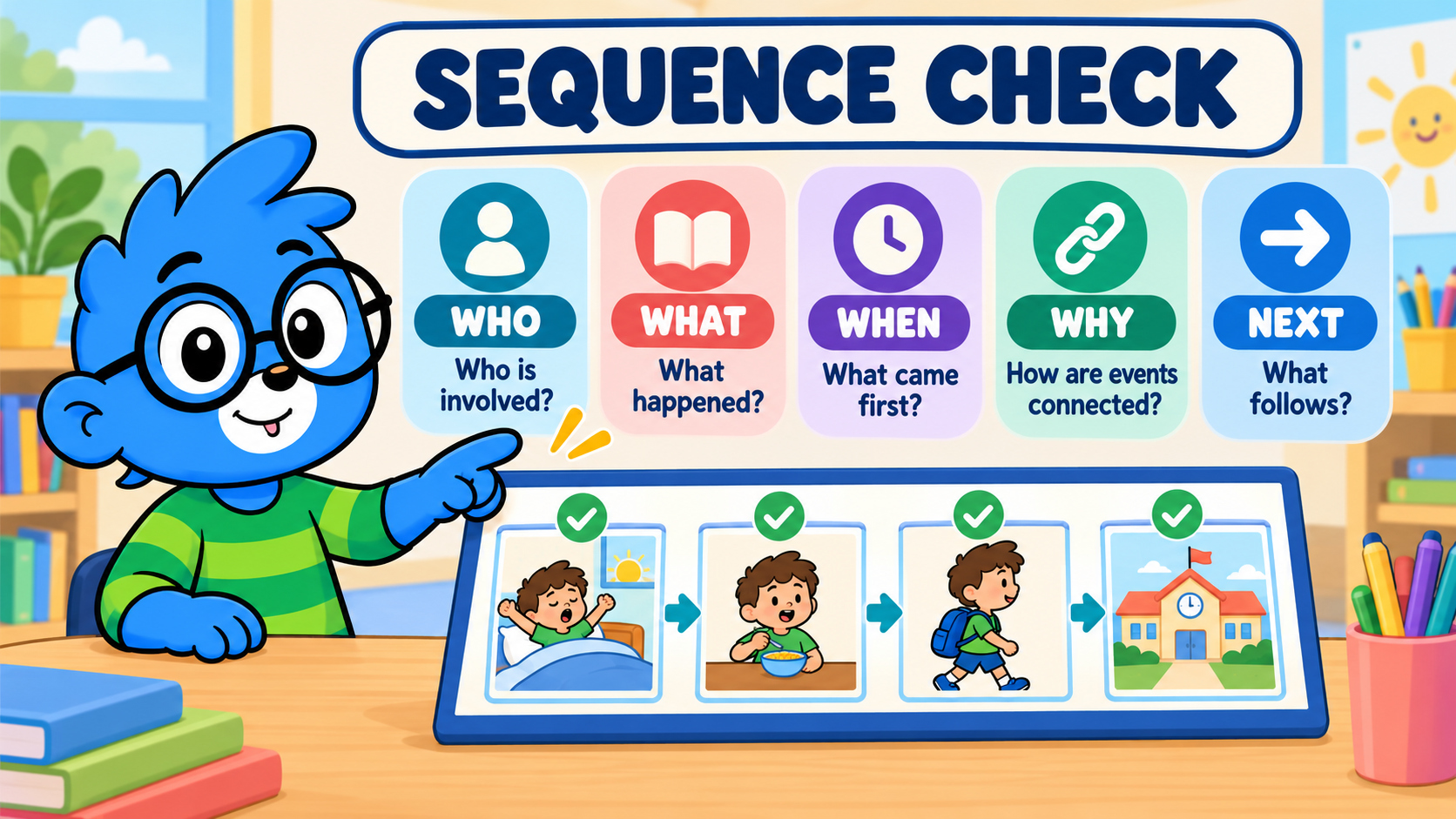
Possible data fields include:
- routine, story, or procedure;
- number and type of events available;
- events ordered or communicated;
- connection words, symbols, gestures, or evidence;
- prompt, model, wait time, and access support;
- partner understanding and repair; and
- next variation to repeat, change, or generalize.
Define what counts as an opportunity. “Four of five” in a familiar picture sequence is different from four new classroom events. Record meaningful communication that falls outside a trial count, such as the learner initiating an explanation, refusing a step, changing the order for a reason, or asking for more information.
Review patterns across partners and settings. If the learner sequences with pictures but not in a live routine, keep the sequence visible while adding real materials. If the learner orders the events but does not explain them, target the listener connection separately. If support helps in therapy but does not travel to class, plan a partner-supported transfer routine.
Carry Sequencing Into Real Routines
Use the sequence beyond the therapy table. Ask the learner to tell a family member what happened, show a peer how to play, explain a classroom task, describe a recipe, retell a book, or report a change in plan. The partner should have a genuine reason to listen rather than already knowing the answer.
Vary one feature at a time while keeping the communication purpose stable. Change the partner, then the setting, then the material, or change the amount of visual support. Keep notes about which support travels well and which condition creates a barrier.
Sequencing is also a way to support autonomy. A learner can sequence a request for help, explain a boundary, show that a routine is finished, or communicate that a planned step needs to change. Preserve yes, no, stop, wait, different, and repair options so the learner can participate in the routine rather than merely follow it.
Frequently Asked Questions
What is a simple sequencing activity for speech therapy?
Use two or three familiar actions, objects, or photos from a meaningful routine. Invite the learner to order them, connect first and next, and show or tell the sequence to a listener. Add events or a new partner when the purpose remains accessible.
Does sequencing have to use picture cards?
No. Real objects, photos, written steps, gestures, AAC symbols, drawings, videos, and spoken descriptions can all support sequencing. Choose the representation that gives the learner access to the event and the communication purpose.
How can I support sequencing without giving the answer?
Use wait time, a visual arrangement, an open question, a choice, or a short model. Prompt the next relationship rather than naming every event. Record the support and adjust it based on the learner’s access and message.
How do I measure progress in sequencing?
Record the event type, number of events, order communicated, connection or explanation, response mode, support, partner, and setting. Look across more than one routine and include meaningful initiation, repair, and transfer.
A sequencing activity speech therapy plan is strongest when the order serves a real communication purpose. Give the learner accessible events to connect, use prompts that preserve ownership, record the context, and let the next activity grow from what the learner communicated.