professional practice praxis questions are easier to solve when you identify the responsibility being tested, the person affected, and the action that protects quality service. A stem may involve ethics, documentation, collaboration, cultural responsiveness, consent, advocacy, reimbursement, research, or supervision. The strongest answer connects the professional principle to a concrete decision instead of choosing the most convenient response.
The current ASHA Speech-Language Pathology 5331 content page includes wellness and prevention, culturally and linguistically appropriate service delivery, counseling, collaboration and teaming, documentation, ethics, legislation, client advocacy, research methodology, and evidence-based practice. Use the live ASHA Cultural Responsiveness resource, ASHA Documentation in Health Care resource, and ETS Speech-Language Pathology 5331 page for current context. The maps and questions below are original study material.
What professional practice questions are testing
A professional practice item may ask you to protect a client’s welfare, maintain confidentiality, obtain consent, document a service, work with an interpreter, address a conflict of interest, refer to another professional, communicate a recommendation, or evaluate evidence. The most polite or fastest option is not automatically the best one. Identify the duty, the risk, the people involved, and the action that is within the clinician’s responsibility.
| Question task | Evidence to locate | Review output |
|---|---|---|
| Ethics | Welfare, competence, honesty, privacy, conflict, and potential harm | Responsible action |
| Documentation | Service, purpose, data, conditions, response, recommendation, and limitation | Accurate record |
| Collaboration | Shared goal, role, communication channel, and referral boundary | Coordinated plan |
| Cultural responsiveness | Language, culture, interpreter, materials, access, and bias | Fair service process |
| Advocacy | Client rights, access barrier, policy, and appropriate action | Supported participation |
Rewrite the stem as a responsibility sentence before reading the choices. “What should the clinician do first?” is different from “Which principle is involved?” and different again from “What should be documented?” This step prevents a good long-term idea from replacing the immediate action the case requires.
Look for details that change the answer: whether the person is a child or adult, whether consent is informed, whether information is private, whether the clinician is competent, whether a qualified interpreter is available, whether a supervisor is involved, whether there is immediate risk, and which law, policy, or professional standard governs the setting.
Anchor review to the ASHA 5331 scope
The ASHA 5331 professional practice framework includes wellness and prevention, culturally and linguistically appropriate service delivery, counseling, collaboration and teaming, documentation, ethics, legislation and client advocacy, and research methodology and evidence-based practice. These topics are connected to clinical decisions across screening, assessment, treatment, and follow-up.
| 5331 lens | Professional practice question example | Study tag |
|---|---|---|
| Welfare | Which action protects the person’s interests and reduces foreseeable harm? | Principle and risk |
| Access | What language, cultural, disability, or communication support is needed? | Equity and inclusion |
| Team practice | Who needs to be involved and what is each role? | Collaboration |
| Documentation | What facts, decisions, limitations, and follow-up belong in the record? | Accuracy and continuity |
| Evidence | How should research and clinical judgment inform the service? | Reasoned practice |
| Advocacy | What barrier prevents the person from accessing appropriate care? | Client rights |
Map each item to one primary lens even when several principles appear. A family’s request may involve privacy, consent, cultural expectations, and team communication, but the question may ask specifically how to share information. The requested action and the facts about authorization decide the answer.
Use ASHA for professional and clinical principles and ETS for current exam information. This page provides original practice material rather than reproducing live test content. When a scenario depends on state law or facility policy, the answer should acknowledge the relevant governing process instead of inventing a universal rule.
Apply client welfare and ethical reasoning
Ethical reasoning begins by identifying who may be affected, what harm or benefit is possible, what responsibility applies, and what action is proportionate. Client welfare includes safe and competent service, honest communication, respect, privacy, access, and attention to the person’s goals. A professional practice question may hide the central issue inside a scheduling, documentation, billing, or team conflict.
| Reasoning step | Question to ask | Study output |
|---|---|---|
| Identify people | Who receives service and who else is affected? | Stakeholder map |
| Identify duty | What ethical, legal, policy, or scope responsibility applies? | Governing principle |
| Identify risk | What could harm welfare, privacy, access, or trust? | Risk boundary |
| Identify action | What can the clinician do now and who should be consulted? | First step |
| Document | What facts and follow-up make the decision transparent? | Record and continuity |
Do not let a friendly intention excuse an unsafe or unauthorized action. Sharing information to help may still require consent. Avoiding a difficult conversation may preserve short-term comfort while leaving a barrier unaddressed. The strongest answer protects welfare and follows a process that can be explained and documented.
Protect confidentiality, consent, and autonomy
Confidentiality concerns how private information is handled. Consent concerns whether a person or authorized decision-maker understands and agrees to a service or disclosure. Autonomy concerns the person’s opportunity to participate in decisions, express preferences, and receive information in an accessible form. Practice questions may test the difference between these ideas.
| Issue | Question to ask | Responsible response |
|---|---|---|
| Privacy | Who is authorized to receive the information and through which channel? | Share only through the appropriate process. |
| Consent | Does the person understand the purpose, risks, choices, and next steps? | Explain and obtain appropriate agreement. |
| Autonomy | How can the person communicate a preference or refusal? | Provide accessible participation. |
| Records | What belongs in the clinical record and who may access it? | Document accurately and protect the record. |
| Conflict | What happens when family, payer, team, or client priorities differ? | Clarify rights, policy, and shared decision making. |
A distractor often assumes that a family member, teacher, supervisor, or colleague can receive all information simply because they are involved. Check the authorization, setting, role, and minimum necessary information. If the person has a communication or literacy barrier, accessible explanation and support are part of meaningful consent.
Document services and clinical decisions
Documentation should allow another authorized professional to understand what happened, why it happened, what the person did, what support was provided, and what comes next. Include relevant data, conditions, clinical interpretation, recommendations, communication with the team, and limitations. Avoid unsupported claims, copied language that does not describe the session, or vague statements that cannot guide follow-up.
| Documentation field | Question to answer | Quality check |
|---|---|---|
| Purpose | Why was the service or contact completed? | Reason is clear. |
| Conditions | What setting, materials, language, supports, and duration mattered? | Interpretation has context. |
| Performance | What did the person say, do, or tolerate? | Data are observable. |
| Clinical decision | What does the evidence support and what remains uncertain? | Interpretation is calibrated. |
| Plan | What recommendation, referral, follow-up, or modification is next? | Continuity is possible. |
When a question asks what to document, choose information that supports care, accountability, and continuity. Do not add irrelevant private details, erase a limitation, or record a conclusion that the data do not support. A concise, accurate record is more useful than a long note with no decision logic.
Communicate clearly with clients and families
Professional communication includes explaining findings, options, recommendations, uncertainty, and follow-up in a way the person can use. Adapt the message to language, literacy, hearing, vision, cognition, culture, and communication mode. Check understanding through teach-back or another accessible method when appropriate. Counseling is not the same as making a decision for the person.
| Communication goal | What to include | Practice filter |
|---|---|---|
| Explain findings | Strengths, needs, conditions, and limitations in plain language | Could the person use this explanation? |
| Discuss options | Benefits, burdens, alternatives, and uncertainty | Is choice visible? |
| Give a recommendation | Action, reason, setting, and whom to contact | Is it actionable? |
| Address disagreement | Listen, clarify goals, explain evidence, and use policy | Is the person respected? |
| Check understanding | Accessible response opportunity and follow-up | Was communication received? |
A professional practice item may offer a choice that uses complex jargon or assumes agreement. Prefer the response that makes the information accessible, invites questions, and records the person’s preferences. Clear communication supports shared decisions without promising outcomes the clinician cannot guarantee.
Collaborate and use referral pathways
Collaboration means communicating relevant information, clarifying roles, listening to other expertise, and keeping the person’s goal visible. Referral is appropriate when a question exceeds the clinician’s competence, scope, equipment, or setting. The SLP still contributes relevant communication information and coordinates follow-up rather than simply passing the case away.
| Situation | Collaboration question | Reasoning move |
|---|---|---|
| Hearing concern | Who can evaluate hearing under appropriate conditions? | Coordinate audiologic information. |
| Medical change | Which provider or setting process addresses urgency? | Communicate promptly and document. |
| Language access | Who can provide qualified interpretation or translation? | Arrange appropriate support. |
| School or work need | Which partners can observe and support the real context? | Plan across settings. |
| Competence limit | Who can provide supervision, consultation, or specialized service? | Protect the person and continue coordination. |
Do not confuse collaboration with asking everyone to make the same decision or with disclosing information without authorization. Identify the purpose, share relevant information through the proper channel, and document the action. The person or authorized decision-maker should remain part of the process whenever appropriate.
Provide culturally and linguistically responsive services
Culturally responsive practice asks how language, culture, identity, values, family structure, communication style, and community context influence service delivery. The clinician selects appropriate materials, explains procedures accessibly, recognizes possible bias, documents limitations, and uses consultation or referral when needed. Cultural responsiveness applies to assessment, diagnosis, treatment, counseling, and discharge.
| Service field | Question to ask | Responsible action |
|---|---|---|
| History | What languages, dialects, routines, and communication partners matter? | Gather a complete background. |
| Materials | Do tasks and examples fit the person’s language and culture? | Adapt or choose appropriate materials. |
| Interpretation | Could difference, exposure, or bias affect the conclusion? | Interpret cautiously and document limits. |
| Recommendations | Can the person and family use the plan in their routine? | Make service practical and respectful. |
| Referral | What expertise is needed to provide fair service? | Use consultation or referral. |
A practice question may use a low score or an unfamiliar communication behavior to test whether you recognize a cultural-linguistic factor. The correct answer does not ignore the concern. It gathers appropriate evidence, uses qualified support, and separates difference, access, and disorder as carefully as the available information allows.
Use interpreters and language-access support
When the clinician and client do not share the language needed for a service, qualified interpretation can support history, instructions, counseling, assessment, and recommendations. Plan the interaction, explain roles, protect privacy, speak directly to the client, and document the language support and any limitation. A bilingual family member may be important to the person but may not provide the same privacy, accuracy, or role clarity as a qualified interpreter.
- Identify the client’s preferred language and communication mode.
- Arrange qualified interpretation or translation through the appropriate channel.
- Brief the interpreter about purpose, terminology, privacy, and turn-taking.
- Speak to the person rather than directing the whole interaction to the interpreter.
- Debrief and document what support was used and what remains uncertain.
Do not treat interpretation as a courtesy added after the clinical decision. It affects the quality of the history, consent, assessment instructions, counseling, and recommendation. If appropriate language access cannot be arranged, the clinician should identify the limitation and use the responsible process rather than pretending the service was fully equivalent.
Match service delivery to context
Service delivery may occur in a clinic, school, hospital, home, workplace, community, or through telepractice. The setting changes privacy, equipment, access, scheduling, partner participation, documentation, emergency procedures, licensure, and reimbursement. A professional practice question may test whether you identify the context-specific responsibility before choosing a service model.
| Context | Question to ask | Practice consideration |
|---|---|---|
| School | How does the communication need affect educational participation? | Coordinate with the educational team and family. |
| Healthcare | What medical, safety, privacy, and documentation procedures apply? | Use the interprofessional pathway. |
| Home | What routines, caregivers, equipment, and resources are available? | Plan for feasible daily use. |
| Workplace | What communication tasks and accommodations matter to the worker? | Respect privacy and role boundaries. |
| Telepractice | What location, technology, consent, privacy, and licensure issues apply? | Verify current requirements and access. |
Choose the answer that matches the setting rather than applying one service model everywhere. If the question includes technology, check whether the person can access the platform and whether the professional has appropriate training and authorization. Context is part of competence.
Understand advocacy and client rights
Advocacy supports a person’s access to communication, education, healthcare, participation, and informed choices. It may involve explaining rights, requesting an accommodation, coordinating a referral, challenging a barrier, or helping the person express a preference. Advocacy should be grounded in the person’s goals and the relevant policy or law.
| Barrier | Advocacy question | Action direction |
|---|---|---|
| Communication access | Can the person receive and express information in an accessible mode? | Request appropriate support. |
| Language access | Is the person receiving service in a language they can use? | Arrange qualified language support. |
| Participation | What activity or role is being limited? | Connect recommendations to the activity. |
| System barrier | Which policy, team, or decision-maker can address it? | Use the proper escalation path. |
| Self-advocacy | How can the person state a preference or request support? | Teach and honor communication access. |
Advocacy does not mean making an unsupported demand or bypassing due process. Look for the option that identifies the barrier, includes the person, documents the concern, and uses an appropriate channel. A good answer preserves dignity while moving the practical issue forward.
Use research and evidence responsibly
Evidence-based practice combines research evidence, clinical expertise, and the person’s values, culture, preferences, and context. Professional practice questions may ask you to judge a study design, interpret evidence, explain a limitation, or select a treatment based on more than habit. Research informs a decision; it does not remove the need for clinical judgment and person-centered planning.
| Evidence lens | Question to ask | Responsible use |
|---|---|---|
| Question | What clinical or service decision needs evidence? | Define the decision first. |
| Design | What population, comparison, measure, and setting were studied? | Check transferability. |
| Quality | What bias, limitation, or uncertainty affects the result? | Calibrate the conclusion. |
| Person | How do preference, culture, access, and burden affect fit? | Individualize implementation. |
| Outcome | What change matters and how will it be measured? | Monitor and modify. |
A distractor may treat one research result as a universal instruction or dismiss research because experience feels sufficient. Choose the answer that identifies the question, evaluates the evidence, considers fit, and uses progress data to refine the service.
Recognize supervision and competence boundaries
Competence includes education, training, experience, current knowledge, supervision, and the ability to recognize when consultation or referral is needed. A clinician should not represent a level of skill, credential, or service that is not accurate. Supervision and collaboration should be matched to the person’s needs and the task’s complexity.
| Boundary clue | Question to ask | Best action |
|---|---|---|
| New procedure | Has the clinician received appropriate training and supervision? | Seek guidance before independent use. |
| Specialized need | Is another clinician or service better equipped? | Consult or refer while coordinating care. |
| Student or assistant role | What requires supervision and who is responsible? | Follow the supervision plan and document. |
| Credential question | Is the title or service represented accurately? | Use truthful professional communication. |
| Changing evidence | What current source or training is needed? | Update knowledge and practice. |
The strongest answer protects the person without abandoning the service. It names the knowledge gap, seeks appropriate supervision or consultation, explains the next step, and documents the decision. “I have done this before” is not the same as current competence for every person or setting.
Map a practice dilemma to a responsible action
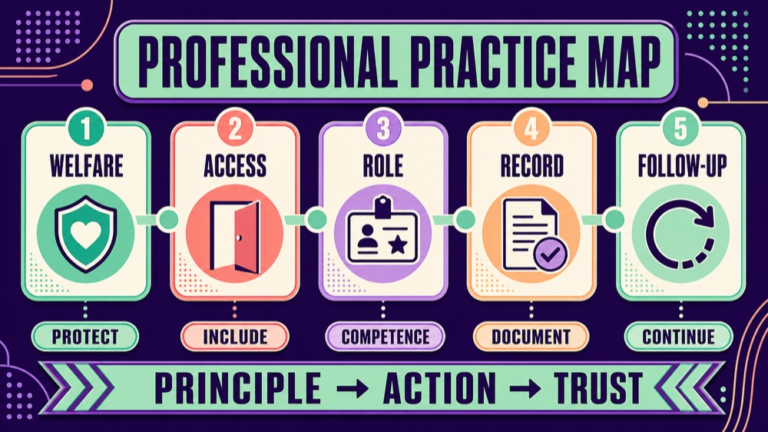
Use the first visual map as a five-step sequence: principle, person, facts, action, and follow-up. Start with the governing responsibility, identify who is affected, separate known facts from assumptions, choose the immediate action that protects welfare and access, and define what should be documented or revisited. This sequence works across ethics, documentation, collaboration, advocacy, and evidence questions.
| Map step | Margin question | Common error |
|---|---|---|
| Principle | What ethical, legal, scope, or policy duty applies? | Choosing convenience before responsibility. |
| Person | Who needs access, choice, privacy, or protection? | Discussing the team while losing the client. |
| Facts | What is known, authorized, documented, and uncertain? | Filling evidence gaps with assumptions. |
| Action | What can be done now and who should be involved? | Skipping the immediate step. |
| Follow-up | What record, referral, education, or review is needed? | Ending with advice and no continuity. |
Write the chain principle → person → facts → action → follow-up beside each item. If an option protects one value by violating another, check whether a more complete process addresses both. Good professional reasoning is transparent and proportionate.
Use a professional practice review board
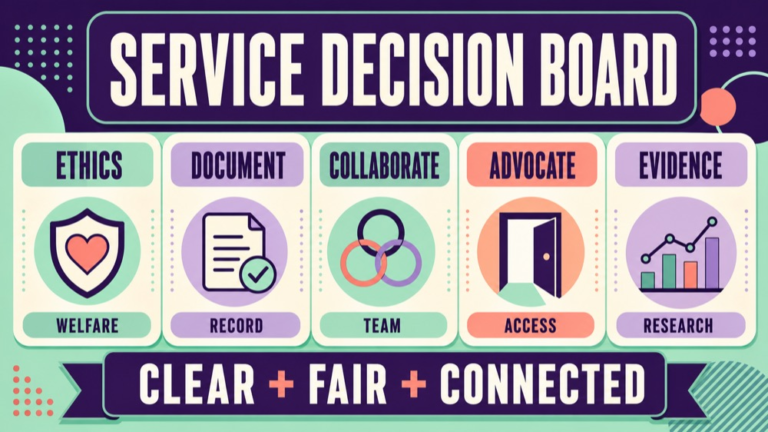
The second visual is a review board with five fields: welfare, access, role, record, and next step. Place the case facts into the fields and label each as known, authorized, or missing. The board helps you notice when an answer sounds helpful but ignores privacy, competence, language access, documentation, or the person’s right to participate.
| Board field | Write down | Use it to ask |
|---|---|---|
| Welfare | Potential benefit, harm, safety, and dignity issue | What protects the person? |
| Access | Language, culture, disability, technology, or accommodation need | What makes service usable and fair? |
| Role | Scope, competence, supervision, team, and referral boundary | Who can take the next action? |
| Record | Facts, consent, communication, limitations, and decisions | What supports continuity? |
| Next step | Action, education, referral, escalation, or review date | What happens now? |
If the board has a missing authorization, language support, or competence field, choose the answer that clarifies it before proceeding. If the board is complete and the question asks for a response, use the person’s welfare and the governing process to compare the choices.
Question 1: confidentiality and collaboration
Practice Question 1. A teacher asks an SLP to email a student’s detailed evaluation report to a volunteer who will help with an after-school activity. The student’s caregiver has authorized communication with the school team, but the volunteer is not listed in the authorization. What is the best next action?
A. Email the entire report because the volunteer is helping the student.
B. Refuse to support the activity and end communication with the school.
C. Clarify the volunteer’s role and authorization, share only appropriate information through the setting’s privacy process, and document the communication decision.
D. Ask the volunteer to promise not to repeat the information and then send the report.
Correct Answer: C. The request involves a useful collaboration goal but an unresolved authorization and minimum-information question. The clinician should clarify the role, follow the setting’s privacy process, share only information appropriate to the authorized purpose, and document the decision. Collaboration does not eliminate confidentiality responsibilities.
Why the Other Options Are Wrong: A shares a detailed report without establishing authorization or need. B abandons a potentially helpful activity instead of solving the privacy issue. D relies on an informal promise rather than the governing process. C protects privacy while preserving appropriate collaboration.
Exam Trap: A helpful purpose does not answer who may receive private information. Look for the missing authorization and the need to match the amount of information to the role.
Question 2: cultural and linguistic responsiveness
Practice Question 2. A multilingual child receives a low score on an English language measure. The referral note does not describe home-language development, dialect, English exposure, or the use of an interpreter. Which professional practice response is best?
A. Report the score as a complete diagnosis because standardized numbers are objective.
B. Repeat the same English measure until the score is higher.
C. Gather a fuller language and cultural history, arrange appropriate language support, and interpret the result with additional relevant evidence.
D. Avoid assessment because multilingual children cannot receive speech-language services.
Correct Answer: C. The score is one data point and the note omits information needed for fair interpretation. The clinician should gather language history, consider dialect and exposure, use qualified language support, and integrate functional evidence before forming a conclusion or plan.
Why the Other Options Are Wrong: A treats an English score as a complete diagnosis without context. B adds repetition without solving the validity problem. D denies service instead of adapting the process. C addresses access, cultural-linguistic factors, and responsible interpretation.
Exam Trap: When the stem highlights missing language background, the key issue is service validity and responsiveness. Do not confuse an assessment limitation with an inability to serve the person.
Question 3: competence and referral
Practice Question 3. A clinician is asked to provide a specialized service that was not included in training and is not covered by current supervision. The client has an urgent functional need, and no qualified provider is immediately available in the clinic. What is the most responsible response?
A. Provide the specialized service independently because the client needs help.
B. Tell the client that no service is possible and provide no follow-up.
C. Explain the competence limitation, seek appropriate consultation or supervision, coordinate a qualified referral or interim support within scope, and document the plan.
D. Represent the service as supervised even though no supervisor is involved.
Correct Answer: C. The client’s need matters, but urgency does not make unsupported practice appropriate. The clinician should be transparent about the boundary, seek consultation or supervision, coordinate a qualified referral or safe interim support within scope, and document communication and follow-up.
Why the Other Options Are Wrong: A risks service outside competence. B abandons the client and misses available coordination. D misrepresents the service and the supervision arrangement. C protects welfare while continuing to help through responsible channels.
Exam Trap: The best answer often includes both a boundary and a bridge. Look for transparent communication, consultation or referral, an interim action within scope, and follow-up rather than a simple yes or no.
Review common professional practice distractors
Professional practice distractors often turn a real value into an incomplete shortcut. They may confuse kindness with consent, collaboration with unrestricted disclosure, cultural responsiveness with avoiding assessment, or advocacy with bypassing policy. Name the missing responsibility before selecting an answer.
| Distractor pattern | Why it sounds attractive | Correction |
|---|---|---|
| Helpful purpose overrides privacy | The request appears beneficial. | Check authorization, role, channel, and amount of information. |
| Score overrides context | The number feels objective. | Consider language, culture, access, construct, and limitation. |
| Referral ends responsibility | It avoids practicing outside scope. | Coordinate, document, and provide an appropriate bridge. |
| Kindness replaces consent | It reduces conflict in the moment. | Explain options and support informed participation. |
| Policy replaces advocacy | It seems safer to do nothing. | Identify the barrier and use the proper escalation path. |
| Research replaces judgment | It sounds evidence-based. | Check person, context, evidence limits, and outcome. |
Use “right value, incomplete process” as a review label. A choice may mention privacy, culture, safety, or competence and still miss the concrete next action that protects the person.
Build a professional practice block
A focused practice block should mix principle recognition with case sequencing. Start with the 5331 list, then work through vignettes that change the client, setting, language, role, or authorization. Finish by explaining why the distractors are incomplete rather than merely memorizing the preferred letter.
- Draw five columns labeled welfare, access, role, record, and next step.
- Sort ten prompts into ethics, documentation, collaboration, culture, advocacy, evidence, or competence.
- Complete the three original questions on this page before reading the rationales.
- Write one privacy case that changes only the authorized recipient.
- Write one language-access case that changes only the available support.
- Check current ASHA and ETS pages for professional and exam information before final review.
Use contrast cases to practice judgment. Keep the same request but change consent; keep the same score but change language background; keep the same competence gap but change whether supervision is available. Your answer should change when the governing facts change.
Track professional reasoning and confidence
Record the responsibility and the action that led to your answer, not only the letter. A choice can sound respectful or practical while ignoring privacy, access, competence, or documentation. A reasoning log shows which professional practice field you missed.
| Log field | Example entry | What it reveals |
|---|---|---|
| Primary duty | Confidentiality and authorized disclosure | Whether you identified the governing principle. |
| Person affected | Student and authorized caregiver | Whether the client remained visible. |
| Missing fact | Volunteer authorization and role | What should be clarified next. |
| Action | Use privacy process and share appropriate information | Whether the principle became concrete. |
| Distractor type | Helpful purpose overrides privacy | Which shortcut to avoid next time. |
| Confidence | 65% before rationale, 90% after explanation | Where review improves transfer. |
Revisit low-confidence items even when correct. Write one sentence for the governing duty and one sentence for the process that protects the person. This builds professional reasoning that transfers across settings and topics.
Professional Practice Praxis questions checklist
Use this checklist before submitting an answer. It is a study aid, not a substitute for the current ASHA Code of Ethics, applicable law, facility policy, supervision, or professional consultation.
- Did I identify the professional duty, risk, or principle being tested?
- Did I keep the client, patient, student, family, or participant visible in the decision?
- Did I check privacy, authorization, consent, autonomy, and accessible communication?
- Did I consider language, culture, dialect, interpreter use, disability, and service access?
- Did I match the action to competence, scope, supervision, and referral boundaries?
- Did I choose documentation that is accurate, relevant, observable, and useful for continuity?
- Did I clarify team roles, communication channels, and follow-up?
- Did I connect advocacy to the person’s rights and an appropriate process?
- Did I evaluate evidence with its population, design, limitations, and person-context fit?
- Did I explain why each distractor is incomplete or irresponsible for this case?
If you can use the checklist consistently, you are practicing the core professional sequence: identify the duty, protect the person, make access possible, stay within role, document the decision, and follow through with the team.
Sources and next steps
For the professional practice exam frame, review ASHA’s Speech-Language Pathology 5331 content page. For culturally responsive service delivery, review ASHA’s Cultural Responsiveness resource, Multilingual Service Delivery, and Collaborating With Interpreters. For documentation, review ASHA’s Documentation in Health Care resource. For current test identity and administration information, use ETS Speech-Language Pathology 5331 and the ETS practice-test page.
This page’s maps, rationales, and A-D practice questions are original educational material. They are separate from the live ETS test and do not reproduce test material. They are not individualized legal or clinical advice. Use the current ASHA Code of Ethics, applicable law, facility policy, and professional consultation for real decisions.
For your next review, complete one timed case using the five-field board: principle → person → facts → action → follow-up. Then change one variable, such as authorization, language support, supervision, or setting, and explain why the best professional response changes or stays the same.
Continue your preparation: Explore the SLP Study Center learning resources.