Preschool language development is broader than a count of words. It includes how a child understands language, expresses ideas, uses play and stories, joins conversations, communicates with different partners, and participates in routines. A careful SLP learning framework notices the whole pattern and asks what supports access, rather than treating one missing skill as a diagnosis.
Preschoolers can show rapid and uneven growth. Language experience, culture, hearing, disability, communication mode, opportunities for interaction, and the demands of a setting all matter. This guide uses broad developmental orientation points, not rigid age cutoffs. When concerns persist across routines or affect participation, the appropriate next step is careful observation and qualified evaluation.
What preschool language development includes
Preschool communication is a network of related abilities. Vocabulary matters, but it is only one part of the picture. A child may know many words yet struggle to understand a complex direction, tell a coherent story, enter peer play, or repair a misunderstanding. Another child may use fewer spoken words while communicating effectively through gestures, signs, symbols, or a device.
| Domain | What to notice | Helpful question |
|---|---|---|
| Receptive language | Understanding words, directions, concepts, questions, and relationships. | What does the child understand with and without context? |
| Expressive language | Words, sentences, grammar, meanings, and communication through available modes. | How does the child share ideas, needs, and experiences? |
| Speech access | How understandable the spoken message is to familiar and unfamiliar partners. | What supports make the message easier to access? |
| Play and narrative | Pretend actions, sequences, characters, explanations, and story structure. | Can the child build meaning across connected events? |
| Conversation | Turns, questions, topic maintenance, repair, and adjustment to a partner. | How does the child join and sustain interaction? |
| Participation | Engagement in classroom, home, peer, and community routines. | Which communication demands affect daily access? |
The domains influence one another, but they should not be collapsed into one score. The best observation names the domain, the context, the support available, and the child’s strength as well as the challenge.
Understanding and expression are both important
Receptive and expressive language can develop at different rates. A preschooler may understand more than they can say, or use familiar scripts while finding it difficult to generate a new message. Look at both sides of communication and include gestures, signs, symbols, drawings, and other modes when they are part of the child’s repertoire.
- Notice whether the child follows familiar and unfamiliar directions.
- Check how context, visual support, repetition, and partner cues change understanding.
- Listen for words, combinations, grammar, explanations, questions, and communication repairs.
- Observe whether the child can communicate for different purposes: requesting, commenting, protesting, imagining, and sharing.
- Record what the child initiates, not only what an adult asks.
- Describe how the child uses all available communication modes.
A short language sample can be more informative than a single impressive or disappointing sentence. Ask what the child was trying to communicate, which words or forms were available, how much support was needed, and whether the message worked with the partner.
Play, narrative, and conversation show language in use
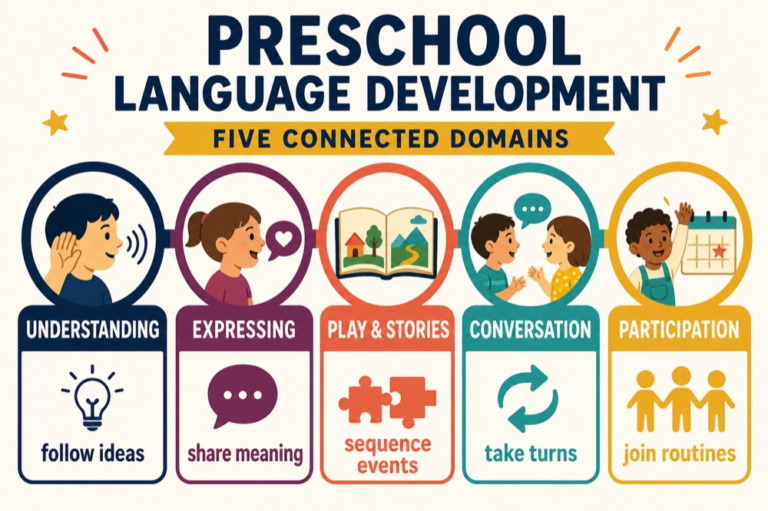
Play creates opportunities to observe meaning beyond isolated vocabulary. In pretend play, notice whether a child assigns roles, sequences actions, uses objects symbolically, and responds to another person’s idea. In stories, notice event order, character goals, causal language, references to time, and whether the listener can follow the message. In conversation, notice turn-taking, topic shifts, questions, repair, and the flexibility to speak with different partners.
These observations should remain descriptive. A child may tell a rich story at home and speak less in a new setting. A peer interaction may be difficult because the environment is noisy, the rules are unfamiliar, or the child lacks an accessible communication method. Context helps explain performance; it should be recorded rather than assumed away.
- Choose a routine that is familiar enough for the child to participate.
- Observe a second routine with different language and partner demands.
- Record the child’s initiations, responses, repairs, and successful supports.
- Compare the communication demand with the opportunity the child was given.
- Ask what additional information would change your interpretation.
Observe the child across routines and partners
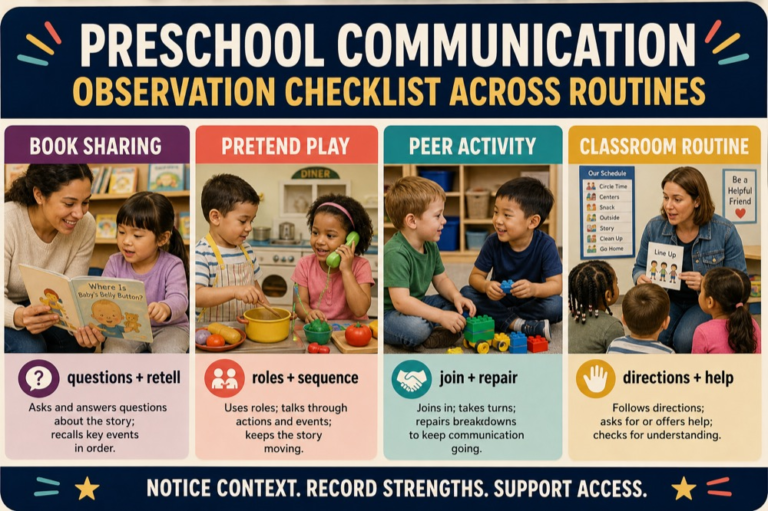
Preschool language development is easier to interpret when you look across people and activities. Book sharing may show vocabulary, comprehension, prediction, and narrative. Play may show symbolic language and negotiation. A classroom transition may show understanding of group directions, self-advocacy, and participation. A meal or dressing routine may reveal functional communication and repair.
| Routine | Possible language evidence | Context to record |
|---|---|---|
| Book sharing | Labels, questions, predictions, retell, and connections. | Adult prompts, shared attention, and interest in the topic. |
| Pretend play | Role language, sequences, negotiation, and flexible ideas. | Partner familiarity, materials, and play rules. |
| Peer activity | Joining, turn-taking, repair, and topic maintenance. | Noise, group size, pace, and peer support. |
| Classroom routine | Following directions, asking for help, and explaining needs. | Visuals, repetition, movement, and language load. |
Include hearing and communication access in the observation. Ask whether the child can see or hear the partner, access the device or symbols, and receive enough processing time. The same child may appear more capable in one environment because the environment offers better access.
Multilingual development needs a full-language view
For a child who uses more than one language, gather information across the full linguistic repertoire and the contexts where each language is used. Vocabulary may be distributed across languages. A child may understand a family language well but have less experience using it in a preschool setting, or may use a school language for one function and another language for a different relationship.
Do not interpret multilingual experience by counting one language alone or treating an accent, code-switch, or language preference as evidence of disorder. Ask about exposure, opportunity, communication partners, cultural routines, and the child’s available modes. Use qualified bilingual assessment or interpretation support when needed.
When a pattern merits closer evaluation
A pattern deserves closer attention when concerns are consistent across settings, communication access is uncertain, skills are lost, participation is becoming difficult, or the child cannot show expected communication even with appropriate support and opportunity. The next step is to gather history, hearing information when relevant, language samples, partner reports, and other assessment evidence. A milestone chart alone cannot determine a cause or a plan.
Separate the referral question from the conclusion. “How can we understand this child’s communication across routines?” is a constructive question. “One quiet activity establishes a disorder” is not. Clinical reasoning should include strengths, context, language experience, disability, access, and family priorities.
Use the concept in clinical reasoning
When a learning scenario asks about preschool language development, work through this sequence:
- Identify whether the prompt is asking about understanding, expression, speech, social communication, play, or participation.
- Describe the behavior in its routine and communication context.
- Separate what is observed from what is inferred.
- Consider hearing, language exposure, communication mode, culture, and partner support.
- Choose the next information or collaboration step that answers the question.
- State the boundary of your conclusion.
For example, if a child uses short spoken phrases but creates elaborate pretend scenes with gestures and symbols, the decision should not be based on spoken length alone. Ask how the child understands, communicates intent, combines modes, and participates with partners. The point of the concept is to improve the question and the observation.
Common interpretation mistakes
- Reducing language development to vocabulary count.
- Ignoring receptive language because a child can repeat words.
- Observing only adult-led questions and not child-initiated communication.
- Using one routine or one language as the entire sample.
- Ignoring hearing, device, motor, sensory, or environmental access.
- Calling a pattern a diagnosis without appropriate evaluation.
- Confusing speech intelligibility with the full language profile.
- Describing weaknesses without documenting strengths and useful supports.
Use the ASHA Practice Portal and ASHA Evidence Maps for topic-specific clinical learning, and review the NIDCD speech and language resource for broad developmental context. The goal is not to force a child into a chart. It is to understand communication well enough to support access and participation.
Sources and next steps
Preschool language development is a connected pattern of understanding, expression, play, stories, conversation, access, and participation. Study the domains separately, observe them together, and keep the boundaries visible. Broad milestones can guide attention; qualified assessment and current evidence guide individual decisions.
Continue your preparation: Explore the SLP Study Center learning resources.