
praxis speech language pathology test dates are best understood as a planning window rather than a date to copy from an old calendar. The useful question is not only “What dates exist?” It is also “Which displayed appointment protects my deadline, gives me a realistic study runway, and fits the current testing conditions?” That shift makes date research more practical.
This guide shows how to plan around the current ETS account without promising a universal testing calendar. Appointment availability, delivery options, fees, rescheduling rules, score timing, and identification or accommodation requirements can change. Use this article to organize your decision, then verify the specific date and conditions in the live ETS process.
Table of Contents
- What test dates can and cannot tell you
- Plan test dates backward from the deadline
- Check the live ETS window
- Build study time around the selected date
- Prepare for change and contingency decisions
- Common test-date mistakes
- Quick date-planning review
What Test Dates Can and Cannot Tell You
A displayed date answers one narrow question: an appointment may be available in the current ETS account. It does not by itself tell you that the date fits your graduate program, that a score will arrive before a receiving organization’s deadline, or that your preparation is complete. Those decisions require different evidence.
Start by separating the date, the deadline, and the readiness decision. The date is an appointment choice. The deadline is an external requirement or personal milestone. Readiness is a judgment about your preparation, energy, support needs, and ability to use the current exam scope. When these are written separately, you can see whether moving the date solves a real problem or merely makes the calendar look tidy.
| Planning layer | Question | Current source |
|---|---|---|
| Availability | Which appointments are displayed for my account and preferred setting? | Live ETS account. |
| Deadline | When does a program, agency, or personal plan need the result? | Receiving organization or your documented plan. |
| Readiness | What preparation can I complete before the appointment? | Current ETS scope plus your study evidence. |
| Contingency | What will I do if the date, location, or circumstances change? | Current ETS change guidance and support channel. |
Plan Praxis Speech-Language Pathology Test Dates Backward
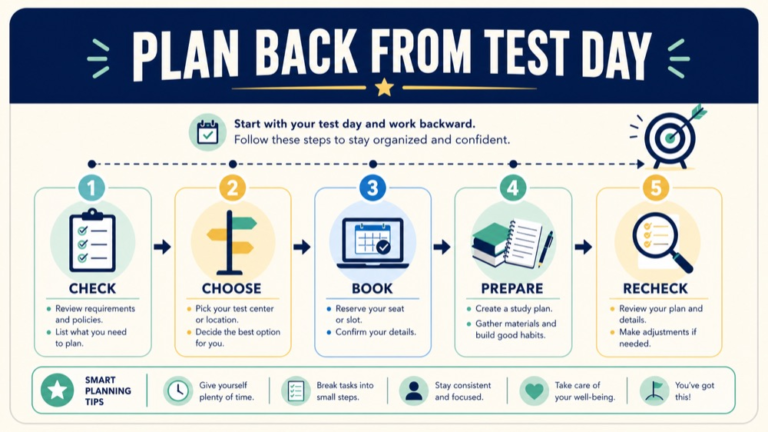
The ETS registration process provides the general path, but the planning work begins with your own deadline. Write the date that matters, then work backward through the steps that need time. Do not assume that a displayed appointment or a score report moves instantly through every receiving system.
- Name the endpoint. Record the date by which a program, credential pathway, employer, or personal plan needs evidence of the result. If no external deadline exists, choose a study checkpoint that is meaningful and flexible.
- Allow for processing. Check current ETS score and recipient information, then allow time for processing, questions, and the receiving organization to update its record.
- Protect preparation. Reserve time for content retrieval, clinical reasoning, mixed practice, timed work, and error review. A date that leaves no room for learning may be a poor fit even when it is available.
- Check personal conditions. Consider coursework, clinical responsibilities, work schedule, travel, health, fatigue, support needs, and the environment in which you will test.
- Compare displayed appointments. Use the live account to compare dates, times, locations, and delivery settings. Record the option you are evaluating before you complete the transaction.
- Choose and document. Save the appointment and the evidence behind the decision, including the deadline it protects and the remaining study runway.
This backward method avoids a common calendar trap: selecting a date because it appears soon, then discovering that the date conflicts with coursework or leaves no time to review mistakes. It also avoids the opposite trap of postponing without a learning reason. The point is not to make the window as early or as late as possible. The point is to make the tradeoff visible.
Check the Live ETS Window
Use the current ETS page to confirm the test identity and the account to confirm availability. A search result, an old shared spreadsheet, or a social post can help you know what to look for, but it cannot settle which appointments are available for you now. The account is also where current transaction details and remaining steps become visible.
- Test identity: confirm Speech-Language Pathology Praxis 5331 before comparing dates.
- Time zone: record the displayed time and the local time you will use for travel or preparation.
- Location: check the center, address, arrival requirements, or displayed remote conditions.
- Delivery setting: read the current instructions for the option you are considering.
- Change language: note the current rescheduling, cancellation, or support path instead of relying on memory.
- Confirmation: keep the number, appointment details, and any action that remains open after checkout.
Dates are also a useful prompt to revisit identity and support needs. If your name, identification, accommodation request, or account information needs attention, treat that as a separate task with its own lead time. The best date cannot repair an unresolved administrative mismatch.
Build Study Time Around the Selected Date
After choosing a date, convert the remaining time into study blocks rather than a single countdown. Begin with the current ETS scope and the study companion. Then alternate between knowledge retrieval and scenario application. A learner may recognize a definition but still need practice deciding which evidence, assessment step, treatment consideration, or professional boundary answers a question.
Use an error log that names more than the letter of a missed answer. Record the task, the clue that mattered, the assumption that pulled you away, the source or concept that clarifies it, and the next action. Revisit errors after a short interval and in a mixed order. That process reveals whether the issue is a missing fact, a comparison problem, an overread stem, or a time-management habit.
Protect a final logistics checkpoint. Confirm the current appointment, route or technical setup, identification, permitted materials, and any support instructions through the live source. Keep the checkpoint short enough that it does not displace substantive study, but specific enough that it reduces avoidable surprise.
Prepare for Change and Contingency Decisions
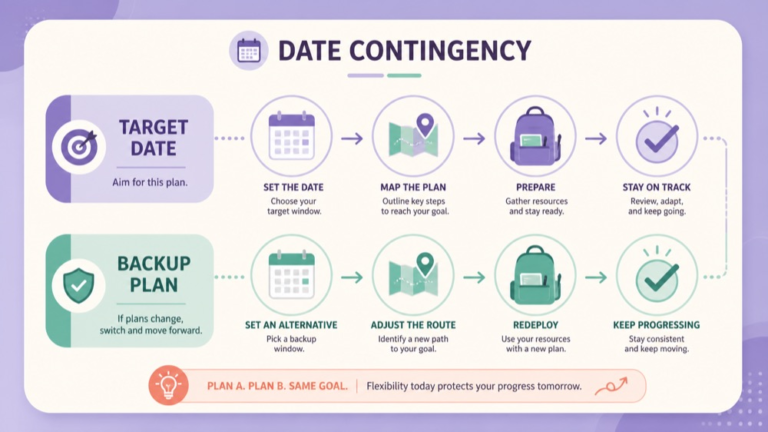
A date plan is stronger when it includes a response to change. A location may not fit after a schedule change. A displayed option may disappear. A personal or program deadline may move. The correct response depends on the current ETS rules and the fact that changed circumstances can affect preparation, score timing, and support needs.
Write three notes: what would make me reconsider the appointment, which source would I check, and how would I revise the study runway? This is not an invitation to worry about every possibility. It is a way to prevent a changed date from turning into an unstructured week. If you do change an appointment, save the new confirmation and update the study plan from the new evidence.
Common Test-Date Mistakes
- Copying a date from an older page instead of checking live ETS availability.
- Choosing an appointment without working backward from the score or application deadline.
- Ignoring time zone, travel, arrival, room, or technical conditions.
- Assuming a displayed date is reserved before the transaction confirms it.
- Leaving no study runway for mixed practice and error review.
- Using a date decision to answer a separate question about certification or licensure.
- Forgetting to record the confirmation number and remaining action.
- Changing the date without updating the preparation calendar and deadline assumptions.
The common thread is confusing a calendar entry with a complete plan. Correct the error by connecting the date to the endpoint, the evidence, the preparation work, and the live policy. A compact record is more useful than a long list of guessed dates.
Quick Date-Planning Review
Before you treat a Praxis date as workable, review this sequence:
- Current ETS test identity and code checked.
- Deadline and score-recipient timing written down.
- Appointment availability, time zone, setting, and location verified in the account.
- Coursework, clinical, work, travel, support, and energy conditions considered.
- Study runway includes retrieval, application, timed work, and error review.
- Confirmation and contingency note saved securely.
Then explain the date in one sentence: “I selected this window because it protects ___ while leaving time for ___, and I will verify ___ in the current ETS account.” That sentence is a practical test of whether the decision is based on evidence rather than calendar anxiety.
Sources and Next Steps
Start with the current ETS Speech-Language Pathology 5331 listing and the ETS test-center information. Use the ETS study companion for study framing, and review ASHA’s exam-context guidance when a question touches the broader credential pathway. Current appointment and policy details remain live verification items.
Continue your preparation: Explore the SLP Study Center learning resources.