
praxis slp score reporting can feel confusing because several different events happen around the same test: you finish the administration, you may see an unofficial result, ETS posts an official score report, and a school, agency, or certification organization may receive a report separately. Checking those events in order makes it easier to know what information is final and what action belongs next.
For the current Speech-Language Pathology Praxis 5331, ETS identifies the test as computer delivered with selected-response questions. ETS says official scores are posted in the Score Reports page of your Praxis account on the score reporting date, which varies by test type and delivery method. Use this guide as a checklist, then use the live ETS account and current policy pages for the date and terms that apply to your appointment.
What Praxis SLP score reporting includes
Score reporting is the handoff from a completed test to the information you and approved recipients can use. The handoff has a timing question, an access question, an interpretation question, and a delivery question. A clear record keeps those questions separate instead of treating a screenshot, an email, and an official report as interchangeable.
Start by recording the test date, delivery method, test code, and the score-reporting date shown in your registration or account. The current ETS score page says the report date varies by test type and delivery method, including at-home versus test-center appointments. If you cannot find a date or the account shows a status you do not understand, use ETS support rather than estimating from another candidate’s timeline.
- Timing: identify the score-reporting date associated with your test and delivery method.
- Access: open the Score Reports page in the Praxis account where the official report will be posted.
- Interpretation: distinguish a possible unofficial result from the official report and from a raw answer count.
- Recipients: confirm which institutions or agencies were selected and what your program or state requires.
- Next action: decide whether you need to save the report, send it, ask a policy question, or revise your study plan.
This sequence is useful whether your result is above, near, or below a target. It creates a small evidence trail that you can revisit when a program asks for documentation or when you plan another attempt.
Find your official score report
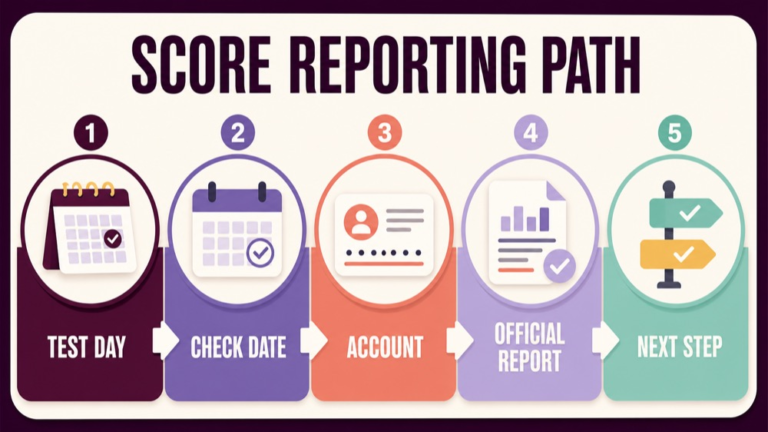
According to the current ETS Getting Your Scores page, your official score report is posted in your Praxis account on the Score Reports page on the score reporting date. An email is used to notify you when it is available. Sign in through the official account route, open the Score Reports page, and look for the report connected to the correct test and date.
Save a copy for your records after you confirm that it is the official report. Use a private, secure location and avoid posting a report publicly because it can contain personal and educational information. If a school, licensing agency, or ASHA-related process needs documentation, follow that organization’s instructions for uploading or sending the report rather than forwarding more information than requested.
The report in your account is the central record for your own review, but delivery to another organization is a separate step. A recipient may receive score information through ETS while your program may also ask you to submit a document. Confirm both paths when a deadline depends on the result.
| Question | Where to check | Record to keep |
|---|---|---|
| When should the score appear? | ETS score calendar and your Praxis account | Test date, delivery method, and listed reporting date |
| Where is the official report? | Praxis account, Score Reports page | Saved report and date accessed |
| Who receives it? | Registration record and current ETS recipient instructions | Recipient names, codes, or confirmation details |
| What target applies? | ASHA, state, agency, school, or employer | Current requirement and the source date |
Use the score reporting calendar
ETS provides a score-calendar tool in the current Getting Your Scores page. Select the test, the test date, and the delivery method shown by the tool. The current page also notes that Praxis scores are reported on Tuesdays and Fridays, with a holiday moving the report to the following Tuesday or Friday. Treat those statements as calendar guidance, not as a substitute for the date returned for your own test.
Check the date in three places when the timing matters: the scheduling or registration screen, the pending-score card in your account, and the live ETS calendar. ETS says the pending score card appears on the Score Reports page. Cancelled or held tests do not appear in that Pending Scores section, so an absent card needs context; it is not enough evidence by itself to draw a conclusion.
- Write down the exact test date and whether you tested at home or at a center.
- Choose Speech-Language Pathology 5331 in the ETS score-calendar tool.
- Compare the returned date with the pending-score information in your account.
- Mark the date and time zone shown by ETS in your personal calendar.
- Recheck the account on or after the listed date and look for the official Score Reports entry.
- If the status is missing, held, or unclear, contact ETS through the official support route.
Do not promise a school or licensing office that a score will arrive on a date copied from a different test. Send the receiving organization the date shown for your appointment and ask how it handles a report that becomes available near its deadline.
Understand the unofficial score
The current ETS page says Praxis tests made up only of selected-response questions may offer an unofficial score at the end of the testing session. The current ETS test page identifies Speech-Language Pathology 5331 as selected-response, so a candidate may see an unofficial result after testing. ETS also says that an unofficial score is not provided in every case, and that its absence does not indicate a problem with the administration or cause a delay in the official score.
An unofficial result is useful as an immediate piece of information, but the official report is the record to use for formal reporting. Before viewing the unofficial result, the computer provides an option to report or cancel the score. ETS currently states that a reported score cannot be canceled, while a canceled score is not reported, cannot be reinstated, and does not receive a refund. Read the current screen carefully before choosing.
- Do not treat the absence of an unofficial result as a diagnosis of a scoring problem.
- Do not use a remembered unofficial result as a substitute for the official report.
- Do not assume an unofficial result is an exact raw-percentage conversion.
- Do not choose report or cancel without reading the current on-screen language.
- Do save your test date and any permitted confirmation information for later comparison.
The most useful emotional response to an unofficial result is a pause. Record what ETS shows, then wait for the official Score Reports entry before sending a formal status to a school, state, or certification organization.
Check the details on your score report
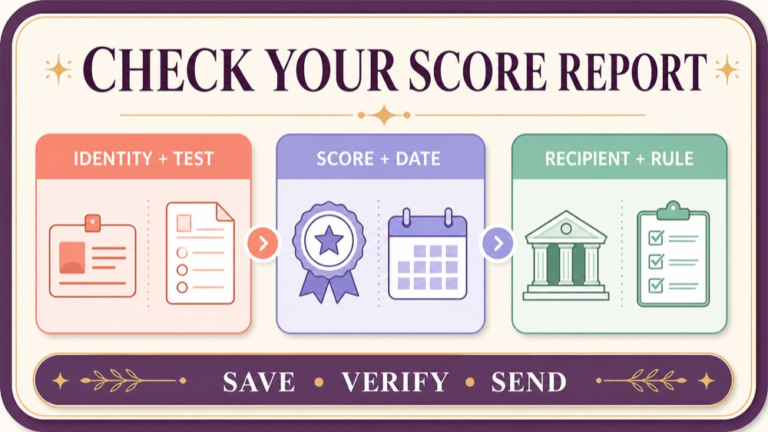
When the official report is available, read the identification and administrative details before interpreting the number. Confirm that the report belongs to you, names the intended Speech-Language Pathology test, and is connected to the correct test date. Then note the reported score, any pass or no-pass information shown, and the content-category information that can guide review.
A score is not simply a percentage of questions correct. ASHA explains that raw points are based on the number of correct answers and that the scaled score is computed from the raw total in a way that adjusts for question difficulty. This is why you should use the score scale and interpretation shown by ETS or ASHA instead of converting a remembered number of correct answers into a guaranteed scaled result.
Use the following review order so that a strong emotion about the result does not hide a practical detail:
- Identity: verify your name, test, code, and test date.
- Score: record the official scaled score and the report date.
- Performance information: note the content categories or diagnostic detail included in the report.
- Target: compare the score with the requirement that actually applies to your pathway.
- Delivery: confirm the intended recipients and whether the organization needs another document.
- Action: save the report, ask a precise question, or build a targeted study review.
If the name, test, date, or score appears inconsistent with your records, stop before forwarding the document and contact ETS through its official score-support route. If the report is correct but a program interprets it differently from your understanding, ask that program for its written requirement and keep the answer with your records.
Read the ASHA passing-score context
ASHA’s current Praxis score page lists 162 as the passing score for Speech-Language Pathology 5331 for purposes of ASHA certification. That is a certification-context reference, not a universal rule for every state, school, employer, or licensing pathway. ETS’s current qualifying-score page says passing scores vary by state or agency and are not set by ETS.
Use a three-source check when you need to decide what your score means administratively: the official ETS report, the current ASHA certification information if ASHA certification is your pathway, and the current requirement from the state or agency that will evaluate your application. A graduate program may also have a separate internal deadline or documentation rule. Keep those requirements in separate fields in your checklist.
| Source | Question it can answer | What it cannot replace |
|---|---|---|
| ETS official score report | What score ETS recorded for this test administration | A state or agency’s separate qualifying rule |
| ASHA Praxis score page | Current certification passing-score context | Individual advice about a candidate’s complete certification file |
| State or licensing agency | Which score and documentation the application requires | ETS’s official record of your test |
| School or employer | Its deadline, upload process, or internal requirement | A national certification or state rule |
This separation prevents a common mistake: declaring a score sufficient because it matches one number while overlooking a different reporting deadline or an additional pathway requirement. The organization that owns the requirement should confirm the requirement.
Confirm who receives your scores
The current ETS score page says scores are sent to institutions or agencies selected during registration, with up to four choices at no extra cost. ETS also notes that some states or territories use automatic score reporting to a teacher-credentialing agency. Automatic reporting does not mean every organization on your personal application receives a copy, so compare the current recipient record with the instructions from the organization evaluating you.
Review recipients before a deadline rather than after a missing document is discovered. Confirm the full institution or agency name, the code if ETS displays one, the pathway or state, and whether the recipient wants an official ETS delivery or a candidate-uploaded report. Do not select a recipient based only on a similar abbreviation.
- List the school or program that needs the score for its own record.
- List the state or agency that evaluates the credential or license.
- Check whether automatic state reporting applies to your testing situation.
- Confirm any recipient change deadline shown in your ETS account.
- Save the receipt or account confirmation after changing recipients.
- Ask the receiving organization how it matches a score to your application.
ETS’s current Sending Your Scores page says free score-recipient changes can be made up to three days before the test date. It also explains that additional score reports can be purchased after that point. Use the live account and current page for the rule associated with your test, because recipient policies and fees can change.
Order an additional score report
If you need to send a score to an organization that was not selected, open the current ETS Sending Your Scores page and sign in to your Praxis account. ETS currently says Praxis scores are valid for ten years and that additional score reports can be ordered during that period. The page lists each additional report as nonrefundable and currently priced at $50 per score recipient.
Before paying, confirm that the recipient actually requires an additional ETS report and that you selected the correct organization or agency. Check whether the program has an internal code, a specific delivery method, or a deadline for matching the report to your application. A fee receipt shows that an order was placed; it does not by itself establish that the receiving office has processed the score.
- Ask the organization for its current score-delivery instruction.
- Sign in to the Praxis account through the official ETS route.
- Locate the test and open the score-recipient or additional-report option.
- Confirm the recipient name, code, and delivery details.
- Review the current fee and nonrefundable language before checkout.
- Save the order confirmation and follow up with the recipient if its process requires it.
Keep the official report, recipient order, and application receipt together. That small record is useful when a school, state office, or certification process asks when the score was sent.
Turn the report into a study decision
A score report can be an administrative document and a study-planning input at the same time. If you met the requirement, review the categories that still feel uncertain before moving on. If you did not meet the target, avoid replacing the entire plan with random practice. Use the category information, your error log, timing notes, and the current ETS Study Companion to identify the next few skills worth repairing.
The current ETS 5331 page describes foundations, professional practice, and specialized knowledge across practice areas that include screening and assessment, treatment, and treatment evaluation. Use that structure as a map rather than as a promise that a category score explains every error. A missed item can reflect knowledge, wording, prioritization, pacing, or a test-day process issue.
- Clarify the target: write the exact score requirement and organization that supplied it.
- Mark the report: record the official score, report date, and content-category information.
- Review the blueprint: connect the weakest area to current source material.
- Analyze decisions: log why a practice choice was attractive and what evidence should control next time.
- Rehearse timing: use original practice scenarios and a timed block that matches the current exam frame.
- Recheck logistics: review the live ETS appointment, score, and retake rules before scheduling anything new.
Keep preparation grounded in authorized resources and new case reasoning. A score report is not an invitation to search for remembered test content, and it does not reveal every question from an administration. The learning goal is to make accurate decisions on new scenarios across the blueprint.
Avoid common score-reporting mistakes
Most score-reporting errors are process errors rather than difficult calculations. A candidate sees an unofficial result and sends it as final, copies a reporting date from another test, compares the score with a target from the wrong pathway, or assumes a recipient has received a report because an order was placed. A short verification routine catches these problems.
- Confusing an unofficial end-of-session result with the official Score Reports entry.
- Assuming that no unofficial result means the test administration had a problem.
- Using a Tuesday-or-Friday general pattern instead of the date returned for the appointment.
- Converting an estimated raw count into an exact scaled score.
- Using ASHA’s certification number as the answer for a different state or agency requirement.
- Forgetting that a program may need its own recipient code or document process.
- Paying for an additional report before confirming that the organization requires it.
- Forwarding a score report with unnecessary personal information.
The fix is to name the evidence for each decision: ETS account for the official report, ETS calendar for the reporting date, current ASHA or agency page for the requirement, and the receiving organization for its document process. If the evidence conflicts, pause and ask the source owner to clarify.
Praxis SLP score reporting checklist
Use this final checklist after the Speech-Language Pathology Praxis and before you tell an organization that your score is complete:
- Did I record the exact test date, delivery method, and test code?
- Did I check the ETS score calendar for my test and date?
- Did I open the official Score Reports page in my Praxis account?
- Did I distinguish an unofficial result from the official report?
- Did I verify my name, test, date, score, and report status?
- Did I compare the result with the correct ASHA, state, agency, school, or employer requirement?
- Did I confirm which recipients were selected and whether automatic reporting applies?
- Did I ask the receiving organization whether it needs an additional report or upload?
- Did I save the report and any score-recipient confirmation securely?
- If I need another attempt, did I turn the score information into a focused study review?
When every answer has a source or a saved record, score reporting becomes a manageable handoff rather than a guessing exercise. Keep the live ETS pages bookmarked, because reporting dates, recipient instructions, fees, and policy language can change.
Sources and next steps
Use the current ETS Getting Your Scores page for the score calendar, official account report, unofficial-score explanation, and report-access guidance. Review ETS Sending Your Scores for recipients and additional reports, and use the current ETS qualifying-score page for the state-or-agency boundary. Confirm certification context with ASHA’s Praxis Scores and Score Reports page, and review the ETS Speech-Language Pathology 5331 page for current test details.
Continue your preparation: Explore the SLP Study Center learning resources.
Continue your preparation: Explore the SLP Study Center learning resources.