praxis slp score recipients are the institutions or agencies that should receive score information from ETS. Selecting them carefully matters because a graduate program, a state licensing office, an ASHA-related pathway, and an employer can have different instructions. The useful task is not to collect names from a forum; it is to match each recipient to the current code, pathway, and delivery requirement.
For Speech-Language Pathology Praxis 5331, start with the current ETS test identity and then use the live registration flow and current recipient-code list. ETS currently says up to four institutions or agencies can be selected during registration at no extra cost. This guide explains how to prepare, choose, verify, and follow up without assuming that one score-delivery route fits every candidate.
What Praxis SLP score recipients mean
A score recipient is the institution or agency you identify so ETS can send score information through its reporting process. The recipient is not automatically the same as the person who reminds you to take the exam, the school where you currently work, or the state where you live. It should be the organization whose current instructions tell you that it needs the Praxis result.
There are several possible roles in the routing process. Your attending institution may be the graduate program connected to your training. A designated recipient may be a state board, certification organization, school district, or another agency. A state may have an automatic reporting arrangement for some testing situations, while a different state or program may require you to select it directly. Keep these roles separate before you open the payment screen.
- Attending institution: the training institution connected to the account or test record when the current instructions request it.
- Designated recipient: an institution or agency you want ETS to receive the score report.
- State or licensing agency: the office that evaluates a state-specific credential or license application.
- Certification organization: an organization whose current pathway instructions may identify a specific recipient or document route.
- Candidate record: the official report in your Praxis account that you should save and review yourself.
One organization can also play different roles depending on what the current form asks. Read the field label, not just the organization’s familiar name. If a program supplies a code or tells you to use an A-code or R-code, keep that instruction with your registration notes.
Make a recipient list before registration
Build the list before selecting an appointment. Ask your graduate program, state board, credentialing agency, and certification organization what they need, when they need it, and whether they want ETS to send the score directly. Write down the exact organization name, state, code, pathway, application deadline, and contact point. If an organization says that a candidate-uploaded report is acceptable, record that separately from a direct ETS-recipient request.
Do not let the four-recipient limit make the decision for you. Start with requirements, then rank the recipients by whether they are necessary for the application in front of you. A program may need your score for its own record, while a state board may need it for licensing. A future employer may ask for proof but may not be an ETS score recipient at all.
| List field | Question to answer | Evidence to save |
|---|---|---|
| Organization | What is the full legal or published name? | Current instruction page or written message |
| Role | Is it an attending institution, state, agency, or other recipient? | Field label and pathway description |
| Code | Which current ETS code matches the organization? | ETS code list and account selection |
| Deadline | When must the organization receive or process the score? | Application page or contact confirmation |
| Delivery | Does the organization want ETS delivery, an upload, or both? | Receiving-office instructions |
If an office does not answer a routing question, do not fill the gap with a code found in an old screenshot. Ask the office or ETS for the current instruction and note the date of the answer. Recipient codes and program contacts can change even when the test code remains the same.
Choose recipients during registration
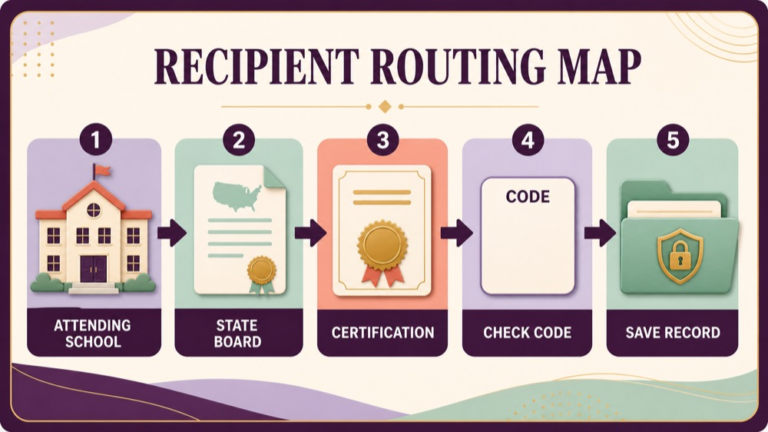
During registration, confirm the test first, then work through the recipient fields slowly. The current ETS page identifies Speech-Language Pathology 5331 as the relevant test for this guide. Check the full test name and code before choosing a recipient, because a code list may serve more than one Audiology or Speech-Language Pathology test.
When the form asks for an attending institution, use the current school or training-program instruction. When it asks for designated score recipients, select the state, agency, or organization that supplied a current requirement. Check the code and name together. A correct-looking abbreviation attached to the wrong state or campus can route the report incorrectly.
- Open the current ETS registration process and identify Speech-Language Pathology 5331.
- Read each recipient field label, including any attending-institution field.
- Compare the organization’s full name and state with your saved requirements.
- Open the current ETS recipient-code list when a code is requested.
- Check whether the code begins with A, R, or RA and whether that role fits the field.
- Review the selected recipients before payment or final submission.
- Save the final selection and confirmation details in a private record.
Use the recipient screen as a verification checkpoint, not as a search for the most familiar school name. If the exact organization does not appear, do not substitute a nearby campus or a similarly named board without confirmation. The current ETS page says codes are updated throughout the year and directs candidates to contact Customer Service when a code is missing.
Read attending-institution and recipient codes
The current ETS Audiology/Speech-Language Pathology code PDF explains the prefixes used in its list. Attending Institution codes are preceded by A, designated score-recipient codes by R, and RA codes may be used in either section. The PDF also says the list was last updated on January 22, 2025 and that codes are updated throughout the year. Treat the live PDF and account selection as the controlling sources.
In practice, the prefix is a clue about the field, not a reason to guess. If your program gives you a code, compare its name, campus, state, and role with the current list. If an organization appears with more than one code or the form offers a choice, ask the organization which entry it wants. Save the exact selection rather than writing only a shortened name.
- A-code: review it in the attending-institution context described by the current ETS list.
- R-code: review it as a designated score-recipient entry.
- RA-code: confirm which registration field the current form permits it to serve.
- Missing code: contact ETS Customer Service or the organization instead of inventing a code.
- Updated list: record the PDF date and recheck it if your appointment is later.
Do not use the code list as proof that an organization has accepted your application. The list helps route score information; the receiving office still controls its application, matching, and document rules.
Check state, agency, and ASHA routing
State and certification routing can overlap, but they are not one requirement. ETS’s current Sending Your Scores page identifies states and territories with automatic score reporting to a teacher-credentialing agency. The same page says that if the state where you test differs from the state where you will apply, or if your state is not on the listed automatic-reporting list, you should select the state as a score recipient so a report can be sent to its teacher-credentialing agency.
That guidance does not answer every SLP licensing question. Check the current state board instructions for the state where you will apply, and ask whether the agency wants an ETS score report, a candidate copy, or another document. If your pathway involves ASHA certification, review the current ASHA registration and score-report instructions as well. A national certification route and a state license can require different records.
| Routing question | Source to check | Reason for the check |
|---|---|---|
| Does my state receive scores automatically? | Current ETS Sending Your Scores page | Automatic reporting depends on the listed state or territory and testing situation. |
| Which state will evaluate my application? | That state board or agency | The test location and application state may differ. |
| What does my program need? | Graduate program or school office | Programs can set their own upload, deadline, or recipient instructions. |
| What does ASHA require for my pathway? | Current ASHA Praxis pages | Certification documentation is separate from state licensing documentation. |
When two organizations give different directions, keep both instructions and ask the organization that owns the requirement to clarify. A score recipient selection should support an actual application, not merely create a larger list of destinations.
Understand free recipient changes
ETS currently says you can change your free score recipients at no cost up to three days before your test date. After that point, the current Sending Your Scores page directs candidates toward purchasing additional score reports for a fee. Check the live account and the current page for the timing tied to your appointment rather than counting backward from a general test calendar.
Put a recipient review date on your study calendar. Recheck the list after your program confirms its code, after a state application opens, and before the free-change window closes. If your appointment moves, recalculate the relevant deadline from the new appointment details shown by ETS.
- Review recipients when you first create the appointment.
- Compare codes with the current ETS PDF and the receiving office.
- Recheck the state of application, not just the state where you plan to test.
- Confirm whether a program needs an attending-institution selection.
- Use the live account to make a permitted free change before the window closes.
- Save the changed list and the account confirmation.
The most important record is not a memory that you selected “the school.” It is the exact organization, code, role, and confirmation shown in the current registration record.
Verify delivery after the score is reported
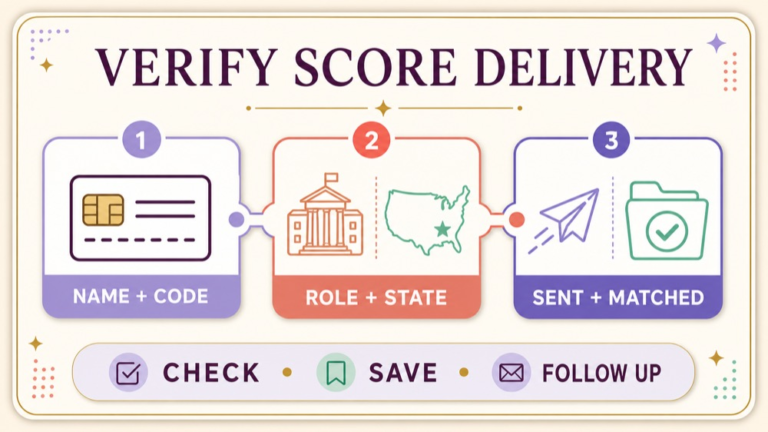
After the official score is posted, open the Score Reports page in your Praxis account and save the report. The current ETS Getting Your Scores page says the official report is posted in the account on the score-reporting date and that selected institutions or agencies also receive score information. Check your own report first, then follow the receiving organization’s process for confirming a match.
ETS’s score-reporting guidance calls the report sent to a selected institution or agency a Designated Institution Score Report. It can include the test-taker’s name, score, pass or no-pass information for designated recipients, background and educational information, and detailed content-category performance. Use only the information the receiving office requests, and protect personal details while uploading or emailing documents.
- Open the official score report in your Praxis account.
- Verify your name, test, code, test date, and score.
- Compare the recipient list with the confirmation you saved.
- Check the receiving organization’s account or application portal if it offers one.
- Ask the office how long its matching process takes and what proof it accepts.
- Keep the report, order confirmation, and follow-up message together.
- Ask ETS about an account or delivery issue with a precise date and recipient code.
A recipient’s internal processing time is different from ETS’s act of sending score information. If a deadline is close, contact the receiving office early and explain the test date, report date, and recipient selected. Do not forward an entire personal record when a score page or official delivery is the requested item.
Order an additional score report carefully
If an organization was not selected during registration, first ask whether it needs an additional ETS report. The current ETS Sending Your Scores page says Praxis scores are valid for ten years and that additional score reports can be ordered during that period. It currently lists the additional report as nonrefundable and priced at $50 per score recipient.
Before checkout, confirm the recipient name and code, the reason the report is needed, the deadline, and whether the organization will match the delivery to your application. ETS describes online paths through the Praxis account, including a score-recipient option associated with the test. Keep the order confirmation, but remember that a payment receipt records the order and does not confirm that the receiving office has completed its own processing.
- Ask the receiving organization for its current code and delivery instruction.
- Check whether your existing candidate copy satisfies the request.
- Confirm that the score is within the period in which ETS makes it available.
- Review the current fee and nonrefundable language before paying.
- Save the recipient, date, amount, and order confirmation.
- Follow up with the receiving office using the information it asks for.
Do not purchase a report solely because a code appears in a list. The fee decision belongs after the receiving organization confirms its requirement and the exact destination is verified.
Keep a score-recipient record
Create one private record with the test code, appointment date, recipients, codes, role of each recipient, report date, application deadline, and follow-up status. A simple table can prevent repeated searches and makes it easier to explain a routing question to ETS or a licensing office.
| Record | Example entry to capture | When to update |
|---|---|---|
| Test identity | Speech-Language Pathology Praxis 5331 | Before registration |
| Recipient role | Attending institution, state agency, or designated organization | When the form asks for the field |
| Code | Exact A, R, or RA code shown in the current list | Before final submission |
| Confirmation | Account or appointment record and date saved | Immediately after registration or change |
| Delivery status | Report available, sent, matched, or question open | After the official score posts |
Store the record securely and limit the personal information in any message to the minimum needed for support. Your score-recipient record should help you answer a question, not create a second copy of sensitive documents in many places.
Avoid common recipient mistakes
Recipient errors usually happen when a candidate mixes up roles, codes, states, or deadlines. A deliberate final review is faster than correcting an incorrect destination after the free-change window. Watch for these patterns:
- Selecting a school because its name looks familiar without checking the current code.
- Confusing an attending institution with a designated score recipient.
- Choosing the state where the test occurs instead of the state that evaluates the application.
- Assuming automatic reporting covers every state, school, or certification route.
- Using an old recipient-code PDF without checking its update date.
- Waiting until the appointment week to ask the program for its code.
- Paying for an additional report before confirming that it is required.
- Treating an order receipt as proof that the office has matched the report.
- Sending more personal information than the receiving office requested.
The repair is consistent: name the organization’s role, verify the exact code, compare the destination with the current requirement, save the confirmation, and follow up after the official report posts. If a name or code is ambiguous, ask the organization or ETS rather than relying on a search result.
Praxis SLP score recipient checklist
Before you complete registration or buy an additional report, confirm each item below:
- Did I select the correct Speech-Language Pathology Praxis test, code 5331?
- Do I know whether each destination is an attending institution or a designated recipient?
- Did I ask the school, state, agency, or certification organization for its current instruction?
- Did I verify the exact name, state, campus, and code in the current ETS list?
- Did I check whether automatic state reporting applies to my situation?
- Did I review the free-recipient change window shown by ETS?
- Did I save the final recipient list and appointment confirmation?
- After the score posted, did I save the official report from my Praxis account?
- Did I ask the receiving office how it confirms delivery or matches an application?
- Before purchasing an additional report, did I verify the destination, fee, deadline, and requirement?
Good Praxis SLP score recipients planning is a small administrative skill with a clear payoff: the result has a verified route to the organization that needs it. Keep the current ETS pages and the receiving organization’s instructions together, and revisit them when an appointment, policy year, or application pathway changes.
Sources and next steps
Start with ETS Sending Your Scores for current recipient changes, additional reports, fees, and automatic-reporting context. Use the current ETS Audiology/Speech-Language Pathology recipient-code PDF for A, R, and RA code guidance, and check ETS Getting Your Scores for account access and score delivery. Review ETS Score Reporting, ASHA Praxis registration guidance, and the current ETS 5331 page before finalizing a recipient choice.
Continue your preparation: Explore the SLP Study Center learning resources.
Continue your preparation: Explore the SLP Study Center learning resources.