
If you search for praxis slp, you are probably looking for more than a list of topics. You need to know what the Speech-Language Pathology Praxis 5331 exam is asking you to do with those topics: recognize the clinical task, weigh the evidence in a short scenario, and choose the response that best fits the client, setting, and professional purpose.
This guide gives you a practical map for that work. It separates current exam facts from study strategy, shows how the three content categories connect, and turns broad subjects into repeatable decisions. Use it as a starting point, then confirm fees, delivery options, score requirements, and certification rules at the current ETS, ASHA, and state-authority pages before you register.
Table of Contents
- What the Praxis SLP Exam Is Really Testing
- Check the Current 5331 Format First
- Map the Three Content Categories
- Study by Clinical Decision, Not by Word List
- Build High-Value Distinctions
- Use Practice Questions as a Feedback System
- Build a Sustainable Praxis SLP Study Plan
- Verify Registration and Score Rules
What the Praxis SLP Exam Is Really Testing
The current ETS description says that Speech-Language Pathology 5331 measures knowledge important for independent practice across primary employment settings. It is not limited to recalling a definition in isolation. The test includes foundational knowledge, professional practice, and specialized knowledge applied from screening and assessment through treatment and treatment evaluation.
That description changes how you should study. If your notes are organized only as long lists of disorders, instruments, and techniques, you may recognize vocabulary without being ready to decide what the scenario requires. A stronger review question is: What decision would a new clinician need to make here, and what evidence would control that decision?
For example, a stem may include a referral concern, a screening result, a case-history detail, a communication partner, and a service setting. Each fact can matter differently. One fact may identify the purpose of the encounter, another may limit what can be concluded, and another may point toward collaboration or referral. The best answer is usually the one that fits the task and the evidence—not simply the answer containing the most familiar clinical term.
Use the following four-part frame whenever you review a topic:
- Task: Is the question asking for a definition, next step, interpretation, priority, referral, treatment choice, or outcome decision?
- Evidence: Which finding in the scenario is decisive, and which details are background?
- Boundary: What can the current information support, and what still requires more assessment or collaboration?
- Result: What observable change, follow-up finding, or professional action would show that the decision was appropriate?
Check the Current 5331 Format First
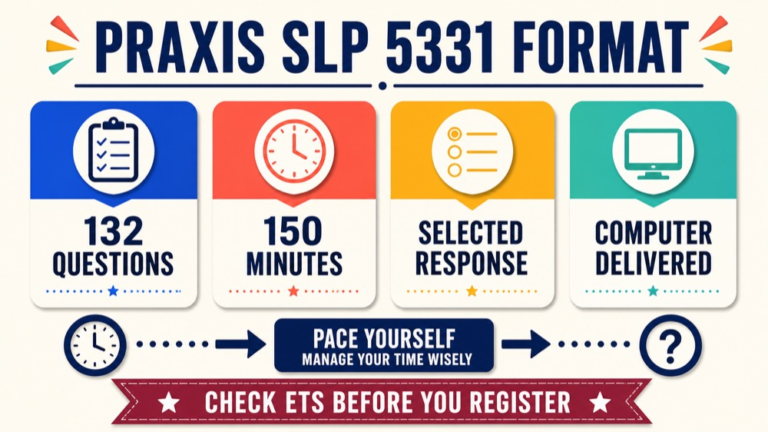
Before you design a calendar, review the current ETS Speech-Language Pathology (5331) test page. At the time this article was checked, ETS listed a computer-delivered, selected-response exam with 132 questions and 150 minutes of testing time. The page also displayed the current test fee, delivery options, and score-recipient information. These are changeable details, so treat this article as a study map rather than a replacement for the registration page.
- Test code: Speech-Language Pathology 5331.
- Question format: selected-response questions as listed by ETS.
- Question count: 132 questions as listed when checked.
- Testing time: 150 minutes as listed when checked.
- Delivery: computer delivered, with current at-home and test-center information shown by ETS.
- Score recipients: confirm the current codes and recipient rules during registration.
One hundred fifty minutes for 132 questions averages a little more than one minute per question. That average is useful for pacing practice, but it does not mean every question deserves exactly the same time. A short, clear item should move quickly; a complicated scenario may deserve a careful read of the task, the decisive clue, and each option. Practice marking a best answer and moving on when one item begins to consume the time needed for several others.
ETS also notes that the test may contain questions that do not count toward the score and that test takers cannot identify them during the session. The practical study rule is to answer every question with the same care. Do not waste time trying to detect which items are experimental, and do not build a strategy around leaving an item blank.
Map the Three Content Categories
ASHA’s current 5331 content page organizes the examination into three broad categories, each listed at approximately 44 questions or one-third of the examination. The categories are not three unrelated subjects. They describe a connected clinical reasoning path: understand the profession and the person, determine what is known, then plan and evaluate what should happen next.
Foundations and Professional Practice
This category includes development and performance across the lifespan, factors that influence communication and swallowing, common disorder characteristics, prevention, culturally and linguistically appropriate service delivery, counseling, collaboration, documentation, ethics, legislation, advocacy, research methods, and evidence-based practice. Study it through the question, What makes this service or professional action appropriate in context?
A common mistake is to treat professional practice as a collection of side topics that can be reviewed at the end. In a scenario, documentation, consent, collaboration, access, or culturally responsive practice may determine which clinical action is defensible. Add those factors to your reasoning rather than searching only for a disorder label.
Screening, Assessment, Evaluation, and Diagnosis
This category covers screening, case history, assessment instruments and procedures, factors that influence communication and swallowing, anatomy and physiology, referrals, assessment across the major practice areas, and etiology. The central question is, What is known now, and what information is still needed?
Keep the purpose of each step visible. A screening result can indicate that more information is warranted; it does not automatically answer every diagnostic or treatment question. An assessment procedure may be appropriate only when it matches the referral concern, the client’s characteristics, and the question being asked. When two options sound reasonable, compare the purpose and evidence requirements of the options instead of choosing the more technical-sounding one.
Planning, Implementation, and Evaluation of Treatment
This category includes treatment factors, prioritization, goal development, treatment details, prognosis, communication of recommendations, general treatment principles, progress monitoring, outcomes, and follow-up referrals. Its central question is, What should happen next, and how will we know whether it is helping?
Do not study treatment as a list of techniques detached from the reason for using them. Link a goal to the client’s needs, link an intervention to the target, and link evaluation to an observable outcome. A response that names a technique but ignores the clinical priority or provides no way to monitor progress may be incomplete even when the technique itself is familiar.
Study by Clinical Decision, Not by Word List
Once you understand the blueprint, turn each broad topic into a decision set. Instead of writing “fluency” at the top of a page, write the decisions you may need to make: describe the observable speech behavior, decide what information is needed, distinguish an assessment purpose from an intervention purpose, select a reasonable next step, or identify what progress data would show.
A focused study block can follow this sequence:
- Name the task: write one sentence such as “choose the next assessment step after a failed screen.”
- Define the construct: explain the key term in plain language and identify the features that matter.
- Choose the nearest confusion: select the concept, procedure, or decision that could easily be mistaken for it.
- Find the separator: write the evidence that makes the two choices behave differently in a scenario.
- Apply it: answer new scenarios before reviewing the explanation.
- Retrieve it: close your notes and state the rule, the boundary, and the next action from memory.
This method gives your review a visible output. At the end of a session, you should have a decision rule, an example, a distinction, and one unanswered question to verify. That is more useful than a page of highlighted text because it tells you what to practice next.
It also helps you integrate practice areas. A mixed set that moves from speech sound production to language, hearing, or feeding and swallowing may feel less comfortable than a single-topic block, but it trains the recognition step that comes before the answer. Read the task first, then use the content clues to narrow the options.
Build High-Value Distinctions
Many learners know both terms in a pair and still miss the question because they do not know which feature separates them in context. Build a distinction table for concepts that share vocabulary but lead to different actions.
- Screening versus assessment: compare the purpose, depth, and decision that each process can support.
- Assessment versus diagnosis: separate collecting and interpreting information from naming or characterizing a condition.
- Evaluation versus treatment: ask whether the task is measuring or changing a skill, behavior, or participation outcome.
- Goal versus technique: identify the observable target before choosing the method used to address it.
- Referral versus recommendation: distinguish identifying a need for another professional from giving a plan within the current scope.
- Impairment versus activity or participation: determine whether the stem focuses on the body function, the task, or the person’s involvement in daily life.
- Validity versus reliability: ask whether a measure is interpreting the intended construct and whether it produces stable results.
- Progress monitoring versus outcome evaluation: distinguish ongoing adjustment from judging whether the broader plan achieved its purpose.
For each pair, write one contrast sentence. For example: “A screen helps decide whether more information is needed; a full assessment answers a defined clinical question with a broader evidence base.” Then write a scenario clue that would make each side more likely. The wording does not need to be elegant. It needs to be retrievable under time pressure.
Use Practice Questions as a Feedback System
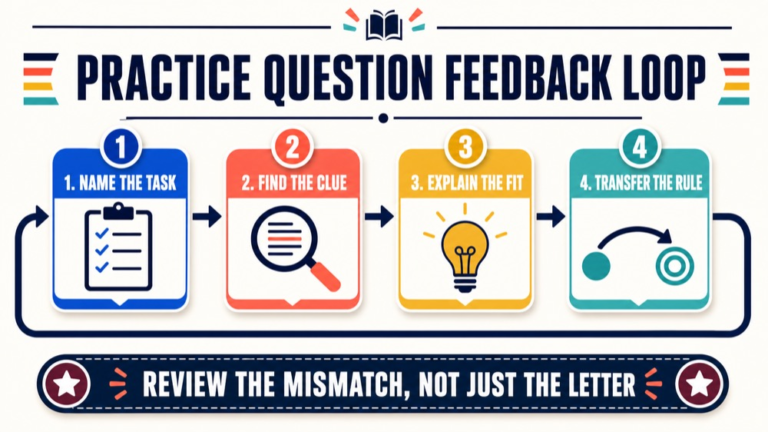
Practice questions should tell you what to do next, not simply give you a percentage. Before looking at the answer choices, identify the task. Is the item asking for a definition, a next step, an interpretation, a priority, a referral, an ethical response, a treatment plan, or an outcome measure? This first classification reduces the chance that a familiar term will pull you toward the wrong type of answer.
After choosing, complete a four-line review:
- Decisive evidence: what detail in the stem controlled the answer?
- Correct fit: why does the best option answer the question that was actually asked?
- Distractor mismatch: what specific evidence or task does each other option miss?
- Transfer rule: what would change the answer in a different population, setting, or stage of care?
If you cannot explain why the distractors are wrong, do not count the item as fully reviewed. A familiar answer may be correct for a different task. The learning value comes from identifying the mismatch and recording the rule that can transfer to a new scenario.
Use original practice material and label it accurately. A study question can imitate the reasoning demand of a multiple-choice item without being an official ETS question or a recalled exam item. Keep the source trail for clinical claims, and use the current ETS page for exam-administration facts.
Build a Sustainable Praxis SLP Study Plan
Your calendar should reflect both coverage and retrieval. A useful weekly cycle has one pass for learning, one pass for distinctions, one mixed application session, and one review of errors. Adjust the number of sessions to your schedule; consistency matters more than copying someone else’s hours.
- Session 1 — foundations: review one professional or foundational decision and write its boundary.
- Session 2 — assessment: compare screening, assessment, evaluation, diagnosis, and referral decisions.
- Session 3 — treatment: connect a goal, intervention, monitoring method, and outcome.
- Session 4 — practice: complete a mixed set and record decisive evidence for every miss.
- Session 5 — distinction repair: revisit the two confusions that caused the most errors.
- Session 6 — timed application: practice pacing without sacrificing a full read of the task and options.
- Session 7 — retrieval and logistics: state core rules from memory and check the current registration information.
Every week, sort missed items into reasoning categories rather than only content categories. “I confused screening with diagnosis” tells you what to repair. “I missed language” is too broad to guide the next session. Over time, the error log becomes a personalized map of the decisions that require more practice.
When the exam is close, reduce the number of new resources. Use your distinction log, mixed practice, source checks, and pacing routine. A last-minute pile of disconnected summaries can create the feeling of activity without improving the decisions you need to make.
Verify Registration and Score Rules
Before registering, return to the current ETS Speech-Language Pathology 5331 page for the fee, delivery options, scheduling instructions, accommodations, and score-recipient details. ASHA’s registration guidance also explains how candidates designate recipients, including the code used to send results to ASHA for certification. Follow the current instructions rather than relying on a screenshot or an older study post.
For ASHA certification, ASHA currently lists a passing score of 162 on a 100–200 scale and explains that states may set different passing requirements for licensure or teacher credentialing. ASHA also states that results submitted for initial certification must come directly from ETS and describes a five-year score-age rule. These facts are important but time-sensitive: verify the current certification page and the relevant state authority for your application.
Finally, remember what a study plan can and cannot do. It can organize retrieval, expose distinctions, and help you practice clinical reasoning. It cannot guarantee a result or replace the current requirements of ETS, ASHA, or a state licensing authority. If you want a structured learning path after this overview, you can explore the SLP Study Center preparation resources while keeping the official sources as the final authority.
Sources
For current test format, timing, delivery, question count, fee, and broad exam information, review the ETS Speech-Language Pathology (5331) test page. For certification context, current passing-score information, state variation, and score-age guidance, review ASHA’s Speech-Language Pathology Praxis Exam overview. For the three content categories and topic coverage, review the ASHA Speech-Language Pathology Exam 5331 content page. For registration and score-recipient instructions, review ASHA Praxis Exam Registration. Check these pages again before registration or any later article update.