
praxis score release dates can refer to a report in an account, a preliminary display, a current requirement, or a personal practice result. Use the current ETS score-date or account information for the specific test and delivery method. Treat a date as a source-based planning point, not a universal interval for every administration. This guide keeps those pieces separate so a source-based fact is not confused with a study estimate or a pathway decision.
Use the current ETS Getting Your Scores page for account access and timing context, the ETS Score Reporting page for report fields, and the ETS Speech-Language Pathology 5331 page for exam context. The ASHA 5331 content page supports the study frame.
Administrative details can change. Add a checked date to your notes, use the responsible organization for a conflict, and treat the examples here as educational guidance rather than an individual certification, licensure, employment, or clinical decision.
What praxis score release dates means
The first step is to name the object you are trying to find or understand. A score report is a record connected to an administration. A preliminary display, when provided, is a different kind of information. A practice percentage is a study observation. A qualifying score is a requirement applied by the organization that uses the result.
| Object | Question it answers | Best next check |
|---|---|---|
| Account report | What result is displayed for this administration? | Open the current score-report area. |
| Timing notice | When does the provider say the report should be available? | Check the test-specific date or instructions. |
| Practice result | How did I perform under this study condition? | Review the set, errors, and confidence. |
| Qualifying rule | What score or status does this pathway use? | Check the responsible state, agency, or authority. |
| Next action | What should I verify or practice now? | Write one dated step. |
These objects may appear together in a search result or conversation, but they should not be merged into one sentence. A clear article answers the reader’s immediate question and then shows which source owns the next fact.
Start with the current ETS source
Use the ETS test-taker and score-reporting pages for current instructions about locating a report, reading timing language, and understanding the fields shown to a test taker or recipient. Reopen the page when you register, receive a report, or plan another attempt.
- Record the page title and URL.
- Write the date you checked it.
- Confirm the test name and number.
- Separate account access from a score requirement.
- Note whether a statement is about timing, reporting, or qualification.
- Save a specific question if the page does not answer it.
- Use the responsible organization for pathway conflicts.
- Recheck before relying on a time-sensitive detail.
Search snippets, discussion posts, and old screenshots can help you formulate a question, but they should not replace the current page that owns the information. A dated source trail makes your notes easier to correct.
Confirm the exam and reporting pathway
Match the result to the full exam identity before you interpret it. For SLP learners, confirm whether the record names Speech-Language Pathology 5331 and whether the result is being used for certification, state licensure, a school process, employment, or another agency workflow.
Different organizations can ask for different receipt or documentation steps. The test provider can explain its report, while the state, agency, program, employer, or certifying authority explains how the result is used in its own process. Keep both lines in your worksheet.
| Identity check | Why it matters | Write down |
|---|---|---|
| Exam | Similar labels can refer to different tests. | Full name and number. |
| Administration | Date and delivery details affect timing context. | Test date and report date. |
| Pathway | The receiving organization may set the qualifying rule. | State, agency, program, or authority. |
| Recipient | A selected recipient does not describe every requirement. | Recipient and receipt question. |
| Source | A current rule can replace an old note. | URL, owner, and checked date. |
Read the result field by field
Read the report from the identity line through the status and recipient context before focusing on the number. Look for the administration date, score or scores, explanatory language, and detailed content-category information when those fields are provided.
- Confirm the name and exam code.
- Confirm the date connected to the result.
- Identify the score field and provider wording.
- Read any status or pass/no-pass context.
- Check the recipient or transmission line.
- Separate category performance from the pathway decision.
- Save the record according to the applicable privacy policy.
- Write questions beside the field rather than editing the record.
A report can document an important result while leaving a pathway question unanswered. That is normal: the receiving organization may still need an application, documentation, fee, background check, supervised practice, or another requirement outside the report.
Separate a report from a practice signal
A practice set is created under a particular mix, time limit, environment, and review method. Its percentage can help you plan study, but it is not the same field as a provider-reported score. Keep the test-result record and preparation record in separate sections.
When you review practice data, add the condition. Note whether you were timed, whether the set covered mixed domains, whether you reviewed explanations, and whether misses came from content, pacing, context, access, function, or sequence. This makes the signal useful without turning it into a forecast.
| Note | Meaning | Do next |
|---|---|---|
| Report displayed | A source-based result field. | Read provider wording and pathway context. |
| Practice percentage | Performance under one study condition. | Classify errors and choose a repair. |
| Low confidence | Uncertainty even when an answer was selected. | Write the evidence-to-action explanation. |
| Old screenshot | A record with unknown currency or context. | Recheck the current source. |
| Friend’s number | Another person’s result or pathway. | Do not substitute it for your process. |
Check timing and status language
Timing pages often use conditional language because availability can depend on the selected test, administration, delivery method, calendar, and account process. Use the current ETS page for the specific test rather than converting a general anecdote into a deadline.
Read “pending,” “preliminary,” “available,” “reported,” and “received” as separate status questions. If a source does not define a status, record the word exactly and ask the provider or receiving organization what it means for your next step.
- Check the current score-date tool or account instructions.
- Use the test-specific date when one is displayed.
- Distinguish notification from the report itself.
- Do not treat a pending card as a result.
- Confirm when a recipient can access or process the record.
- Plan with a buffer for an application or deadline.
Match the result to the organization using it
ETS can describe report fields and general score context, but a state, agency, program, employer, or certifying authority may determine the qualifying rule or receipt process. Write the exact organization and pathway beside your result note.
For current passing-score context, use the ETS passing-score page and then follow the selected state or agency’s current instructions. For clinical study context, the ASHA Practice Portal can support topic review; it does not replace an administrative rule.
| Question | Source to start with | Record |
|---|---|---|
| Where is the report? | ETS test-taker instructions. | Account area and access date. |
| What does the field mean? | ETS score-reporting explanation. | Field name and wording. |
| What score is used? | State, agency, or certifying authority. | Pathway and current rule. |
| Was it received? | The named recipient or program. | Receipt or processing step. |
| What should I study? | Your practice log plus current clinical sources. | Error category and next repair. |
READ THE SCORE RELEASE CALENDAR
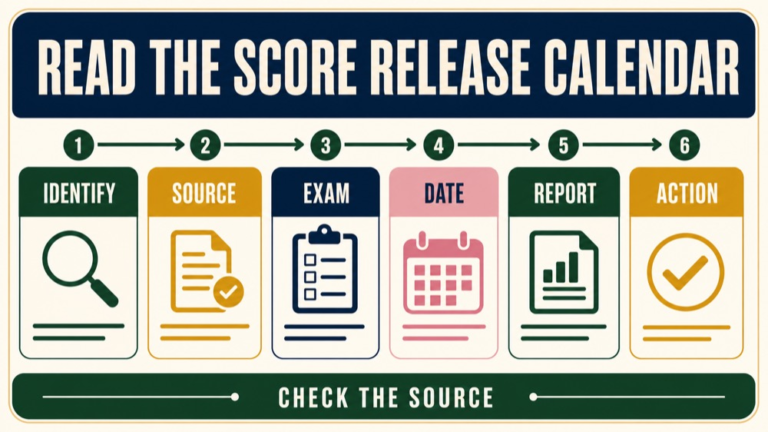
Use the first map to move from a vague result question to a traceable field. Start with exam identity, check the source, locate the report or calendar, and write the exact item that remains unclear. This prevents a search result from doing the work of a current source.
If the reader’s question is about a score, keep the provider-reported field separate from any study estimate. If the question is about a deadline, use the test-specific timing source and leave room for the receiving organization’s processing step.
FROM TEST DATE TO SCORE REPORT
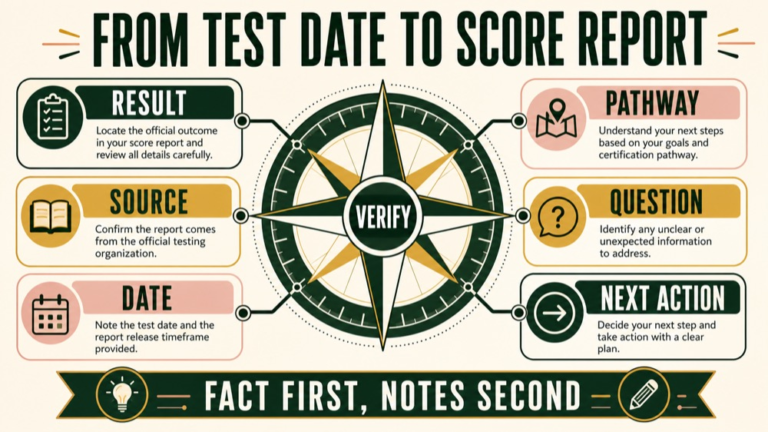
The second map turns a verified result into a next action. A source fact can lead to a report check; a practice pattern can lead to a focused review; a pathway question can lead to a direct message to the responsible organization.
- FACT: cite the current page.
- FIELD: name what the report displays.
- PATH: identify who uses the result.
- SIGNAL: record the practice condition and pattern.
- REPAIR: choose one study change.
- FOLLOW-UP: set a date to verify or review.
Use the result to choose a study action
Once the administrative question is settled, return to the reasoning behind your practice work. Identify whether misses involve evidence, context, access, function, pacing, professional sequence, or transfer. Then choose a small repair that can be checked in the next session.
- Describe: state what happened under the condition.
- Classify: name the primary error pattern.
- Repair: select one resource or practice change.
- Transfer: change one context variable after a delay.
- Compare: review the explanation, not only the percentage.
For language, cultural, and communication-access context, consult the ASHA Cultural Responsiveness resource when it is relevant to the case. Add language history, mode, partner, environment, and function to the reasoning record rather than treating them as decorative details.
Common mistakes to avoid
Most result confusion comes from moving a statement from one context to another. Check these common mistakes before you email a score or mark a task complete:
- Using a search snippet instead of the current source.
- Confusing a notification with the account report.
- Comparing a practice percentage with a reported scaled score.
- Applying another candidate’s date or qualifying rule.
- Reading a status word without checking its definition.
- Assuming one recipient’s process covers every pathway.
- Posting private score information when a direct channel is available.
- Changing every study resource after one result without classifying the miss.
A precise question is more useful than a broad worry. Include the exam identity, date, field, pathway, source checked, and the exact ambiguity you need resolved.
Keep access, privacy, and function visible
Give yourself a fair study condition. Consider language, dialect, communication mode, hearing, vision, motor access, technology, fatigue, noise, scheduling, and environment when you compare practice results. If a barrier changes the condition, record it before drawing a study conclusion.
Protect private score records and use the communication channel named by the responsible organization. In clinical examples, connect reasoning to activity and participation while keeping the example educational and within professional boundaries.
Quick verification checklist
Before relying on a result for a deadline or pathway, confirm:
- Exam name and number match the intended test.
- Administration and reporting dates are recorded.
- Current ETS account or timing instructions were checked.
- Score, status, and recipient fields were read separately.
- Practice data are stored separately from the report.
- State, agency, program, employer, or certifying authority is named.
- Current qualifying or receipt instructions are linked.
- Private information is shared only through an appropriate channel.
- One unresolved question is written in plain language.
- One study repair and a follow-up date are scheduled.
Questions to take to the source
Use these questions when the page or report does not settle the issue:
- Which exam and code does this result describe?
- Which date controls the report or process?
- Where is the current report located?
- What does the displayed status mean?
- Which score field should the recipient use?
- Who sets the qualifying rule for this pathway?
- Has the intended recipient received or processed the result?
- What should happen if two public sources differ?
- Which detail is a study signal rather than an administrative fact?
- When should the source be checked again?
Sources and next steps
Start with the current ETS Getting Your Scores page, ETS Score Reporting page, ETS passing-score page, and ETS Speech-Language Pathology 5331 page. Use the ASHA 5331 content page and ASHA Practice Portal for study and clinical context.
For language and cultural context, review the ASHA Cultural Responsiveness resource. Recheck current state, agency, employer, school, program, facility, and professional requirements before relying on an administrative detail.
Next, write the exam identity, source URL, field or question, pathway, and one dated action. Keep the verified fact and the study signal in separate lines.
Continue your preparation: Explore the SLP Study Center learning resources.