
The praxis exam in speech language pathology is easier to prepare for when you treat it as a decision-making exam rather than a list of disconnected facts. The test asks you to connect foundational knowledge, professional judgment, assessment, and treatment across the scope of speech-language pathology. That means your study plan should mirror the way the exam organizes knowledge and the way a beginning clinician is expected to reason.
Table of Contents
- what the praxis exam is and what it is not
- what the praxis exam measures
- how the exam format changes your preparation
- how to turn the blueprint into a study plan
- common preparation traps to correct early
- what to verify before you register and before you test
- quick review
- references
This guide explains what the Speech-Language Pathology Praxis 5331 exam is, what the current official sources say about its structure, how to divide your study time, and which preparation mistakes create avoidable gaps. Use the official ETS and ASHA pages linked below to verify current registration, score-reporting, and policy details before test day.
What the Praxis Exam Is—and What It Is Not
The Speech-Language Pathology Praxis exam is test code 5331. ETS owns and administers the exam, while ASHA uses the exam as part of its certification standards and provides professional guidance about the role of the score. The exam is also used by state licensing or credentialing systems, so the exact requirement for a candidate can depend on the state or agency involved.
ASHA describes the exam as an integral component of the certification process. The current ASHA certification page lists a passing score of 162 for the purposes of ASHA certification, but a state may adopt a different score or additional requirements. A useful study habit is to separate three questions that are often blended together:
- What does the current ETS test page say about the exam format, timing, delivery, and registration?
- What does ASHA require for certification, including the current passing-score rule and score-report process?
- What does the state or credentialing agency require for the license or school credential you are pursuing?
Those questions have related answers, but they are not interchangeable. A strong learning article can explain the exam and help you study; it cannot replace the current instructions from ETS, ASHA, or your state authority. Before relying on a date, fee, score-recipient code, accommodation rule, or licensure requirement, check the live source rather than an older study post.
What the Praxis Exam Measures
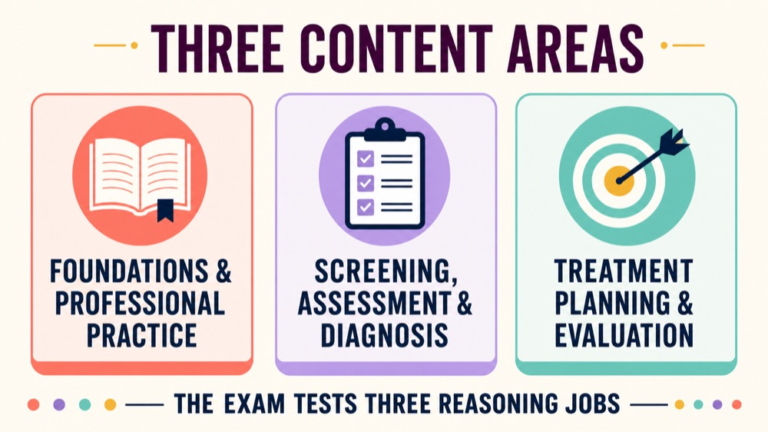
ETS currently describes the test as a computer-delivered, selected-response exam with 132 questions and 150 minutes of testing time. The content is organized into three broad categories with approximately equal representation. Think of those categories as three different reasoning jobs rather than three isolated textbooks.
- Foundations and Professional Practice: connect normal development, disorder characteristics, professional responsibilities, ethics, evidence-based practice, documentation, collaboration, and culturally responsive service delivery.
- Screening, Assessment, Evaluation, and Diagnosis: decide what information is needed, which procedure fits the referral question, how to interpret findings, and when a referral or additional evaluation is appropriate.
- Planning, Implementation, and Evaluation of Treatment: move from assessment findings to priorities, goals, treatment decisions, monitoring, outcomes, recommendations, and follow-up.
Within those categories, ETS identifies nine recurring areas of practice: speech sound production; fluency; voice, resonance, and motor speech; receptive and expressive language; social aspects of communication including pragmatics; cognitive aspects of communication; augmentative and alternative communication; hearing; and feeding and swallowing. The same area can appear in more than one reasoning context. For example, feeding and swallowing knowledge may be tested through screening, assessment selection, treatment planning, or outcome evaluation.
That overlap explains why memorizing a term without practicing its use can feel productive but leave a gap on exam day. For each major topic, build a small chain: definition, clinical significance, assessment implication, treatment implication, and the boundary that prevents an overconfident conclusion. You are not trying to diagnose a real person from a short practice stem; you are learning to choose the best-supported next decision from the information provided.
How the Exam Format Changes Your Preparation
A 132-question selected-response exam completed in 150 minutes gives you an average of a little over one minute per question. That average is a planning reference, not a command to rush every item. Some questions will be direct, while others require you to compare the referral question, available evidence, scope, and likely next step. Your preparation should therefore include both knowledge review and timed decision practice.
Use the stem as a decision filter
Before looking for a familiar diagnosis or intervention name, identify the job the question is asking you to do. Is the task screening, assessment, evaluation, diagnosis, treatment planning, implementation, or treatment evaluation? Is the patient information sufficient for a definitive conclusion, or is the safer answer the next assessment or referral step? Naming the decision type helps prevent an attractive but premature answer from taking over.
Read qualifiers as evidence
Words such as first, best, most appropriate, initial, and next change the task. So do details about setting, age, communication profile, hearing status, cultural or linguistic background, medical context, and previous intervention. These details are not decoration. They tell you which option is supported and which option assumes information the stem has not supplied.
Track decisions, not only percentages
A practice score can show that a problem exists, but it does not explain why you missed an item. After each timed set, classify the miss. Was the concept unknown, the question misread, the assessment choice confused with the treatment choice, or the answer selected before the evidence was weighed? A short error log is more useful than repeatedly rereading the same chapter without changing the decision process.
How to Turn the Blueprint Into a Study Plan
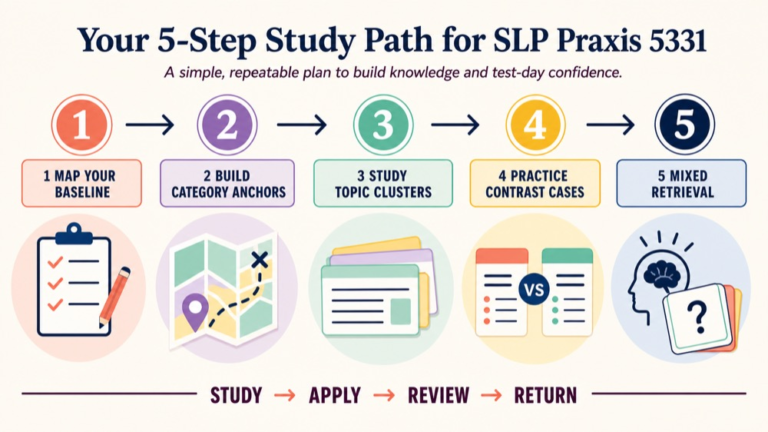
Start with a diagnostic practice set or a structured self-check, then use the result to distribute time across the three official categories. Equal blueprint representation does not mean equal personal study time. If assessment reasoning is your weakest area, it deserves more deliberate practice even though the test also includes foundations and treatment.
- Map your baseline. Complete a mixed set under realistic timing and record both the answer and the reason you chose it. Mark uncertainty separately from a confident error.
- Build category anchors. For each of the three categories, write the central question it answers: what should a clinician know, what should a clinician find out, and what should a clinician do and evaluate?
- Study in topic clusters. Review one area of practice through more than one category. For instance, study language disorders through assessment selection, differential reasoning, goal development, and treatment monitoring rather than through terminology alone.
- Practice contrast cases. Pair nearby decisions, such as screening versus comprehensive assessment, assessment versus diagnosis, or treatment selection versus treatment evaluation. Explain the deciding evidence in one sentence.
- Finish with mixed retrieval. As test day approaches, combine domains and question types. Keep an error log, revisit weak concepts, and practice moving on when a question requires more time than the evidence justifies.
A workable weekly rhythm can include one content-review block, one focused reasoning block, one mixed timed set, and one error-log review. The exact number of hours depends on your schedule and starting point. The important feature is the feedback loop: study a concept, apply it, inspect the decision, and return to the source or explanation that resolves the confusion.
Common Preparation Traps to Correct Early
Many candidates do not struggle because they lack effort. They struggle because the effort is aimed at a less useful target. The following traps are worth checking in your first week of preparation:
- Studying only by disorder name: the exam can ask what to assess, how to interpret a finding, or what to do next, not only which label fits.
- Treating every question as a treatment question: an assessment or referral decision may come before intervention planning.
- Ignoring professional-practice details: ethics, documentation, collaboration, advocacy, and culturally responsive care are part of the tested reasoning landscape.
- Using an old score or timing claim without checking it: current exam and certification information belongs to ETS and ASHA.
- Counting a practice percentage as a diagnosis of readiness: use performance patterns and error types to choose the next study action.
- Rereading explanations passively: close the explanation and state the rule, decisive evidence, and why the nearest alternative is weaker.
The best review question after a miss is not only, Why was my answer wrong? Ask, What evidence would have made the correct answer reasonable before I saw the options? That question builds a portable reasoning rule instead of a one-time memory.
What to Verify Before You Register and Before You Test
Use the current ETS Speech-Language Pathology 5331 page for the live test listing, delivery options, fee, registration path, and official preparation links. Use ASHA’s Praxis certification guidance for the role of the exam, the current certification passing score, and certification-related timing. The ASHA 5331 content page is useful for reviewing the three broad categories and topic areas, but always confirm that your study materials reflect the current exam information.
On the practical side, confirm your state’s requirements, your graduate-program timeline, score-recipient instructions, identification and accommodation rules, and the date by which your score must be available. Keep a short checklist so that administrative uncertainty does not consume the study time you need for clinical reasoning.
Finally, remember the purpose of this exam: demonstrating knowledge expected of a beginning speech-language pathology practitioner. A clear study plan connects the blueprint to decisions, uses practice errors as feedback, and keeps current official requirements separate from advice found on third-party preparation pages.
Quick Review
Before you move to the next study session, see whether you can explain these points without looking back: the test code is 5331; ETS administers the computer-delivered selected-response exam; the current ETS listing gives the test length and question count; the content spans foundations and professional practice, assessment and diagnosis, and treatment planning and evaluation; and ASHA certification guidance is separate from state-specific requirements.
For a structured next step, explore the SLP Study Center learning resources and use this article as a map for deciding which category or topic cluster deserves your next focused review.
References
Primary sources checked for this article: ETS Speech-Language Pathology (5331), ASHA About the Speech-Language Pathology Praxis Exam, and ASHA Speech-Language Pathology Exam (5331) Content. Check the live pages again before relying on time-sensitive registration or policy details.