
praxis 5331 practice test should do more than produce a percentage. A useful practice test shows how you distribute time, read decision verbs, use case evidence, compare distractors, protect communication access, and explain the next step. The value comes from the review record that follows the timed portion.
Use the current ASHA Speech-Language Pathology 5331 content page for the study frame and the live ETS 5331 page for current exam context. The ASHA Practice Portal adds clinical context. The questions, rationales, maps, and checklist below are original educational material, separate from live test material and not individualized clinical advice.
Use the clock as feedback rather than as a promise about an individual result. Record the reason for a miss or delay: pacing, reading, evidence, access, function, sequence, or professional boundary. That detail tells you what to practice next.
What a Praxis 5331 practice test should show you
A practice test is a structured sample of your study process. It can reveal whether you understand a domain when the wording is unfamiliar, whether you can maintain context under time pressure, and whether you can explain why a tempting alternative is weaker. It should guide the next review rather than become a broad label about readiness.
| Signal | Question | Useful record |
|---|---|---|
| Purpose | Choose whether you are checking pacing, domain coverage, evidence use, or transfer. | A measurable reason for the session. |
| Set | Mix evaluation, treatment, foundations, access, and professional-practice scenarios. | A broad learning sample. |
| Clock | Choose a time window and a checkpoint for uncertain or lengthy items. | Useful pacing data. |
| Log | Record answer, confidence, clue, distractor, error type, and next review. | A repair plan rather than a percentage. |
| Review | Reserve time after the test to compare the reasoning behind each choice. | Evidence about how you decided. |
Choose a test size that leaves time for review. More questions are not automatically more informative when the explanations are skipped. A smaller mixed set with a clear rationale and one changed-case transfer prompt can show more about your reasoning than a long set of unexamined answers.
Start with the current source frame
Confirm the current exam identity and content frame before writing a practice-test schedule. The ASHA and ETS pages are source anchors for current context. Third-party practice pages can show common formats and learner language, but search results do not establish current scoring, administration, clinical truth, or professional requirements.
Keep a checked date beside administrative notes. If you record a time, registration detail, score-reporting point, or resource statement, revisit the live source when you revise the plan. Durable reasoning rules can stay in one section of your notes while changing exam facts stay dated.
For language and cultural context, review the ASHA Multilingual Service Delivery resource and the ASHA Cultural Responsiveness resource. Use current topic guidance when a question depends on language history, access, collaboration, or person-centered practice.
Set up a practice test with a clear purpose
Decide what the session is meant to teach before setting the timer. You might be checking domain rotation, pacing, evidence use, access checks, professional sequence, or transfer. A clear purpose helps you choose a useful set and interpret the result without overgeneralizing from one sitting.
| Setup element | Plan | Output |
|---|---|---|
| Question mix | Include evaluation, treatment, foundations, access, and professional practice. | A varied study sample. |
| Time boundary | Set a window and a checkpoint for uncertain items. | Pacing evidence. |
| Environment | Reduce avoidable interruptions and prepare water and a break. | A repeatable condition. |
| Answer log | Record choice, confidence, clue, distractor, and error type. | A targeted review map. |
| Review block | Protect time after the clock for rationale and transfer. | A learning action. |
Use original educational questions and keep the source boundary explicit. Avoid material presented as leaked, recalled, or guaranteed to represent a live test. A practice session is more trustworthy when it teaches a reasoning process rather than implying access to restricted content.
Use a two-part test session
Separate the timed run from the learning review. During the run, commit to choices, mark uncertainty, and follow the pacing rule. During the review, slow down and examine the evidence, sequence, access, function, and professional boundary. If the same clock governs both parts, the explanation is usually the first thing to disappear.
- Run: read the stem, identify the decision, choose, mark confidence, and continue at the checkpoint.
- Review: revisit uncertain and incorrect items, compare the closest distractor, and write the decisive clue.
- Transfer: change one context variable and solve a paired case after a delay.
- Schedule: assign one error type to the next focused session.
Use a pause between the two parts. A short reset helps you review the answer rather than defend the first impression. The goal is not to erase the timed result; it is to understand which part of the process produced it.
Read each item as a decision problem
Before scanning choices, write the action, person, activity, condition, evidence, and boundary. This six-field spine protects you from a technical term in a distractor becoming the center of the case. It also shows whether the question is asking for clarification, evaluation, treatment, referral, monitoring, documentation, or collaboration.
| Field | Prompt | Why it matters |
|---|---|---|
| Verb | What action does the item request? | Clarify, assess, interpret, treat, refer, monitor, or document. |
| Clue | Which fact changes the decision? | A contrast, limitation, support response, or safety signal. |
| Context | Where, with whom, in what language or mode, and under what demand? | Access, partner, setting, culture, and activity. |
| Sequence | What belongs now and what should happen later? | Clarification, safety, evidence, action, follow-up. |
| Function | What participation outcome matters? | School, work, family, care, or daily communication. |
| Boundary | What must be protected or confirmed? | Consent, privacy, competence, supervision, and handoff. |
When the case leaves a fact unstated, identify it as information to gather or confirm. Do not invent a hearing result, language history, consent, or local process. A careful answer can describe uncertainty and still choose a proportionate next step.
Compare answer choices with case evidence
The strongest distractor usually represents a real action used at the wrong time, under the wrong conditions, or at the wrong level of conclusion. Compare the top choices with the same questions: Which answers the requested verb? Which uses the decisive clue? Which fits the sequence? Which protects access and function? Which respects the professional boundary?
- Write one sentence for the selected choice and the case fact that supports it.
- Name the strongest distractor and the specific mismatch that weakens it.
- State what the evidence does not establish.
- Change one setting, partner, language, mode, support, or urgency variable.
- Write the revised action and schedule delayed review.
A choice is not stronger because it uses more technical vocabulary. It is stronger when its action is proportionate to the evidence and fits the person’s activity, context, and boundary.
Keep access, function, and professional boundaries visible
Read for language history, dialect, culture, communication mode, hearing, vision, motor access, technology, partner, noise, fatigue, consent, privacy, competence, supervision, safety, and local process when the scenario includes them. These details can change what a person can show and which next step is appropriate.
- Ask whether directions and response mode were accessible.
- Separate language difference, dialect, and communication mode from a disorder conclusion.
- Connect the action to the person’s activity and participation outcome.
- Record what a support changes in opportunity, effort, accuracy, or participation.
- Notice the role, authorization, privacy, competence, and supervision boundary.
- Stop, communicate, document, refer, or hand off when the case requires that sequence.
These checks are part of the answer rationale. They should not be added as a generic paragraph after a technical choice. A complete response shows how the person can participate and what the evidence can reasonably support.
SET UP A PRACTICE TEST THAT TEACHES
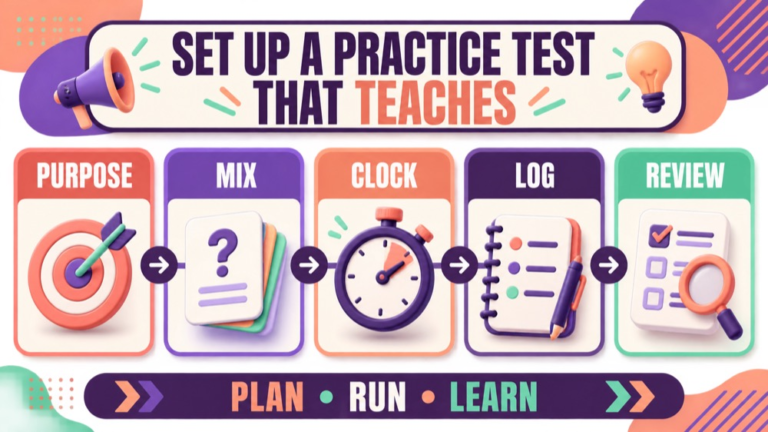
The setup map turns a timed test into a learning instrument: purpose, question mix, clock, log, and review. Write the purpose before opening the set. During the session, record the clue and confidence. Afterward, use the review block to turn the result into a focused next action.
| Setup note | Example | Why it helps |
|---|---|---|
| Purpose | Check pacing and evaluation-to-treatment transfer. | Gives the session a measurable focus. |
| Mix | Six evaluation, six treatment, four professional items. | Creates cross-domain evidence. |
| Clock | Use a checkpoint and mark items for return. | Separates pacing from knowledge. |
| Log | Choice, confidence, clue, distractor, error type. | Shows how the answer was formed. |
| Review | Write one rationale and one paired case. | Builds retention and transfer. |
Customize the numbers to your schedule. Keep the format stable for a few sessions so the comparison means something, then change one variable when you want to test transfer.
REVIEW THE TEST BEYOND THE SCORE
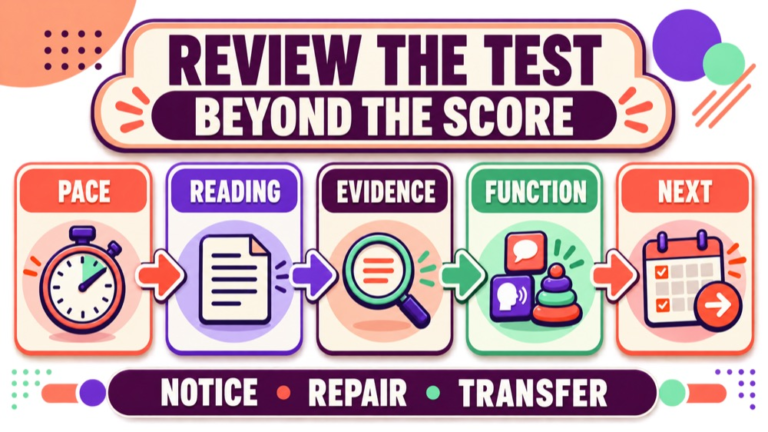
Review the test beyond the score. Look at what happened to the evidence, context, sequence, access, function, and professional boundary. A high percentage with weak explanations may call for rationale work; a lower percentage with clear error categories may provide a practical repair path.
| Result | Review question | Next action |
|---|---|---|
| Fast and correct | Did you use the clue or recognize a familiar phrase? | Add a changed-case transfer item. |
| Slow and correct | Which reading step consumed time? | Practice the six-field stem spine. |
| Fast and wrong | Which assumption or distractor drove the choice? | Rewrite the verb and decisive clue. |
| Slow and wrong | Was the issue content, access, sequence, or pace? | Classify one error and target it. |
| Correct but uncertain | Can you defend the choice without the key? | Write the rationale and closest distractor. |
Use the score as one data point. The review explanation is what tells you whether to change content, pacing, environment, or transfer practice.
Question 1: an evaluation decision
Practice Question 1. A child follows a short direction in a quiet room but misses multi-step directions during a noisy classroom transition. The teacher requests a broad language score before hearing and language history are reviewed. What is the best next step?
- A. Select the broadest test immediately because it may cover every possible concern.
- B. Conclude that the child has a global language disorder from the classroom report.
- C. Clarify the classroom concern, review relevant language and hearing context, observe the demand, and select representative evidence.
- D. Use only the quiet-room sample because it is easier to control.
Correct Answer: C. The contrast between quiet and noisy conditions is the decisive clue. The next step should define the concern and examine language, hearing, partner, rate, noise, and representative activity before a broad measure or conclusion.
Why the Other Options Are Wrong: A chooses a tool before defining the question. B expands one report into a broad conclusion. D removes the condition in which the concern appears. C matches evidence to the refined evaluation need.
Exam Trap: When the prompt asks for the next step, a test request does not remove the need to clarify the referral question.
Question 2: a treatment decision
Practice Question 2. An adult reaches a speech target more accurately during structured practice with a visual cue but avoids speaking during a work meeting. Which treatment response best uses the practice-test evidence?
- A. Treat structured accuracy as evidence that the meeting goal is complete.
- B. Remove the visual cue immediately so every trial measures unaided performance.
- C. Keep the helpful support while adding supported meeting practice and tracking accuracy, cueing, effort, and participation.
- D. Replace the target without reviewing the listener, activity, or meeting demand.
Correct Answer: C. The structured result shows that the cue may help, while the unchanged meeting participation shows that transfer conditions need practice. A functional plan can retain support and shape the target in the meaningful activity.
Why the Other Options Are Wrong: A treats a narrow practice result as the full outcome. B removes an access support before understanding its role. D changes direction without addressing the named activity. C connects target, support, context, and participation.
Exam Trap: A support can make participation possible. Compare the target, cue, effort, listener, and outcome rather than using support as a failure label.
Question 3: a safety and professional decision
Practice Question 3. During a facility-approved swallowing screen, a patient becomes less alert and develops a new vocal change after a trial. The local process requires the screen to stop and the team to be notified. What should the practice-test answer prioritize?
- A. Continue until enough trials have been collected for a fuller result.
- B. Use the earlier trial as the final result and continue the meal.
- C. Stop under the local process, communicate the change, document conditions and response, and arrange qualified follow-up.
- D. Ask an untrained helper to complete the remaining trials while the clinician writes the note.
Correct Answer: C. The new condition and stated stop process control the sequence. Stopping, communicating, documenting, and arranging qualified follow-up protect safety, role, and continuity without expanding a screen into a broader evaluation.
Why the Other Options Are Wrong: A disregards the local process. B treats earlier performance as final after conditions changed. D transfers a safety-sensitive task without appropriate competence or oversight. C makes the boundary and handoff explicit.
Exam Trap: A safety signal changes the order of action. More observations are not the priority after a stop rule.
Turn test results into the next review
Use one error category for each miss. A broad label such as “weak in treatment” is less useful than “selected a drill result without checking the work activity” or “ignored a local stop rule.” The table helps you make the repair specific.
| Error type | What it looks like | Repair |
|---|---|---|
| Pacing | You rushed the end or spent too long on one question. | Use a checkpoint and mark items for return. |
| Reading | You answered a different verb than the one in the stem. | Rewrite the question as one action sentence. |
| Evidence | You missed the contrast or treated one result as the whole picture. | Circle the clue and state its limit. |
| Access | Language, mode, hearing, partner, culture, or setting was ignored. | Add the condition needed for fair participation. |
| Function | The selected action did not reach the named activity. | Write the participation outcome. |
| Boundary | Safety, consent, privacy, competence, or handoff was overlooked. | Put the role and process into sequence. |
Review the strongest distractor, not only the correct answer. That comparison shows which reasoning path was attractive and what condition made it weaker. Then create a paired item that changes one variable.
Practice-test checklist
Before starting and after finishing, check the following points:
- Did I confirm the current ETS and ASHA source frame?
- Did I define the purpose, set, time window, checkpoint, and review block?
- Did I identify the decision verb before scanning choices?
- Did I mark person, activity, context, evidence, and boundary?
- Did I record confidence and uncertain items?
- Did I compare the selected choice with the strongest distractor?
- Did I check language, dialect, culture, hearing, mode, partner, environment, and support?
- Did I connect the answer to function and participation?
- Did I notice consent, privacy, safety, competence, supervision, and handoff?
- Did I classify each miss by pacing, reading, evidence, access, function, sequence, or boundary?
- Did I write a transfer version and schedule delayed review?
A complete practice test leaves you with a next action. If all you have is a score, return to the question record and add the clue, rationale, distractor, and repair.
Sources and next steps
For the current study frame, review the ASHA Speech-Language Pathology 5331 content page and the live ETS 5331 page. For clinical context, use the ASHA Practice Portal. For language and cultural context, review the ASHA Multilingual Service Delivery and ASHA Cultural Responsiveness resources.
For current preparation-resource information, check the ETS practice-test page. The questions, rationales, maps, and checklist here are original educational material, separate from live test material. Recheck current sources before relying on administrative, scoring, professional, state, school, agency, or facility requirements.
For the next session, run a short mixed practice test, record the clue behind each uncertain answer, classify one miss, and solve a paired case after a delay.
Continue your preparation: Explore the SLP Study Center learning resources.