
praxis 5331 practice questions work best when each item has a job in your study plan. Use one question to practice the decision verb, the decisive clue, evidence fit, context, sequence, access, and function. Then record what the answer teaches you and return to it after a delay. That process makes domain rotation more useful than a pile of unchecked answer letters.
Start with the current ASHA Speech-Language Pathology 5331 content page and the live ETS 5331 page for the exam frame. Use the ASHA Practice Portal for clinical topic context. The questions, rationales, maps, and checklist here are original educational material, separate from live test material and not individualized clinical advice.
A study question can show where your process needs work, but it cannot forecast an individual score. Keep current source checks separate from your original practice notes, and revisit date-sensitive information before carrying it into a plan.
How Praxis 5331 practice questions become a study system
A useful question set produces more than a correct choice. It gives you a compact case in which you can identify what decision is requested, what evidence matters, what context changes interpretation, and what action is proportionate. The explanation should also show why the other choices are weaker and how one changed condition would alter the answer.
| Study layer | What to practice | Record |
|---|---|---|
| Foundations | Identify the communication, development, health, learning, or participation concept in the case. | A concept tied to the scenario. |
| Evaluation | Match the referral concern to representative evidence and interpretation limits. | A defensible next step. |
| Treatment | Connect target, cue, activity, partner, and outcome to function. | An action linked to participation. |
| Professional practice | Protect consent, privacy, competence, safety, supervision, and handoff. | A sequence with the boundary visible. |
| Transfer | Change one context variable and reassess the action. | A rule that survives new wording. |
Rotate the layer you emphasize. If you only memorize foundations terms, you may not practice treatment transfer or professional sequencing. If you only time questions, you may not notice that the missed clue was language access or a safety boundary. A complete record keeps the reasoning visible.
Use current sources to frame the 5331 review
Confirm the current exam frame before building a long question schedule. The ASHA content page and ETS page are the source anchors for current identity and preparation context. Search results and third-party pages can show common learner intent, but they do not establish current scoring, administration, clinical truth, or professional obligations.
Record a checked date beside administrative details. If a page discusses time, registration, score reporting, or resource availability, recheck the live source when revising your notes. Keep durable reasoning rules separate from information that can change.
For multilingual and cultural context, review the ASHA Multilingual Service Delivery resource and the ASHA Cultural Responsiveness resource. Use the current topic page when a question depends on language history, communication access, collaboration, or person-centered practice.
Rotate domains without losing the decision
Domain rotation is useful when it changes the kind of reasoning you practice, not only the label at the top of the page. Before answering, name the decision type. Then choose the domain lens that helps you check the case.
| Domain lens | Core question | Typical risk |
|---|---|---|
| Foundations | What communication, health, learning, or development idea frames the case? | Choosing a definition without applying it. |
| Evaluation | What evidence answers the defined concern under fair conditions? | Selecting a measure before clarifying the question. |
| Treatment | What supported action connects target to activity and outcome? | Stopping at structured accuracy. |
| Professional practice | What safe, competent, collaborative sequence is required? | Skipping consent, safety, or handoff. |
| Access | How can the person understand and show the skill? | Treating language or mode as background. |
Keep the decision visible as you rotate. The same topic may produce an evaluation question in one item and a treatment or collaboration question in another. The action word tells you which kind of reasoning to use.
Build a question record before checking answers
Before reading the key, write the answer, confidence, decisive clue, and one reason. After reading the key, add the closest distractor, error category, and transfer change. This takes less time than rebuilding an entire study session after a pattern of unexplained misses.
| Record field | Prompt | Example output |
|---|---|---|
| Decision | What action is requested? | Clarify the referral question. |
| Clue | What detail changes the choice? | Performance changes in noise. |
| Answer | Which option fits and why? | Gather context before selecting evidence. |
| Distractor | Which choice is closest and what is missing? | Broad testing comes before question definition. |
| Boundary | What access, safety, role, or privacy limit matters? | Use a representative and safe condition. |
| Transfer | What changes if one variable changes? | Change partner or setting and reassess. |
Do not use confidence as a substitute for evidence. A high-confidence choice still needs a rationale, and a low-confidence choice may be defensible if the evidence supports it. The record helps you distinguish those situations.
Read context before technical vocabulary
Technical vocabulary can make an option sound correct before you have understood the scenario. Read the person, activity, setting, language or mode, partner, time course, evidence, and urgency first. Then compare the choices with that scenario spine in mind.
If the case includes a contrast, treat it as meaningful: quiet versus noise, structured practice versus participation, supported versus unsupported communication, or stable versus changed alertness. If the case includes a missing history or a local process, include that boundary in the next step.
- First read: identify the person and activity.
- Second read: mark the context and decisive contrast.
- Choice review: compare fit, evidence, sequence, access, function, and role.
- Rationale: state the reason and the evidence limit.
- Transfer: change one condition and solve again later.
Compare choices with an evidence ladder
Use the evidence ladder below when two or more answers sound plausible. A choice rises when it responds to the verb, uses the decisive clue, respects sequence, protects access, connects to function, and honors the boundary.
| Ladder step | Question | What to write |
|---|---|---|
| Question | What action does the item request? | Underline clarify, assess, interpret, treat, refer, monitor, or document. |
| Evidence | What fact changes the decision? | Use the report, observation, measure, response, or missing history. |
| Context | Where, with whom, in what language or mode, and under what demand? | Include access, partner, setting, and activity. |
| Sequence | What belongs now and what should come later? | Order clarification, safety, evidence, action, and follow-up. |
| Boundary | What must be protected or confirmed? | Consent, privacy, competence, supervision, and local process. |
| Outcome | What will the action answer or change? | Connect to function and participation. |
The strongest choice is not necessarily the most elaborate. It is the one that solves the requested decision at the level supported by the evidence. Avoid making a narrow observation into a broad conclusion or choosing a later action before the case is ready for it.
Keep access, function, and professional role visible
Read each scenario for language history, dialect, culture, communication mode, hearing, vision, motor access, technology, partner behavior, noise, fatigue, consent, privacy, competence, supervision, safety, and local process when relevant. These conditions can change both performance and the next action.
- Ask whether the person had an accessible way to understand the directions.
- Separate language difference, dialect, and communication mode from a disorder conclusion.
- Connect the decision to the activity and participation outcome.
- Record what a cue or support changes in opportunity, effort, accuracy, or participation.
- Notice the role, consent, privacy, competence, supervision, and handoff boundary.
- Stop or refer when a safety clue or local process requires it.
These checks belong inside the rationale. A technical answer with no access or function connection may be a poor fit even when the term is familiar. A professional answer should also show who communicates what and what happens next.
ROTATE THE 5331 PRACTICE DOMAINS
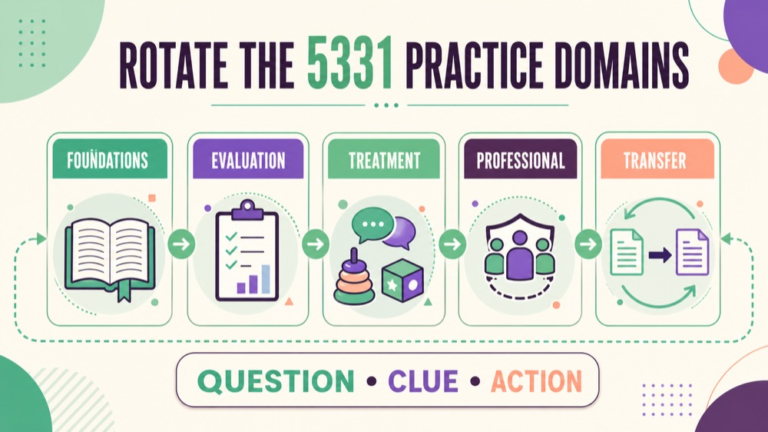
Use the domain-rotation map to distribute practice across foundations, evaluation, treatment, professional practice, access, and transfer. Before opening an answer explanation, mark the lane and the decision verb. Afterward, add the error category that tells you what to repair.
| Rotation note | Study question | Next action |
|---|---|---|
| Evaluation | Did the evidence answer the referral concern? | Create a representative-condition transfer case. |
| Treatment | Did the target reach the functional activity? | Add partner and participation data. |
| Professional | What boundary controlled the sequence? | Write the handoff or documentation step. |
| Access | How could the person show the skill? | Change language, mode, partner, or environment. |
| Transfer | What changed and what stayed stable? | Schedule delayed paired practice. |
Rotation works when the questions stay connected to decisions. Do not let a domain label replace a scenario analysis. The map is a study organizer, not a clinical label.
TURN EACH QUESTION INTO A STUDY SIGNAL
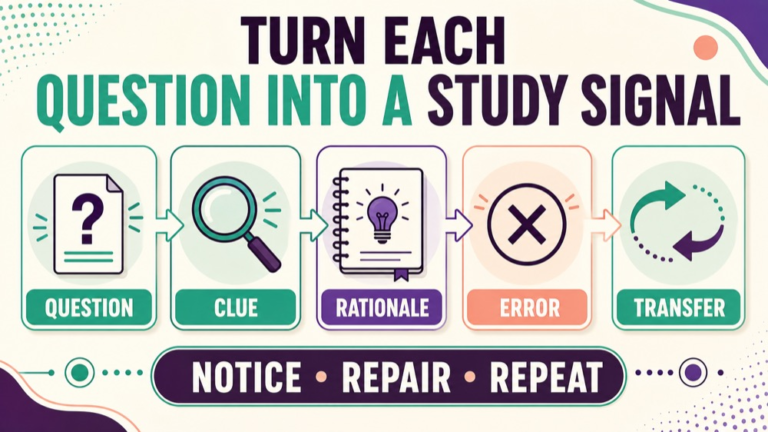
Turn each answer into a signal for the next review. A missed item may indicate reading, evidence, access, sequence, function, boundary, or transfer difficulty. A correct but uncertain item may need a stronger rationale. A correct and fast item may deserve a changed-case challenge.
| Signal | What it suggests | Review action |
|---|---|---|
| Missed clue | The evidence was not prioritized. | Circle the contrast and rewrite the action. |
| Wrong sequence | A later step was chosen too early. | Put clarification, safety, action, and follow-up in order. |
| Access omission | The conditions for participation were overlooked. | Add language, mode, partner, or environment. |
| Weak rationale | The letter was recognized without a rule. | Explain the best choice and closest distractor. |
| Transfer miss | The rule did not survive new wording. | Change one variable and solve after a delay. |
Keep the signal specific. “Study harder” does not tell you what to do. “Review how a support changes participation in a new setting” gives you a concrete next item.
Question 1: an evaluation and context decision
Practice Question 1. A student answers simple questions in a quiet room but misses directions during a noisy classroom transition. The teacher asks for a broad language score, and the record does not include hearing or language history. Which next step best fits the evaluation question?
- A. Choose the broadest test immediately because it can cover the largest number of skills.
- B. Conclude that the student has a global language disorder from the classroom report.
- C. Clarify the participation concern, gather language and hearing context, observe the routine, and select representative evidence.
- D. Use the quiet-room sample as the final description because it is easier to score.
Correct Answer: C. The change between quiet individual work and a noisy group routine is the decisive clue. Clarification, language and hearing history, representative observation, and measure selection should come before a broad interpretation.
Why the Other Options Are Wrong: A chooses a tool before defining the need. B expands one report into a global conclusion. D removes the context in which the concern appears. C matches the evidence to the refined evaluation question.
Exam Trap: A request for a score may actually be a request to understand a participation problem. Find the activity and condition first.
Question 2: a treatment and function decision
Practice Question 2. An adult uses a speech target more accurately during structured practice with a visual cue but avoids speaking during a weekly work meeting. Which treatment response best fits the functional goal?
- A. Treat structured accuracy as evidence that meeting participation is complete.
- B. Remove the visual cue at once so all later trials measure unaided performance.
- C. Keep the helpful support while adding supported meeting practice and tracking accuracy, cueing, effort, and participation.
- D. Replace the target without reviewing the listener, activity, or work demand.
Correct Answer: C. The structured result shows that the cue may help, while the unchanged meeting participation shows that transfer conditions need practice. A functional plan can preserve support and shape the target within the meaningful activity.
Why the Other Options Are Wrong: A treats one narrow result as the whole outcome. B removes a possible access support before understanding its role. D changes the target without addressing the named activity. C connects target, support, context, and participation.
Exam Trap: The presence of a cue is not the same as treatment failure. Ask what the support makes possible and how it can be adapted.
Question 3: a professional sequence decision
Practice Question 3. A facility-approved swallowing screen is underway when a patient becomes less alert and develops a new vocal change after a trial. The local process requires the screen to stop and the team to be notified. What is the best response?
- A. Continue until enough trials are collected for a more detailed screen.
- B. Use the earlier trial as the final result and continue the meal.
- C. Stop under the process, communicate the change, document the conditions and response, and arrange qualified follow-up.
- D. Ask an untrained helper to complete the remaining trials while the clinician writes the note.
Correct Answer: C. The new condition and stated stop process control the sequence. Stopping, communicating, documenting, and arranging qualified follow-up protects safety, role, and continuity without expanding a screen into a broader evaluation.
Why the Other Options Are Wrong: A disregards the local process. B treats earlier performance as final after conditions changed. D assigns a safety-sensitive task without appropriate competence or oversight. C makes the boundary and handoff explicit.
Exam Trap: When a stop rule is present, the item is testing sequence and communication. More data is not the priority after a safety signal.
Turn wrong answers into targeted practice
Classify a wrong answer before selecting another resource. A broad domain label hides the reasoning problem. The table gives you a first repair; add the actual clue from your question record.
| Error type | What it looks like | Repair |
|---|---|---|
| Domain label | You knew the topic but not the decision the case required. | Rewrite the item as an action sentence. |
| Clue | A contrast, limitation, or condition was overlooked. | Circle the detail that shifts the answer. |
| Access | Language, dialect, mode, hearing, partner, culture, or environment was ignored. | Write how the person can show the skill. |
| Sequence | A later intervention or conclusion was selected too soon. | Place the choices on a timeline. |
| Function | The answer stayed at the drill or impairment level. | Name the activity and participation outcome. |
| Boundary | Consent, privacy, safety, competence, or handoff was missing. | Add the role and continuity requirement. |
| Transfer | The rule failed when one condition changed. | Change one variable and solve a paired item. |
Review low-confidence correct answers as well. The goal is not to punish uncertainty; it is to convert it into a rationale, a comparison, or a transfer task. That makes the next practice question more purposeful.
Use a five-session domain rotation
A five-session rotation can keep the 5331 review varied while leaving room for explanation and delayed retrieval. Adjust it to your current source frame and question log.
- Session 1: foundations and evaluation purpose, evidence, and representative conditions.
- Session 2: treatment targets, cues, activities, partners, outcomes, and adaptation.
- Session 3: language, dialect, culture, communication mode, hearing, and access.
- Session 4: safety, consent, privacy, competence, supervision, collaboration, and handoff.
- Session 5: mixed timed practice followed by rationale and transfer review.
Use the current ETS and ASHA pages when you revise administrative or professional notes. Use the error log to decide whether the next session should change topic, pacing, environment, or review method.
Praxis 5331 practice question checklist
Before closing a session, check the following points:
- Did I identify the decision verb?
- Did I name the person, activity, setting, partner, language or mode, and urgency?
- Did I mark the decisive clue and separate evidence from assumption?
- Did I compare the best choice with the strongest distractor?
- Did I check access, language, culture, hearing, support, and environment?
- Did I connect the action to function and participation?
- Did I notice safety, consent, privacy, competence, supervision, and handoff boundaries?
- Did I explain what the evidence does not establish?
- Did I record confidence and classify the error type?
- Did I change one variable for transfer practice?
- Did I schedule a delayed review?
- Did I recheck live ETS or ASHA pages for date-sensitive information?
A complete practice record contains a decision, clue, answer, rationale, distractor analysis, boundary, transfer version, and next date. That record is the part of the session you can use again.
Sources and next steps
For the current study frame, review the ASHA Speech-Language Pathology 5331 content page and the live ETS 5331 page. For clinical topic context, use the ASHA Practice Portal. For language and cultural context, review the ASHA Multilingual Service Delivery and ASHA Cultural Responsiveness resources.
For current preparation-resource context, check the ETS practice-test page. The questions, choices, rationales, maps, and checklist here are original educational material, separate from live test material. Recheck current sources before relying on administrative, scoring, professional, state, school, agency, or facility requirements.
For the next session, choose one question from a different domain, write the evidence ladder, compare the closest distractor, and solve a paired version after a delay.
Continue your preparation: Explore the SLP Study Center learning resources.