
praxis 5331 practice exam can show how your study process behaves across mixed decisions, but a percentage is only one output. A useful practice exam also reveals pacing, evidence reading, access checks, professional sequence, confidence, and transfer. The review after the timed run is where those signals become a plan.
Use the current ASHA Speech-Language Pathology 5331 content page for the study frame and the live ETS 5331 page for current exam context. The ASHA Practice Portal provides clinical topic context. The questions, rationales, maps, and checklist below are original educational material, separate from live test material and not individualized clinical advice.
Set the purpose before you start. You may be checking pacing, domain coverage, evidence use, or the quality of your explanations. Keep current exam facts dated and separate from your original practice notes, then use the error log to choose the next review.
What a Praxis 5331 practice exam should measure
A practice exam is a sample of decisions under a defined condition. It can tell you whether you identify the requested action, find the clue that changes interpretation, compare answer choices, and explain the reason after the clock stops. It should give you information for the next session, not a sweeping statement about your future result.
| Signal | What it shows | Record |
|---|---|---|
| Pacing | How you distribute time and handle a lengthy or uncertain stem. | Checkpoint notes and marked return items. |
| Decision reading | How accurately you identify the action requested by the question. | The verb in your question record. |
| Evidence use | How well you connect the decisive clue to the selected option. | One evidence-to-action sentence. |
| Context | How you account for language, mode, partner, setting, function, and support. | A context check beside the answer. |
| Professional sequence | How you protect safety, consent, privacy, competence, and handoff. | A before-and-after action order. |
| Transfer | How the reasoning changes when one case variable changes. | A paired scenario after a delay. |
Choose a practice size that leaves room for review. A long run with no rationale log may produce a number but little direction. A shorter mixed session with careful comparison and one changed-case prompt can provide a clearer learning signal.
Confirm the current 5331 source frame
Start with current source checks. The ASHA content page and ETS page anchor exam identity and preparation context. Search results and third-party practice pages can show formats that learners recognize, but they do not establish current scoring, administration, clinical truth, or professional requirements.
Record a checked date beside registration, timing, score-reporting, or resource notes. Revisit the live source when you update those notes. Durable reasoning principles, such as matching evidence to the decision, can remain separate from details that may change.
For language and cultural context, review the ASHA Multilingual Service Delivery resource and the ASHA Cultural Responsiveness resource. Bring those considerations into a practice case when its language history, access, collaboration, or person-centered context is relevant.
Plan the practice exam around decisions
Choose a mixed set and define what you will observe. Include evaluation, treatment, foundations, access, safety, and professional-practice reasoning. Prepare a simple log with answer, confidence, decisive clue, closest distractor, error type, and later transfer question.
| Plan element | Question | Output |
|---|---|---|
| Content mix | Which decisions will the set sample? | A list of lanes or domains. |
| Time boundary | How will you handle uncertainty and lengthy stems? | A checkpoint and return rule. |
| Environment | What interruptions can be reduced? | A repeatable study condition. |
| Log | Which reasoning details will be recorded? | A short answer-and-error template. |
| Review | How much time is reserved after the clock? | A protected explanation block. |
| Transfer | Which one variable will be changed later? | A paired-case prompt. |
Use original educational items and keep the source boundary explicit. Avoid material presented as leaked, recalled, or guaranteed to represent a live test. A trustworthy study session teaches a reasoning process instead of implying restricted access.
Use a timed run and a protected review
Separate the timed run from the review. During the run, read the stem, identify the action, choose, mark confidence, and continue according to the checkpoint. During review, slow down and examine the clue, sequence, access, function, and professional boundary.
- Orient: write the person, activity, condition, and decision verb.
- Decide: compare the choices and commit before reading the explanation.
- Mark: note confidence and any item that needs return.
- Review: explain the selected choice and the strongest distractor.
- Transfer: change one variable and solve a paired case after a delay.
If one item consumes too much time, mark it and continue. A checkpoint protects the rest of the set and gives you useful pacing information. The review block is where you learn whether the delay came from knowledge, reading, context, confidence, or the environment.
Read for evidence, context, and sequence
Before looking for a familiar technical term, write the action, person, activity, condition, evidence, and boundary. This prevents an attractive distractor from taking over the case. It also helps you distinguish a question about clarification from one about assessment, treatment, referral, monitoring, documentation, or collaboration.
| Field | Prompt | Study use |
|---|---|---|
| Question fit | Does the option answer clarify, assess, interpret, treat, refer, monitor, or document? | Write the requested action. |
| Evidence fit | Which report, observation, measure, response, or missing detail supports it? | Circle the decisive clue. |
| Context fit | Does it account for language, culture, mode, hearing, partner, and environment? | Name the access condition. |
| Sequence fit | Is it appropriate now, or does clarification or safety come first? | Put the action on a timeline. |
| Function fit | Does it connect to the person’s activity and participation? | Name the real-world outcome. |
| Boundary fit | Does it respect role, consent, privacy, competence, and local process? | Write the limit or handoff. |
When a history, consent detail, or local process is missing, identify it as something to gather or confirm. Do not fill the gap with an assumption. A careful answer can state uncertainty while still choosing the next proportionate step.
Compare the answer with the closest distractor
The closest distractor often represents a real action at the wrong time, in the wrong context, or at an unsupported level of conclusion. Write why the selected choice fits and what the alternative misses. Use the same comparison across every domain.
- Does the selected choice answer the verb in the stem?
- Which fact supports it, and which fact weakens the distractor?
- Does the sequence put clarification, safety, evidence, action, and follow-up in order?
- Does the choice protect language, mode, hearing, partner, environment, and support?
- Does it connect to the person’s activity and participation?
- Does it respect consent, privacy, competence, supervision, and handoff?
A technical word is not proof of fit. The strongest answer is the one whose action is proportionate to the case and its boundary.
Keep access, function, and professional judgment visible
Read for language history, dialect, culture, communication mode, hearing, vision, motor access, technology, partner, noise, fatigue, consent, privacy, competence, supervision, safety, and local process when relevant. These details can change the opportunity to communicate, the interpretation of a result, or the order of action.
- Ask whether the directions and response mode were accessible.
- Separate language difference, dialect, and communication mode from a disorder conclusion.
- Connect a measure or treatment action to the named activity.
- Record what a cue changes in opportunity, effort, accuracy, or participation.
- Notice the role and authorization boundary before sharing or acting.
- Stop, communicate, document, refer, or hand off when the case requires it.
These checks should appear in the rationale, not as generic decoration after the technical answer. A complete response shows how evidence, access, function, and professional judgment fit together.
BUILD A PRACTICE EXAM REVIEW LOOP
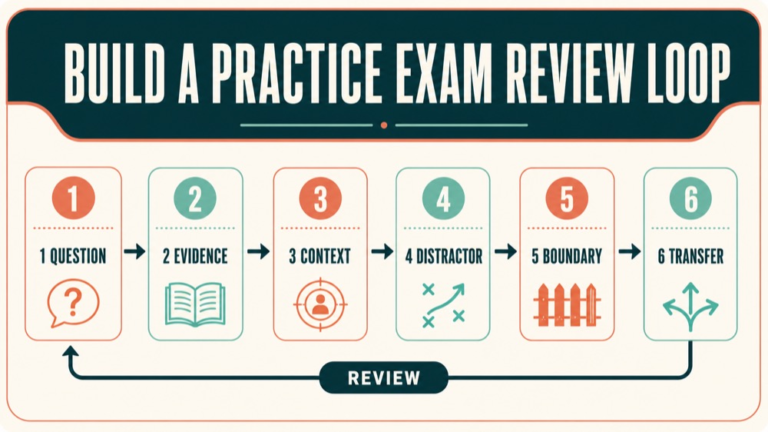
The review-loop map connects the timed run to a useful next session. Record the decision, evidence, context, distractor, boundary, and transfer question. Keep the loop short enough to repeat and specific enough to show which reasoning step needs repair.
| Loop step | Write | Result |
|---|---|---|
| Question | The exact action requested. | A focused task. |
| Evidence | The clue that changed the choice. | An anchored rationale. |
| Context | Language, mode, partner, setting, or support. | An access check. |
| Distractor | The closest alternative and its mismatch. | An error category. |
| Transfer | One changed condition and revised action. | A portable rule. |
| Review | A later date and targeted resource or item. | A next step. |
If you cannot complete the transfer step, return to the context. The missing piece may be the partner, activity, support, urgency, or decision verb.
FIND THE SIGNAL BEHIND EACH MISS
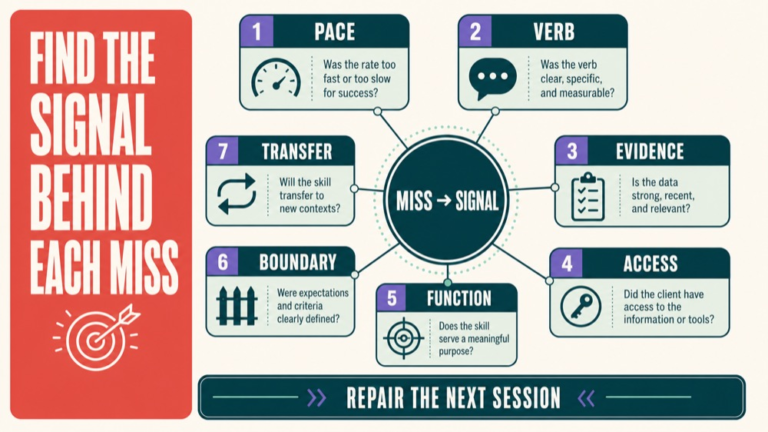
A miss is a signal only after you name what happened. Sort it into pacing, verb, evidence, access, function, sequence, boundary, or transfer. Then choose a repair that targets that category rather than repeating the entire test without a change.
| Signal | Review question | Repair |
|---|---|---|
| Pace | The clock changed your reading or you ran out of review time. | Use a checkpoint and mark items for return. |
| Verb | You answered a neighboring question instead of the requested decision. | Underline the action word. |
| Evidence | You overlooked a contrast, limitation, or changed condition. | Write the clue and its implication. |
| Access | Language, mode, hearing, partner, culture, or setting was treated as background. | Add the condition needed for fair participation. |
| Function | The choice stopped at a drill instead of the person’s activity. | Connect target or measure to participation. |
| Boundary | Safety, consent, privacy, competence, supervision, or handoff was missed. | Write the professional sequence. |
| Transfer | The rule failed when the case wording changed. | Change one variable and solve again. |
Review correct but uncertain choices too. If you cannot defend the answer without the key, write the evidence-to-action sentence and compare the closest distractor. Recognition and explanation are related but distinct study tasks.
Question 1: an assessment decision
Practice Question 1. A child answers familiar questions in a quiet room but misses multi-step directions during a noisy classroom transition. The teacher asks for a broad language score before hearing and language history are reviewed. What is the best next step?
- A. Select the broadest test immediately because it may cover every possible concern.
- B. Conclude that the child has a global language disorder from the classroom report.
- C. Clarify the classroom concern, review language and hearing context, observe the routine, and select representative evidence.
- D. Use the quiet-room result as the final description because it is easier to control.
Correct Answer: C. The contrast between the quiet room and the noisy group routine is the decisive clue. A proportionate next step defines the concern and examines language, hearing, partner, rate, noise, and representative activity before a broad measure or conclusion.
Why the Other Options Are Wrong: A chooses a tool before the question is defined. B expands a context-specific report into a broad conclusion. D removes the condition in which the concern appears. C connects evidence to the refined evaluation question.
Exam Trap: When a case asks for a next step, do not let a request for a score replace clarification of the activity and context.
Question 2: a treatment decision
Practice Question 2. An adult reaches a speech target more accurately during structured practice with a visual cue but continues to avoid speaking during a work meeting. Which treatment response best fits the evidence?
- A. Treat structured accuracy as evidence that the work goal is complete.
- B. Remove the visual cue immediately so all practice measures unaided performance.
- C. Keep the useful support while adding supported meeting practice and tracking accuracy, cueing, effort, and participation.
- D. Replace the target with a new exercise without examining the meeting activity.
Correct Answer: C. The structured result shows that the cue may help, while the unchanged meeting participation shows that transfer needs practice. A functional plan can retain support and shape the target within the activity, listener, and outcome that matter.
Why the Other Options Are Wrong: A treats a narrow practice result as the complete outcome. B removes a possible access support before understanding its role. D changes the plan without addressing the named activity. C connects target, support, context, and participation.
Exam Trap: The presence of a cue does not by itself mean the plan failed. Ask what the cue makes possible and how practice can broaden.
Question 3: a professional-practice decision
Practice Question 3. A facility-approved swallowing screen is underway when a patient becomes less alert and develops a new vocal change after a trial. The local process requires the screen to stop and the team to be notified. What should the answer prioritize?
- A. Continue until enough trials have been collected for a fuller screen.
- B. Use the earlier trial as the final result and continue the meal.
- C. Stop under the local process, communicate the change, document conditions and response, and arrange qualified follow-up.
- D. Ask an untrained helper to complete the trials while the clinician writes the note.
Correct Answer: C. The new condition and stated stop process control the sequence. Stopping, communicating, documenting, and arranging qualified follow-up protect safety, role, and continuity without expanding a screen into a broader evaluation.
Why the Other Options Are Wrong: A disregards the local process. B treats earlier performance as final after conditions changed. D transfers a safety-sensitive task without appropriate competence or oversight. C keeps the boundary and handoff visible.
Exam Trap: When a stop rule appears, the item is testing sequence and communication. Additional observations are not the priority.
Classify misses before changing resources
Do not replace every study resource after one result. First classify the miss. A reading error needs a different repair from an access error, and a sequence error needs a different repair from a missing concept. Your log should identify the clue and the next action.
| Error | What it looks like | Targeted repair |
|---|---|---|
| Pace | The clock changed your reading or you ran out of review time. | Use a checkpoint and mark items for return. |
| Verb | You answered a neighboring question instead of the requested decision. | Underline the action word. |
| Evidence | You overlooked a contrast, limitation, or changed condition. | Write the clue and its implication. |
| Access | Language, mode, hearing, partner, culture, or setting was treated as background. | Add the condition needed for fair participation. |
| Function | The choice stopped at a drill instead of the person’s activity. | Connect target or measure to participation. |
| Boundary | Safety, consent, privacy, competence, supervision, or handoff was missed. | Write the professional sequence. |
| Transfer | The rule failed when the case wording changed. | Change one variable and solve again. |
Look for patterns across several sessions. If the final items are weak, examine pacing and recovery. If professional questions are weak across the set, review role, authorization, safety, and handoff. If context is repeatedly missed, add access and function to the first read of every stem.
Use a repeatable practice-exam cycle
Alternate timed work with focused repair. This keeps the practice exam from becoming a single high-pressure event and lets you see whether a change in process helps.
- Cycle 1: run a short mixed set and record clues, confidence, and pacing.
- Cycle 2: repair the most common evaluation or access error with paired cases.
- Cycle 3: review treatment, function, support, partner, and outcome decisions.
- Cycle 4: review safety, consent, privacy, competence, collaboration, and handoff.
- Cycle 5: run another mixed set and compare the reasoning record, not only the score.
- Cycle 6: revisit low-confidence and missed items after a delay.
Use the live ETS and ASHA pages for current details, and use your own log to determine whether the next change should be content, pacing, environment, or transfer practice.
Practice-exam checklist
Before starting and after finishing, check the following points:
- Did I confirm the current ASHA and ETS source frame?
- Did I define the purpose, mixed set, time boundary, checkpoint, and review block?
- Did I identify the decision verb before scanning choices?
- Did I mark person, activity, condition, evidence, and boundary?
- Did I record confidence and items for return?
- Did I compare the best answer with the closest distractor?
- Did I check language, dialect, culture, hearing, mode, partner, environment, and support?
- Did I connect the answer to function and participation?
- Did I notice safety, consent, privacy, competence, supervision, and handoff?
- Did I classify each miss by pace, verb, evidence, access, function, sequence, boundary, or transfer?
- Did I write one changed-case question and schedule delayed review?
A complete practice exam leaves a next action. If all you have is a score, return to the log and add the clue, distractor, boundary, and repair.
Sources and next steps
For the current study frame, review the ASHA Speech-Language Pathology 5331 content page and the live ETS 5331 page. For clinical context, use the ASHA Practice Portal. For language and cultural context, review the ASHA Multilingual Service Delivery and ASHA Cultural Responsiveness resources.
For current preparation-resource context, check the ETS practice-test page. The questions, rationales, maps, and checklist here are original educational material, separate from live test material. Recheck current sources before relying on administrative, scoring, professional, state, school, agency, or facility requirements.
For your next session, run a short mixed set, log the decisive clue behind each uncertain answer, classify one miss, and solve a paired case after a delay.
Continue your preparation: Explore the SLP Study Center learning resources.