
praxis 5331 eligibility is not one universal checklist for every U.S. test taker. The word eligibility can refer to whether ETS lets you schedule an appointment, whether your program says you are ready, whether a state accepts the score for a particular purpose, or whether a certification pathway has additional requirements.
This guide separates those questions so you can verify each one with the organization that controls it. It uses current ETS and ASHA context for orientation, but it does not replace a university handbook, state rule, employer requirement, accommodation process, or current certification standard. Treat any missing detail as a question to confirm, not as permission to guess.
What Praxis 5331 eligibility means
ETS registration eligibility and professional eligibility are related but not identical. The ETS account answers questions about selecting and managing a test appointment. A university or clinical program may answer questions about coursework, clinical experiences, or when students are encouraged to test. A state or certification organization may answer how the score is used in a credential or license pathway.
ASHA identifies the Speech-Language Pathology Praxis exam as part of its certification process, but that context does not turn the exam into a complete certification checklist. Certification has multiple requirements, and state licensure or employment may add requirements. A student who asks, Can I register? may need ETS information. A student who asks, Will this score satisfy my next professional step? needs the current requirements of the receiving organization.
- Appointment question: Can I create or manage an ETS registration for the test?
- Program question: Does my university or clinical program expect a particular stage before testing?
- Certification question: How does the exam fit into the current certification pathway?
- State question: What does the applicable state or jurisdiction require for its purpose?
- Employer question: Does an employer use the score or another document for hiring or onboarding?
Separate the five eligibility questions
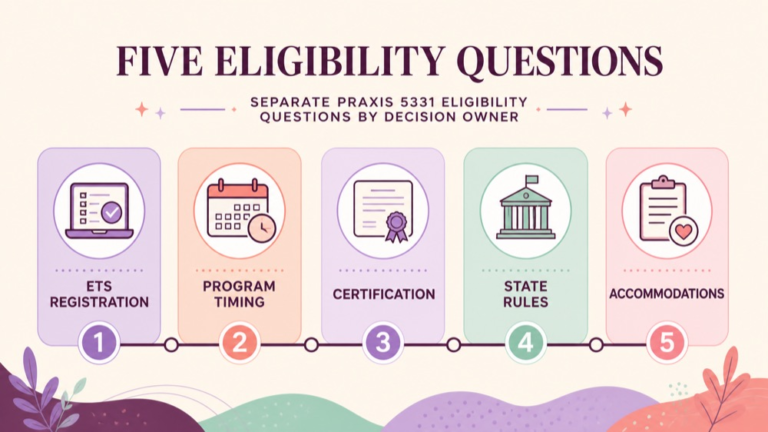
Make a five-column note before searching. The note keeps the same word from spreading across unrelated decisions.
| Question | Likely source | What to record |
|---|---|---|
| Can I register? | Current ETS test and registration pages | Test name, code, account steps, availability, payment, and appointment information. |
| When should I test? | University or clinical program | Program milestones, application timing, preparation expectations, and local advising. |
| How is the score used? | ASHA certification information and the receiving organization | Certification pathway, score-report process, and documents that may be required. |
| What does my state require? | Current state board or applicable jurisdiction | Rule, form, deadline, score use, and whether the rule applies to the intended purpose. |
| What support do I need? | Current ETS accommodation process and relevant program support | Documentation, request timing, and the approval status for the actual exam. |
The source column is the important part. A study guide can explain the exam’s scope, but it is not automatically the controlling source for a state license. A classmate can share an experience, but that experience is not a current rule. A university advisor can explain program practice, but an advisor may not speak for ETS or a state board. Match the decision to the authority.
Use the right source for the right decision
Use a source hierarchy that reflects the decision you are making. Start with the live ETS page for exam administration and registration. Use the current ASHA pages for certification context. Use your program for local academic timing. Use the applicable state or jurisdiction for licensure requirements. Use the accommodation process for documentation and approval questions.
- Name the decision: write whether you are asking about an appointment, academic readiness, certification, licensure, employment, or accommodation.
- Find the controlling organization: choose the source that can actually decide or publish that requirement.
- Check the current version: record the page title and date you reviewed when the issue is time-sensitive.
- Compare the wording: distinguish must, may, recommends, accepts, and applies to the purpose you have in mind.
- Save a follow-up question: if the page is unclear, ask the organization directly and keep the answer with your planning record.
This process prevents a common error: turning a broad exam description into a promise about a professional outcome. It also supports better study decisions. If your uncertainty is about the test itself, read ETS material. If it is about the meaning of the score, read the receiving pathway. If it is about clinical readiness, speak with your program and use a preparation plan that fits your actual training.
Plan registration without overclaiming
Once you know which question you are asking, use the ETS registration process to inspect the current test listing, delivery options, availability, and transaction details. Confirm the name and code, appointment setting, identification plan, score recipients, and current policies. An open appointment does not answer whether the date fits your program or credential timeline.
Do not postpone every decision because the word eligibility feels large. Break it down. You may be able to verify appointment logistics today, ask your program about timing tomorrow, and check a state requirement separately. You can then write what is confirmed, what is pending, and what source will resolve the pending item.
Keep an evidence note:
- Confirmed: a current ETS or organization page directly supports the statement.
- Local: the statement comes from a program, advisor, employer, or jurisdiction-specific source.
- Pending: the statement needs a current answer before you rely on it.
- Not assumed: a rule from another person, state, exam, or year has not been transferred.
Accommodations and documentation
Accommodation planning should be treated as its own eligibility question. A prior classroom support or a university arrangement may inform the conversation, but it does not automatically establish what ETS will approve for a current Praxis appointment. Read the current ETS process, identify documentation needs, and allow the required time for review before choosing a plan.
Keep private records of requests and decisions. Do not put sensitive medical or disability information into a public study note, shared screenshot, or article comment. If your program has an accessibility office or testing coordinator, ask how its support connects with the ETS process, while keeping the source boundaries clear.
For exam preparation, plan the testing environment you are actually approved to use. Do not practice under a set of assumptions that differs from the current appointment. The goal is a prepared, compliant, and realistic test-day plan.
Common eligibility mistakes
- Assuming every U.S. student follows the same eligibility path.
- Confusing the ability to register with completion of certification or licensure requirements.
- Using an old university email or forum post as the current state rule.
- Assuming a passing-score statement applies to every jurisdiction or professional purpose.
- Ignoring program timing because the ETS appointment page shows an open slot.
- Transferring a classroom accommodation directly to the ETS exam without checking approval.
- Failing to identify which organization controls the question being asked.
- Presenting an uncertain policy detail as a guaranteed outcome.
The correction is a source-matching habit. Write the decision, name the organization, check the current page, record the boundary, and ask the unresolved question. This is more reliable than trying to memorize one universal eligibility paragraph.
Quick eligibility audit
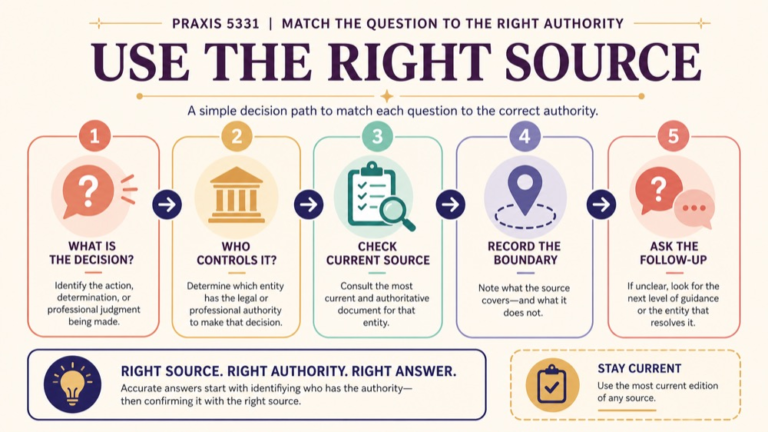
Use this audit before you register or tell someone that you are eligible:
- Have I written the exact decision I need to make?
- Am I asking about ETS registration, program timing, certification, state use, employment, or accommodation?
- Did I open the current source controlled by the relevant organization?
- Did I check the test name and code on the current ETS page?
- Did I separate a score requirement from a registration requirement?
- Did I record the date or version of a time-sensitive rule?
- Did I identify any missing documentation, approval, or deadline?
- Can I explain what is confirmed and what still needs verification?
A strong answer to an exam-preparation question does not claim more than the evidence supports. It states the likely decision, names the source, and includes the next step. That is the same reasoning you can use when reviewing a Praxis scenario about administration, certification, or professional responsibility.
Sources and next steps
Review the current ETS Speech-Language Pathology Praxis 5331 page and ETS registration process for appointment information. For professional context, read ASHA’s Speech-Language Pathology Praxis information and the current SLP certification standards. Then confirm any state, program, employer, or accommodation requirement with the organization that controls it.
Continue your preparation: Explore the SLP Study Center learning resources.